
My First Evening in Milan: Pasta Mistakes, Cappuccino Temptations, and a City That Comes Alive at Night
A Rough Start to the Journey
I arrived in Milan this afternoon—finally. I say finally because the journey began with an unsettling moment that briefly made me question whether the trip would even happen at all.
Our airplane had nearly touched the runway when, without warning, it began climbing again. Within seconds we were rising sharply back into the sky. A calm but brief announcement followed: it was not safe to land. That was all the explanation we received.
The next ten or fifteen minutes felt far longer than they were, suspended somewhere between uncertainty and patience as the aircraft circled before attempting the approach again.
Fortunately, the second landing was successful, and we touched the ground safely.
First Impressions of Milan
Perhaps the tension of that moment lingered in my mind, because my first impression of Milan was not particularly enthusiastic.
As the taxi drove through the streets toward my hotel, the city appeared somewhat worn and subdued. Many buildings seemed to have passed their most glorious years long ago. Their facades carried a grayish tone, as though the stone had absorbed decades of weather and time.
I could not help noticing that many of them looked as if they had not been renovated in quite some time—perhaps not even in many years.
Of course, every city has its admirers, and I am certain that many travelers find precisely this sense of age and history charming. There is a certain authenticity in buildings that reveal their years openly.
My hotel room, however, was a completely different story.
Small, modern, and thoughtfully designed, it felt immediately welcoming. After the tension of the flight and the long journey, it was exactly the kind of quiet comfort I needed.
By the time I checked in, it was already close to five in the afternoon. I was tired, but curiosity won over exhaustion. I decided to step outside and explore the neighborhood, at least to understand where I had landed in this vast city.
Discovering the Duomo
The location, as it turned out, could hardly be better.
Without following a map or any clear direction, I wandered only a few minutes from the hotel. At one point I stepped inside a nearby building simply to admire an unexpectedly beautiful ceiling above me.
And then, almost by accident, I emerged into the great open space of Milan’s main square.
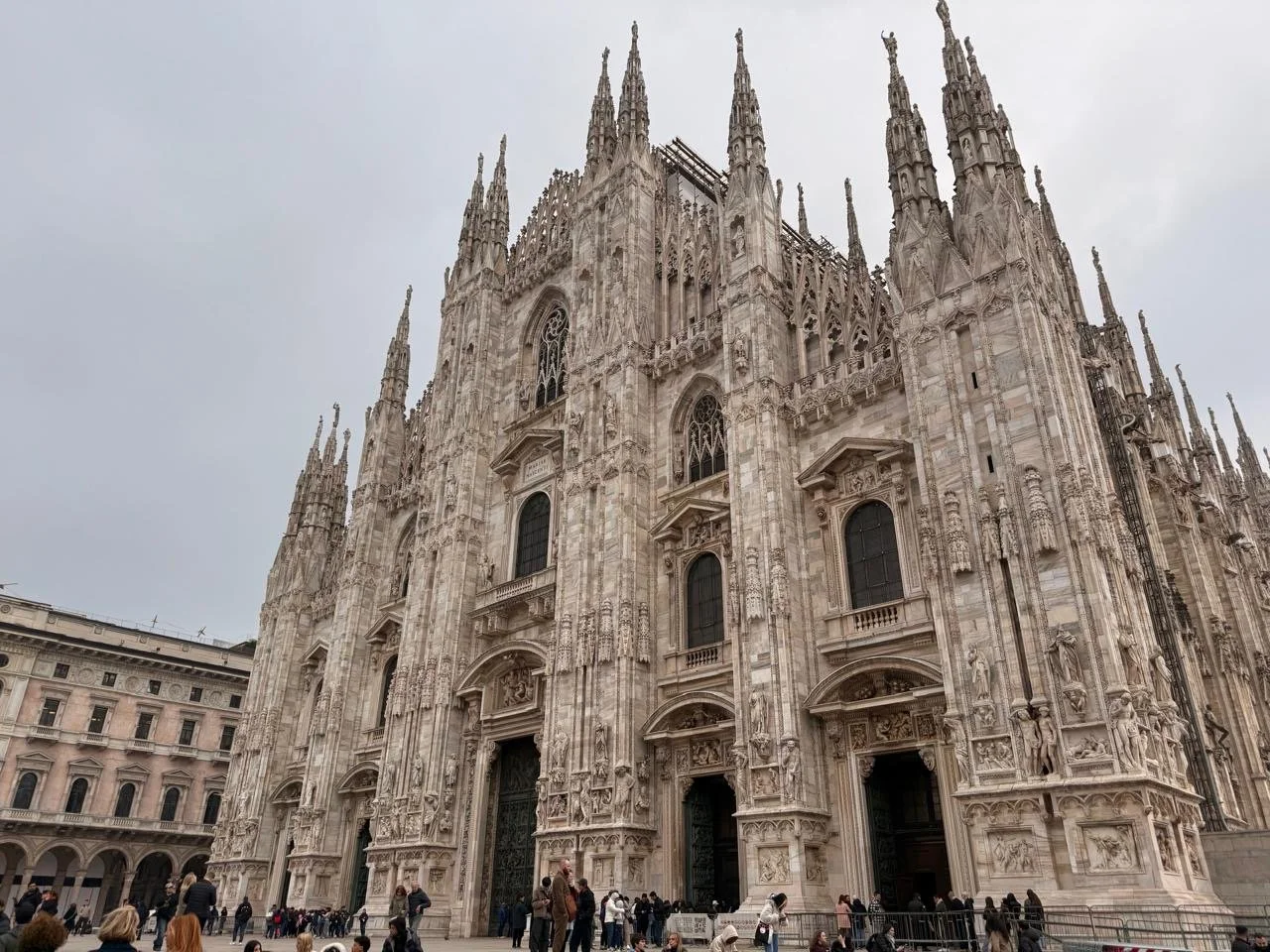
There it stood—the Duomo.
Even in daylight the cathedral dominates the entire piazza with a kind of theatrical presence, its white marble façade rising in countless spires and carvings that seem almost impossibly intricate.
When Milan Comes Alive at Night
But the real transformation happened later.
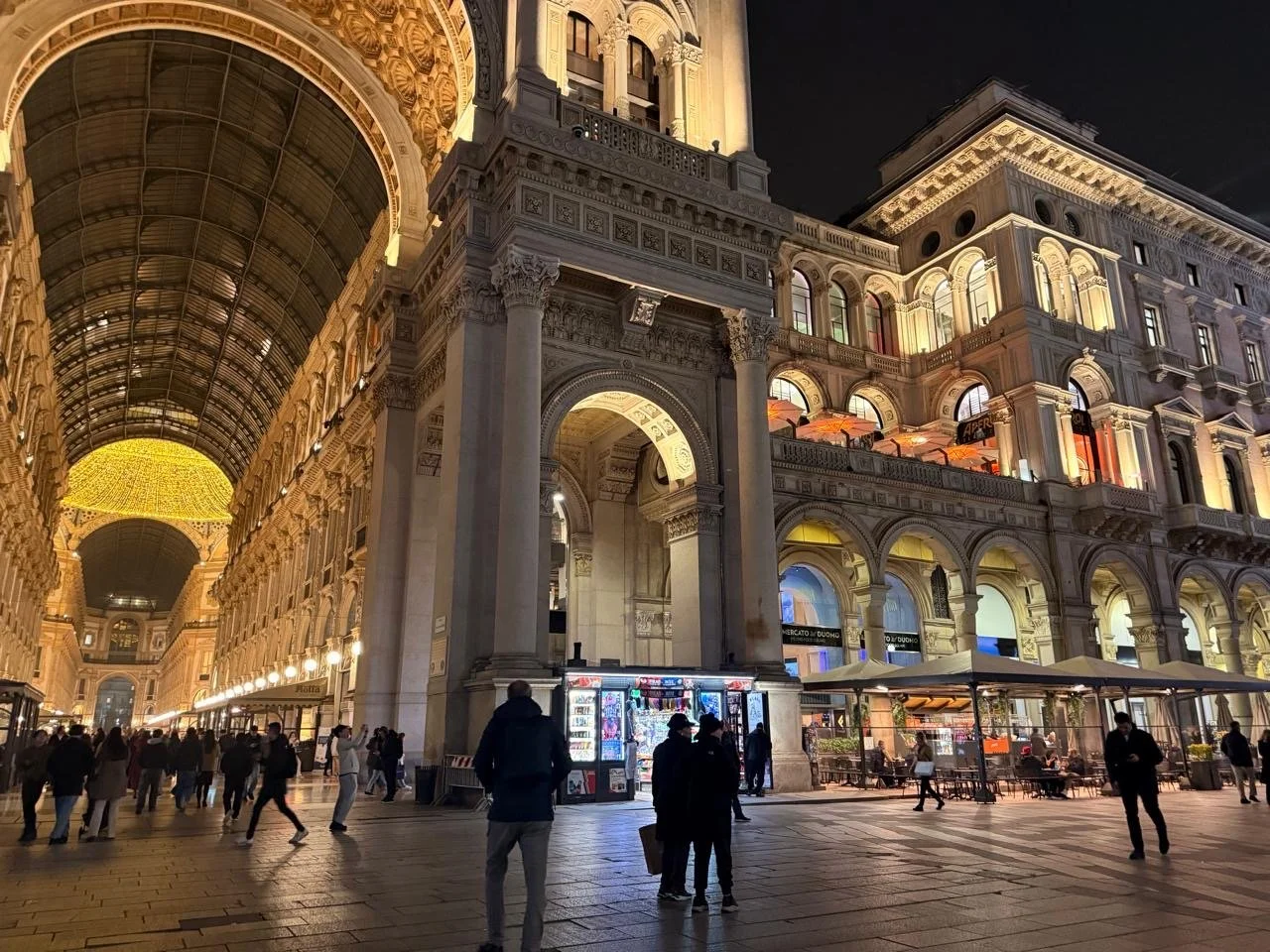
After sunset, the city changed completely. Buildings throughout the historic center were illuminated with a warm golden light that softened the stone and gave the streets an almost festive atmosphere. The gray tones that had seemed so dull earlier in the day now glowed gently against the evening sky.
Milan suddenly felt elegant, dramatic, and full of quiet life.
In that moment I was reminded strongly of Saint Petersburg, which I visited last December. During the day that city also felt somewhat gloomy, almost austere. Yet once darkness arrived, the lights reflecting on the streets and buildings transformed everything, revealing a different personality entirely.
Cities, it seems, sometimes need the evening to show their true character.
And tonight, Milan did exactly that.
A City Still Celebrating the Olympics
The Olympics ended a little more than a week ago, yet their presence still lingers in the city. Decorations remain in place, and people are still working around the area, dismantling structures and moving equipment.
But even without the Olympics, I imagine this part of Milan is always lively and full of people.
I had a couple of hours before returning to my hotel and paused to think about how I wanted to spend them.
I wandered slowly past the windows of Italian boutiques, admiring the effortless elegance of the displays—shoes, jackets, silk scarves arranged with that mysterious Italian ability to make everything look casual and perfect at the same time.
And then I realized something simple.
It was time for a real Italian dinner.
My First Italian Dinner in Twenty Years
The last time I visited Italy was about twenty years ago, so long ago that I can barely remember what the food tasted like. Of course, Italian food exists everywhere in the world, but it is widely understood that it never quite tastes the same as it does in the country where it was born.
I stepped into the first restaurant that felt warm and welcoming and asked for a table by the window.
Several male waiters were standing near the entrance, quietly watching the street and waiting for customers to appear. They gave me the small table I had asked for.
I ordered a glass of Pinot Grigio, served in a generous glass, and a seafood pasta.
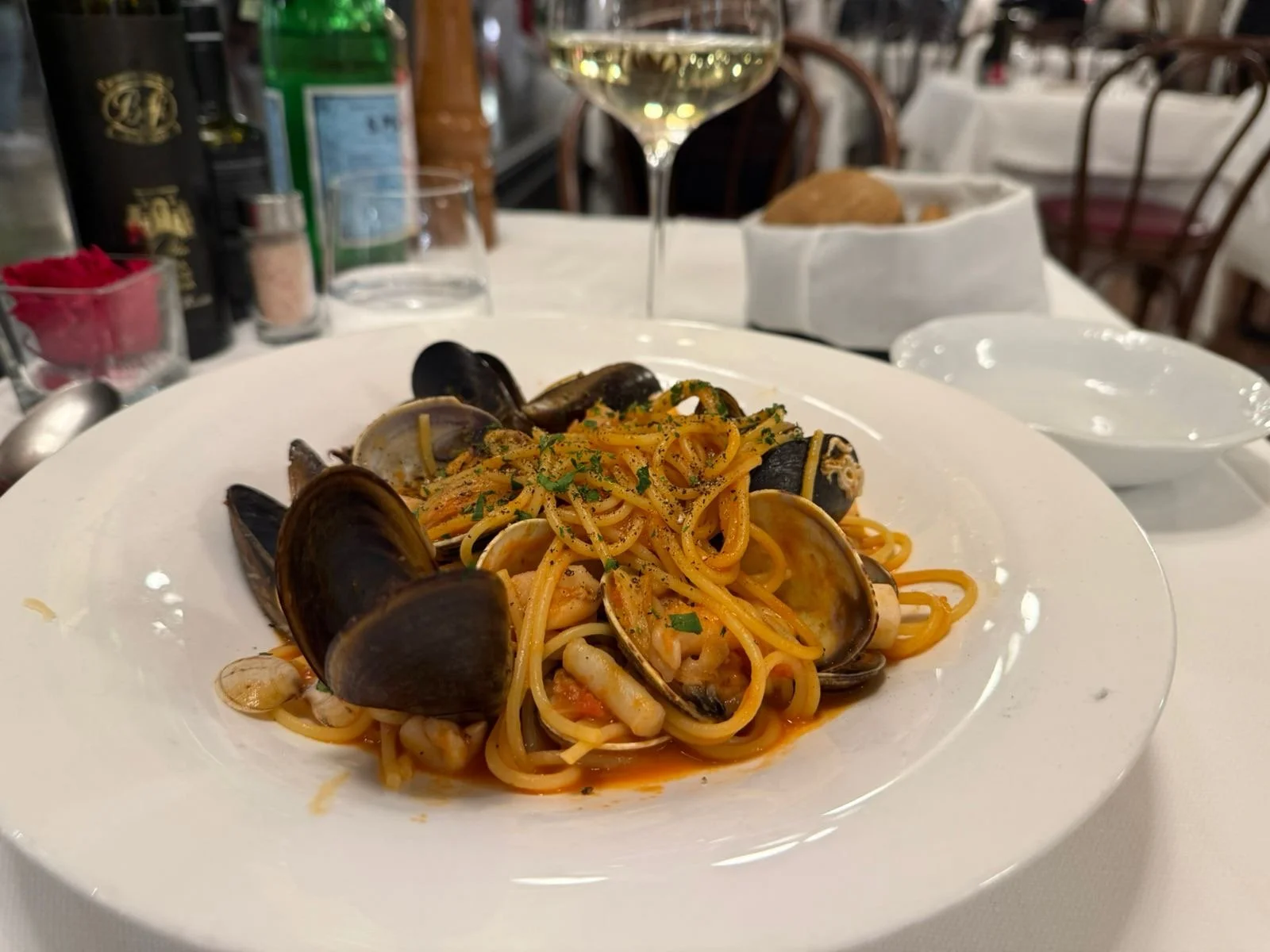
When the dish arrived, it looked almost too beautiful to disturb—a generous bowl of pasta with mussels, clams, and shrimp resting among the noodles like small treasures from the sea.
I am not even a great seafood lover, unlike many of my friends, yet the dish was undeniably delicious.
My only difficulty was that I had almost no idea how to eat it.
My Seafood Pasta Disaster
The bowl looked beautiful but complicated—long strands of pasta intertwined with mussels and clams still resting in their dark shells, shrimp tucked between the noodles, everything covered in a light sauce that smelled unmistakably of the sea.
The waiter had thoughtfully brought me a fork, a knife, and a large spoon. Seeing all three utensils in front of me made me assume that the dish required some sort of careful technique, perhaps something Italians had mastered since childhood.
Confidently, I decided to use them all.
I placed the spoon under the pasta, held the fork above it, and began twirling energetically, the way I had seen people do in movies. The knife helped separate the noodles and occasionally assisted with the shells.
It felt quite efficient—almost professional.
For several minutes I was rather pleased with myself, convinced that I was handling the dish exactly as one should in Italy.
Later, however, I learned that this was not the case at all.
Apparently Italians almost always eat pasta with just a fork, twirling a small amount of noodles gently against the plate until they form a neat bite. The spoon is mostly unnecessary, and cutting pasta with a knife is something locals rarely do.
In other words, my confident three-utensil method was probably the most foreign way imaginable to approach the dish.
At one point another thought crossed my mind.
The pasta was excellent, but a small voice inside me suggested that it might be even better with a little grated Parmesan cheese.
In most countries this would seem like a perfectly reasonable request.
Yet just as I was about to call the waiter, something stopped me.
Perhaps it was the atmosphere of the restaurant, or the quiet confidence with which everyone around me was eating their food exactly as it was served.
I suddenly had the strange feeling that asking for Parmesan on seafood pasta might be… wrong.
So I said nothing.
Only later did I discover that this instinct had probably saved me from committing one of the small culinary crimes of Italian dining, where cheese and seafood are rarely—almost never—combined.
The Cappuccino Moment
Having survived my pasta adventure, I decided to complete my meal with dessert.
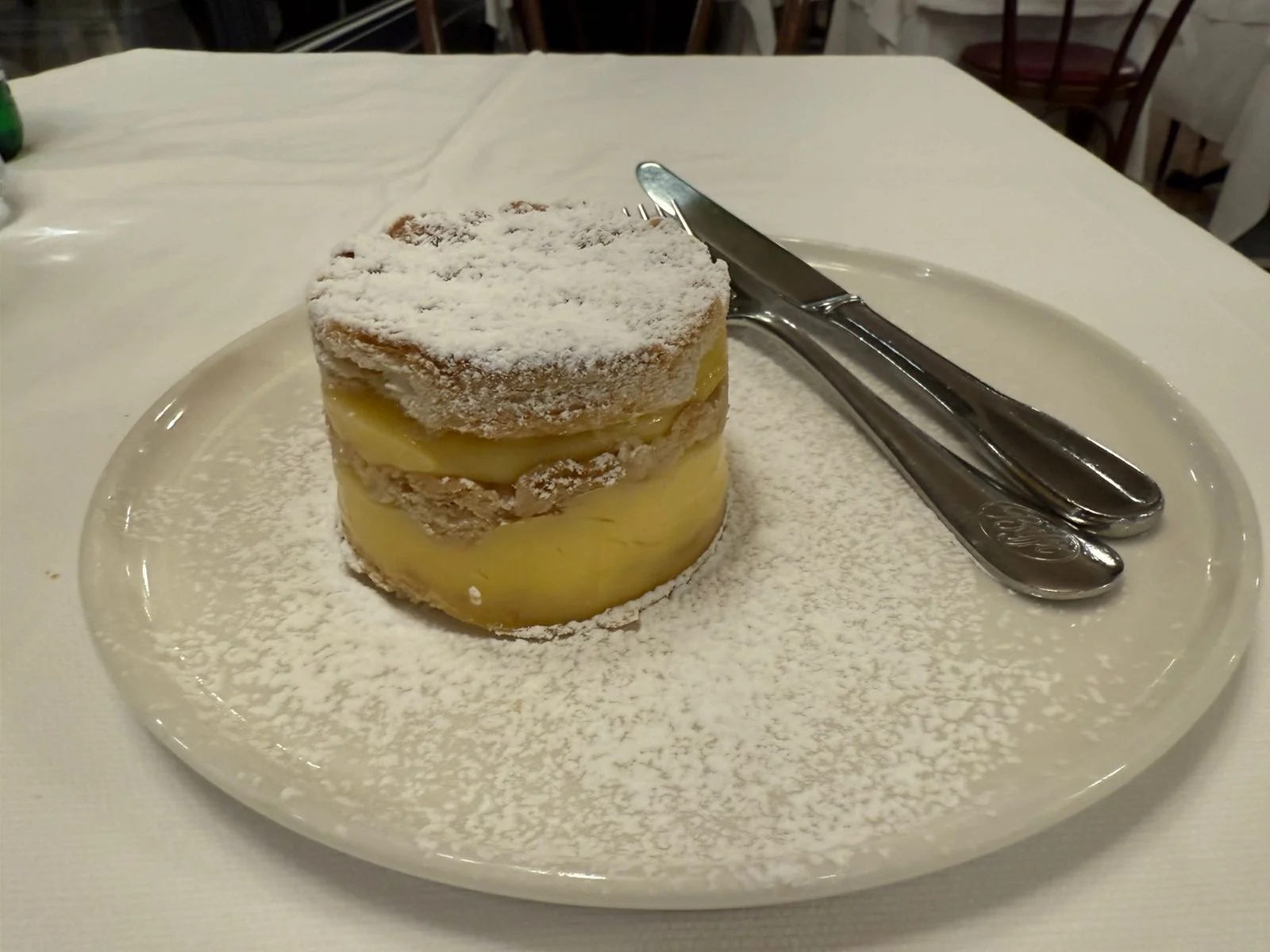
Instead of bringing a menu, the waiter arrived with a tray filled with desserts and placed it gently in front of me so I could choose. It felt almost ceremonial—a quiet moment of decision among small works of pastry art.
One dessert immediately caught my attention: mille-feuille, with its delicate layers of pastry and cream.
Then I opened my mouth and almost asked for a cappuccino.
But something stopped me again.
It was the same quiet hesitation that had prevented me earlier from asking for Parmesan. I suddenly had the feeling that cappuccino might not belong at this moment, late in the evening, after a full dinner.
So instead of ordering it, I paused.
Only later did I learn that this instinct had been correct. In Italy, cappuccino is almost exclusively a morning drink, usually enjoyed with breakfast and a pastry. After lunch or dinner, Italians almost always order a small espresso instead—a quick, strong coffee meant to finish the meal rather than accompany dessert.
So although I had already revealed myself as a foreigner by eating my seafood pasta with a fork, spoon, and knife all at once, at least I had managed to avoid another small cultural mistake.
Somehow, my inner voice had protected me again.
Ending the First Day in Milan
By the end of the evening, I felt that my first day in Milan had been quite successful, especially considering how it had begun on the airplane.
The tension of that strange landing already felt distant, replaced by the calm satisfaction of a good meal and my first small discoveries in the city.
It seemed like the right moment to return to my hotel, rest, and let the city wait for tomorrow.
I walked back through the evening streets already thinking about breakfast at the hotel and the quiet pleasure of starting a new day somewhere unfamiliar.
Tomorrow, Milano would reveal itself properly.
And this time, I would be ready for it.
Learning a Language Through Travel
Travel has a curious way of reminding us how much language and culture are connected. Something as simple as ordering pasta or choosing the right coffee suddenly becomes a small lesson in how people live, eat, and think.
That evening in Milan, I realized that understanding a country often begins with understanding its everyday habits — how meals are served, what people order at different times of day, and even which small requests might seem unusual to locals.
These details may seem minor, but they are exactly what make travel so fascinating.
And they are also a reminder of why learning a language opens so many doors when exploring the world.
At Polyglottist Language Academy, we believe language learning should feel connected to real life — the way people actually speak, travel, dine, and interact in different cultures. Our classes focus not only on grammar and vocabulary, but also on the cultural knowledge that makes communication feel natural and confident.
If you are interested in exploring Italian language and culture more deeply, Polyglottist Language Academy offers Italian classes for beginners and intermediate learners, both online and in small interactive groups. Our lessons are designed to help students develop practical communication skills while also learning about the cultural nuances that make Italy so unique.
Whether you are preparing for a future trip to Italy or simply fascinated by the language, our Italian courses provide a welcoming and engaging environment to begin that journey.
You can learn more about our Italian classes at Polyglottist Language Academy and join students from around the world who are discovering the beauty of the Italian language.
Continue Reading the Greta Travel Series
If you enjoyed this story about my first evening in Milan, you might also enjoy other travel reflections from the Greta series, where I share small cultural discoveries from different cities and countries.
Here are a few other stories you may like:
Moscow: The Most Beautiful Winter City I’ve Ever Walked Through
Traveling From St. Petersburg To Moscow By Train: A First-Hand Account
What Do Austrians Eat For Breakfast? A Simple And Elegant Morning Tradition
Visiting Vienna In Winter: Quiet Streets, Timeless Cafés, And Ice Skating Under The Sky
What It’s Like To Take The Saint Petersburg Metro For The First Time
Why Russian Bakeries Matter In St. Petersburg: Pekarni, Rum Baba, And Everyday Life
A DAY AT DOM KNIGI: BOOKSTORES, COFFEE, AND KAZAN CATHEDRAL IN ST. PETERSBURG
Where To Stay In Downtown St. Petersburg: A Real Apart Hotel Experience
Walking In Saint Petersburg In December: A Winter City That Has Adapted
My First Morning In St. Petersburg: Snow, Silence, And The Smell Of Fresh Bread
MY FIRST 24 HOURS IN ST. PETERSBURG: NEVSKY PROSPECT, TOO MUCH TEA, AND RUSSIAN DONUT “PISHKA”