
Traveling from St. Petersburg to Moscow by Train: A First-Hand Account
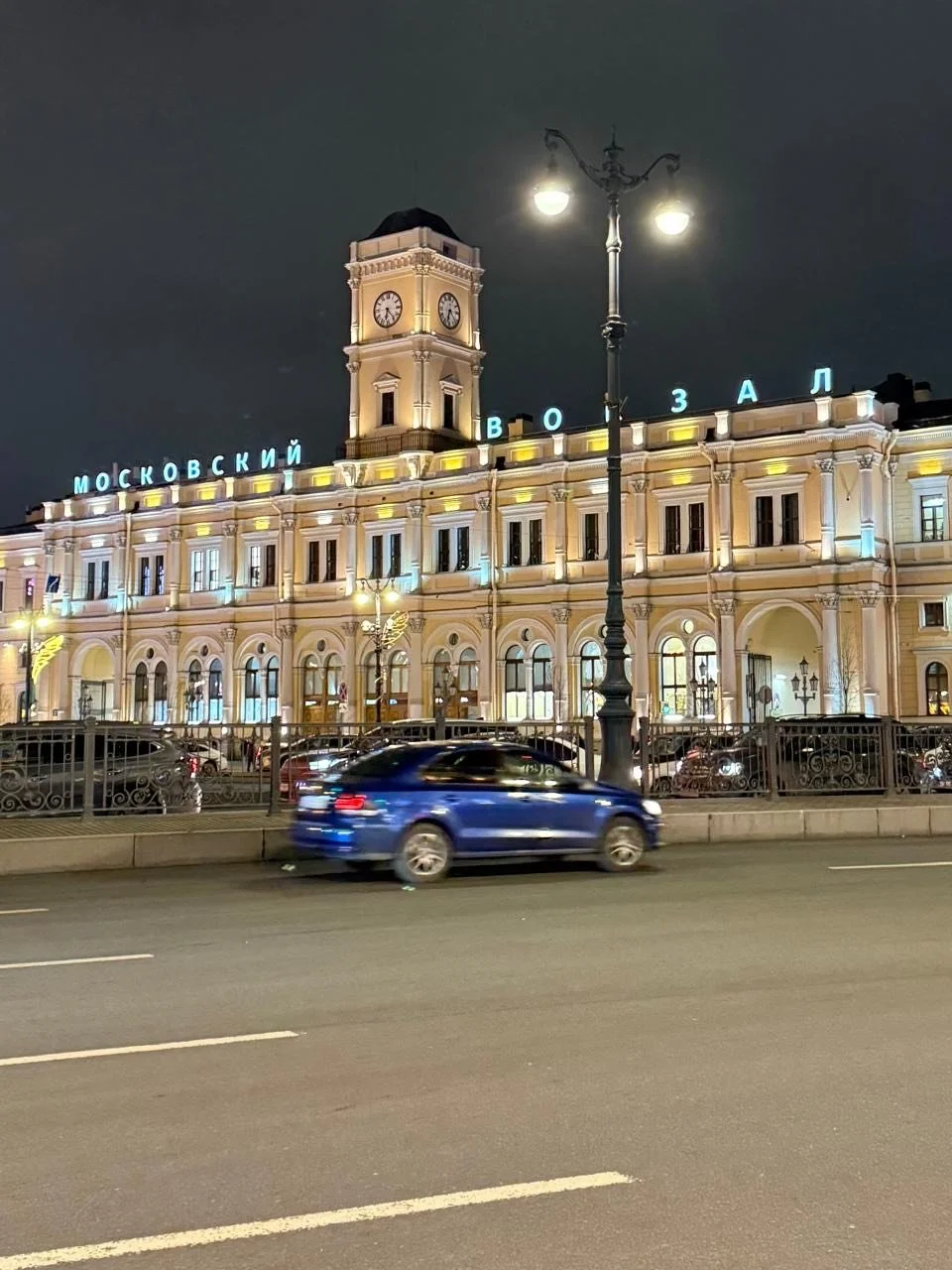
Taking the Sapsan from Saint Petersburg to Moscow
After spending a magical week in Saint Petersburg, I am now taking the train from Saint Petersburg to Moscow, a route many travelers describe as the most comfortable and efficient way to move between Russia’s two great cities. I have always loved train travel in Europe—the quiet rhythm, the long views through the window, the sense of slow movement across a landscape—but this is my first time taking a train in Russia.
Today I’m boarding the Sapsan, the country’s fastest train, which covers the roughly 400-mile (about 650-kilometer)journey between Saint Petersburg and Moscow in just four hours. The train can reach speeds of up to 250 km/h (about 155 mph), and the whole experience feels less like a long journey and more like a smooth, fast glide between two worlds.
Arriving at Moskovsky Railway Station
I walk to Moskovsky Railway Station, the main departure point for trains heading south to Moscow. Not every train here goes to Moscow, but departures are frequent, and on most days there is a train roughly every hour. It gives the impression that the two cities are in constant conversation with each other, connected by steel rails and tight schedules.
Before entering the station, I pass through the familiar ritual of Russian travel: luggage scanning. Everyone places their bags on the conveyor belt without complaint. I’m not entirely sure what they are looking for, but it feels routine, almost ceremonial. I travel often, and I’ve learned that each country has its own quiet rules. Packing light helps; it makes these small transitions easier.
Waiting for the Sapsan
Even though I arrive about an hour and a half early, the wait doesn’t feel long. The platform is announced about an hour before departure, and the mood shifts instantly. For some reason, people hurry toward the platform as if the train might leave early without them. I find it oddly surprising, because on the Sapsan every seat is assigned—this isn’t the kind of train where you need to race to claim a spot.
What I do notice, though, is the amount of luggage most passengers carry. Many people seem to travel with quite a lot of things, something I’ve observed more than once in Russia. I once asked a couple of Russians about this habit, and they told me they like to feel as comfortable as possible wherever they go. It seems to apply especially to women, who often have elaborate beauty routines and carry numerous small jars and tubes with them during the trip.
Boarding the Train
The friendly train attendant in a red hat greets me and shows me to my seat. I look around and see a very clean, well-maintained carriage. Not many passengers have arrived in my car, even though so many people were rushing toward the train earlier. They must have spread out, because now the carriage feels almost empty.
I start arranging my things, preparing for the long trip. I usually carry my diary with me, though I rarely take it out. I also always choose a book carefully before a journey. It’s one of my favorite rituals. Sadly, I have far too many books waiting for me at home, more than I’ll ever have time to read.
I download some music as well, just in case there is no Wi-Fi, although there is internet on the train. As more passengers begin to arrive, I notice a few middle-aged couples, some female friends traveling together, and several men of different ages, even a few who are quite elderly. The carriage slowly fills, but the atmosphere remains quiet and unhurried.
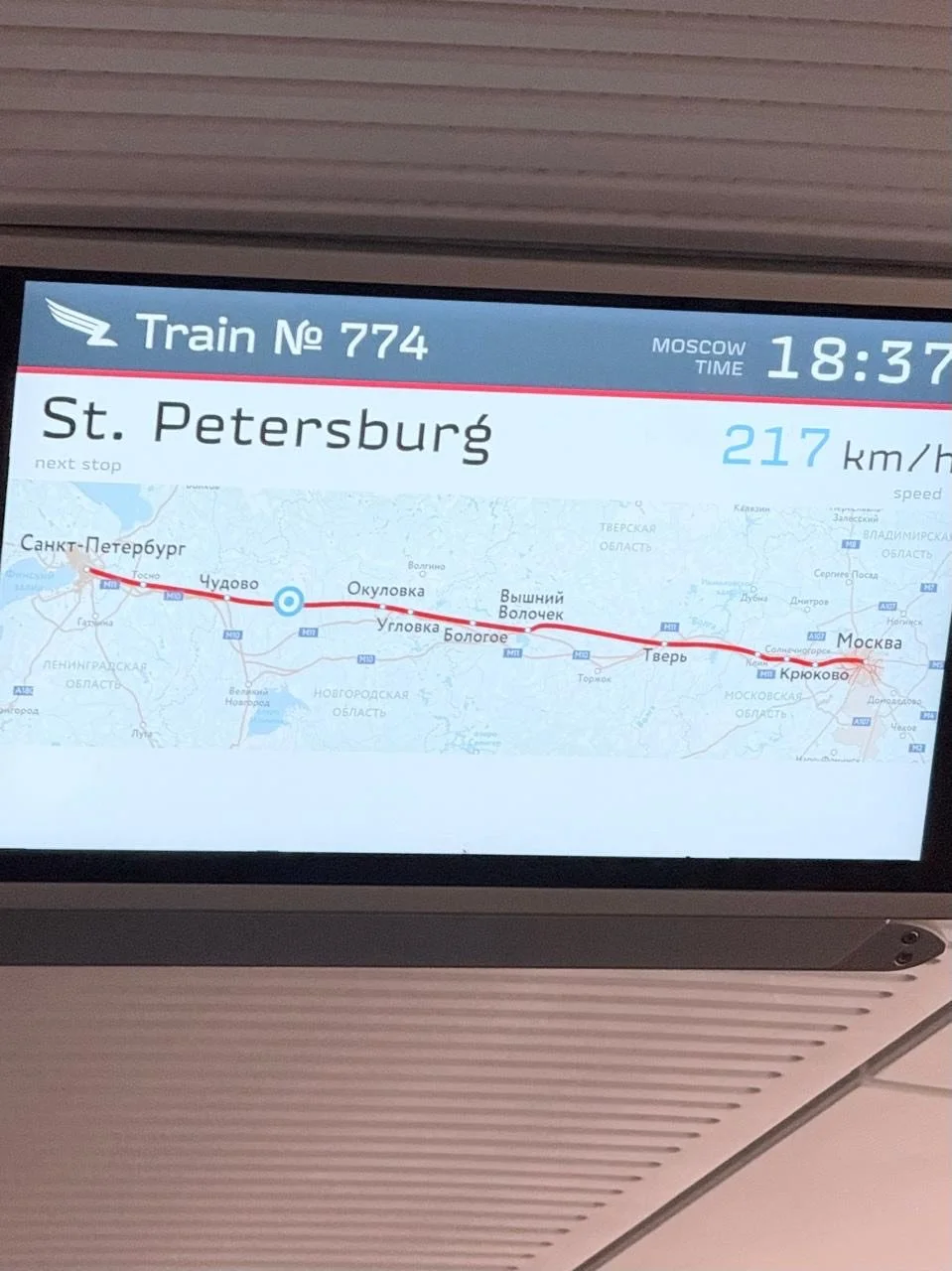
Leaving Saint Petersburg
I don’t notice how quickly time passes, and soon it’s announced that the train will leave in just a couple of minutes. The train begins to move, very slowly at first, still within the limits of the city. But as soon as we leave the urban outskirts behind, it starts gaining speed quickly. The trees flash past the window in a blur.
The Winter Landscape Between the Two Cities
It’s winter, and although there wasn’t much snow in the city, there is plenty of it out here. To be honest, the landscape looks a little gloomy. The trees have lost their leaves and show only their dark branches against the grey sky.
From time to time, we pass clusters of modest village houses. I assume these are Russian dachas, not permanent homes. Many people in big cities, especially in Moscow and Saint Petersburg, have these small country houses where they spend the summer.
Russians I’ve spoken to explained that during the Soviet era, families used their dachas to grow fresh vegetables and fruit. It was a way to eat better and save money at the same time. Nowadays, many of those old, modest houses have been replaced with larger ones, where entire families spend a good part of the warm season.
Inside the Sapsan: The Quiet Atmosphere on Russia’s High-Speed Train
Inside the Sapsan, the mood is almost surprisingly passive. Most people sit very still, and even couples don’t seem to talk much to each other. Many passengers are sleeping, heads tilted toward the window or resting against the seat, as if the four-hour ride between Saint Petersburg and Moscow is simply time to disappear for a while. This is what the Sapsan train experience feels like inside the carriage—quiet, self-contained, and oddly private, despite being surrounded by strangers on a high-speed train in Russia.
And then, in the middle of all that silence, there is one exception: a middle-aged man and woman who seem to have just met. They are leaning slightly toward each other, speaking quickly and vividly in Russian. Despite the energy of their conversation, there is nothing romantic about it. They simply appear genuinely interested in whatever they are discussing, as if the topic itself matters more than the person across from them. Their voices rise and fall with quiet enthusiasm, and their exchange feels almost out of place in the sleepy carriage—two people fully awake and engaged while everyone else drifts through the journey in silence.
A Full Menu on the Sapsan
A little later, the attendant brings a menu, and I realize that dining on the Sapsan is nothing like the simple train meals I had imagined. The menu is surprisingly extensive, with a wide selection of dishes and an almost unlimited supply of drinks—coffee, tea, champagne, and even wine. It feels less like ordering on a train and more like sitting in a quiet restaurant that just happens to be moving at high speed across the Russian countryside.
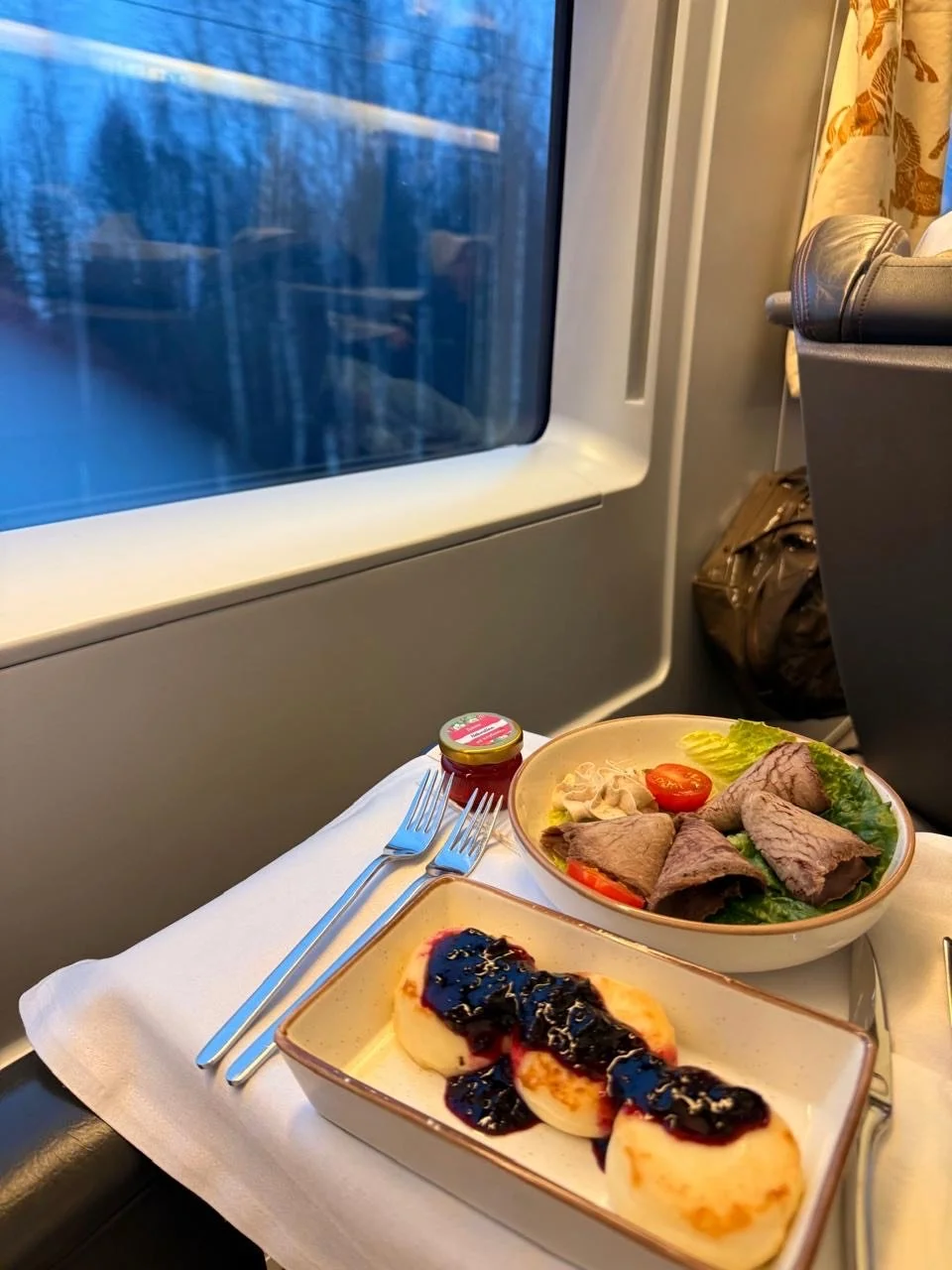
After placing my order, the food arrives in separate courses, each served on proper plates with real cutlery and a white cloth on the table. The presentation is careful and elegant, and the service is unhurried. Everything about it feels refined, almost ceremonial, as if the meal is meant to be part of the journey rather than just a practical necessity.
Outside the window, the winter landscape continues to blur into shades of grey and blue. Inside, with warm food, soft lighting, and a glass never left empty for long, the Sapsan train experience feels unexpectedly luxurious for a high-speed train in Russia. For a few hours, the journey between Saint Petersburg and Moscow becomes less about distance and more about the quiet comfort of the ride itself.
Arriving in Moscow by Sapsan
The meal takes so much time that I don’t even open my book or reach for my diary. Instead, I find myself watching the grey landscape outside the window, the blurred trees and scattered buildings passing by like quiet, repetitive thoughts. Somewhere between one cup of tea and the last bite of syrniki, the journey seems to disappear. When I finally lift my eyes, I realize we are already approaching Moscow.
The forests give way to wide roads, apartment blocks, and industrial edges of the city. The train begins to slow down, and the atmosphere in the carriage subtly changes. People start gathering their things, checking their phones, and putting on coats. The calm, suspended feeling of the Sapsan train experience fades as the reality of arrival sets in. Traveling from Saint Petersburg to Moscow by high-speed train in Russia suddenly feels incredibly fast—four hours that seemed long at the start now feel almost too short.
Within minutes, we glide into the station. Moscow is waiting just beyond the platform—larger, louder, and more intense than Saint Petersburg. The journey between the two cities is over, but it feels less like an ending and more like the beginning of a new chapter.
Learn Russian with Polyglottist Language Academy
If this journey between Saint Petersburg and Moscow awakens your curiosity about the Russian language and culture, it might be the perfect time to begin learning it yourself. At Polyglottist Language Academy, we offer in-person and online Russian classes for adults at every level, from complete beginners to advanced speakers. Our small, interactive classes focus not only on grammar and vocabulary, but also on real-life communication, cultural insights, and the subtle details that make the language come alive. Whether you dream of ordering syrniki on a train, reading Russian literature, or simply understanding conversations around you, our experienced instructors will guide you step by step. You can join from anywhere in the world and start building real confidence in Russian—join our Russian classes here.
Continue Reading
If you enjoyed this journey, you might also like these articles from our blog:
What It’s Like To Take The Saint Petersburg Metro For The First Time
Why Russian Bakeries Matter In St. Petersburg: Pekarni, Rum Baba, And Everyday Life
A DAY AT DOM KNIGI: BOOKSTORES, COFFEE, AND KAZAN CATHEDRAL IN ST. PETERSBURG
Where To Stay In Downtown St. Petersburg: A Real Apart Hotel Experience
Walking In Saint Petersburg In December: A Winter City That Has Adapted
My First Morning In St. Petersburg: Snow, Silence, And The Smell Of Fresh Bread
MY FIRST 24 HOURS IN ST. PETERSBURG: NEVSKY PROSPECT, TOO MUCH TEA, AND RUSSIAN DONUT “PISHKA”