My First Morning in St. Petersburg: Snow, Silence, and the Smell of Fresh Bread
Waking Up to My First Morning in Saint Petersburg
My bed in the aparthotel was almost too comfortable, I thought. I don’t think I’ve ever slept so well, even though I’ve stayed in hundreds of hotels in many different countries. I had four pillows, each one softer than the last. The curtains were so thick that when I finally woke up, I wasn’t entirely sure whether it was still morning or already afternoon. The sky outside was completely gray, and the daylight was so faint it felt like early dawn. It was the perfect beginning to my first morning in Saint Petersburg, where time seems to behave differently.
A Quiet Café Across the Street: My First Stop of the Day
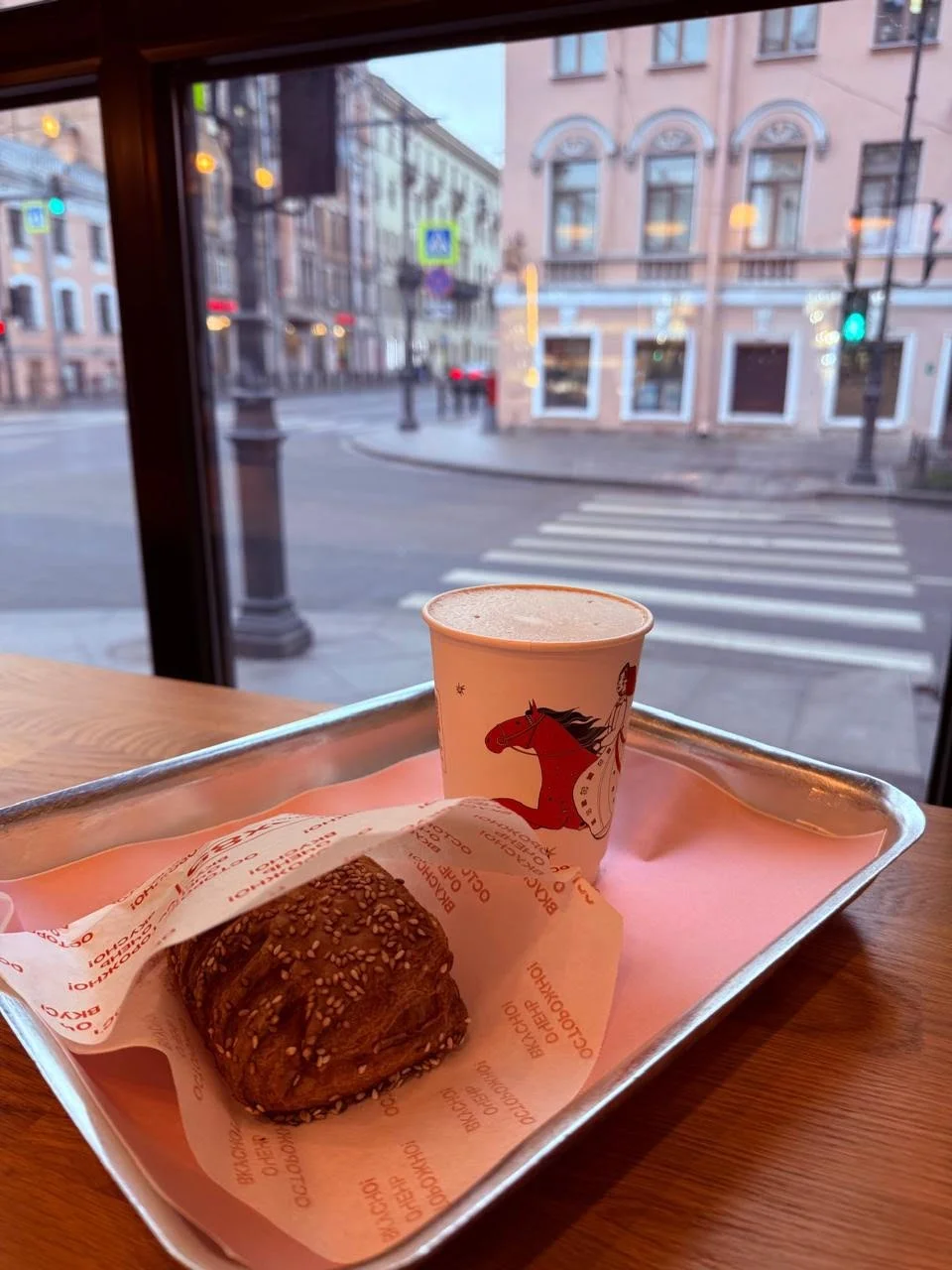
I decided to explore the neighborhood and, most importantly, find some good coffee and pastries. Directly across the street from my hotel, I discovered a cozy place called Цех 85. I ordered a spinach-and-cheese pastry and a cappuccino, then took a seat by the window to watch the passersby, admire the light dusting of snow (to my disappointment, there wasn’t much of it), and decide what I wanted to do with my day.
I found myself strangely curious about the people walking by—what kind of lives they lived, what jobs they had, how much they earned, what their everyday worries looked like. It was late morning, and the café was almost empty. The few customers who were there sat in near silence. I suddenly became aware of every sound I made—the clinking cup, the rustle of my coat—as if I might disturb the peaceful stillness of the room.
Experiencing the Central District in Winter
Life here must feel incredibly calm, perhaps even idyllic, especially if you live in one of the central neighborhoods. I’m staying in the district officially called Central, home to many of the city’s major attractions: St. Isaac’s Cathedral, the Church of the Savior on Blood, Nevsky Prospekt, and dozens of smaller, elegant streets. I read online that this is considered the “most dangerous” part of the city—but dangerous in the very soft Saint Petersburg sense, meaning that almost no serious crime actually happens here. It feels safe at any hour of the day, and the quiet of this winter morning only confirmed it.
How Locals Adapt to Short Winter Days
I tried to imagine how locals adapt to days so short they feel almost symbolic, as if daylight were merely a gesture rather than a presence. Time moves differently here—less like a line and more like a slow, pale circle. People must learn to measure their days not by the sun but by habit, ritual, and resilience: a hot drink in the morning, a walk in the early dusk, a late dinner warmed by lamplight.
Perhaps this is why cafés glow so invitingly, why windows are lit even in mid-afternoon, why the city feels built for interiors as much as exteriors. Instead of resisting the darkness, Saint Petersburg seems to fold it into its rhythm, teaching its residents to find light elsewhere—in conversation, in pastries, in small errands, in the simple act of stepping outside even when the sky never truly brightens.
A Step Away From the Noise: The Strange Quiet of Side Streets
What struck me most that morning was the contrast between the worlds that coexist here. The major streets—Nevsky Prospekt especially—were already stirring with their usual winter brightness: music drifting from shop doors, festive decorations blinking above the crowds, the hum of traffic moving steadily through the cold.
But all it took was turning a single corner to be plunged into an entirely different universe. The noise dropped away at once, as if someone had gently closed a door behind me. The cafés on these side streets were hushed, warm little pockets where people spoke softly, if at all, and even the baristas moved with a kind of quiet precision. Outside, the narrow streets were so still that the only sound was the muted crunch of snow under my boots.
In that moment, the city no longer felt real but like a painting—one of those soft, wintry canvases where light hangs in the air like mist and time seems to hesitate before moving forward again.
Café Culture in Saint Petersburg: A World Designed With Intention
Cafés here feel different from the ones I’m used to in Western cities, where the focus is often on efficiency, minimalism, or a kind of casual, unpolished charm. In Saint Petersburg, every café seems to have been designed with intention, almost as if it were a small museum of someone’s imagination.
Décor matters immensely. Owners hire professional designers, carefully choosing themes, color palettes, lighting, furniture—everything down to the shape of the plates—to create a space that feels unique and memorable. As I later learned, this is partly due to the sheer competition in the city’s café culture, and partly because customers have very high expectations. They are spoiled, in the best possible way, and they demand beauty, atmosphere, and impeccable service wherever they go.
For me, this made people-watching even more enjoyable—one of my favorite cultural activities wherever I travel. Here, each café offers a different stage to observe the tiny rituals of daily life: quiet conversations, elegant coats draped over chairs, the slow swirl of steam rising from teapots, all unfolding against backdrops that feel curated with almost theatrical care.
The Bakery Motif: Warm Bread in a Cold City
And always, somewhere in the background of these quiet streets and beautifully designed cafés, there was the scent of fresh bread—warm, yeasty, comforting in a way that felt almost symbolic.
When bakeries open here, their windows fogged from the heat of the ovens, their shelves lined with pastries that seem to appear endlessly replenished: pirozhki filled with meat or cabbage, buttery croissants, soft syrniki, glossy buns brushed with egg wash.
The smell drifted out into the cold air like an invitation, softening the harshness of winter and adding another layer to the city’s morning gentleness. It struck me that in a place often described as monumental, grand, and severe, it is the bakeries that introduce something tender and human-scale.
Perhaps that’s why I kept noticing them wherever I walked—they were anchors of warmth in a city of stone and snow, small reminders that daily life here is not just about imperial facades and sweeping boulevards, but also about simple pleasures rising in an oven at dawn.
Final Reflections: What Saint Petersburg Feels Like in the Morning
When I stepped back outside, still warmed by the quiet comfort of the café, I realized that Saint Petersburg feels remarkably gentle in the morning—softer, more intimate, almost hesitant to reveal itself all at once. The fears I carried from my first day now seemed premature, even unnecessary.
I am often quick to judge a new city; I’ve long told my friends that I can sense the spirit of a place within the first hour and decide immediately whether I like it or not. But here, in this vast, layered, contradictory city, I felt something different—a need to slow down, to resist the urge for instant verdicts.
In fact, I found myself guarding against the opposite impulse: not the fear of disliking Saint Petersburg, but the danger of falling in love with it too deeply and too fast. This city deserves patience, careful attention, and time to unfold. And on this quiet winter morning, wrapped in gray light and the smell of warm bread, I felt ready to give it exactly that.
If you’d like to keep following my journey through Saint Petersburg, you can continue with the next pieces in this winter series. Each morning and evening revealed a different side of the city—its cafés, its quiet streets, its hidden corners, and the rhythm of daily life that slowly unfolded as the days passed. You can read more here:
From Curiosity to Communication
Travel often awakens curiosity—not only about places, but about the language that shapes everyday life within them. Understanding Russian opens doors to cultural details that remain invisible otherwise: tone, humor, habits, and unspoken rules.
At Polyglottist Language Academy, our Russian programs combine language instruction with cultural context, helping students move from passive observation to active participation. Classes are available online and designed for adults who want meaningful, usable Russian.
If stories like these spark your interest in Russian culture, language learning can be a natural continuation of that curiosity.
👉 Discover Russian classes at Polyglottist Language Academy
Continue Exploring Saint Petersburg with Greta
If you’re curious to see more of Saint Petersburg through everyday experiences rather than checklists and highlights, you can continue following Greta’s journey through the city. Each article focuses on a different layer of daily life—from walking the streets in winter to settling into an apartment, noticing routines, and observing how the city reveals itself slowly over time.
Why Russian Bakeries Matter In St. Petersburg: Pekarni, Rum Baba, And Everyday Life
MY FIRST 24 HOURS IN ST. PETERSBURG: NEVSKY PROSPECT, TOO MUCH TEA, AND RUSSIAN DONUT “PISHKA”
A DAY AT DOM KNIGI: BOOKSTORES, COFFEE, AND KAZAN CATHEDRAL IN ST. PETERSBURG
Where To Stay In Downtown St. Petersburg: A Real Apart Hotel Experience
Walking In Saint Petersburg In December: A Winter City That Has Adapted
My First Morning In St. Petersburg: Snow, Silence, And The Smell Of Fresh Bread