Walking in Saint Petersburg in December: A Winter City That Has Adapted
Winter I Didn’t Expect — Saint Petersburg in December Today
December in Saint Petersburg no longer looks the way many people imagine it. I arrived expecting deep snow and sharp cold—the kind of winter that defines postcards and old photographs. Instead, I found a city shaped by milder temperatures, barely below freezing at night and often rising above zero during the day. There was a light dusting of snow early in the morning, but by midday it had already melted into wet pavement and reflective puddles.
This isn’t nostalgia speaking; it’s simply reality. Saint Petersburg, like so many places around the world, is feeling the effects of global warming. Winters are less predictable, less severe, and far less snowy than they once were. At first, this felt disappointing. I had come for a specific image of winter, and the city refused to match it.
But walking through Saint Petersburg in December quickly made something else clear: the city has adapted—and it has done so deliberately.
Walking Through Saint Petersburg After Dark in Winter
What Saint Petersburg lacks in snow, it replaces with light.
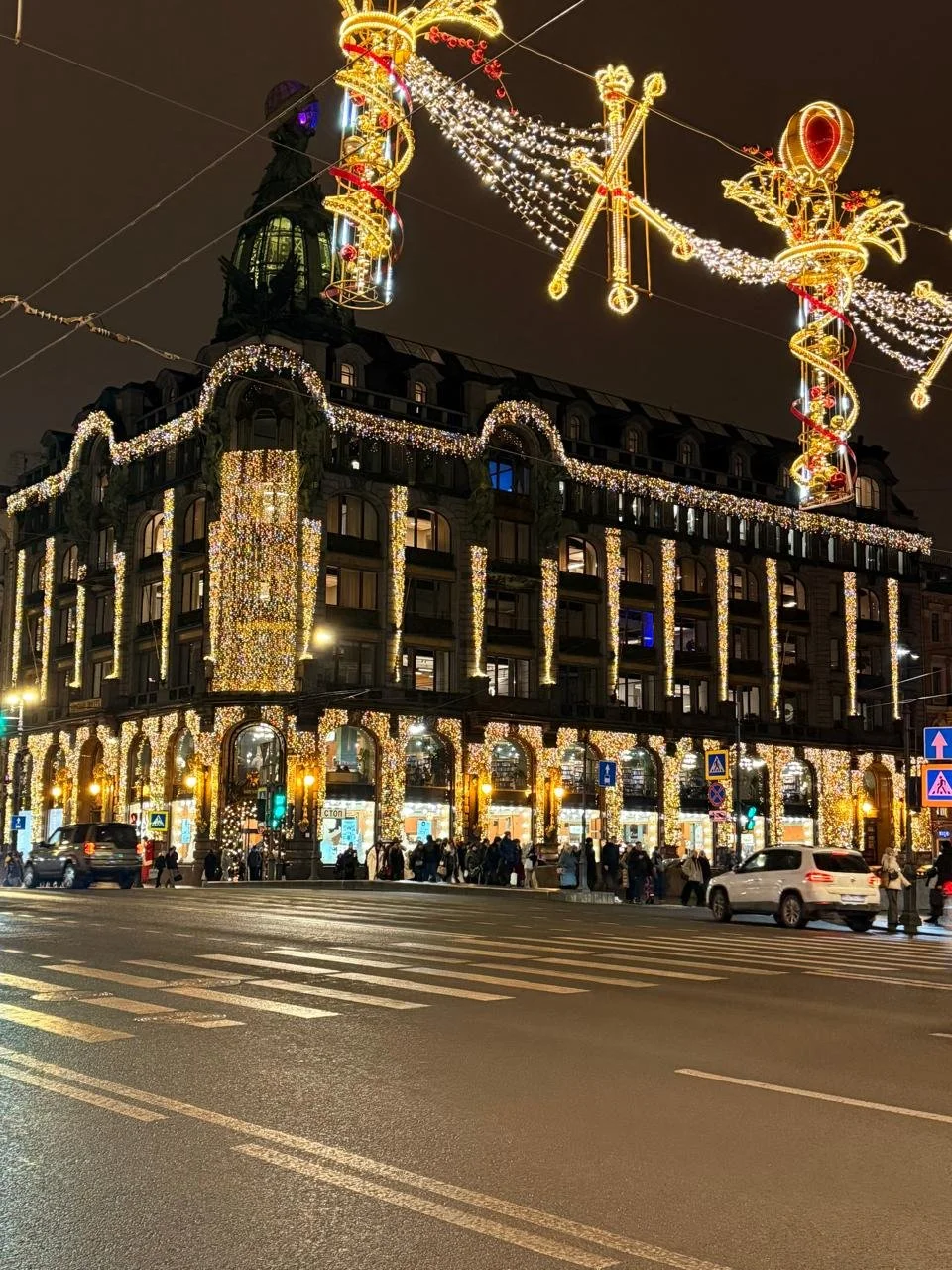
As afternoon fades, the city transforms. Buildings are illuminated with remarkable care, their façades outlined in warm gold and soft white light that highlights every column, arch, and decorative detail. Streets are decorated almost uniformly, as if the city agreed on a shared visual language for winter and the New Year season. Decorative installations appear everywhere—not chaotic or excessive, but intentional and cohesive.
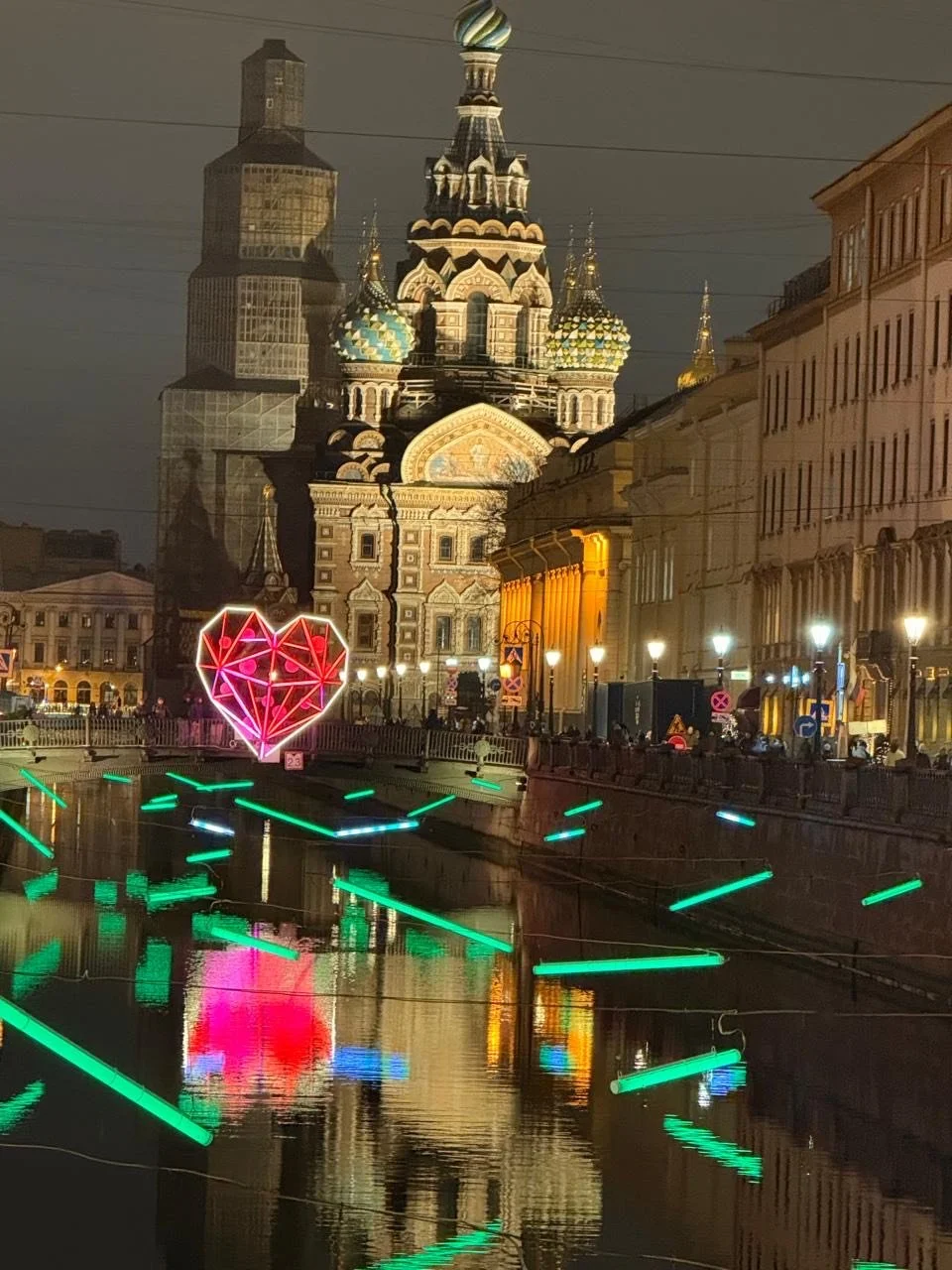
Walking through the city after sunset, I realized something unexpected: Saint Petersburg is often brighter at night than during the day. In daylight, the sky remains heavy and gray, most lights switched off, colors muted. But once darkness arrives, everything comes alive. Streetlights glow warmly. Historic buildings shine. Bridges, shop windows, and public spaces feel animated rather than subdued.
This changes the experience of walking entirely. Instead of retreating indoors, people stay out longer. You walk not to escape winter, but to experience how each street has been lit, how another building has been transformed, how darkness has been redesigned rather than endured. Saint Petersburg in December is not a city surviving winter—it is a city actively replacing sunlight with architecture, electricity, and care.
Why Walking Is the Best Way to Experience Saint Petersburg in December
Saint Petersburg is a city best understood on foot, and December makes that especially clear. Distances that look short on a map stretch unexpectedly long. Streets are wide, blocks expansive, and walking forces you to slow down—not because of cold, but because of scale.
In winter, walking becomes more attentive. You watch the pavement, step around shallow puddles, adjust your pace instinctively. The city asks for awareness, not endurance. There is no dramatic cold to conquer, no snowdrifts to battle—just a constant negotiation between movement and surface, between body and space.
Walking reveals how the city actually functions in winter. Sidewalks are cleared just enough. Crossings remain orderly. Life continues smoothly, without urgency or complaint. It’s a quiet competence that only becomes visible when you move through it slowly.
Practical Notes: Weather and Walking in Saint Petersburg in December
December in Saint Petersburg is typically cold but increasingly mild, with daytime temperatures often hovering around or slightly above freezing. Snow is possible but not guaranteed, and more common conditions include wet pavement, slush, and occasional ice. Waterproof shoes with good traction are more useful than heavy winter boots, and layered clothing tends to work better than extreme cold-weather gear. Walking is very manageable, especially in the historic center, where sidewalks are regularly cleared and strong public lighting makes evening walks both safe and atmospheric.
Nevsky Prospekt in December: A Street Built for Movement
Nevsky Prospekt, the city’s main artery, feels almost purpose-built for walking. Even in December, it absorbs people continuously—locals, tourists, commuters—without ever feeling congested. The flow is steady, confident, unhurried.
Here, walking has momentum. People move with intention: coats zipped high, scarves tight, hands deep in pockets. There’s no lingering without reason, but also no rush. Nevsky doesn’t demand speed; it demands participation. You walk because everyone else is walking, and the street carries you forward naturally.
In December, under festive lights and New Year decorations, Nevsky becomes even more compelling. Illuminated façades frame the street, reflections shimmer on damp pavement, and the absence of heavy snow only sharpens the clarity of light and color. The street feels awake, celebratory, and unmistakably urban.
Turning Off Nevsky: History, Restoration, and the Winter City
Turning off Nevsky Prospekt doesn’t plunge you into neglect or decay, as one might expect in a historic city of this scale. Instead, it reveals just how thoroughly Saint Petersburg’s downtown is being restored. Most buildings here have already been renovated—fresh façades, repaired stonework, carefully preserved details—while the occasional structure in poor condition or wrapped in scaffolding serves as a reminder that the process is still ongoing. The contrast is not between grandeur and neglect, but between completion and transition.
What makes this especially striking is the age of these buildings. Nearly all were constructed in the 18th or 19th century, and new construction in the historic center is tightly restricted. Unless an accidental empty space appears, entirely new buildings simply aren’t allowed. The city is not expanding here; it is refining itself.
Walking through these streets feels like moving through layers of time that are being carefully cleaned rather than replaced. It’s easy to imagine that if I return in a few years, even the remaining unfinished façades will have joined the rest—quietly restored, seamlessly absorbed into the fabric of a city that clearly intends to preserve itself rather than reinvent itself.
Eating on Your Own Schedule: Winter Cafés and Daily Life
Walking through Saint Petersburg in winter, it quickly becomes clear that the city does not revolve around fixed mealtimes. Many people seem to eat not according to the clock, but according to their own rhythm. This makes sense in a city where so many work online, freelance, or have flexible schedules that don’t fit neatly into traditional lunch or dinner hours.
Cafés and restaurants reflect this reality. They open early, stay open late, and quietly assume that hunger can arrive at any moment. Georgian restaurants, bakeries, cafés, casual eateries, and full-service restaurants appear one after another, offering warmth and food without pressure or ceremony.
Despite this abundance, it’s easy to imagine that most people are loyal to just a few places. Regulars slip in confidently, order without hesitation, and settle into familiar corners as if following a private routine. Walking past these spaces, you sense that while Saint Petersburg offers endless choice, daily life here is built on quiet preferences.
Walking, Rhythm, and Visual Order in Saint Petersburg’s Historic Center
Walking on after eating, I became more aware of how movement itself shapes the city’s daily rhythm. People walk with confidence here, even in winter conditions that might slow a visitor down. There is a shared understanding of how to navigate wet pavement, narrow sidewalks, and occasional ice without drama. No one hesitates, no one complains; the city has taught its residents how to move through it efficiently.
What you notice next, especially when walking longer distances, is how visually consistent the historic center feels. Facades follow the same architectural logic, colors repeating in variations of pale yellow, soft green, muted pink, and stone gray. Because new construction is so tightly restricted, the city doesn’t feel fragmented or chaotic. Instead, it feels continuous, as though the streets belong to a single, extended architectural conversation that began centuries ago and is still being carefully maintained.
And then, as evening approaches, the transformation begins again. Decorative lights flicker on, one building at a time, until entire streets glow with coordinated illumination. The effect is subtle but powerful. Walking through Saint Petersburg at this hour feels almost ceremonial, as if you’re witnessing a collective effort to make winter not only bearable, but beautiful. People slow down slightly—not to linger, but to notice. Conversations pause. Phones come out. For a moment, walking becomes less about getting somewhere and more about being present in a city that clearly refuses to let darkness define it.
Understanding the City Through Language
Observing a city is one thing; understanding it is another. Language often becomes the quiet threshold between the two. Being able to read a sign, recognize a phrase, or follow a short exchange in a café can turn moments of observation into moments of belonging.
At Polyglottist Language Academy, our Russian classes focus on how the language is actually used in everyday life—spoken, heard, and lived. Rather than memorizing isolated rules, students learn to navigate real conversations and cultural context.
If Saint Petersburg has begun to feel familiar in small, unexpected ways, learning Russian may be the next step in deepening that connection.
👉 Explore our Russian classes at Polyglottist Language Academy
Continue Exploring Saint Petersburg with Greta
If you’re curious to see more of Saint Petersburg through everyday experiences rather than checklists and highlights, you can continue following Greta’s journey through the city. Each article focuses on a different layer of daily life—from walking the streets in winter to settling into an apartment, noticing routines, and observing how the city reveals itself slowly over time.
Why Russian Bakeries Matter In St. Petersburg: Pekarni, Rum Baba, And Everyday Life
MY FIRST 24 HOURS IN ST. PETERSBURG: NEVSKY PROSPECT, TOO MUCH TEA, AND RUSSIAN DONUT “PISHKA”
A DAY AT DOM KNIGI: BOOKSTORES, COFFEE, AND KAZAN CATHEDRAL IN ST. PETERSBURG
Where To Stay In Downtown St. Petersburg: A Real Apart Hotel Experience
Walking In Saint Petersburg In December: A Winter City That Has Adapted
My First Morning In St. Petersburg: Snow, Silence, And The Smell Of Fresh Bread