
Visiting Vienna in Winter: Quiet Streets, Timeless Cafés, and Ice Skating Under the Sky
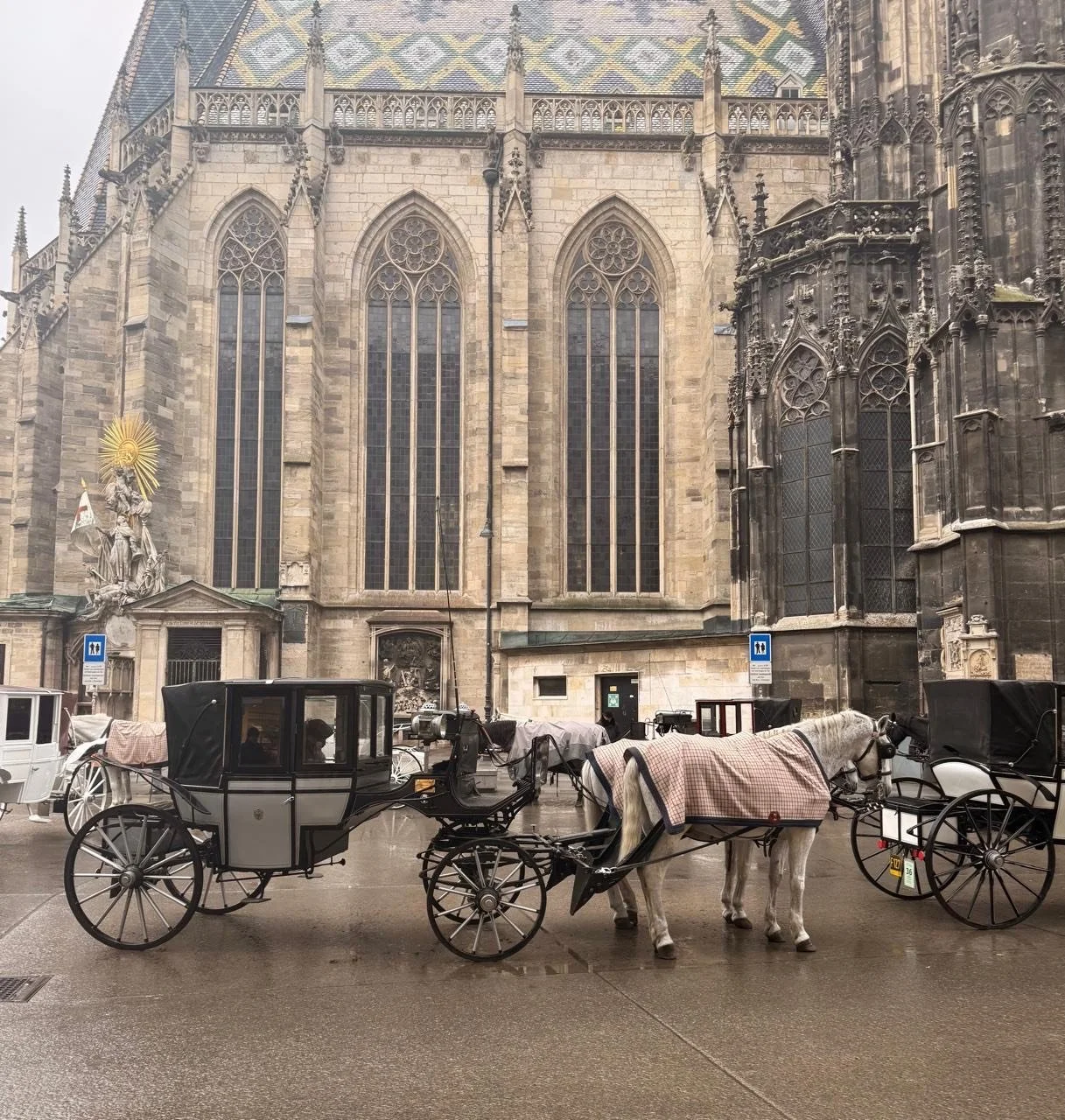
Vienna greeted me with sunlight, spotless streets, and a deep, almost ceremonial calm. It was the middle of the day, yet the streets were surprisingly quiet. The city center looked exactly as I remembered it from years ago—magnificent, formal, and unapologetically grand. I hadn’t planned anything, booked no excursions, and set no agenda. I wanted only to wander, to rediscover the spirit of a city I barely remembered.
As I walked, Vienna felt strangely detached from modernity, as if it existed outside of time—untouched, preserved, and quietly confident in its beauty. I let myself walk without direction, turning down streets simply because they felt right. In front of the cathedral, built in imposing Gothic style, horse-drawn carriages waited, reinforcing the sense that the city was carefully performing its own history.
I have a habit, whenever I visit a new place, of asking myself a simple question: Could I live here? Vienna is beautiful from countless angles, but I felt something unexpected—a sense that I might never fully belong. Not because the city is unwelcoming, but because it carries such cultural weight and elegance that I imagined living there with a constant, quiet feeling of inadequacy. And in that realization, I understood something important: admiration does not always translate into belonging.
Looking for Traditional Austrian Food in Vienna
After two or three hours of walking, I started looking for a place to eat traditional Austrian food. I remembered that Austrians eat a lot of schnitzel and have an astonishing variety of cakes and pastries, from simple everyday treats to elaborate creations. The most famous, of course, is strudel.
After checking a few reviews, I discovered that I was just one street away from a traditional Austrian restaurant with excellent ratings.
As I approached, I felt oddly intimidated. Do they speak English? Will I be able to read the menu? I stepped inside and felt even more uneasy. About half of the tables were occupied, mostly by men; only one couple with a child sat quietly, speaking in low voices.
My attention was immediately drawn to two older gentlemen who had clearly finished their meal—and even their coffee—long ago, yet were still deeply absorbed in conversation. Both wore old-fashioned jackets; one of them had a checkered pattern and a mustache that, at least in my imagination, belonged to the 1960s. Looking around, I realized that nearly all the men in the restaurant wore suits or jackets, even the younger ones.
I felt uncomfortable, though I couldn’t quite explain why. I actually like men in suits. Still, I became painfully aware of my own outfit: a bright white sweater with red details, white velvet pants, and red nail polish. Sitting there, I felt unmistakably out of place.
Schnitzel, Porcelain, and Quiet Conversations
The waiter was a younger man who, to my relief, spoke excellent English. I ordered a schnitzel with potato salad and a drink whose name I didn’t recognize. The food arrived quickly, served on old-fashioned porcelain that looked as though it had been taken straight from a grandmother’s cupboard—I was almost afraid to touch it.
The schnitzel looked unremarkable, and the potato salad was frankly unappetizing at first glance, but both turned out to be excellent. I lingered for a while and then left. As I was heading out, I noticed that everyone who had been there when I arrived was still there. No one looked at me; everyone remained absorbed in conversation, including the two older gentlemen who seemed as if they might have known each other for the past fifty years. And then I stepped outside.
Vienna Architecture in Winter: Order, Permanence, and Restraint
The cold air stung my face slightly. It was January, and the temperature hovered just below freezing. I walked on, passing more and more magnificent buildings. To me, architectural style says a great deal about the people who choose to live within it—their values, their sense of order, their relationship with history.
Vienna’s architecture reflects a deep respect for structure and continuity: grand Baroque façades, restrained elegance, and a quiet insistence on symmetry and proportion. The city does not shout for attention; it stands composed and self-assured, as if certain of its place in the world. Walking through it, I felt that Vienna prefers permanence over experimentation, tradition over urgency—and perhaps that is exactly what gives it its unmistakable character.
Ice Skating in Vienna: A Winter Ritual
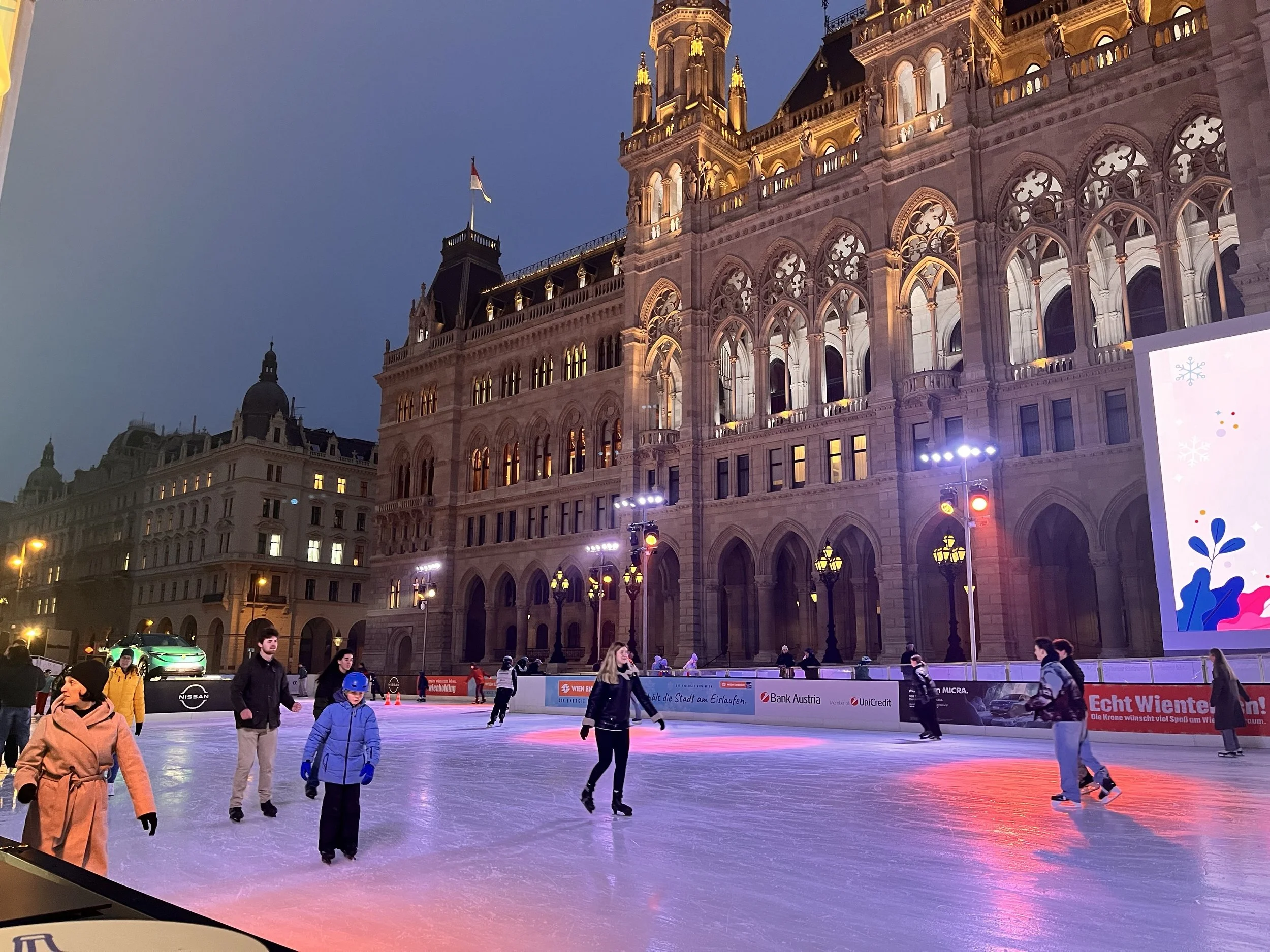
My walk eventually led me to an ice-skating rink, unexpectedly large and surprisingly long. What struck me most was how many people were there. A long line had formed at the skate rental counter, filled with people patiently waiting their turn.
I walked alongside the rink for a while—it seemed almost endless—then stopped to watch the skaters. Most of them moved confidently, with ease, and a few even skated with real virtuosity. Watching them, I thought that skating might be one of those skills I genuinely wish I had—but probably never will. With that thought, I turned and walked steadily back toward my hotel.
Learning German Through Travel and Culture
Experiences like this—ordering food, reading a menu, observing social rituals, understanding what feels familiar and what feels foreign—are deeply connected to language. Learning German opens a new layer of Vienna: its humor, its formality, its subtle social codes.
At Polyglottist Language Academy, our German classes are designed for adults who want more than grammar drills. We focus on real-life language, cultural context, and confident communication—whether you’re traveling, relocating, or simply curious about the German-speaking world.
👉 Explore our in person and online German classes and learn the language the way it’s actually used.
Follow Greta’s Travels Around the World
If you enjoyed this glimpse into winter in Vienna, you may also like Greta’s reflections from other cities around the world:
What It’s Like To Take The Saint Petersburg Metro For The First Time
Why Russian Bakeries Matter In St. Petersburg: Pekarni, Rum Baba, And Everyday Life
Where To Stay In Downtown St. Petersburg: A Real Apart Hotel Experience
Walking In Saint Petersburg In December: A Winter City That Has Adapted
My First Morning In St. Petersburg: Snow, Silence, And The Smell Of Fresh Bread