
Why the Dutch Love Complaining About the Weather
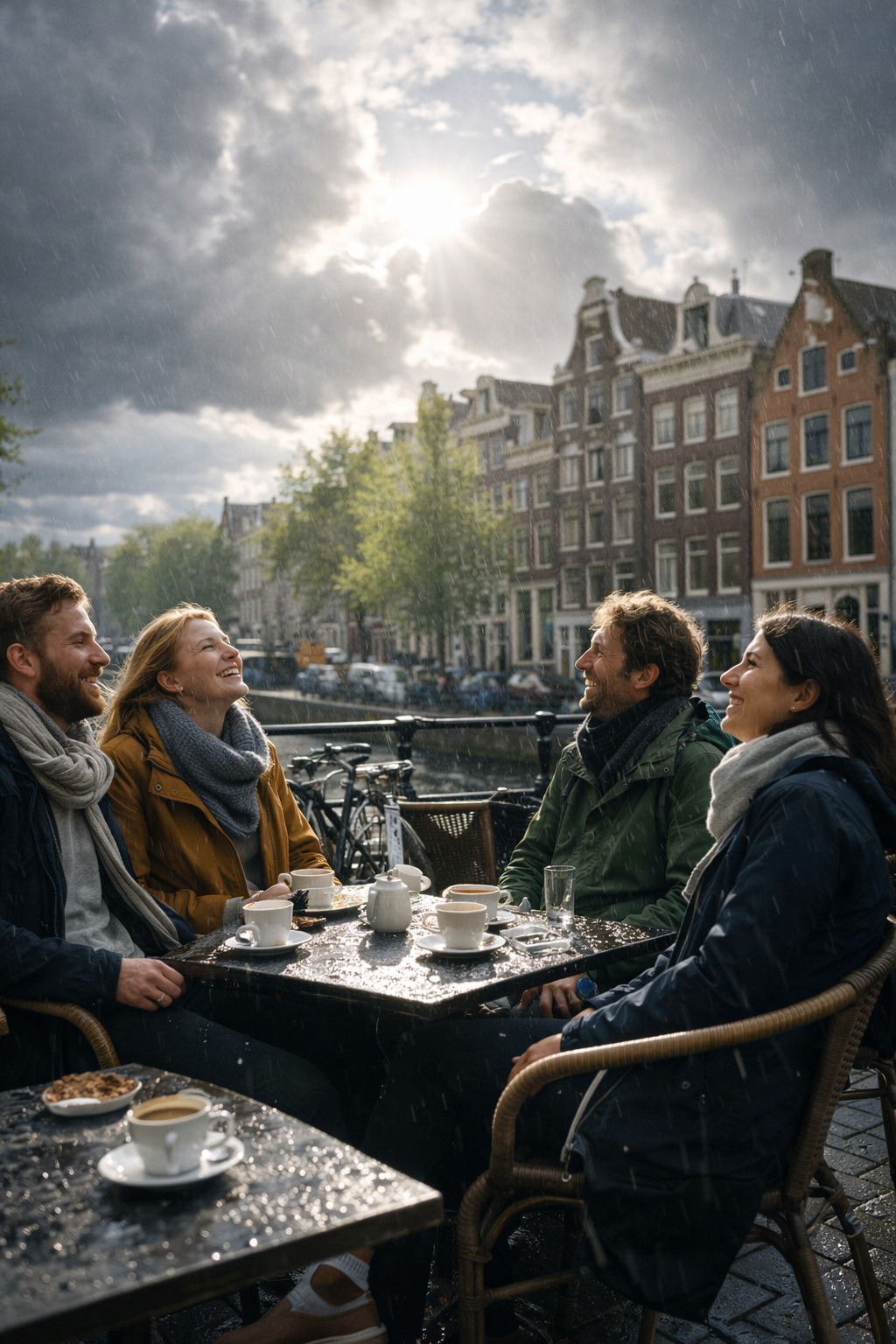
If you live in the Netherlands long enough, you start to measure time not in hours or seasons, but in shades of grey. You learn to read the sky like a mood ring. You stop asking “Will it rain today?” and start asking “How often?” And somewhere along the way, you notice something else: the Dutch don’t just live with their weather—they talk about it. Constantly. Cheerfully. Grumpily. Ironically. Almost lovingly.
“Lekker weertje, hè?” someone says to you as the wind whips your hood back and the rain hits you horizontally on your bike. “Nice weather, huh?” You look at them, wondering if they’re joking. They probably are.
This article is about that habit: why the Dutch love complaining about the weather. It’s about skies and storms, but also about culture, humor, stoicism, and the strange comfort of a shared grumble. And because you’re likely a language‑and‑culture lover, we’ll also look at the phrases you can use to join in—and how this little national ritual even shows up in Dutch classes.
Is it really that bad? The truth about Dutch weather
Let’s begin with a fair question: is Dutch weather objectively terrible, or just mildly annoying?
Meteorologically speaking, the Netherlands is not a land of extremes. Winters are usually cold rather than brutal; summers are mild rather than scorching. You won’t find hurricanes tearing roofs off, or blizzards shutting down cities for weeks. On paper, that sounds almost pleasant.
The problem is less the numbers and more the experience:
It rains often—sometimes lightly, sometimes heavily, but reliably, throughout the year.
It is frequently cloudy, with long stretches of grey skies that turn days into permanent late afternoon.
The wind can be fierce, especially in autumn and winter, turning “a bit of rain” into a wet sandblasting.
Temperatures hover in a moderate but frustrating zone—not cold enough to be dramatic, not warm enough to be reliably enjoyable.
In autumn and winter, daylight is scarce: late sunrises, early sunsets, and dim light in between.
Add to this the special Dutch touch: the weather can change several times a day. You may leave home in weak but hopeful sunshine and ride back in something that feels emotionally like November—even if it’s April.
If you move to the Netherlands from a sunnier or more stable climate, what hits you is not catastrophe, but accumulation: a steady drip of drizzle, gusts, and grey that seeps into every corner of daily life. That is exactly what makes it such fertile ground for commentary.
A climate you have to live in, not around
In many countries, you go from house to car to office to mall to car to house. You see the weather through a windshield. In the Netherlands, you see it in your face.
The Dutch infrastructure and lifestyle are built on the assumption that you will be outside—often, and for more than a few steps. That changes how weather feels:
Cycling and walking are normal, not niche. The average Dutch person doesn’t just go for cute weekend bike rides; they commute, do groceries, take the kids to school, visit friends, and go to appointments by bike.
Public transport and bikes intertwine. You ride to the station, stand on an outdoor platform, get off somewhere else, and ride again. Even a “simple” commute can involve several weather exposures.
Cities are compact and walkable. This is wonderful for quality of life—but only if you make peace with being out in whatever the sky has planned for you.
This means the weather is not just background scenery. It is a participant in your day. It influences your hair, your shoes, your bag, your mood, your timing. You start to think in layers, waterproofing, and wind direction.
And so it creeps into another part of life: conversation.
“Gezellig klagen”: complaining as a Dutch art form
The Dutch have a reputation for directness. They say what they mean and don’t waste time dressing it up. At the same time, they’re not known for very dramatic emotional displays in everyday life. The result is a fascinating cultural trick: a lot of feeling gets funneled through very ordinary topics.
Enter the weather.
There is a wonderful expression that captures a whole subculture: gezellig klagen—complaining in a cozy, sociable way. It’s not a standard dictionary phrase, but it fits perfectly. The complaint is real (“What awful weather”), but the tone isn’t necessarily bitter. It can be warm, humorous, even bonding.
In this sense, weather is the perfect target:
It affects everyone equally.
No one is responsible or guilty.
It’s always slightly wrong by someone’s standards: too wet, too windy, too cold, too humid, too grey.
It changes just enough to give you fresh material every day.
When a Dutch person sighs “Bah, slecht weer vandaag” (“Ugh, bad weather today”), they may be sharing more than a meteorological observation. They might be telling you “I’m tired,” “I’m stressed,” or simply “I would like a sympathetic human to agree with me.” And the standard response isn’t to argue with them. The socially correct move is to complain right along.
Small talk with bigger meaning
For many Americans, small talk about the weather is a way to be polite, especially in more reserved or formal settings: a neutral, boring but safe topic. In the Netherlands, weather talk is small talk—but it can be strangely vivid and emotionally loaded.
Here’s what is happening under the surface.
1. Bonding through shared inconvenience
Nothing creates solidarity faster than a common enemy. In the Dutch context, that enemy is often the sky.
If you and a stranger are locking your bikes in a freezing drizzle, and one of you mutters “Het komt met bakken uit de lucht” (“It’s coming down in buckets”), you’ve immediately created a tiny alliance. You’ve both been wronged by the same thing. You both have a right to be annoyed. You both know that the other person understands.
This shared grumble is a way of saying: We’re in the same little, soggy boat.
2. A safe topic in a direct culture
Because Dutch communication leans direct, topics can get real, fast. That can be refreshing, but also intense for people not used to it.
Weather offers a safe middle ground:
It lets people be honest (“It’s miserable out there today”) without targeting anyone personally.
It fills silences without feeling fake.
It allows interaction with strangers and acquaintances that doesn’t risk awkward intimacy.
You can start with “Wat een rotweer” and—depending on how the conversation goes—either stay there, or move smoothly into work, family, politics, or plans.
3. Indirect emotional expression
In a culture that values emotional control and practicality, it may be more comfortable to say “I’m sick of this rain” than “I’m feeling low today.” Everyone knows there’s a connection; no one has to spell it out.
That doesn’t mean Dutch people are cold. It simply means emotion often wears a practical mask. The weather is one of its favorite disguises.
Geography, water, and the Dutch sky
To really understand Dutch weather culture, you have to look down as well as up.
Much of the Netherlands sits at or below sea level. The land is criss‑crossed with rivers, canals, and lakes. Water has always been both friend and enemy: essential for trade and agriculture, but also a threat, constantly needing to be pumped away, blocked, and controlled with dikes and barriers.
This geography has a few cultural consequences:
Everything is damp. You feel it in your clothes, your bones, your walls. Even when it’s not raining, the air often has a gentle, intrusive moisture.
Fog and mist are familiar. They blur the boundaries between land and water, sky and earth.
The horizon is low and open. There are few mountains or hills to block your view. The sky is huge, and so are its moods.
Dutch landscape painting from the 17th century onward is obsessed with clouds and light: massive cloud formations, strips of land under giant skies, sun breaking through mist. This isn’t just aesthetic taste. It’s a reflection of a country where the sky genuinely dominates.
On a daily level, this geography also means that the climate is heavily influenced by the nearby sea. That’s what gives the Netherlands its mild but unpredictable maritime weather. Nothing stays the same for long.
Over centuries, the Dutch have developed a collective personality that fits this landscape: practical, calm, obsessed with maintenance and planning. You build dikes, you raise your house, you check the water level, you update the pumps. The enemy is not drama, but slow, persistent pressure.
So when the Dutch complain about the weather, they’re not just moaning about raindrops. They are, in a funny way, taking part in a very long national conversation with water and wind.
The great Dutch contradiction: complain, then carry on
Here’s the puzzle that makes this topic so satisfying to write about: Dutch people complain about the weather constantly—and then behave as if it does not matter at all.
You see it everywhere.
Biking through the storm
On a rainy day in Utrecht or Groningen, find a busy intersection and just watch. You’ll see:
People biking with hoods half‑on, half‑off, squinting into the wind.
Parents with two children on the bike, plastic covers stretched over the front seat, everyone slightly soggy but unfazed.
Office workers in neat clothes, one hand on the handlebars, the other holding an umbrella at a doomed angle.
Students in too‑light jackets, speed‑pedaling through a downpour, laughing.
If you listen closely, you’ll also hear the soundtrack: “Pff, kijk die regen dan” (“Pff, just look at that rain”), “Echt geen weer om te fietsen” (“Really not weather for biking”), “Ik ben het zo zat” (“I’m so done with this”). But no one stops. Life goes on, wet but undeterred.
Terraces at ten degrees
On the first day in spring when the sun appears—and sometimes when it’s still objectively cold—something magical happens: terraces explode. Every café puts out chairs and tables; people flock to them like sun‑starved plants, face turned toward the light, coats still zipped, blankets over their knees if necessary.
You might hear someone say, half‑joking, “We moeten ervan profiteren” (“We have to take advantage of it”). There’s a sense that good weather is a resource that must be harvested immediately, even if the temperature is barely into double digits.
Yesterday’s grumbling is instantly forgiven, as if the sky has apologized and all is well again.
Planning around movement, not perfection
The Dutch rarely cancel plans because of mediocre weather. Barbecues might be supplemented with tarps and umbrellas. Picnics move under trees. Hikes happen in waterproof jackets instead of T‑shirts.
The baseline assumption is not “If the weather is good, we’ll do X,” but “We’ll do X, unless the weather is truly insane.” And even then, people will argue over how insane it really is.
This is where the famous stoicism comes in. Complaining is not a sign of actual paralysis. It’s a verbal release valve that lets people vent little frustrations while the deeper cultural script says: “We’re practical. We continue. There is no such thing as bad weather, only bad clothing.”
Are the Dutch actually miserable about their weather?
Spending months under low, grey skies is not psychologically neutral. Many people in the Netherlands experience winter blues or full‑blown seasonal affective disorder. The lack of light, constant dampness, and repetitive gloom can be wearing.
At the same time, the habit of complaining doesn’t map neatly onto inner misery. A Dutch person who mutters “Ik ben dat weer echt zat” (“I’m really fed up with this weather”) at 8:30 in the morning may be laughing on a terrace at 3 p.m. if the sun peeks out.
This is where stereotype meets reality:
Stereotype: The Dutch are always unhappy with their weather.
Reality: The Dutch are very vocal about their weather, but quite capable of enjoying life in spite of, and even because of, its unpredictability.
In fact, the contrast between theatrical annoyance and underlying resilience is part of the national charm. The complaint is a performance. The soggy commute, the full terrace, the Tuesday night sports practice in the rain—that’s the truth.
What makes Dutch weather‑talk different from other countries?
If you’re American, British, or from another northern European country, you might say: “We talk about the weather too. What’s so special about the Dutch?”
The answer lies in the combination of several traits.
Compared to the UK
Brits are famous for talking about drizzle. British weather‑talk is often about politeness, understatement, and a kind of national shrug: “Can’t be helped, really.”
Dutch weather‑talk is less about politeness and more about openness. The tone is more blunt:
“Wat een kutweer” (“What shitty weather”)—a phrase you will hear on the street—is not exactly small‑talk‑polite, but it is very Dutch.
There is usually less hedging (“a bit unpleasant”) and more direct judgment (“awful,” “terrible,” “so done with this”).
Compared to Germany and Belgium
Germans and Belgians also live with similar climates, but their national clichés often center on other things: bureaucracy, food, punctuality, language quirks. In the Dutch case, complaining itself is a cliché, with the weather as its favorite subject.
Belgian weather‑talk can feel very similar to the Dutch version, especially in Flanders, where language and media overlap. But the strong, normalized cycling culture, the country’s branding as a “biking nation,” and the iconic below‑sea‑level story all give the Dutch case a special flavor.
Compared to Scandinavia
In Scandinavian countries, you’ll often hear some variation on: “There’s no bad weather, only bad clothes.” There’s a cultural emphasis on stoic acceptance and active outdoor life, even in very harsh conditions.
The Dutch have absorbed this mentality to an extent—they, too, invest heavily in practical clothing and just get on with it. The difference is that they’re more likely to talk about how annoying it is, and to make jokes about it, even as they zip up their rain pants and head out.
Compared to the United States
The United States is too big and varied to have one weather script. Americans in Minnesota, Florida, and California live in completely different meteorological universes.
Still, in many American contexts, weather talk often revolves around extremes: heatwaves, blizzards, hurricanes, tornado warnings. You talk about it because something dramatic is happening.
Dutch weather is more like an ongoing, low‑level inconvenience. You talk about it constantly not because it is spectacular, but because it is always slightly in the way. That makes the ritual of complaining more central and more evenly distributed across the population.
The language of the sky: Dutch weather expressions
If you’re learning Dutch or just curious about how language reflects culture, weather is a gold mine. Here are some expressions and phrases you can sprinkle into your own writing—or your next rainy‑day conversation.
Everyday comments
These are the lines you’ll hear on the street, at the bus stop, in the office:
“Mooi weertje vandaag.”
Literally: “Lovely weather today.”
Usage: Can be completely sincere on a genuinely nice day, or wryly ironic if said during a downpour. The intonation tells you which.“Lekker weertje, hè?”
Literally: “Nice weather, huh?”
Usage: A classic opener with strangers; can be warm and genuine or dripping with sarcasm.“Bah, slecht weer vandaag.”
Literally: “Ugh, bad weather today.”
Usage: Straightforward complaint. A good one to have in your pocket; not too strong, not too mild.“Wat een rotweer.”
Literally: “What rotten/awful weather.”
Usage: More emotional. This is what you say when you’ve just been ambushed by a cold shower on a bike.
Sayings and proverbs
Proverbs show the deeper cultural meanings attached to the sky:
“Na regen komt zonneschijn.”
Literally: “After rain comes sunshine.”
Meaning: Better times follow bad times. Optimistic, and so incredibly apt for the Dutch climate that it almost feels like a weather forecast and life philosophy in one.“Weer of geen weer.”
Literally: “Weather or no weather.”
Meaning: “We’re doing it regardless of the weather.” You’ll see this used in advertising for events that promise to continue unless there’s a hurricane.“Als je het weer niet leuk vindt, wacht een uurtje.”
Literally: “If you don’t like the weather, wait an hour.”
Meaning: It will change soon. Not a fixed proverb, but a widely used saying.
Wind and water in idioms
Because wind and water are everywhere, they’ve found their way into metaphors:
“De wind in de zeilen hebben.”
Literally: “To have the wind in your sails.”
Meaning: Things are going well; circumstances are in your favor.“De wind van voren krijgen.”
Literally: “To get wind from the front.”
Meaning: To be harshly criticized or told off.
These expressions are not just linguistically interesting; they are ready‑made color for your article. Dropping them in with translations and little explanations lets your readers feel they’re getting a language lesson alongside cultural insight.
How complaining about the weather shows Dutch humor
Dutch humor is often dry, ironic, and self‑aware. It tends to play with understatement and overstatement at the same time.
Weather is the perfect canvas:
People complain about “terrible storms” that are, objectively, just firm rain and wind.
Jokes abound about how many times a day a Dutch person complains.
There’s an almost affectionate exaggeration in the way people talk about “this awful little country” with its rain—which they would never dream of leaving.
The key to understanding this humor is tone. The same sentence—“Het is weer typisch Nederlands vandaag” (“It’s typically Dutch again today”)—can be despairing or affectionate, depending on the voice and the context.
There’s also a subtle pride underneath. When Dutch people roll their eyes at their own weather, they are engaging in a shared national cliché. They know that foreigners expect this. They know it’s part of the “brand.” Laughing about it is a way of saying: “We know who we are.”
How to complain like a local (mini language lesson)
If you’re a learner of Dutch—or writing for readers who might be—this is a perfect place to weave in some practical, playful language content.
Imagine a short dialogue:
You unlock your bike in a chilly drizzle. A neighbor, also wrestling with a wet saddle, glances up.
Neighbor: “Lekker weertje, hè?”
You (trying out your Dutch): “Nou, wat een rotweer.”Instant camaraderie. You’re in.
A quick starter kit of phrases:
“Lekker weertje, hè?” – Nice weather, huh? (Can be sarcastic.)
“Wat een rotweer.” – What awful weather.
“Ik ben dat weer zo zat.” – I’m so fed up with this weather.
“Na regen komt zonneschijn.” – After rain comes sunshine.
“Niets aan te doen.” – Nothing can be done about it.
For American readers, you can present this as a social skill as much as a linguistic one: a way to signal “I’m trying to join your culture, not just live next to it.”
Learning Dutch with the weather as your friend
If you’re reading this, there’s a good chance you’re interested not just in Dutch culture, but in the language itself. The wonderful thing about Dutch weather obsession is that it gives you endless material to practice with.
At Polyglottist Language Academy, our Dutch classes often use real, everyday topics as a starting point for conversation—and the weather is an ideal one.
If you’d like to turn your fascination with Dutch weather—and Dutch complaints—into real conversational skills, you can explore our Dutch courses here: Dutch classes at Polyglottist Language Academy.
FAQs: Dutch people and their weather obsession
Do Dutch people really complain about the weather more than others?
It’s hard to measure scientifically, but anecdotally, yes—weather is a very common topic in everyday Dutch conversation. The key difference is how openly and playfully they do it, and how much it overlaps with a wider tradition of casual complaining.
Are Dutch people actually unhappy because of their weather?
Some people are strongly affected by the long, dark winters and frequent grey days. However, the habit of complaining doesn’t always reflect deep unhappiness. Often it’s a light ritual, a way to connect, or a quick emotional release before getting on with the day.
Why don’t they just drive everywhere instead of biking in the rain?
Cars are certainly used, but the Netherlands is designed around bikes and public transport. Distances are short, cities are dense, and biking is efficient, healthy, and normal. For many journeys, cycling is simply the easiest option—even if it’s raining.
Do Dutch people ever stop complaining about the weather?
Yes. When there’s a genuinely beautiful day—blue sky, comfortable temperature, gentle breeze—people will gush about it instead. You’ll hear “eindelijk lekker weer” (“finally nice weather”), and terraces will be packed. The negativity flips instantly into enthusiasm.
What’s the best way for a foreigner to join in?
Keep it light and friendly. Learn a few simple phrases like “Wat een rotweer” and “Na regen komt zonneschijn,” and use them with a smile. Dutch people don’t expect you to love the weather; they enjoy it when you share the joke.
Other Dutch blog articles you might enjoy
If this topic has sparked your curiosity about Dutch language and culture, you might also like:
Where To Learn Dutch In San Francisco Before Moving To The Netherlands
Preparing For Life In The Netherlands? Dutch Language Courses In San Jose Explained
Learn Dutch Online In New York: Practical Classes For Busy Professionals
The Dutch Identity: A Culture Shaped By Land, Sea, And Trade
Why Dutch People Rarely Use Curtains (And What It Says About Them)