
Introduction
Few foods in the Netherlands capture the essence of national identity as completely as herring, a humble fish that has been celebrated, eaten, and woven into Dutch life for centuries. For outsiders, the sight of someone holding a raw fish by the tail and lowering it into their mouth may seem curious, even shocking. Yet in the Netherlands, this ritual is more than a quirky tradition — it is a connection to history, community, and the sea that has shaped the nation.
The Dutch relationship with herring goes back to the Middle Ages, when innovative preservation techniques allowed the fish to be salted and stored, fueling trade and wealth during the country’s Golden Age. Herring was not just food; it was the lifeblood of commerce, a foundation of prosperity, and a staple of daily diets. Even today, this silver-blue fish remains an icon of Dutch culture, celebrated every spring during “Vlaggetjesdag” (Flag Day), when the first catch of the season is unveiled with ceremony and pride.
To love herring as the Dutch do is to embrace both history and flavor. Whether eaten in the traditional style, dangling into your mouth, or more modestly on a bun with onions and pickles, herring is as much about experience as taste. And for visitors to the Netherlands, eating herring like a local is a rite of passage — a way to step into Dutch life, if only for a bite or two.
In this article, we’ll explore why herring is so important to the Dutch, how it became a national icon, and the many ways to eat it like a local. By the end, you may find yourself craving a trip to a Dutch herring stall, ready to try it for yourself.
The History of Dutch Herring
The Dutch love affair with herring begins not in restaurants but in fishing boats and marketplaces centuries ago.
Medieval Innovation: Around the 14th century, a Dutch fisherman named Willem Beukelszoon developed a method called “gibbing,” in which the gills and part of the gullet were removed while leaving the pancreas intact. This allowed the enzymes to preserve the fish naturally, making herring last longer.
Trade and Prosperity: Preserved herring became an export commodity, helping the Dutch dominate trade across Europe. Entire towns and ports thrived on the herring industry, fueling the economy and maritime power of the Dutch Republic.
Cultural Staple: While herring was vital to international commerce, it was also everyday food for ordinary people, affordable and nourishing.
This dual role — both a luxury export and a common meal — made herring a true “people’s fish.”
Herring Season and Vlaggetjesdag
Every year in June, the Netherlands celebrates the arrival of Hollandse Nieuwe (“New Dutch Herring”), the first catch of the season.
What It Means: The fish are caught when they are at their fattest, just before spawning, giving them a rich, buttery flavor.
The Festival: Vlaggetjesdag (Flag Day), held in Scheveningen, marks the first auction of the year’s herring catch. Fishing boats are decorated with flags, parades are held, and the first barrels are sold for charity at astonishingly high prices.
Cultural Ritual: Eating the first herring of the season is both a celebration of Dutch heritage and a joyful communal event.
How to Eat Herring Like a Local
If you want to fit in while enjoying herring in the Netherlands, there are several authentic ways to do it:
The Classic “By the Tail” Method
Hold the fish by its tail.
Tilt your head back.
Lower the herring into your mouth, taking bites as you go.
This is the most iconic way, beloved for its theatricality.
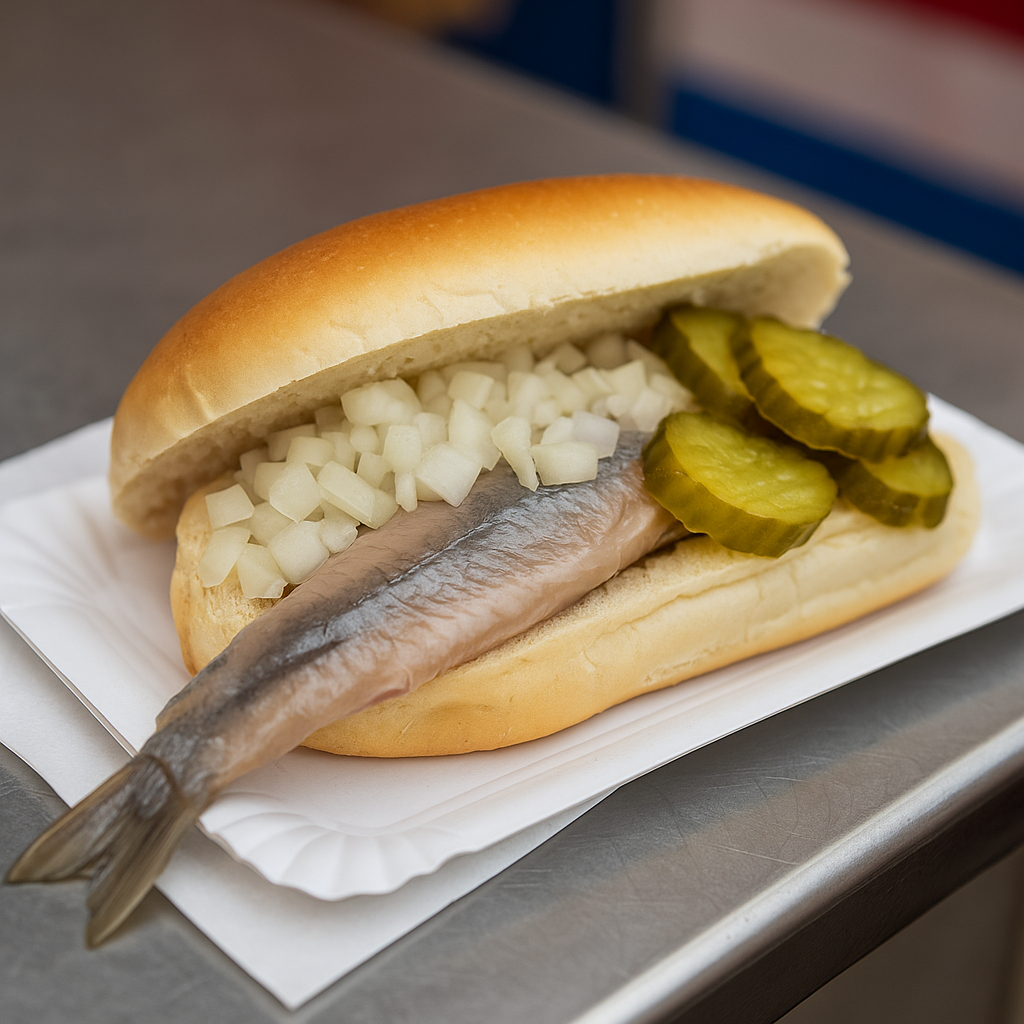
On a Bun (Broodje Haring)
Many Dutch eat herring in a soft white bread roll.
Typically served with chopped raw onions and sliced pickles.
A more accessible option for those new to the taste.
With Onions and Pickles (Losse Haring)
Served on a paper plate with toppings.
Eaten with toothpicks or small forks, less dramatic than the tail method but just as authentic.
Whichever way you choose, the important thing is to enjoy it fresh, ideally from a herring cart (haringkar) on the street.
The Taste of Herring
For newcomers, herring can be a surprise. It’s raw, but cured with salt and enzymatic processes, giving it a silky texture and mild, slightly salty flavor. It is far less “fishy” than some expect, closer to sushi than sardines. Combined with onions and pickles, the flavors balance into something bright, sharp, and refreshing.
Herring as Dutch Identity
Herring is not just food in the Netherlands — it’s a cultural marker.
A Symbol of Resilience: Just as the Dutch learned to master water through dikes and polders, they learned to master the sea’s bounty through preservation.
A Social Experience: Buying herring at a stand is often done with friends or colleagues, a casual way to connect.
A Tourist Experience: Visitors are encouraged to try herring, but locals delight in showing how it’s really done.
In this way, herring connects the Dutch past with the present, uniting people through a shared tradition.
Herring Across the Netherlands
Amsterdam: Famous for its street stalls where tourists and locals alike gather.
Rotterdam: As a major port, herring has long been part of its maritime culture.
Scheveningen (The Hague): Home to Vlaggetjesdag, the ultimate herring festival.
Friesland and the North: Coastal communities here historically relied heavily on the herring trade.
No matter where you go in the Netherlands, you’ll find herring stalls ready to serve.
FAQs About Dutch Herring
Q: Is Dutch herring really raw?
A: It’s technically raw but cured and preserved in a traditional way, giving it a safe and unique flavor.
Q: When is the best time to eat herring in the Netherlands?
A: During herring season, starting in June with “Hollandse Nieuwe.”
Q: Can I try herring if I don’t like fishy flavors?
A: Yes. Dutch herring is surprisingly mild, especially with onions and pickles.
Q: Why do Dutch people eat herring with onions?
A: The sharpness of onions balances the buttery richness of the fish.
Q: What’s the difference between Hollandse Nieuwe and regular herring?
A: Hollandse Nieuwe is the first catch of the season, considered the freshest and tastiest.
Q: Is eating herring by the tail really common?
A: Yes, though many also enjoy it in bread rolls or with forks. Both are authentic.
Q: Is herring healthy?
A: Absolutely. It’s high in omega-3 fatty acids, vitamins, and protein.
Q: Do other countries eat herring this way?
A: Scandinavia, Germany, and Eastern Europe all have herring traditions, but the Dutch style is uniquely celebrated.
Conclusion
Herring is more than just a snack in the Netherlands — it’s a link between past and present, a tradition that reflects the nation’s connection to the sea, and a ritual that continues to bring people together. Eating herring like a local is not only about flavor but about embracing a slice of Dutch identity, whether you hold it by the tail or tuck it into a soft bun with onions and pickles.
Explore More on Our Blog
If you enjoyed this article, you might also like: