
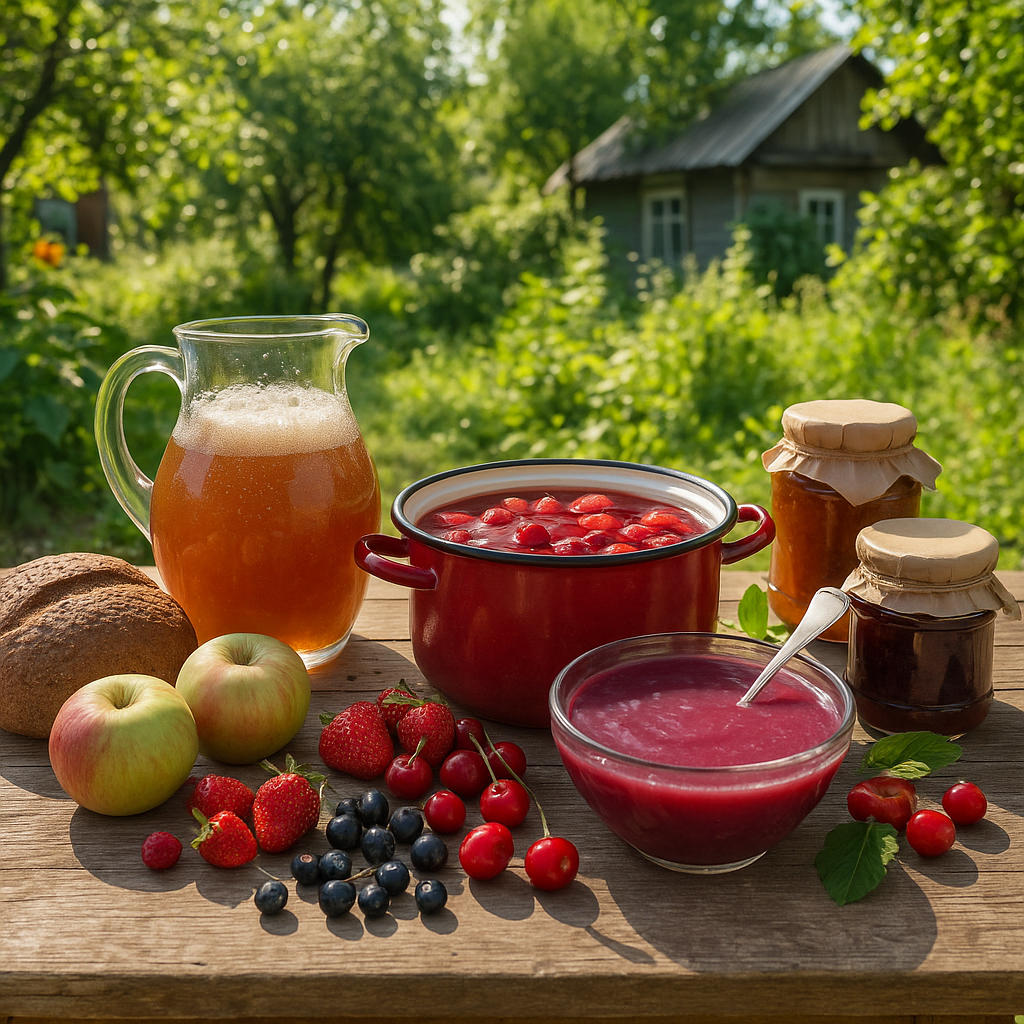
When people think of Russian cuisine, they often imagine steaming bowls of borscht, hearty dumplings like pelmeni, or black bread served with pickled cucumbers. Yet an equally important part of Russian food culture lies not on the plate but in the glass. Beyond vodka, which has become a global cliché, Russia has an entire tradition of homemade, seasonal, and deeply symbolic drinks that are woven into daily life and celebrations. Among the most beloved are kvass, a tangy fermented beverage often called “bread beer”; kompot, a sweet fruit drink that evokes the taste of summer; and kissel, a unique thickened berry drink that doubles as a dessert. Each of these beverages carries centuries of history, flavors of the Russian countryside, and cultural associations that go far beyond refreshment.
These drinks are not simply “old-fashioned” or “peasant” recipes—they represent resilience, creativity, and a way of life shaped by climate and tradition. Kvass quenched thirst in the fields long before bottled sodas existed; kompot was a way of preserving fruit flavors through long winters; and kissel offered a nourishing, comforting treat when luxuries were scarce. For travelers in Russia today, they remain easy to find at markets, cafés, and even street stands, offering an authentic taste of Russian life.
For learners of Russian, discovering these drinks is more than a culinary adventure—it’s a linguistic one as well. Words like квас (kvass), компот (kompot), and кисель (kissel) appear in literature, songs, and proverbs, carrying meanings that link language to everyday culture. Understanding them enriches not only your vocabulary but also your sense of what it means to experience Russian life “from the inside.”
In this article, we’ll take a closer look at each of these traditional Russian drinks. We’ll explore their history, preparation, cultural significance, and the ways in which they are still enjoyed today. Along the way, we’ll uncover how these drinks connect to Russian identity, how they’ve been portrayed in literature and folklore, and why they remain cherished even in an age of global coffee chains and soft drinks. By the end, you’ll see why kvass, kompot, and kissel deserve a place on your list of Russian experiences.
Kvass: The Soul of Russian Refreshment
Origins and History
Kvass has been part of Russian life for more than a thousand years. Its name comes from the Old Slavic word for “sour,” and that gives you a hint of its flavor profile: tangy, lightly sweet, refreshing. Kvass is made by fermenting rye bread or flour with water, sugar, and sometimes malt, producing a low-alcohol beverage (usually less than 1%).
In medieval times, kvass was so central to Russian life that almost every household had a barrel of it brewing. Monasteries brewed it, peasants drank it, and even nobles enjoyed it flavored with berries or herbs. It was considered healthier than water, which was often unsafe, and it provided energy for laborers in the fields.
How Kvass is Made
Traditional kvass is made by soaking rye bread in water, fermenting it with sugar and yeast, and sometimes adding flavorings like raisins, honey, or mint. The fermentation produces a natural carbonation, giving kvass a light fizz. Unlike beer, it remains very low in alcohol, making it suitable for all ages.
Cultural Role
Kvass is sold from street stands in summer, often from bright yellow tanks that appear on Russian sidewalks.
It’s an ingredient in okroshka, a cold summer soup where kvass serves as the base instead of broth.
It symbolizes Russian identity—humble, nourishing, and tied to the land.
Modern Kvass
Today, you can buy bottled kvass in supermarkets across Russia, with flavors ranging from classic rye to fruit-infused versions. But many Russians still swear that homemade kvass, brewed in the family kitchen or dacha, tastes far superior.
Kompot: A Taste of Summer All Year
Origins and History
Kompot is one of the simplest and most beloved Russian drinks. It is essentially fruit simmered in water with sugar, sometimes flavored with spices like cinnamon or cloves. Originating as a way to preserve fruit harvests, kompot became a staple on Russian tables, especially in rural areas where seasonal fruit was abundant in summer but scarce in winter.
How Kompot is Made
The beauty of kompot lies in its flexibility. Apples, cherries, strawberries, apricots, plums, currants, or even dried fruits can be used. The fruit is boiled in water with sugar, cooled, and served as a refreshing drink. In winter, dried fruit kompot provides vitamins and warmth.
Cultural Role
Kompot is often served in school cafeterias, making it a nostalgic childhood drink for many Russians.
It’s associated with summer holidays at the dacha, where fresh fruit from the garden is turned into jars of kompot for the winter.
It represents hospitality: offering kompot to guests is a sign of care and tradition.
Modern Kompot
Though bottled juices have become common, kompot is still popular, especially at home and in traditional restaurants. In fact, many Russians will choose kompot over soda because of its natural ingredients and cultural resonance.
Kissel: The Dessert-Drink Hybrid
Origins and History
Kissel is one of the most unique drinks in Russian cuisine, straddling the line between beverage and dessert. It dates back to at least the 10th century and was originally made from fermented oats. Over time, fruit and berry versions became more popular, thickened with potato starch to achieve a pudding-like consistency.
How Kissel is Made
Kissel is prepared by cooking fruit or berries (like cranberries, cherries, or blackcurrants) with sugar, then thickening the mixture with starch. Depending on how much starch is used, kissel can be a drinkable liquid or a spoonable dessert.
Cultural Role
Kissel is often served warm in winter, offering comfort and nourishment.
It’s a common dish in school meals, like kompot, giving it nostalgic associations.
In Russian folklore, there is even a reference to a “Kissel River” in the mythical land of abundance.
Modern Kissel
While some consider kissel old-fashioned, it remains a staple in traditional kitchens and can be found in restaurants serving classic Russian fare. Instant kissel powders are also sold in stores, but homemade kissel is still preferred by many.
Why These Drinks Matter
Kvass, kompot, and kissel are more than just drinks. They reflect how Russians adapted to their environment, using available ingredients to create nourishment and comfort. They embody values of thrift, community, and tradition, reminding Russians of their roots in a rapidly changing world.
For language learners, these drinks are also cultural touchstones. To order kvass at a market stall, to be offered kompot at a family table, or to taste kissel for the first time is to step into the living culture of Russia.
Practical Russian Vocabulary
Квас (kvas) – kvass
Компот (kompot) – kompot
Кисель (kisel’) – kissel
Фрукты (frukty) – fruits
Ягоды (yagody) – berries
Хлеб (khleb) – bread
Сахар (sakhar) – sugar
Вода (voda) – water
Practicing these words while tasting the drinks makes learning Russian deliciously memorable.
FAQs: Traditional Russian Drinks
1. Is kvass alcoholic?
Only slightly (usually less than 1%). It’s considered safe for children and adults alike.
2. What does kvass taste like?
Tangy, slightly sour, lightly sweet, and a bit fizzy.
3. Is kompot the same as juice?
Not exactly. Kompot is made by simmering fruit in water, not by pressing or concentrating juice.
4. Can kompot be served hot?
Yes. In winter, dried fruit kompot is often served warm.
5. Is kissel a drink or dessert?
Both. Depending on thickness, it can be sipped or eaten with a spoon.
6. Are these drinks still popular in modern Russia?
Yes. While sodas and coffee are widespread, these traditional drinks remain part of everyday life and cultural memory.
7. Where can tourists try these drinks?
In traditional Russian restaurants, markets, or even school-style canteens. Kvass is also sold from street stands in summer.
8. Are there similar drinks in other countries?
Yes. Eastern European countries have their own versions of kvass, kompot, and kissel, but the Russian tradition is especially strong.
Conclusion: A Toast to Tradition
Kvass, kompot, and kissel may not be as famous internationally as vodka, but they tell a richer story about Russian life. They are drinks of the people: humble, adaptable, and deeply tied to the rhythms of the seasons. To taste them is to taste Russian history, hospitality, and imagination.
At Polyglottist Language Academy, we believe that learning a language means exploring the foods, drinks, and traditions that shape daily life. Our Russian classes don’t just teach grammar—they open the door to cultural experiences that make language learning alive and meaningful. If you’re ready to discover Russian from the inside out, sign up today for our classes and join a community of learners passionate about language and culture.
And if you enjoyed this article, you may also like:
Borscht Beyond Beets: The Many Variations Of Russia’s Most Famous Soup
Russian Pickling Tradition: Cucumbers, Sauerkraut, And Forest Mushrooms
Blini Through The Seasons: From Maslenitsa To Modern Brunch Tables
Zakuski In The 19th Century Russia: Caviar, Aspic, And Aristocratic Indulgence
The Comfort Of Olivier Salad: Why Russians Can’t Celebrate New Year Without It