
The Comfort of Olivier Salad: Why Russians Can’t Celebrate New Year Without It
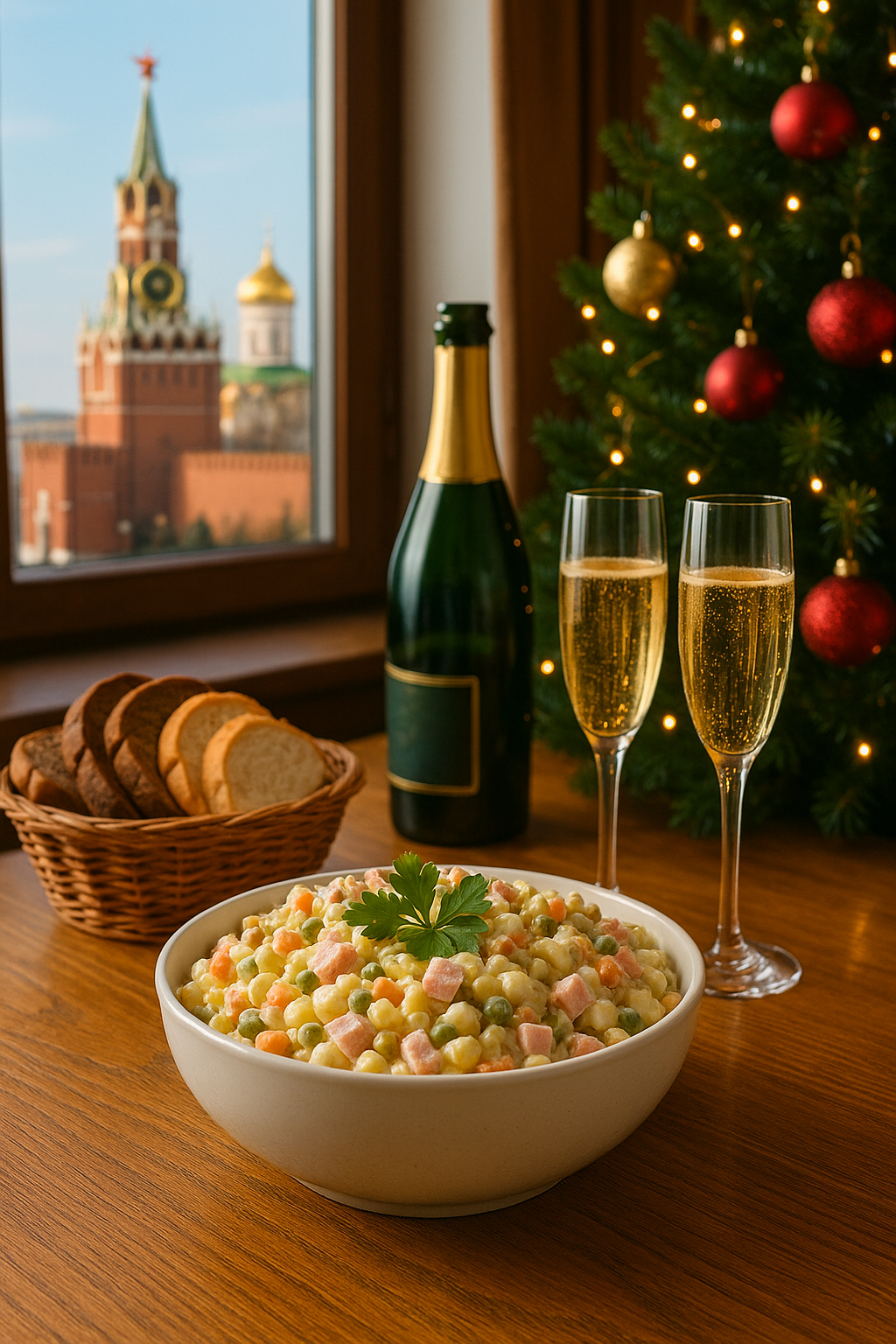
The arrival of New Year’s Eve in Russia is unlike anywhere else in the world, not only because of the midnight toasts, the chiming of the Kremlin clock, or the familiar voice of the President giving his annual address, but because of what’s on the table. No Russian New Year celebration feels complete without a large bowl of Olivier salad—creamy, colorful, and packed with nostalgic meaning. To outsiders, it may look like just another potato salad, but for Russians it is far more: a dish that carries memories of childhood, family gatherings, Soviet kitchens, and the enduring sense of comfort that comes with tradition.
What’s remarkable about Olivier salad is not only its taste but its universality. Rich or poor, young or old, whether in Moscow, Vladivostok, or abroad in Brooklyn, Russians make Olivier for New Year’s Eve. It is so deeply woven into the cultural fabric that to imagine the holiday table without it would feel wrong, almost incomplete. The clatter of knives chopping boiled potatoes, carrots, and pickles in the days before December 31st is as much a part of the New Year soundtrack as festive films like The Irony of Fate playing on TV.
For language learners and cultural explorers, Olivier salad is more than food—it’s a key to understanding the Russian mindset. Russians have a word, уют (uyut), which means coziness, comfort, warmth. Olivier embodies уют in edible form. It’s not gourmet cuisine, and it doesn’t need to be. Its power lies in its simplicity, its ability to gather people together around the table, and its connection to memories passed down through generations.
In this article, we’ll explore the story of Olivier salad: its surprising French origins, how it transformed into a Soviet staple, why it became inseparable from New Year’s celebrations, and what it reveals about Russian culture. Along the way, you’ll learn not only about the recipe itself but also about the cultural rituals tied to food, language, and celebration. By the end, you’ll see that Olivier salad is not just a dish—it’s a tradition, a comfort, and a symbol of belonging.
The Origins of Olivier Salad
Olivier salad is named after Lucien Olivier, a Belgian chef who ran the renowned Hermitage restaurant in Moscow in the 1860s. His original recipe was a closely guarded secret and far more extravagant than what we know today: grouse, crayfish tails, caviar, and a special Provençal sauce. Diners adored it, and it quickly became the signature dish of his restaurant.
Over time, however, the recipe was simplified and adapted. Ingredients like grouse and caviar disappeared, replaced by boiled potatoes, carrots, pickles, eggs, peas, and a mayonnaise-based dressing. By the Soviet period, Olivier had been democratized—no longer an elite delicacy but an everyday salad that could be made with affordable, accessible ingredients.
This transformation is crucial: Olivier became a symbol of how Russian cuisine absorbed foreign influences and reshaped them into something uniquely local. What began as haute cuisine ended up as comfort food.
Olivier and the Soviet New Year
In the Soviet Union, New Year’s Eve replaced Christmas as the main winter holiday. With religious celebrations suppressed, New Year’s became the central time for family gatherings, gifts, and feasts. Olivier salad found its permanent place on this holiday table.
Why New Year? Because Olivier was festive yet practical. It could be made in large batches, it used ingredients available even in the Soviet planned economy, and it kept well in the fridge—perfect for guests arriving late at night or continuing the celebration into January 1st.
Soon, Olivier was inseparable from the rituals of Soviet New Year’s: watching The Irony of Fate, decorating the ёлка (New Year tree), and listening to the Kremlin chimes as the clock struck midnight.
What’s in Olivier Salad?
The classic Soviet-style Olivier includes:
Boiled potatoes
Boiled carrots
Pickles (usually dill pickles)
Boiled eggs
Peas (often canned)
Cooked meat (traditionally bologna-style sausage, докторская колбаса)
Mayonnaise
Every family has its variation: some add apples, others chicken or ham, and many debate the “right” ratio of mayonnaise. But the essence remains the same: finely diced ingredients bound together in a creamy dressing.
Why Russians Can’t Celebrate New Year Without It
Tradition and Nostalgia – For many, the taste of Olivier is the taste of childhood. It recalls parents and grandparents preparing it in cramped kitchens, laughter, and togetherness.
Practicality – Olivier is filling, easy to make in bulk, and keeps well. Perfect for the all-night feasting that defines Russian New Year’s.
Symbol of Continuity – In a country that has undergone immense political, social, and economic changes, Olivier has stayed constant. It’s a dish that outlived the Soviet Union itself.
Comfort and Coziness – Amid winter cold and long nights, Olivier offers warmth, creaminess, and comfort.
Food as a Cultural Key
To understand Russian culture, you can’t just study grammar or vocabulary—you need to understand the role of food in shaping memory and community. Olivier salad demonstrates several cultural traits:
Communality – Russian meals are about sharing, not individual plates. Olivier is served from one big bowl, reinforcing the sense of togetherness.
Resourcefulness – The recipe adapts to what’s available. This reflects the Soviet habit of making do with what you had.
Emphasis on Ritual – Food is inseparable from holidays and traditions. Just as turkey belongs to Thanksgiving in the U.S., Olivier belongs to New Year’s in Russia.
The Language of Olivier
For learners, food vocabulary is a gateway to cultural understanding. Words like картошка (potatoes), огурцы(cucumbers), яйца (eggs), and колбаса (sausage) are essential not only for shopping but also for engaging in cultural conversations. Russians often use food metaphors in daily speech, and discussing Olivier is an easy way to connect with people during the holidays.
Olivier Abroad: A Taste of Home
Russian emigrants carry Olivier with them wherever they go. In Brighton Beach, Berlin, Tel Aviv, or Toronto, Russian families still prepare Olivier for New Year’s Eve. It’s more than a salad—it’s a connection to home, memory, and identity.
For many second-generation Russians abroad, learning how to make Olivier becomes a rite of passage. It’s a way of honoring their roots while living in a globalized world.
Practical Exercise for Learners
Try writing a shopping list for Olivier in Russian:
Картошка – potatoes
Морковь – carrots
Огурцы солёные – pickles
Яйца – eggs
Колбаса – sausage
Майонез – mayonnaise
Горошек – peas
Even this simple activity helps reinforce vocabulary while tying language learning to culture.
FAQs About Olivier Salad and Russian New Year
1. Is Olivier salad only eaten at New Year?
Mostly, yes. It appears at other celebrations too, but New Year’s Eve is its primary home.
2. Why mayonnaise?
Mayonnaise became the standard dressing during the Soviet era because it was widely available and added richness.
3. Is Olivier salad healthy?
Not particularly—it’s indulgent comfort food, more about tradition than nutrition.
4. Do all Russians make it the same way?
No. Families debate ingredients endlessly—apples or no apples, ham or sausage, more or less mayo.
5. What’s the difference between Olivier and American potato salad?
Olivier is more complex—more ingredients, finer dice, and usually includes meat.
6. Do young Russians still eat Olivier?
Absolutely. Despite globalization and modern cuisine trends, Olivier remains beloved.
7. Can vegetarians make Olivier?
Yes—just omit the meat or substitute with mushrooms or tofu.
8. Is Olivier known outside Russia?
Yes, in many post-Soviet countries it’s also traditional. It’s often simply called “Russian salad” abroad.
Conclusion: More Than a Salad
Olivier salad is more than just a dish on the Russian New Year’s table. It’s a vessel of memory, a cultural touchstone, and a shared experience across generations and borders. To learn Russian is to understand not only the words but the traditions that shape them. Saying спасибо with a full heart and eating Olivier on December 31st are equally part of the Russian cultural code.
At Polyglottist Language Academy, we believe that language learning should always include culture. That’s why our Russian classes go beyond grammar drills to explore the foods, films, holidays, and traditions that make Russian vibrant and alive. If you want to learn Russian in a way that connects you to real people and their customs, sign up today for our classes and join a community of learners who experience language fully.
And if this article whetted your appetite for Russian culture, check out these other blog posts: