
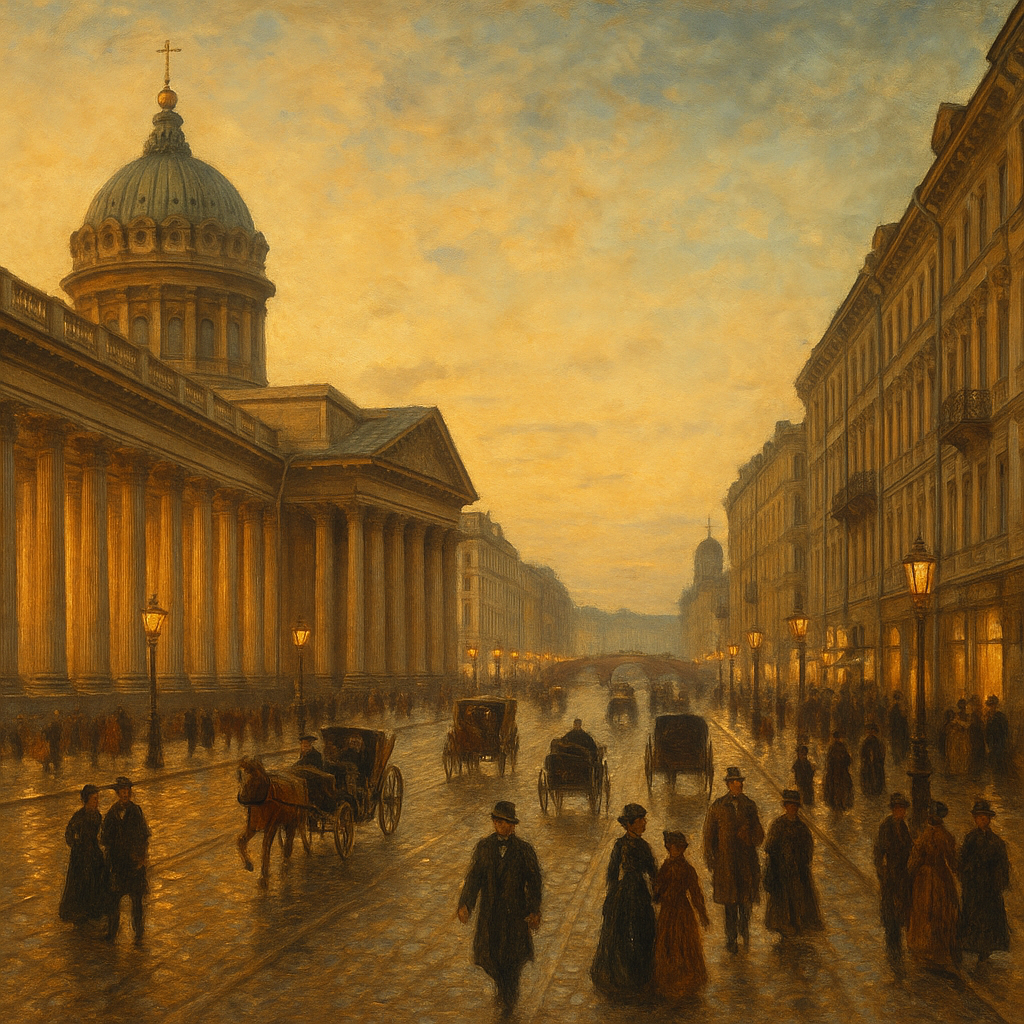
Stretching for nearly five kilometers through the very heart of St. Petersburg, Nevsky Prospekt is more than just a street—it is a stage upon which Russian history, literature, and daily life have unfolded for more than three centuries. From the grandeur of its 18th-century palaces to the bustling rhythm of modern shops, cafés, and theaters, Nevsky Prospekt captures both the elegance and the contradictions of Russia. To walk along its broad sidewalks is to trace the footsteps of tsars, poets, revolutionaries, and everyday citizens whose lives intersected here. For Dostoevsky, Russia’s great chronicler of human struggle and inner turmoil, Nevsky Prospekt was not merely a backdrop but a character in itself—a place of temptation, disillusionment, comedy, and tragedy.
Nevsky Prospekt’s reputation has always been double-sided. On one hand, it is St. Petersburg’s most prestigious boulevard, lined with some of the city’s finest architecture, including the Kazan Cathedral, the Anichkov Bridge, and ornate 19th-century buildings. On the other hand, it is also a place of fleeting encounters, false appearances, and hidden struggles, as Dostoevsky described so vividly in his short story Nevsky Prospekt and in the pages of novels like Crime and Punishment. It is precisely this tension between surface glitter and underlying reality that gives Nevsky Prospekt its enduring fascination.
For travelers, Nevsky Prospekt is the lifeline of St. Petersburg—a street where every corner reveals history, from imperial processions to revolutionary demonstrations. For Russians, it represents both national pride and the complexity of urban life. And for language learners, it offers a chance to connect words with lived experience: reading Dostoevsky’s descriptions while standing before the same façades, overhearing modern conversations that echo the cadences of the Russian language in its natural setting.
In this article, we will take a deep dive into the world of Nevsky Prospekt. We’ll explore its origins, its architectural highlights, its role in Russian literature and culture, and above all, its immortalization in Dostoevsky’s works. We’ll also reflect on what it means today to walk this avenue, where past and present converge.
The Birth of Nevsky Prospekt
Nevsky Prospekt was created in the early 18th century under the direction of Peter the Great, the visionary founder of St. Petersburg. Designed as the city’s main thoroughfare, it connected the Admiralty in the west with the Alexander Nevsky Monastery in the east. The street quickly became the backbone of St. Petersburg’s urban plan, an axis of power, religion, and commerce.
The avenue took its name from Alexander Nevsky, the medieval prince and saint who had defended Russia from foreign invaders. By dedicating the city’s central artery to such a figure, Peter the Great tied the new capital’s future to a glorious past, linking Russian orthodoxy and national pride to imperial ambition.
Nevsky Prospekt as a Cultural Boulevard
By the 19th century, Nevsky Prospekt had blossomed into one of Europe’s most dazzling streets. Aristocrats built grand residences along its length, while merchants opened shops and theaters that drew crowds day and night. Gaslights illuminated the street, making it the first in St. Petersburg to truly come alive after dark.
The avenue became a symbol of Russia’s cosmopolitan identity: elegant, modern, and yet deeply Russian. Carriages rolled past fashionable boutiques, while students and writers debated ideas in cafés. To stroll down Nevsky was to see and be seen, to participate in the spectacle of city life.
Dostoevsky and Nevsky Prospekt
Few writers captured the contradictions of Nevsky Prospekt better than Fyodor Dostoevsky. In his short story Nevsky Prospekt (1840s), he describes the street as both beautiful and deceptive:
By day, it dazzles with sunlight reflecting on windows and the splendor of palaces.
By night, it becomes a place of illusions, where shadows conceal sin and desperation.
For Dostoevsky, Nevsky was a metaphor for Petersburg itself—a city of grandeur and poverty, faith and despair.
In Crime and Punishment, Raskolnikov wanders Nevsky in turmoil, torn between moral guilt and rationalization. The street mirrors his psychological state: crowded, noisy, overwhelming. In The Idiot and The Brothers Karamazov, Nevsky appears as a meeting ground, a stage upon which destinies cross.
Through Dostoevsky’s pen, Nevsky Prospekt became more than a street. It became the symbol of Petersburg’s soul: brilliant but troubled, a place of both dreams and nightmares.
Architectural Highlights
Walking along Nevsky Prospekt is a lesson in Russian architecture:
The Kazan Cathedral – Modeled after St. Peter’s Basilica in Rome, it stands as a symbol of both imperial ambition and Russian Orthodoxy.
The Anichkov Bridge – Famous for its bronze horse statues, it offers one of the best views of the avenue.
The Singer House – An art nouveau gem, now home to the House of Books (Dom Knigi).
Gostiny Dvor – One of the oldest shopping arcades in the world, still bustling with commerce.
The Stroganov Palace – A baroque masterpiece associated with one of Russia’s wealthiest families.
Each building tells a story of the social and cultural fabric of St. Petersburg, from imperial grandeur to commercial innovation.
Nevsky Prospekt Today
In the 21st century, Nevsky Prospekt is still the lifeblood of St. Petersburg. Tourists flock to its landmarks, students gather in cafés, and residents use it as the city’s central artery. Street musicians play on corners, artists sell paintings, and bookstores still line the avenue—echoes of its artistic past.
At the same time, modern life has left its mark: international shops and fast-food restaurants share space with historic façades. Yet the essence of Nevsky remains: a street of encounters, contrasts, and energy.
Learning Russian Through Nevsky Prospekt
For learners of Russian, walking Nevsky can be an educational experience:
Reading signs: The avenue is filled with historic plaques, giving practice in Cyrillic reading.
Listening to conversations: Crowds provide exposure to natural Russian speech.
Engaging with culture: Visiting bookstores or watching a performance offers real immersion.
Pairing Dostoevsky’s writings with a stroll down Nevsky makes literature come alive, transforming language learning into lived experience.
FAQs: Nevsky Prospekt
1. Where is Nevsky Prospekt?
It is the main avenue of St. Petersburg, Russia, running for about 4.5 kilometers from the Admiralty to the Alexander Nevsky Lavra.
2. Why is Nevsky Prospekt famous?
It is the city’s cultural and historical heart, celebrated in Russian literature, especially by Dostoevsky and Gogol.
3. Which landmarks are on Nevsky Prospekt?
The Kazan Cathedral, Anichkov Bridge, Stroganov Palace, Gostiny Dvor, and the Singer House.
4. Did Dostoevsky live near Nevsky Prospekt?
Yes, he lived in various apartments around central St. Petersburg, often within walking distance of Nevsky.
5. Is Nevsky Prospekt pedestrian-friendly?
Yes. Wide sidewalks and pedestrian crossings make it ideal for walking, though it is also a busy traffic route.
6. Can you shop on Nevsky Prospekt?
Absolutely. From luxury boutiques to souvenir shops and bookstores, Nevsky remains a shopping hub.
7. How long does it take to walk Nevsky Prospekt?
At a leisurely pace with stops, 2–3 hours.
8. What’s the best time to visit?
Summer evenings during the White Nights are magical, but winter brings its own charm with festive lights.
Conclusion: Nevsky as a Window into Russia
Nevsky Prospekt is more than an avenue. It is a mirror of Russian life, a space where beauty and struggle, past and present, coexist. For Dostoevsky, it was both a dream and a warning, a place of dazzling façades and hidden despair. For travelers today, it remains one of the most compelling ways to experience St. Petersburg.
At Polyglottist Language Academy, we believe that language learning should be a journey into culture as much as grammar. Studying Russian through the lens of places like Nevsky Prospekt allows you to see how literature, history, and everyday life intertwine. If you’re ready to immerse yourself in the beauty and complexity of Russian, sign up for our classes today and take the first step on your own Nevsky journey.
And if this article inspired you, explore our other posts on Russian culture and language: