
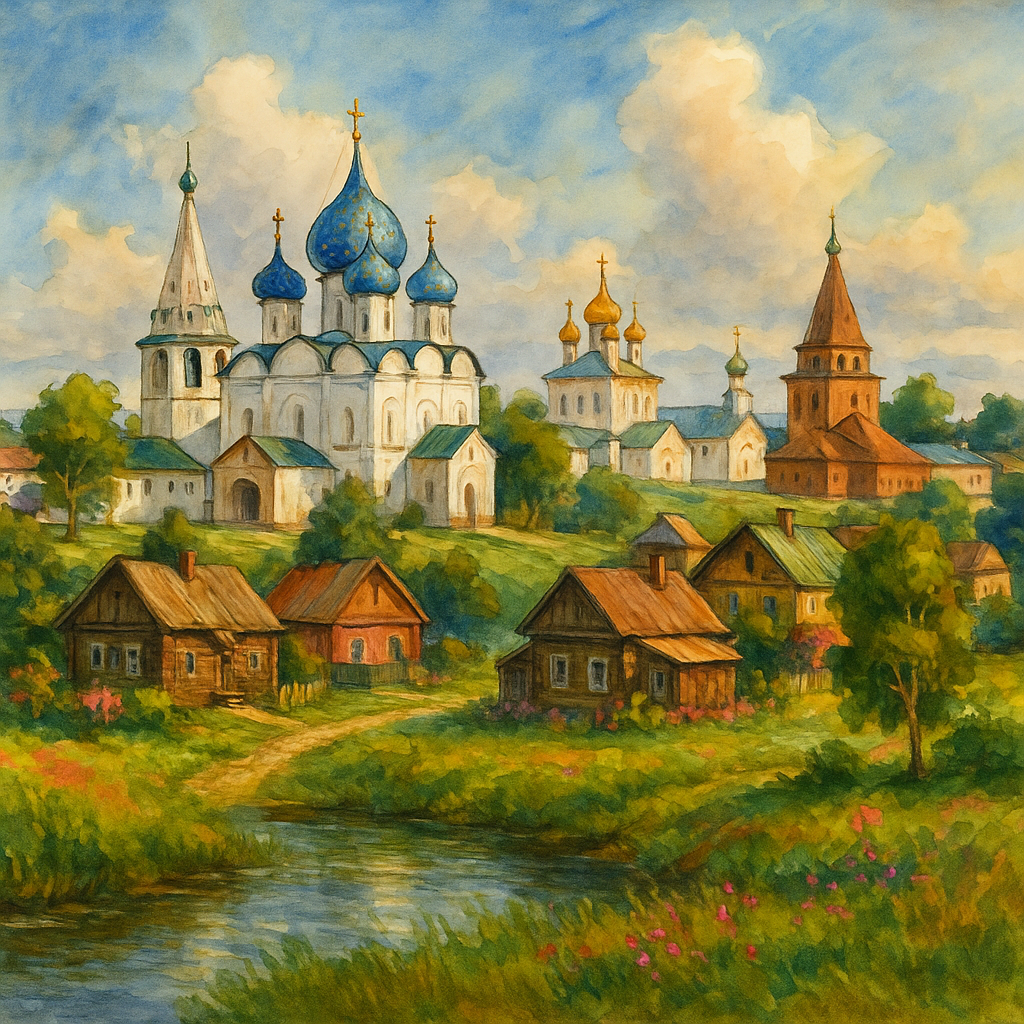
In a country as vast as Russia, where glittering metropolises like Moscow and St. Petersburg often dominate the traveler’s imagination, there exists a town that feels as though it has been lifted straight out of a medieval storybook and lovingly preserved for centuries: Suzdal. Nestled in the rolling landscapes of the Vladimir region, this small town of fewer than 10,000 people is one of the jewels of the Golden Ring—the famed route of historic towns northeast of Moscow. To step into Suzdal is to enter another world, where onion-domed churches dot the skyline, wooden houses line quiet streets, and the rhythm of life seems to follow an ancient calendar of festivals, markets, and traditions.
Suzdal has been called “an open-air museum,” and the description is not an exaggeration. With more than 200 historical monuments, including monasteries, kremlins, and wooden churches, the town feels like a living chronicle of Russian history. But Suzdal is more than just its architecture—it is the atmosphere that enchants. The bells of monasteries ring softly in the distance, the Kamenka River winds gently through the town, and horse-drawn carts still clip-clop past fields where locals tend gardens and orchards. Unlike many places where history is hidden behind glass or cordoned off by velvet ropes, Suzdal’s past is woven seamlessly into its present.
For Russians, Suzdal occupies a special place in the cultural imagination. It represents a vision of “old Russia,” a romanticized yet tangible reminder of the nation’s spiritual and artistic roots. For language learners and cultural explorers, it is also an ideal destination: a place where you can hear Russian spoken in its most authentic, regional tones, where traditions remain strong, and where every conversation with a shopkeeper, craftsman, or guide is an opportunity to connect with living culture.
In this article, we’ll dive deep into Suzdal’s story. We’ll explore its rich history, its role as a center of religion and culture, its architectural treasures, and its enduring traditions. We’ll discover how Suzdal transformed from a powerful medieval principality to a quiet provincial town, and why that very decline helped preserve its fairy-tale charm. By the end, you’ll understand why Suzdal is not only a must-see destination on the Golden Ring but also a window into the soul of Russia itself.
A Brief History of Suzdal
Early Beginnings
Suzdal was first mentioned in chronicles in the 11th century, during the time of Kievan Rus. By the 12th century, it had grown into the capital of the Rostov-Suzdal Principality, a major political and cultural center of the time.
A Spiritual Center
By the 13th and 14th centuries, Suzdal was renowned for its monasteries and churches, becoming one of Russia’s most important religious centers. The town’s wealth of sacred architecture reflects this era of prosperity.
Decline and Preservation
When political power shifted to Moscow in the 14th century, Suzdal’s influence waned. Ironically, this decline was its salvation: while Moscow expanded and modernized, Suzdal remained a small, quiet town. As a result, its historic architecture survived largely intact, giving us the fairy-tale town we see today.
Architectural Treasures
The Suzdal Kremlin
Dating back to the 10th century, the Suzdal Kremlin is one of the oldest in Russia. Inside, the Nativity of the Virgin Cathedral dazzles with its blue onion domes decorated with golden stars, an image that has become a symbol of the town.
Monasteries and Convents
Suzdal is famous for its monasteries, each with its own story:
The Spaso-Yevfimiev Monastery: A fortress-like complex with 12 towers and a museum of medieval life.
The Pokrovsky Monastery: Known for housing noblewomen, including wives of tsars, who were forced to take vows.
The Alexander Monastery: A serene site with stunning white-stone architecture.
Wooden Architecture Museum
Perhaps the most enchanting place in Suzdal is the Museum of Wooden Architecture and Peasant Life, where chapels, windmills, and houses from the 18th and 19th centuries have been preserved. Walking here feels like traveling back in time to a rural Russian village.
Festivals and Traditions
Suzdal is not only about silent monuments—it is also about living traditions. The town is famous for its festivals, which attract visitors from all over Russia.
Cucumber Festival: Held every summer, this quirky event celebrates the humble cucumber with tastings, contests, and music.
Maslenitsa: The Russian festival of pancakes before Lent, celebrated with bonfires, sleigh rides, and folk songs.
Orthodox Holidays: With so many monasteries and churches, Suzdal’s religious festivals are especially beautiful and deeply rooted in tradition.
Everyday Suzdal: Life and Atmosphere
What makes Suzdal enchanting is not only its monuments but its everyday life. Wooden houses painted in bright colors line quiet streets. Babushkas sell honey and pickles at the market. The scent of fresh bread and mead wafts through small cafés.
Even simple activities—renting a bicycle, walking along the Kamenka River, or taking a horse-drawn carriage ride—become memorable in this timeless setting.
Suzdal in Russian Culture
Suzdal has inspired countless painters, photographers, and filmmakers. Soviet directors often used the town as a backdrop for historical films because its preserved architecture required little alteration. For Russians, Suzdal represents not just a town but an idea: the endurance of tradition, beauty, and spirituality amidst change.
A Traveler’s Experience
For those exploring the Golden Ring, Suzdal often feels like the highlight. Unlike larger cities, it offers a more intimate, slower-paced experience. Travelers often remark on the friendliness of locals and the sense that time flows differently here.
For Russian language learners, it’s a perfect place to practice everyday interactions, from ordering food in a café to chatting with artisans at the market.
FAQs: Visiting Suzdal
1. Where is Suzdal located?
Suzdal is about 220 kilometers northeast of Moscow, in the Vladimir region.
2. How do you get to Suzdal?
Most visitors take a train from Moscow to Vladimir and then a short bus or taxi ride to Suzdal.
3. How long should you spend in Suzdal?
A day trip is possible, but staying overnight allows you to experience the quiet evenings and early mornings.
4. What is Suzdal best known for?
Its preserved medieval architecture, monasteries, and fairy-tale atmosphere.
5. Is Suzdal part of the Golden Ring?
Yes, it is one of the most famous towns on the Golden Ring route.
6. Can you stay overnight in Suzdal?
Yes, there are charming guesthouses, hotels, and even monastery accommodations.
7. What food is Suzdal famous for?
Local honey, mead (medovukha), pickles, and traditional Russian dishes.
8. Is Suzdal touristy?
It attracts many visitors, but its small size and preserved atmosphere keep it authentic.
Conclusion: Suzdal as Russia’s Fairy-Tale Town
Suzdal is not just a destination—it is an experience, a journey into the heart of Russia’s past and a glimpse of a simpler, more poetic way of life. Its cobblestone streets, golden-domed churches, wooden houses, and lively festivals make it a place where history is not confined to books but lives in the air, the architecture, and the conversations with locals.
For Russian language learners, Suzdal offers more than sightseeing. It offers immersion in authentic culture, opportunities to practice the language in real contexts, and the chance to feel how words and traditions intertwine.
At Polyglottist Language Academy, we believe that learning Russian is not just about grammar and vocabulary but also about discovering the places and traditions that shape the language. Suzdal is one of those places where language and culture meet in the most beautiful way. If you want to explore Russian culture while mastering the language, sign up today for our classes and let us help you unlock the richness of Russia.
And if you enjoyed this article, check out these other deep dives into Russian life, language, and culture: