
The world of Russian mythology is as vast, dark, and captivating as the forests that stretch endlessly across the Russian landscape, a realm where ancient figures still live in the imagination of children and adults alike, where morality tales blend with the supernatural, and where the line between wisdom and danger is often blurred. Few cultures hold on so strongly to their folkloric past as Russia, and its myths are more than just children’s bedtime stories—they are repositories of national identity, lessons about human nature, and reflections of a worldview shaped by centuries of hardship, resilience, and awe before nature’s power.
At the center of this mythic universe stands Baba Yaga, the witch-like figure who dwells in a hut that walks on chicken legs, a character who is by turns terrifying, wise, cruel, and generous. Unlike the wicked witches of Western fairy tales, Baba Yaga is never just one thing. She can eat children, yes, but she can also help the hero find his way, provide magical objects, or deliver the wisdom needed to survive. This ambiguity is central to Russian myths: they rarely present simple binaries of good versus evil, but rather a spectrum of choices, consequences, and unpredictable outcomes.
Yet Baba Yaga is only one part of a mythological tapestry filled with forest spirits, water demons, shape-shifters, and heroic knights. Russian folklore brings us domovoi who protect the household, rusalki who lure men to watery deaths, firebirds whose glowing feathers inspire quests, and bogatyrs who fight monsters and defend the weak. Each myth is not just a story, but a symbolic reflection of Russian life: the dangers of wandering too deep into the forest, the moral complexities of relying on cunning instead of brute strength, and the constant negotiation between human beings and the vast natural world around them.
For learners of Russian language and culture, exploring these myths is an enriching journey. The characters and phrases from folklore often appear in modern Russian literature, proverbs, and even casual conversation. To understand Russian culture deeply, it helps to know why someone might refer to a person as “like a Baba Yaga,” or why a glowing feather might symbolize temptation and destiny. Russian mythology offers a bridge between the past and the present, between imagination and language learning, allowing you to access layers of meaning that textbooks alone can never provide.
This article will take you through the fascinating world of Russian myths. We’ll begin with Baba Yaga—her origins, her many faces, and her role in folklore—before moving on to other key figures such as the Firebird, Koschei the Deathless, rusalki, domovoi, and bogatyrs. We’ll also look at how these myths shaped Russian literature, how they still influence contemporary culture, and how you as a learner can integrate them into your understanding of the Russian language.
Baba Yaga: The Archetypal Witch
Baba Yaga is perhaps the most famous figure in Russian mythology, instantly recognizable by her hut that stands on chicken legs and her habit of flying in a mortar while steering with a pestle.
Origins and Symbolism
Dual Nature: Baba Yaga is neither purely good nor purely evil. She can devour children but also guide the hero.
Nature Embodied: She often represents the wild, untamed forces of the forest.
Initiation Figure: In many tales, heroes must face Baba Yaga as a rite of passage.
Role in Folklore
Guardian of Knowledge: She often tests the protagonist before granting aid.
Fear and Respect: Children are warned of her dangers, but adults see her as a figure of wisdom.
Koschei the Deathless
Koschei (or Kashchei) is a skeletal, deathless villain who kidnaps princesses and locks them away.
Key Traits
Immortal: His soul (or death) is hidden outside his body, often in a needle inside an egg inside a duck inside a hare inside a chest buried under a tree.
Symbolism: Represents fear of death, greed, and the corruption of power.
Lessons for Learners
Koschei stories are filled with phrases about resilience, trickery, and fate—common themes in Russian idioms and proverbs.
The Firebird
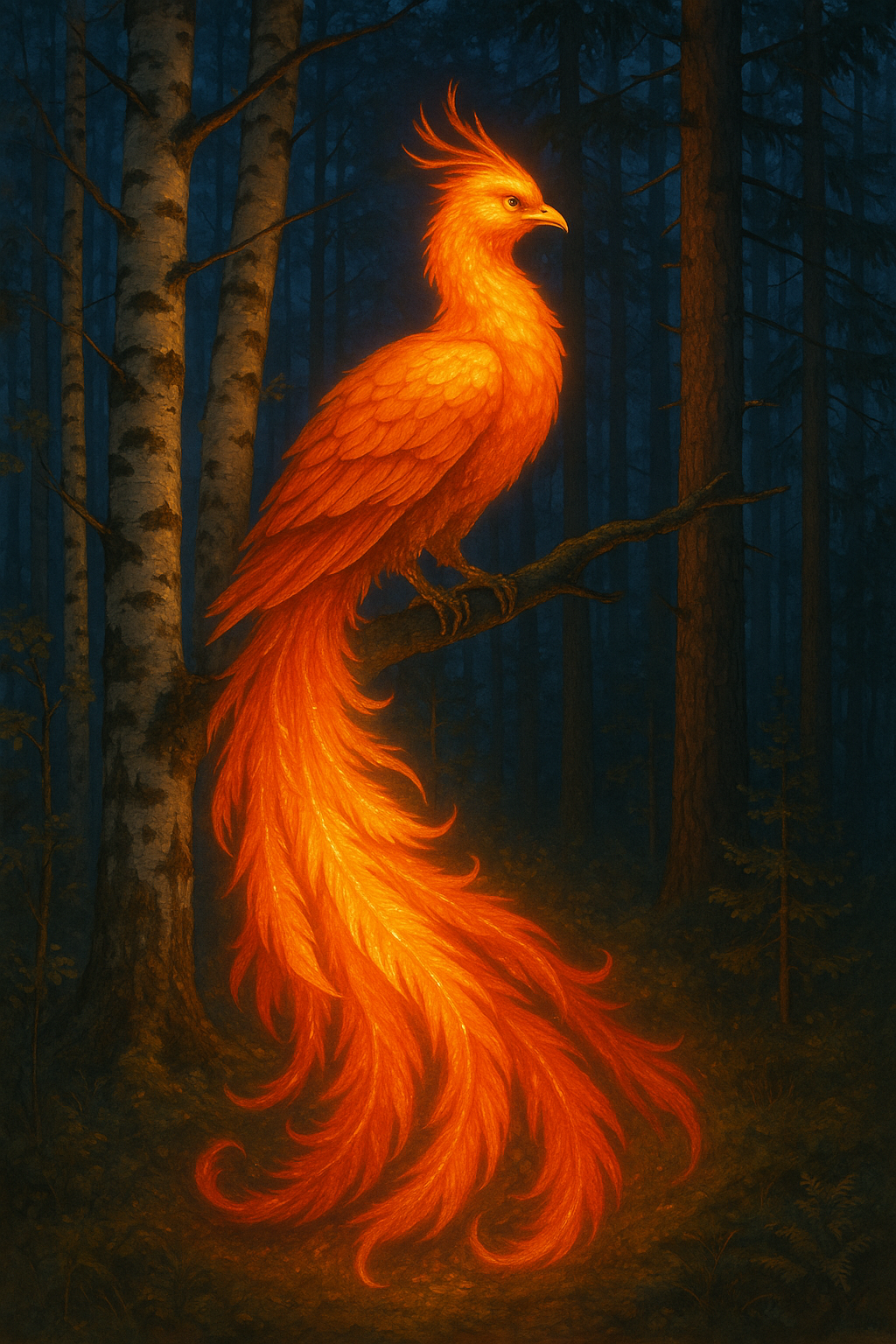
The Firebird is a magical glowing bird whose feathers light up like flames. It appears in many Russian fairy tales and has inspired ballets, paintings, and music (notably Stravinsky’s Firebird).
Significance
Temptation and Reward: Heroes often pursue the Firebird at great cost.
Symbol of Destiny: The glowing feather sparks quests that change lives.
Cultural Influence: The Firebird is a national symbol of wonder and beauty.
Rusalki: Water Spirits
Rusalki are female water spirits, sometimes portrayed as beautiful maidens, other times as drowned souls who lure men to their deaths.
Symbolism
Ambiguity: They represent fertility and life-giving waters but also danger.
Echoes in Language: Modern Russian still uses references to rusalki in literature and art to signal seduction and peril.
Domovoi: Household Spirits
The domovoi is a household guardian spirit, usually unseen, who protects the home if treated respectfully.
Cultural Role
Protector: Brings good luck if honored with offerings.
Trickster: Can cause mischief if angered.
Reflection of Daily Life: Domovoi myths show how spiritual belief was woven into everyday routines.
Bogatyrs: The Epic Heroes
Bogatyrs are the knights and warriors of Russian folklore, often appearing in byliny (epic poems).
Famous Bogatyrs
Ilya Muromets: The peasant who became a strong hero.
Dobrynya Nikitich: Known for fighting dragons.
Alyosha Popovich: Clever and witty, relying on brains as much as brawn.
Importance
They embody Russian ideals of strength, loyalty, and cunning.
Mythology in Russian Literature
Russian myths were not confined to oral tales—they shaped literature:
Pushkin’s fairy tales (Сказки Пушкина) draw heavily on folklore.
Gogol’s stories incorporate mythic figures like devils and witches.
Symbolist poets reinterpreted myths for modern times.
Knowing these myths helps learners unlock references in classic literature.
Modern Echoes of Myths
Even today, Russian myths influence pop culture:
Children’s cartoons still depict Baba Yaga.
Fantasy novels use Koschei and rusalki as characters.
Political cartoons sometimes portray leaders as bogatyrs or villains.
For a learner, understanding these references brings modern Russian media to life.
Tips for Learners: Using Myths in Language Practice
Read Fairy Tales in Russian – Start with simplified versions, then move to originals.
Watch Adaptations – Soviet films of fairy tales are a great resource.
Learn Key Phrases – Expressions like Свет мой, зеркальце (Mirror, mirror, my light) come from fairy tales.
Compare with Your Culture – Find parallels with your own folklore to remember stories better.
FAQs About Russian Myths
Q: Are Russian myths only for children?
A: No. While often told to children, they contain deep moral and cultural lessons for all ages.
Q: Is Baba Yaga always evil?
A: Not at all. She can be a villain or a helper, depending on the story.
Q: Why do so many myths involve the forest?
A: Forests dominate the Russian landscape, symbolizing both danger and mystery.
Q: Do Russians today still believe in these myths?
A: Few believe literally, but the stories remain culturally significant.
Q: Are Russian myths similar to Western fairy tales?
A: They share themes, but Russian myths often emphasize moral ambiguity and resilience.
Q: What’s the best way to start learning them?
A: Begin with children’s fairy tales in Russian—they use simple language.
Q: Do Russian idioms come from myths?
A: Yes, many idioms and cultural references stem from folklore.
Q: Which myth is most referenced today?
A: Baba Yaga remains the most iconic figure, often used in jokes, cartoons, and literature.
Final Thoughts
Exploring Russian myths means exploring a world where witches may guide as well as terrify, where birds can spark destinies, and where household spirits guard against bad luck. These stories are not only keys to understanding Russian culture but also rich resources for language learning. They train your ear with vivid vocabulary, introduce idiomatic expressions, and open cultural doors that pure grammar drills cannot.
At Polyglottist Language Academy, we know that language is more than words—it’s stories, culture, and imagination. That’s why our Russian classes incorporate folklore, literature, and cultural traditions alongside grammar and conversation. Sign up today, and let us guide you into the magical world of Russian language and myth.