
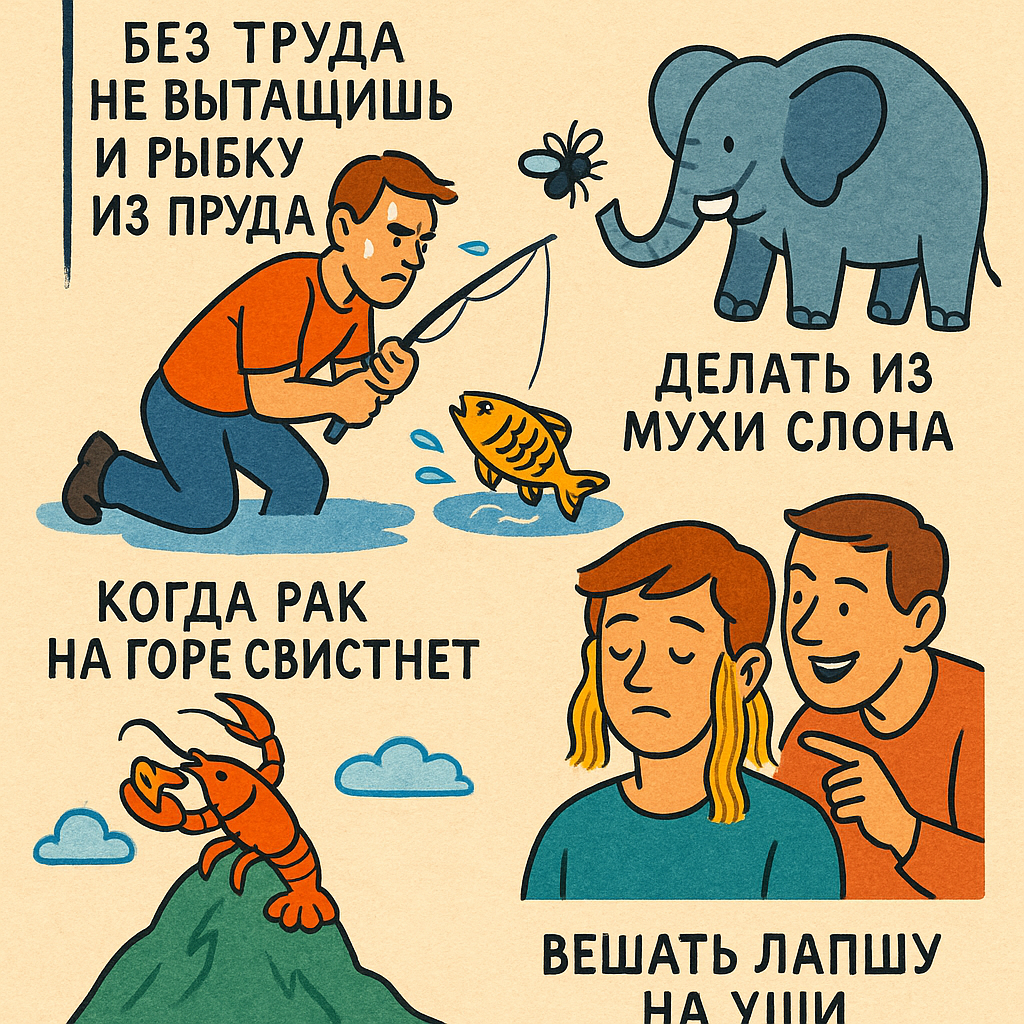
Languages are never just about grammar and vocabulary; they are living mirrors of culture, history, and everyday life. Nowhere is this more evident than in idioms—those colorful phrases that carry meanings far beyond their literal words. Russian, with its rich literary tradition and deep cultural roots, is especially full of idioms that reveal how Russians think, feel, and relate to the world. These expressions are more than linguistic decorations: they are shortcuts into the Russian mindset, windows into humor, resilience, irony, and philosophy.
For learners of Russian, idioms can feel intimidating at first. The words themselves often make no sense in direct translation, and the imagery can seem unusual to someone raised in another culture. But that’s exactly what makes idioms so rewarding: when you learn them, you’re not just memorizing phrases—you’re stepping into another worldview. And perhaps best of all, idioms make your Russian sound instantly more natural. Dropping one into a casual chat signals to native speakers that you’ve moved beyond textbooks and into the living language of the street, the kitchen, and the café.
In this article, we’ll explore 8 Russian idioms you can start using in conversation today. Each one comes with an explanation of its literal meaning, its figurative use, cultural context, and examples of how to use it naturally. By the end, you’ll not only have some fun new phrases to try out but also a deeper appreciation of how Russian idioms capture the spirit of the people who use them.
1. Без труда не вытащишь и рыбку из пруда
(Bez truda ne vytashchish i rybku iz pruda)
Literal meaning: “Without effort, you can’t even pull a fish out of the pond.”
Figurative meaning: Nothing comes without hard work.
This idiom reflects Russia’s deep agrarian and fishing traditions, where survival often depended on effort and patience. It’s a reminder that results require persistence.
In conversation:
“Я знаю, что учить русский трудно, но без труда не вытащишь и рыбку из пруда.”
(“I know learning Russian is hard, but nothing comes without effort.”)
2. Делать из мухи слона
(Delat’ iz mukhi slona)
Literal meaning: “To make an elephant out of a fly.”
Figurative meaning: To exaggerate, to make a mountain out of a molehill.
This idiom is often used humorously, chiding someone for blowing things out of proportion.
In conversation:
“Перестань делать из мухи слона — это всего лишь ошибка в тексте.”
(“Stop making an elephant out of a fly—it’s just a typo.”)
3. Когда рак на горе свистнет
(Kogda rak na gore svistnet)
Literal meaning: “When the crayfish whistles on the mountain.”
Figurative meaning: Something that will never happen (like “when pigs fly” in English).
This colorful idiom uses absurd imagery to emphasize impossibility.
In conversation:
“Он починит машину? Только когда рак на горе свистнет.”
(“He’ll fix the car? Only when pigs fly.”)
4. Вешать лапшу на уши
(Veshat’ lapshu na ushi)
Literal meaning: “To hang noodles on someone’s ears.”
Figurative meaning: To deceive or trick someone, usually with smooth talk.
It’s an idiom rooted in Russian humor, implying that someone is being fed nonsense.
In conversation:
“Не вешай мне лапшу на уши, я знаю правду.”
(“Don’t feed me nonsense, I know the truth.”)
5. Как сельдь в бочке
(Kak seld’ v bochke)
Literal meaning: “Like herrings in a barrel.”
Figurative meaning: Cramped, crowded, packed tightly.
Reflecting Russia’s love of herring as a staple food, this idiom captures the unpleasantness of being in a tight space.
In conversation:
“В метро утром — как сельдь в бочке.”
(“In the subway in the morning—it’s packed like sardines.”)
6. Любовь зла, полюбишь и козла
(Lyubov’ zla, polyubish i kozla)
Literal meaning: “Love is evil; you might even fall in love with a goat.”
Figurative meaning: Love is blind.
This idiom has a humorous, slightly cynical edge, showing the Russian tendency to mix wisdom with irony.
In conversation:
“Она снова встречается с ним? Ну, любовь зла, полюбишь и козла.”
(“She’s dating him again? Well, love is blind.”)
7. Сидеть сложа руки
(Sid’et slozha ruki)
Literal meaning: “To sit with folded arms.”
Figurative meaning: To do nothing, to be idle.
Used to criticize inactivity when action is needed.
In conversation:
“Мы не можем сидеть сложа руки, нужно действовать.”
(“We can’t just sit around doing nothing; we need to act.”)
8. После дождичка в четверг
(Posle dozhdichka v chetverg)
Literal meaning: “After a little rain on Thursday.”
Figurative meaning: Something indefinitely postponed, unlikely to happen soon.
It’s often used to poke fun at vague promises.
In conversation:
“Ты вернёшь мне деньги? Конечно, после дождичка в четверг.”
(“You’ll pay me back? Sure—after it rains on Thursday.”)
Why Idioms Matter in Russian
Idioms are not just decorative—they are essential to sounding fluent. Russians use idioms daily, often unconsciously. By learning them, you:
Gain cultural insight.
Sound more natural and expressive.
Avoid misunderstandings.
Connect emotionally with native speakers.
FAQs
1. Are Russian idioms used in everyday conversation?
Yes—Russians sprinkle idioms into daily speech constantly, often to add humor or color.
2. Are these idioms understood across all Russian-speaking regions?
Most are universal, though some may have regional variations.
3. Do Russian idioms translate well into English?
Not literally. Direct translation often makes no sense, which is why it’s important to learn both meaning and usage.
4. How should beginners approach idioms?
Start small—learn one or two and practice using them in context.
5. Are idioms taught in Russian language textbooks?
Not always. Many textbooks focus on grammar, leaving idioms for advanced learners.
6. Which idiom is most useful for beginners?
Probably “Без труда не вытащишь и рыбку из пруда”, since it’s widely known and motivational.
7. Are idioms used in formal settings?
Yes, but more cautiously. In casual speech, idioms are far more common.
8. Can idioms help me sound fluent faster?
Definitely—using idioms appropriately is one of the fastest ways to impress native speakers.
Conclusion: Speak Russian Like a Native
Learning Russian idioms is about more than expanding your vocabulary—it’s about stepping into the cultural logic of the language. Each idiom carries centuries of humor, wisdom, and imagery, giving you a direct connection to the Russian way of expressing life’s challenges, ironies, and joys. By weaving idioms into your conversations, you’ll sound more authentic and unlock deeper connections with native speakers.
At Polyglottist Language Academy, we don’t just teach Russian grammar—we immerse you in the culture, expressions, and idioms that make Russian alive. Our classes are designed to help you master not only the language but also the cultural nuances that textbooks often overlook. Sign up today and start speaking Russian with confidence and authenticity.
💡 Keep exploring Russian language and culture on our blog:
How Russians Navigate Public Space—And Why Americans Struggle With It
What It’s Like To Be The Only Foreigner In A Russian Dacha Community
The Cultural Importance Of Grandmothers (Babushki) In Russian Society
Russian Weddings, Toasts, And Table Traditions You Didn't Know Existed
What Watching Soviet Cartoons Teaches You About The Russian Mindset