
The Cultural Importance of Grandmothers (Babushki) in Russian Society
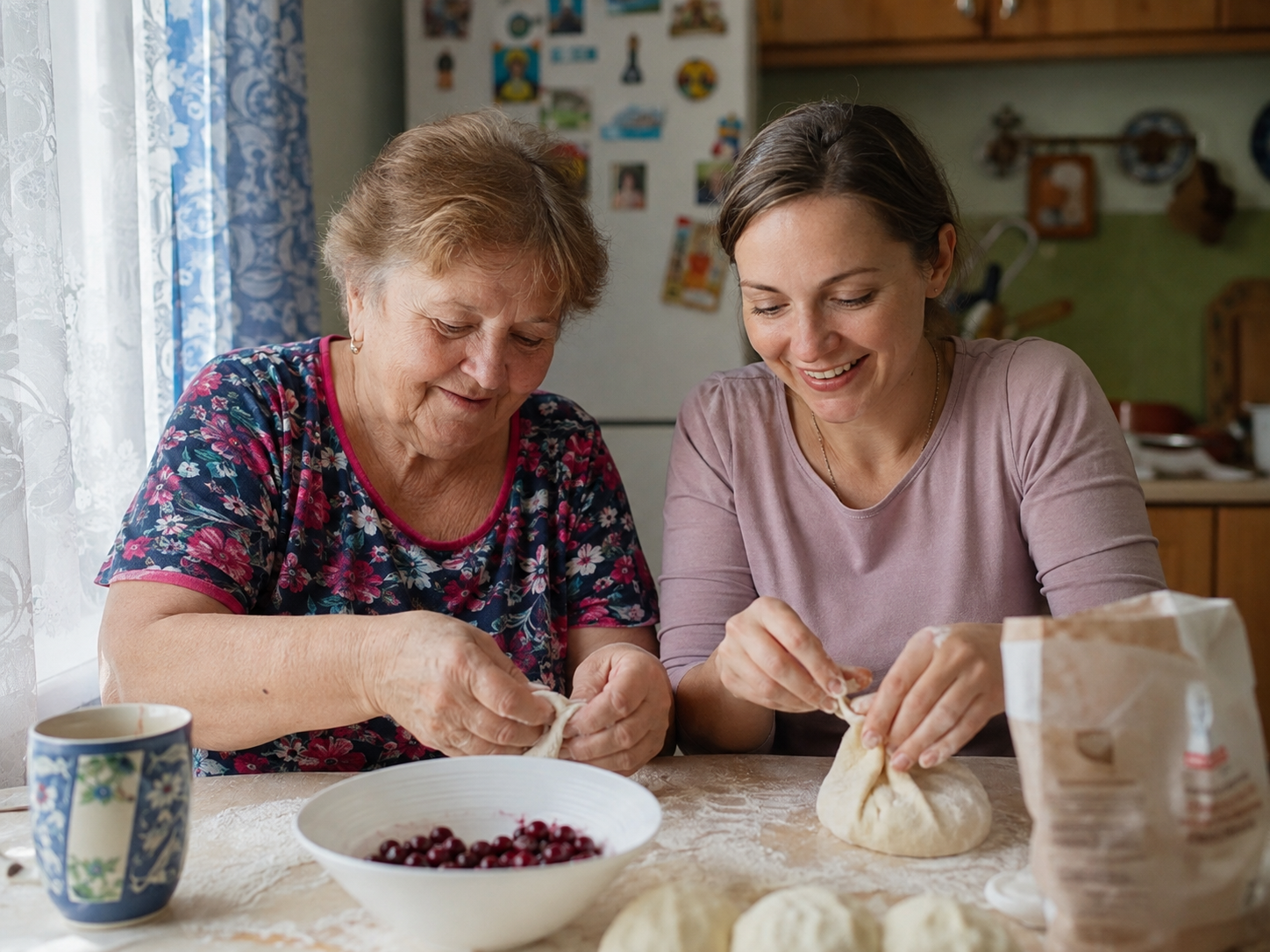
Anyone who spends much time around Russian families eventually realizes that бабушка (babushka) can mean considerably more than the English word “grandmother” initially suggests. The dictionary translation is simple enough: бабушка means grandmother or grandma. Yet in Russian family life, the person behind that word has often occupied a remarkably large amount of territory. She may be the grandmother who appears at birthdays and holidays, but she may just as easily be the person who picked you up from school for years, knew exactly what you would and would not eat, spent entire summers with you at the dacha, remembered where every relative came from, and continued to have opinions about your clothing long after you were old enough to choose it yourself.
This is partly where the familiar image of the Russian babushka comes from. Outside Russia, she has almost become a cultural character: an elderly woman in a headscarf, growing vegetables, making soup, worrying about everyone's health and refusing to accept the possibility that anyone could genuinely be full. Russians make plenty of jokes about this image themselves because parts of it are recognizable, but the stereotype becomes more interesting when we stop treating these habits as personality quirks and look at the kind of family life that produced them. Grandmothers became important not because Russian women possess some special instinct for grandmothering, but because families often depended heavily on relatives for childcare, household work, practical help and continuity across generations.
What Does “Babushka” Actually Mean?
In ordinary Russian, бабушка is simply the normal word for a grandmother. Моя бабушка means “my grandmother,” and there is nothing particularly folkloric about the expression. Families also use affectionate variations, including бабуля (babulya), which can have some of the warmth of “granny” or an affectionate “grandma,” although every household develops its own nicknames and ways of speaking.
The word can also be used more broadly for an elderly woman in certain contexts, especially in informal speech or when children are talking. That broader use probably contributes to the way babushka sometimes appears in English as though it refers to a particular type of old Russian woman rather than somebody's grandmother. In Russian, however, the family meaning comes first, while the larger cultural character has grown around it.
That character is immediately recognizable. A stereotypical babushka feeds you when you are not hungry, believes the weather is colder than you think it is, and sends you home with food after you have already explained that your refrigerator is full. She remembers details about your health that you have forgotten yourself and may have strong views about your work, your apartment, your spouse, your children and possibly your posture. The jokes work because many people recognize some version of this behavior, but the more interesting part is how naturally a grandmother could become involved in nearly every corner of family life.
When Grandmother Is Part of Everyday Childhood
One of the strongest associations surrounding Russian grandmothers is their involvement with grandchildren. A grandmother might collect a child from school, make dinner before the parents came home, supervise homework, stay with a sick grandchild or take care of children during school vacations. In some families, this was occasional help; in others, it came close to a second form of parenting. A child could spend enough time with a grandmother that her home, routines and rules became another version of ordinary childhood rather than somewhere visited only for special occasions.
This kind of arrangement was particularly valuable when both parents worked or when childcare was difficult to organize around ordinary working life. For many women, retirement or reduced employment did not mean that responsibility disappeared; it could simply change form. Instead of going to work every day, a grandmother might become the person who made the household function when younger adults were not available. Her time became one of the resources the family quietly relied on.
Once a grandmother has helped raise a child in this way, the closeness does not necessarily vanish when that child grows up. Someone who has spent years feeding you, collecting you, worrying about you and solving practical problems may not suddenly decide at eighteen or thirty that your decisions are entirely private matters. What looks from the outside like excessive interference often grows out of a relationship in which involvement has always been normal.
The historical setting matters here as well. Russian families across the twentieth century lived through war, political upheaval, housing shortages, Soviet economic life, the collapse of the Soviet Union and the instability of the 1990s. These experiences were not identical from one generation to another, but they repeatedly made family networks important. Relatives helped one another with childcare, housing, food, money, information and whatever else was difficult to manage alone, and the boundaries between households could be much more porous than a simple family tree suggests.
Help moved in several directions. Parents assisted adult children, adult children helped ageing parents, grandparents cared for grandchildren, and relatives shared whatever they happened to have: time, space, a dacha, food, practical skills or useful connections. In the middle of this network, the grandmother often performed an impressive amount of work that barely looked like work because everyone called it helping the family.
Food, the Dacha and the Texture of Childhood
The famous association between Russian grandmothers and food deserves more than the standard joke about being forced to eat another helping. Food is one of the easiest ways to care for someone without announcing that you are doing anything especially emotional. You cook something they like, save a portion, put another spoonful on their plate, send them home with leftovers or worry that they have become too thin. In many families, these gestures are so ordinary that nobody would describe them as a love language, even though that is often what they amount to.
There is a generational history behind the intensity attached to food as well. Some older Russians lived through wartime deprivation, while later generations remember Soviet shortages or the insecurity of the 1990s. Even people who never experienced serious scarcity themselves may have been raised by adults who did, and household habits can survive long after the circumstances that created them have changed. Saving food, avoiding waste and feeling reassured by a well-stocked kitchen can become part of family culture without anyone consciously connecting those habits to history.
The food itself often becomes part of family memory. One grandmother makes borscht differently from another; somebody has a particular recipe for сырники (syrniki), while another family has a version of пирожки (pirozhki) that has been made the same way for decades. These dishes rarely exist in the tidy standardized form of a cookbook because family cooking changes with region, available ingredients, migration and personal taste. What people remember is not “Russian cuisine” in the abstract, but the version that belonged to one kitchen.
For many families, the дача (dacha) belongs to the same world of memory. Describing a dacha simply as a Russian country house misses the variety involved: some are comfortable modern homes, while others are modest cottages surrounded by currant bushes, apple trees, sheds and vegetable beds demanding far more work than the word “vacation” suggests. Adults may remember all the maintenance, but children often remember summer.
When grandparents could remain outside the city longer than working parents, grandchildren sometimes spent extended periods there with them. That created a very particular childhood landscape of berries picked directly from bushes, jars being prepared for preserves, old furniture, mosquito bites, neighbors appearing at the gate, cucumbers from the garden and long afternoons that seemed to have no schedule. The grandmother becomes part of that landscape because she was there through the ordinary days, not just the memorable ones.
This is why nostalgia around babushki can be so specific. People are not always nostalgic for some broad idea of traditional Russian life. They may be remembering one kitchen, one garden, one particular soup, one old room at the dacha and the person who seemed to hold that little world together.
The Person Who Remembers the Family
As grandchildren get older, another role often becomes more visible: grandmothers remember things that nobody younger knows. Family history rarely arrives neatly arranged by year. It appears because somebody finds an old photograph, recognizes a name, asks where a piece of furniture came from or wonders why a relative moved to another city decades ago. A grandmother may know who lived in which apartment, who stopped speaking to whom, which recipe came from which branch of the family, where a surname originated, or why an ordinary household object has been kept for fifty years.
In Russian families, these stories can cover extraordinary historical change without ever sounding like a history lecture. A grandmother may talk about the Soviet period through salaries, queues, apartments, school, food, travel or the things people could and could not obtain. The 1990s may appear in stories about jobs disappearing, prices changing, relatives leaving the country or the feeling that everyday assumptions no longer seemed reliable. Large historical events become strangely intimate when they are remembered through what happened to one family.
Family memory is naturally imperfect. People remember selectively, disagree with one another and sometimes avoid difficult subjects for decades. One story may be repeated so often that everyone can recite it, while something much more significant is barely mentioned. That unevenness is part of what makes family history different from official history: it preserves what people noticed, feared, loved, misunderstood or chose not to discuss.
Grandmothers are often central to this process partly because they have simply been present for so long and partly because the domestic world has traditionally contained a great deal of information that never enters written records. Who cooked what, who cared for whom, which relative secretly sent money, how people managed when something was scarce and why two branches of a family no longer spoke to each other are the kinds of details that often survive only because somebody remembers them.
Love, Advice and the Problem of Boundaries
The same closeness that makes a grandmother invaluable can also make her exhausting. A woman who has spent decades taking care of other people may have strong opinions about what those people should do with their health, careers, marriages, money, children and clothing. From her point of view, giving advice may be almost inseparable from caring. The adult child or grandchild receiving it may experience the same conversation as a violation of privacy.
Russian family humor often revolves around this contradiction because it is possible to be genuinely irritated by a grandmother's interference and deeply attached to her at the same time. Someone may complain that their grandmother has an opinion about absolutely everything, then call her first when something serious happens. That relationship is harder to describe accurately if we insist that it must be either warm and loving or intrusive and controlling. In many families, it contains both.
Ideas about boundaries have also shifted from one generation to another. A younger adult who expects decisions about relationships, work or parenting to remain personal may encounter an older relative who grew up with a much more collective understanding of family life. To the grandmother, asking questions and intervening may feel like participation; to the grandchild, it may feel like being managed. Neither person necessarily sees herself as having crossed any line because they are working with different ideas of where that line belongs.
There is a less sentimental side to the celebrated image of the self-sacrificing babushka as well. When older women are expected to organize their lives around children and grandchildren, their unpaid labor can become almost invisible. A grandmother who cooks, babysits, cleans and rearranges her week for everybody else may be praised for devotion while nobody asks whether this is how she actually wants to spend her time. The warm cultural image and the burden attached to it can exist together.
When a Grandmother Is Also Your Connection to Russian
For Russian heritage learners, the grandmother's role can continue in another way entirely: she may be the reason Russian is still somewhere in the learner's head. A child raised outside a Russian-speaking country may hear Russian constantly from a grandmother while answering mostly in English, German, Dutch or another language. Years later, that person may genuinely believe they “don't speak Russian,” only to discover that they understand far more than an ordinary beginner.
Heritage Russian often looks uneven because it developed inside a family rather than through lessons. Someone may understand their grandmother almost perfectly and still struggle to form sentences. Their pronunciation may sound surprisingly natural even when their grammar is uncertain, simply because they heard the sounds of Russian throughout childhood. They may know exactly how a familiar expression should sound while having no idea why the grammar works the way it does.
The vocabulary can be just as uneven. A person may know an impressive number of words connected with food, clothes, illness, household objects, relatives, bedtime, affectionate names and family instructions, yet have difficulty explaining what they do for work. Childhood language follows childhood life. Nobody at the dinner table was making sure the child learned an evenly balanced vocabulary.
There is often something especially personal about the Russian inherited from a grandmother because it is not simply “Russian”; it is her Russian. It may contain regional vocabulary, expressions associated with her generation, Soviet-era words, family jokes and diminutives that have been used for decades without anyone thinking about them. Heritage learners sometimes begin formal Russian classes and discover that a word they assumed everyone used sounds old-fashioned to younger speakers, or that an expression they thought was standard belongs mostly to their family.
Those discoveries do not mean the Russian learned at home is defective. They show how language carries history. An expression can reveal where a family came from, what generation somebody belongs to or how long a particular phrase has been circulating inside the household. For a heritage learner, formal study can be surprisingly satisfying because grammar begins giving names to things that have sounded familiar since childhood.
There is another common surprise: understanding one grandmother extremely well does not always mean understanding unfamiliar Russian speakers equally well. After years of conversation, you know one person's voice, pace, vocabulary and favorite expressions almost instinctively. She may also have been adjusting her language to you without realizing it. Put the same learner into a rapid conversation between several strangers, and Russian can suddenly feel much more difficult.
In other words, you can know your grandmother's Russian extremely well without yet feeling comfortable in Russian outside the family. Classes can help widen that world by adding vocabulary, reading, writing, more conscious grammar and experience with different speakers. The point is not to replace the Russian learned at home with a supposedly better textbook version, but to build outward from what is already there.
This is also why heritage learners do not always fit neatly into ordinary class labels. One person may speak comfortably but barely read Cyrillic, another may understand everything and answer only in English, while someone else has beautiful pronunciation and major gaps in basic grammar. At Polyglottist Language Academy, learners with family exposure are often better served by looking at what they can actually do in Russian rather than assuming that “Complete Beginner” automatically describes them.
Readers who recognize themselves in this experience may also find our article “My Grandparents Spoke Russian” — A Guide for Heritage Learners Starting From Scratch useful. It looks more closely at what happens when Russian survives through parents or grandparents and an adult later decides to develop the language more fully.
EXPLORE RUSSIAN CLASSES AT POLYGLOTTIST LANGUAGE ACADEMY
The Babushka Is Changing Too
The traditional image becomes misleading when it is treated as though it describes every generation equally. A woman becoming a grandmother today may be in her forties or fifties, still have decades of professional life ahead of her, travel frequently, run a business, study languages, live abroad or simply have no intention of becoming a full-time caregiver. Another woman of the same age may genuinely want to spend several days a week with her grandchildren. Both fit comfortably inside the word бабушка.
A woman born before the Second World War, one born during the Khrushchev era, one born in the 1970s and one born after the end of the Soviet Union grew up in very different worlds. Even the phrase “Soviet generation” can conceal more than it explains. For one grandmother, the Soviet Union formed almost all of adult life; for another, it survives mainly as childhood memories. Ideas about careers, travel, marriage, retirement, money and personal independence naturally differ across those generations.
Migration has changed the relationship as well. Russian-speaking families now live throughout Europe, North America, Israel, Central Asia and elsewhere, and the grandmother who might once have lived several metro stops away may now live several countries or time zones away. She sees grandchildren on video calls, visits for several weeks instead of dropping by regularly, and may hear them answer in another language even when they understand her Russian.
At that point, preserving Russian can become far more personal than an ordinary educational goal. Simple household phrases may be enough when a child is young, but an adult relationship requires a much richer language. A grandmother wants to tell stories about her own childhood, explain what happened to relatives, joke, argue, gossip and talk about things that cannot be reduced to the vocabulary of food and daily routines. Some heritage learners return to Russian as adults because they realize they want access to those conversations while they still can have them.
Others begin only after that generation is gone. They remember fragments of language, old expressions, inscriptions on photographs or the fact that grandparents spoke Russian with one another even though it was never fully passed down. What once seemed like background noise from childhood can suddenly feel significant years later, especially when somebody starts asking questions about where the family came from and realizes how much information disappeared with the people who once knew it.
What Remains Behind the Stereotype
The familiar babushka stereotype contains enough truth to remain recognizable. Russian grandmothers have often played a deeply practical role in family life, helping raise grandchildren, cooking for several generations, maintaining dachas, keeping households running and remembering family stories that might otherwise disappear. Much of that work looked ordinary precisely because it happened inside the family and was rarely described as work at all.
Real grandmothers, of course, have never been one type of woman. Some cook constantly and some do not cook. Some adore the dacha, while others have spent enough of their lives growing vegetables and would happily never plant another cucumber. Some want grandchildren around all the time, while others value their independence. Some hold very traditional views, and some are considerably less conventional than the younger members of the family expect.
Perhaps that is why бабушка is such an interesting word for a Russian learner. “Grandmother” is a perfectly accurate translation, but the English word alone cannot tell you about summers at the dacha, containers of food sent home with adult grandchildren, arguments about whether you are dressed warmly enough, old photographs, childhood expressions, or stories about a country that changed dramatically during one person's lifetime. Those things are not part of the dictionary definition, but for many families they are part of what the word has come to carry.
Related Articles
What Does “Солнышко” Mean In Russian? More Than Just “Little Sun”
Do Bears Really Walk The Streets In Russia? Busting The Biggest Russian Myths
Russian Blini: History, Recipes, And Why They're More Than Just Pancakes
Russian Wedding Traditions: What Happens At A Traditional Russian Wedding
5 Russian Stereotypes That Are Actually True (And 5 That Are Completely Wrong)