
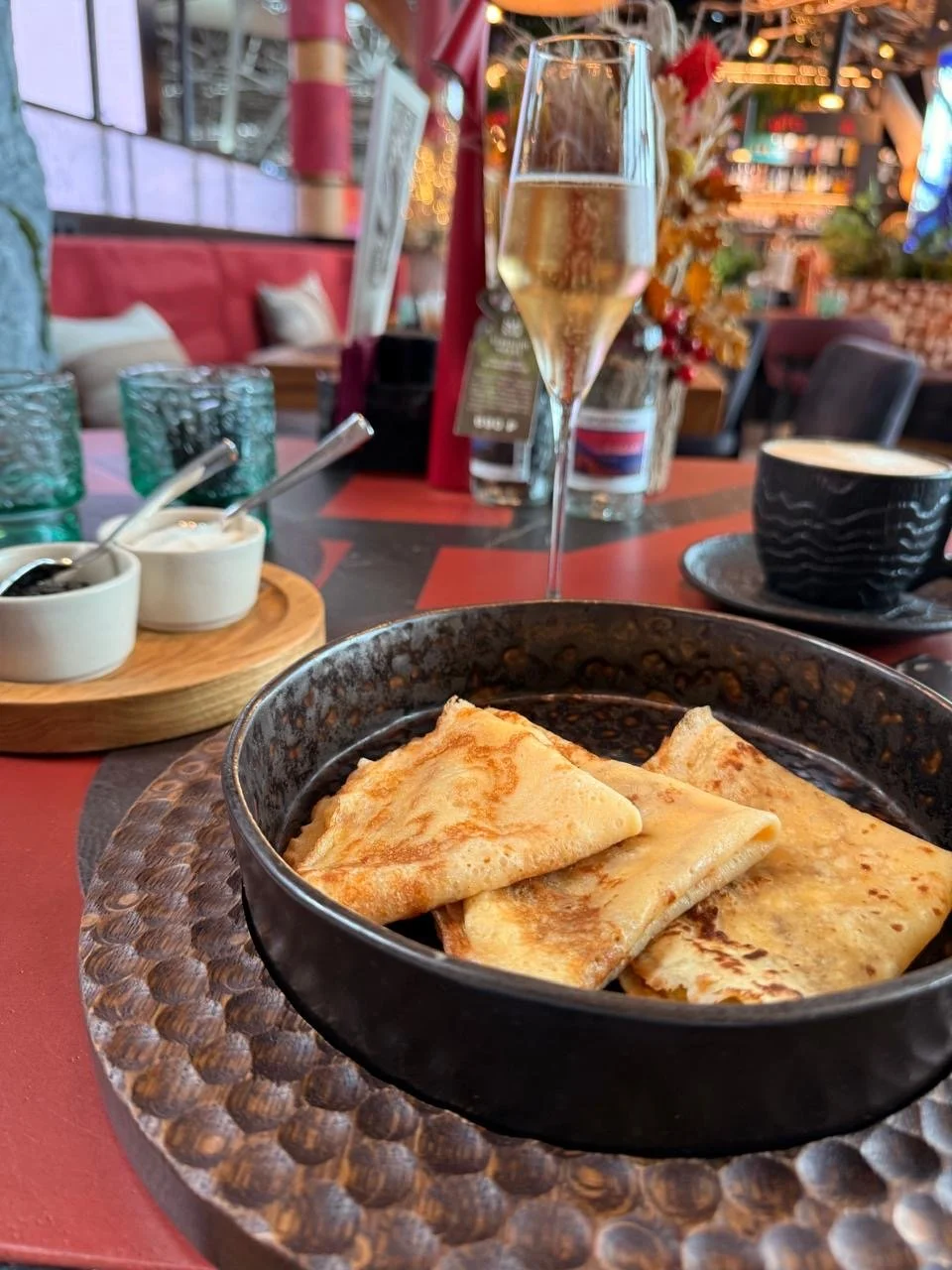
The first blin is rarely served to a guest.
It may be too thick because the pan was not hot enough. It may tear when you try to turn it. One side may be pale while the other is nearly burned. Sometimes it sticks so completely that it has to be scraped from the pan in pieces.
The cook usually eats this failed attempt while standing at the stove.
Then the rhythm begins: pour, tilt, wait, flip, stack. As each new blin lands on the plate, someone brushes it with butter. Children appear in the kitchen. Someone opens a jar of jam. Someone else reaches for the sour cream before the rest of the meal is ready.
This scene tells us more about Russian blini than the elegant restaurant image of three tiny pancakes topped with caviar.
Blini can certainly be festive. They can be served with smoked fish, red caviar, mushrooms, or rich sour cream. But they are also practical, adaptable household food: made from ordinary ingredients, eaten directly from the pan, folded around leftovers, served at family gatherings, and remembered long after the exact recipe has been forgotten.
Their cultural importance comes from this ability to move between worlds. Blini belong to the ordinary kitchen and the holiday table, to pre-Lenten celebration and memorial meals, to childhood breakfasts and modern fast-food counters.
They are more than pancakes because Russians have asked them to do much more than pancakes usually do.
First, forget the tiny caviar pancake
In Russian, one pancake is a блин—blin. The plural is блины́—bliny, commonly written “blini” in English.
English-language menus can make the terminology confusing. You may see “blini” used for both singular and plural, and you may also encounter the English plural “blinis.” In Russian, however, the difference is straightforward:
блин — one blin
блины́ — several blini
Many people outside Eastern Europe imagine blini as small, thick, savory pancakes designed mainly to hold caviar. That style exists, especially in restaurants and formal presentations, but it represents only one part of the tradition.
The blini made in Russian homes are often broad, thin, flexible, and lightly browned. They may resemble French crêpes, but the comparison is imperfect. Russian batters may include yeast, kefir, sour milk, buckwheat flour, or combinations of grains that produce a different flavor and texture. Some blini are delicate and almost lace-like. Others are thicker, tangier, and more substantial.
They are generally less sweet than American breakfast pancakes. Instead of arriving already defined as a sweet dish, they can move easily between savory and sweet fillings.
This flexibility is part of their appeal. A stack of neutral, buttery blini can become dinner with mushrooms and onions, dessert with jam, or a festive dish with fish and caviar.
Blini, blinchiki, and oladyi are not interchangeable
Russian food vocabulary becomes especially interesting when several English translations seem to collapse into the word “pancake.”
Блины́ are the general category of blini.
Бли́нчики—blinchiki—is a diminutive form. In everyday culinary use, it often suggests thinner blini that are filled, folded, or rolled. Blinchiki may contain meat, mushrooms, sweetened farmer’s cheese, or fruit. They are sometimes fried again after filling so that the outside becomes lightly crisp.
Ола́дьи—oladyi—are different. They are smaller and thicker, often made with kefir or yeast. They are much closer in shape to what Americans might identify as small pancakes or fritters.
A Russian speaker would not usually look at a plate of thick oladyi and call them exactly the same thing as thin blini. For language learners, this is a useful reminder: food words carry distinctions that a dictionary translation does not always preserve.
A very old food without a simple origin story
Blini are often introduced with a dramatic sentence: “Ancient Slavs made round golden pancakes to worship the sun.”
It is an appealing story. It is also too neat.
Blini likely developed from very old Slavic traditions of grinding grain, mixing batter, and cooking flat foods on hot surfaces. There is no single recorded moment when someone “invented” the Russian blin. Early versions would have depended on the grains available in a particular region and household: rye, millet, barley, oats, buckwheat, wheat, or some combination of them.
The connection between blini and the sun is culturally important. Their round shape, warm color, and association with the end of winter made the symbolism natural and powerful. But direct evidence proving that every early blin was a deliberate pre-Christian sun offering is limited.
It is more accurate to say that blini accumulated meaning over time.
They were practical grain-based food before they became a national symbol. Seasonal customs, family rituals, Orthodox traditions, literature, and nostalgia later gathered around them.
Recipes also changed with wealth and social position. A rural household might make blini from whatever flour and liquid were available. An affluent urban or aristocratic kitchen could use fine wheat flour, cream, eggs, butter, multiple stages of fermentation, and expensive toppings.
The humble and luxurious versions did not cancel each other out. They became part of the same culinary language.
That is one reason blini are so difficult to define through a single “authentic recipe.” A family’s recipe may be traditional without being ancient. A quick milk-based batter can be genuinely Russian even if it does not use yeast. A buckwheat version may reflect older grain traditions, while a delicate wheat-flour blinchik may represent modern home cooking.
Authenticity here is not one frozen formula. It is continuity through adaptation.
Maslenitsa: when winter leaves one blin at a time
Blini are eaten throughout the year, but their most famous season is Маслени́ца—Maslenitsa.
Maslenitsa takes place during the week before Orthodox Great Lent. In the traditional pre-Lenten sequence, meat has already been removed from the diet, while dairy products, butter, and eggs are still permitted. Blini fit this pantry perfectly.
The Russian name itself is related to ма́сло, a word that can mean butter or oil. English descriptions sometimes call Maslenitsa “Butter Week,” “Cheese Week,” or “Pancake Week.”
Like many long-lived holidays, Maslenitsa has several historical layers. It contains seasonal customs associated with the departure of winter, but it is also firmly connected to the Orthodox calendar. Calling it purely pagan ignores its Christian development. Calling it purely religious overlooks the older folk customs that helped shape its atmosphere.
Traditional festivities have included sledding, outdoor games, visiting relatives, generous meals, bonfires, and the burning of a straw effigy representing winter. Contemporary celebrations may take place in parks or public squares, with concerts, costumes, food stalls, crafts, and organized family activities.
At the center of it all are blini.
Their round, golden appearance easily evokes the returning sun. More practically, they use exactly the rich foods people traditionally enjoyed before the austerity of Lent.
Maslenitsa is not only about eating as many blini as possible, however. The week ends with Forgiveness Sunday, when people traditionally ask one another for forgiveness before Lent begins.
This combination may surprise outsiders: noise and celebration followed by humility; abundance followed by restraint; winter games followed by spiritual preparation.
Yet those contrasts are central to Maslenitsa. The holiday stands at a threshold, and blini are the food that marks the crossing.
A food for arrivals, departures, and remembrance
Blini do not symbolize only sunshine and celebration.
They have also appeared in traditions connected with birth, marriage, funerals, memorial meals, family visits, and hospitality. Cultural accounts sometimes describe them as accompanying a person “from birth to death.” That should not be taken as a universal rule followed identically in every Russian region, but it captures something important about their range.
To an outsider, it might seem contradictory that the same food could appear at both a wedding and a memorial meal. Within ritual food traditions, however, this is not unusual.
Certain foods become associated with moments when ordinary life changes direction. A person enters the family, leaves the family, forms a new household, returns home, or is remembered after death.
Blini are well suited to these moments. They are circular, repeatable, and meant to be shared. They can be simple enough for everyday life yet abundant enough for a feast.
They are also strongly associated with hospitality. A stack of blini suggests that the cook is prepared to keep feeding people. Even a modest topping—butter, honey, jam, or sour cream—can make the table feel generous.
Adult language learners often notice that hospitality vocabulary is easier to understand after seeing how hospitality actually works. In Russian-speaking homes, food may be offered repeatedly. A guest’s first refusal may not always be interpreted as a final answer. The host may insist, not because the guest’s wishes are being ignored, but because feeding someone is a form of care.
Blini embody that care particularly well. There is always room for one more on the plate.
The problem with caviar
Blini with caviar are real, traditional, and delicious. They are also overrepresented in Western images of Russian cuisine.
The combination is visually memorable: a warm golden blin, cool sour cream, jewel-like red caviar, perhaps smoked salmon and dill. It photographs beautifully and signals luxury immediately.
But it can create the false impression that blini are naturally elite food.
For many families, the familiar toppings are far more ordinary:
melted butter
sour cream
honey
fruit preserves
sweetened condensed milk
berries
apples
tvorog, a fresh curd cheese
mushrooms and onions
minced meat
chicken
eggs with green onions
herring or other fish
Sometimes blini are simply sprinkled with sugar and rolled while still warm.
The contrast between humble and luxurious fillings is culturally revealing. Blini do not belong to one social level. They can stretch a small amount of filling into a complete meal, or they can support some of the most expensive ingredients on the table.
Even the same household may serve them differently depending on the occasion. Tuesday dinner might mean blinchiki filled with leftover meat. A holiday table might bring out smoked salmon and caviar. A child may want only jam.
The blin remains the same welcoming surface. The context changes around it.
From the family stove to the Soviet cafeteria
Blini survived the Soviet period easily because they could function as both home food and institutional food.
They appeared in household kitchens, workplace cafeterias, public dining rooms, and prepared-food counters. Filled blinchiki were especially practical: inexpensive, portioned, easy to reheat, and adaptable to different fillings.
This everyday Soviet history matters because cultural traditions do not survive only through formal ceremonies. They survive because people continue eating the food on ordinary weekdays.
In the post-Soviet period, blini also became fast-casual food. Chains such as Teremok built menus around blini filled with meat, cheese, mushrooms, fish, and sweet ingredients.
At first glance, serving blini as fast food might appear to cheapen tradition. In another sense, it continues one of the food’s oldest strengths: speed, flexibility, and accessibility.
A modern customer can order a filled blin from a counter, eat it on the way to work, and still recognize something connected to Maslenitsa, childhood, and family cooking.
Tradition and convenience are not always enemies. Sometimes convenience is how tradition stays alive.
Three ways to make blini at home
There is no single recipe that represents every Russian household. The versions below are practical adaptations for a modern stovetop.
The first is a thin everyday blin suitable for almost any filling. The second uses yeast for a more traditional festive texture. The third brings in the earthy flavor of buckwheat.
Everyday thin Russian blini
This is the best starting point for beginners.
Makes: approximately 12–14 blini
Pan size: about 8 inches or 20 centimeters
Ingredients
1 cup all-purpose flour, about 125 grams
2 large eggs
1½ cups milk, 360 milliliters
½ cup water, 120 milliliters
2 tablespoons melted butter or neutral oil
1 teaspoon sugar
½ teaspoon salt
Additional butter or oil for the pan
Method
Whisk the eggs, milk, water, sugar, and salt together. Gradually add the flour, whisking until the batter is smooth. Stir in the melted butter.
Let the batter rest for 20–30 minutes. This gives the flour time to absorb the liquid and makes the blini less likely to tear.
Heat a lightly greased frying pan over medium-high heat. Pour in a small amount of batter—usually two to three tablespoons—and immediately tilt the pan so the batter spreads into a thin circle.
Cook until the surface looks dry and the edges begin to lift. Turn the blin and cook the second side briefly.
Stack the finished blini and brush them lightly with butter if desired.
The batter should be thinner than American pancake batter. When you tilt the pan, it should move quickly. When the first blin comes out too thick, add a tablespoon or two of water.
Traditional-style yeast blini
Yeast gives blini a slightly tangy aroma and a soft, airy texture. These take longer, but the flavor is especially good with butter, sour cream, fish, or mushrooms.
Makes: approximately 14–16 blini
Ingredients
2 cups all-purpose flour, about 250 grams
2 cups warm milk, 480 milliliters
2 large eggs
2 tablespoons melted butter
1 teaspoon active dry yeast
1 teaspoon sugar
½ teaspoon salt
Butter or oil for cooking
Method
Mix one cup of the warm milk with the yeast, sugar, and approximately half of the flour. Cover and leave in a warm place for 30–45 minutes, until the mixture looks active and slightly bubbly.
Whisk in the remaining milk, flour, eggs, melted butter, and salt. Cover again and allow the batter to rise for approximately 45 minutes.
Stir gently before cooking. The batter should be pourable but slightly thicker and more aerated than the everyday version.
Cook in a lightly greased pan, tilting gently to spread the batter. Yeast blini may not spread quite as thinly as non-yeast blini, and that is perfectly normal.
Serve them immediately when possible. The scent of butter and yeast is part of the experience.
Buckwheat blini
Buckwheat gives blini a darker color and a nutty, earthy taste. Because buckwheat contains no gluten, combining it with wheat flour makes the blini easier to turn.
Makes: approximately 10–12 blini
Ingredients
¾ cup all-purpose flour, about 95 grams
½ cup buckwheat flour, about 60 grams
2 large eggs
1½ cups milk, 360 milliliters
½ cup water, 120 milliliters
2 tablespoons melted butter
½ teaspoon salt
1 teaspoon sugar, optional
Method
Prepare the batter in the same way as the everyday thin blini, mixing the two flours before gradually adding them to the liquid.
Rest the batter for at least 30 minutes. Buckwheat absorbs liquid as it sits, so you may need to add a little extra water before cooking.
These blini pair particularly well with sour cream, smoked fish, mushrooms, or caviar. They can also be served simply with butter and salt.
Why the first blin matters
Russian has a proverb that every nervous beginner should appreciate:
Первый блин комом.
Literally, it means something close to “The first blin comes out as a lump” or “The first pancake is a flop.”
Its practical logic is obvious. The first blin often fails while the cook adjusts the temperature, batter thickness, and amount of oil.
Figuratively, the expression means that the first attempt at something is often imperfect.
You might use it after a disappointing first presentation, a clumsy first driving lesson, or an awkward attempt to speak Russian in public.
For adult learners, this proverb is almost too appropriate. The first conversation may not go smoothly. A case ending may be wrong. The stress may fall on the wrong syllable. The sentence may stick to the pan.
That does not mean the next attempt will fail.
A small blini vocabulary lesson
Food offers a memorable way to build vocabulary because each word is connected to something visible and physical.
блин — blin — one blin or pancake
блины́ — bliny — blini, pancakes
бли́нчик — blinchik — a small or thin blin, often filled
те́сто — testo — dough or batter
мука́ — muka — flour
дрожжи́ — drozhzhi — yeast
сковорода́ — skovoroda — frying pan
начи́нка — nachinka — filling
смета́на — smetana — sour cream
творо́г — tvorog — fresh curd cheese
и́кра — ikra — roe or caviar
жари́ть — zharit’ — to fry or cook in a pan
перевора́чивать — perevorachivat’ — to turn over or flip
Маслени́ца — Maslenitsa — the pre-Lenten festival associated with blini
There is also another use of блин that surprises beginners. Russians use it as a mild informal exclamation, something like “dang,” “shoot,” or a softened “damn.”
Ой, блин, я забыл соль.
“Oh, blin, I forgot the salt.”
It is common in casual conversation, but it is still colloquial. You probably would not use it in a formal presentation or during your first conversation with someone in a professional setting.
This is a wonderful example of how language and food culture overlap. A beginner may first learn блин from a menu and then hear the same word when someone drops a phone.
What blini can teach beyond the recipe
Learning a language means gradually discovering why familiar translations are not always sufficient.
“Pancake” tells you roughly what a blin is made from. It does not tell you when it appears, what it suggests emotionally, or why a failed first blin became a proverb.
“Festival” tells you what Maslenitsa is in general. It does not capture the movement from winter games and rich food to Forgiveness Sunday and Lent.
“Hospitality” explains a social idea. It does not fully describe a host placing another hot blin on your plate after you have already said you are full.
These details are part of communication. They help learners understand humor, family stories, literature, invitations, and ordinary conversations.
At Polyglottist Language Academy, we believe that studying Russian should open more than a grammar book. Vocabulary becomes more memorable when it belongs to a real kitchen, holiday, proverb, or family habit. Our online Russian classes help adult students build practical language skills while also exploring the cultural context that gives those skills meaning.
Explore online Russian classes
Related reading
Russian Black Bread: What It Is And Why Russians Are So Proud Of It
Traditional Russian Winter Breakfast: What Russians Really Eat
Why Russian Bakeries Matter In St. Petersburg: Pekarni, Rum Baba, And Everyday Life
Kvass, Kompot, And Kissel: Traditional Russian Drinks You Should Try
Questions readers often ask about Russian blini
Are Russian blini the same as French crêpes?
They can look similar, especially when blini are made thin and without yeast. However, Russian blini belong to a different culinary tradition and may use yeast, kefir, buckwheat flour, or other ingredients that change their flavor and texture. Their connection to Maslenitsa and Russian family customs also gives them a distinct cultural role.
What is the difference between blini and blinchiki?
The words overlap, but blini is the broader term. Blinchiki often refers to thin blini that are filled and rolled or folded. Usage can vary between families and recipes.
Are blini always served with caviar?
No. Caviar is a famous festive topping, but many people more commonly eat blini with butter, sour cream, jam, honey, condensed milk, tvorog, mushrooms, meat, or fish.
Why are blini eaten during Maslenitsa?
Maslenitsa occurs before Orthodox Lent, during a week when meat is traditionally avoided but dairy products, butter, and eggs may still be eaten. Blini fit these dietary customs and also became associated with the returning sun and the end of winter.
What does “the first pancake is always a flop” mean in Russian?
The expression Первый блин комом means that a first attempt is often unsuccessful or imperfect. It can refer to cooking, but Russians also use it for work, study, creative projects, and other new experiences.