
Why Russians Always Offer You More Food
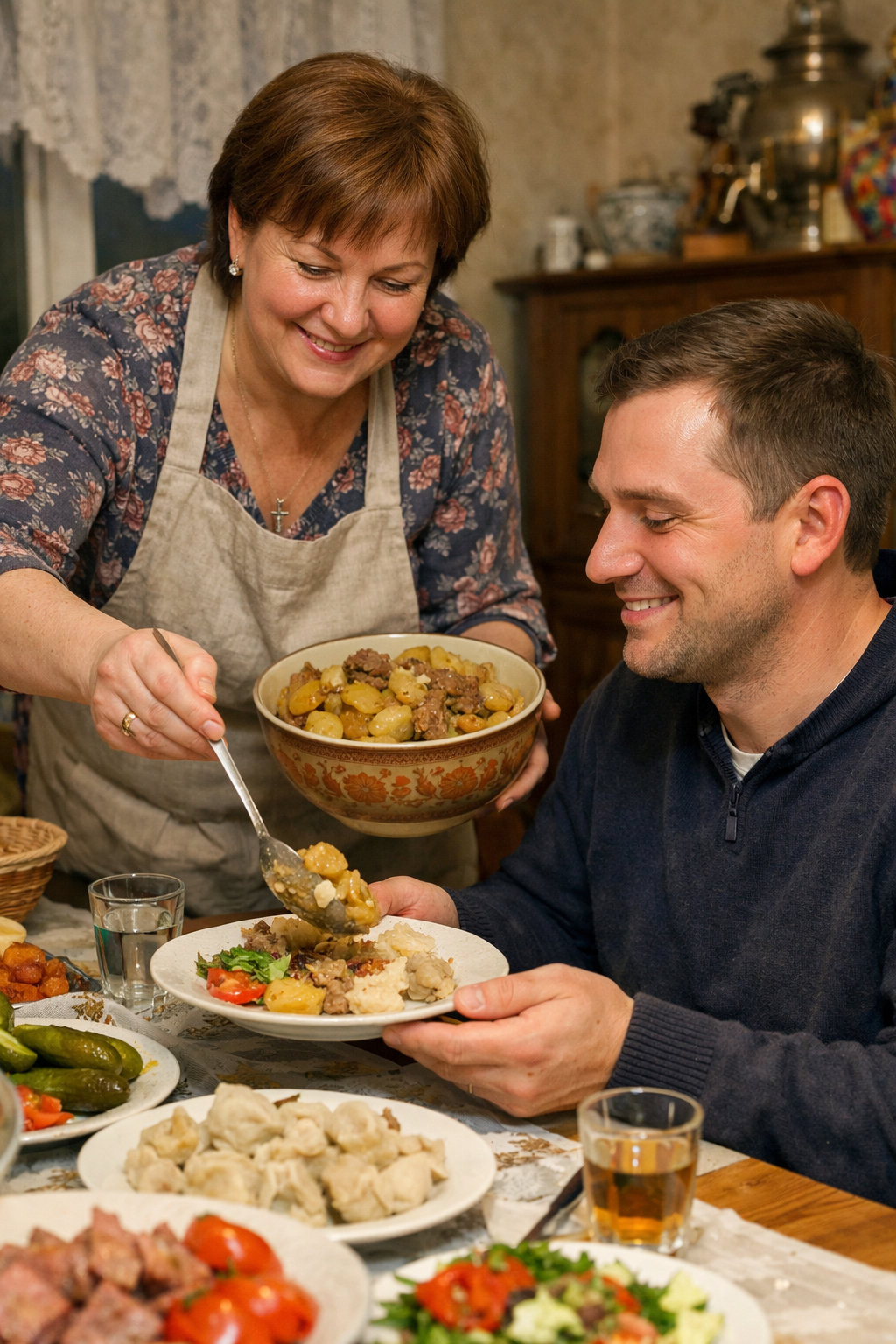
There is a particular moment that many foreigners experience in Russia—somewhere between the second bowl of soup and the third slice of cake—when they realize that the warm, smiling person across the table is not going to accept “no, thank you” as a final answer, and that what seemed like a polite gesture has quietly turned into a cultural ritual where generosity, affection, and identity are all expressed through one simple question: “Maybe just a little more?”
At first, it can feel overwhelming.
You say you’re full.
Your host smiles and gives you more anyway.
You insist you really can’t eat another bite.
Another dish appears.
For many visitors, this experience is both charming and confusing. Why is it so hard to refuse food in Russia? Why do hosts keep insisting, even when guests clearly say they’re full? And why does it sometimes feel like refusing food is almost… rude?
The answer lies deep within Russian culture, history, and psychology. Food in Russia is not just nourishment. It is hospitality, emotional expression, social glue, and even a quiet form of survival wisdom passed down through generations.
To understand why Russians always offer you more food, you have to look beyond the table.
Food as a Language of Care
In many cultures, people express kindness through words. In Russia, kindness is often expressed through actions, and food is one of the most important.
If a Russian cares about you, they will:
Feed you.
Ask if you’ve eaten.
Offer tea.
Bring out snacks.
Insist you try something.
The phrase “Ты голодный?” (“Are you hungry?”) is not just a practical question. It’s a way of asking:
Are you comfortable?
Do you feel welcome?
Are you being taken care of?
Offering food is a deeply ingrained way to show affection and responsibility toward another person.
The Historical Roots of Russian Hospitality
To understand Russian generosity at the table, you need to look at the country’s history.
For centuries, life in Russia was shaped by:
Long, harsh winters.
Agricultural uncertainty.
War and political upheaval.
Periods of famine and food shortages.
In such conditions, food was not something to be taken for granted. Having enough to eat was a sign of:
Stability
Safety
Prosperity
Sharing food became a moral and social duty.
If someone came to your home:
You fed them.
Even if you had little.
Especially if you had little.
Hospitality was not about luxury. It was about human dignity.
This mindset survived through:
The tsarist era
The Soviet period
The economic hardships of the 1990s
Even today, many Russians carry an inherited memory—sometimes unconscious—that food equals security.
So when they offer you more, they’re not just being polite. They’re expressing something much deeper.
The Soviet Legacy: When Food Meant Survival
During the Soviet era, food was often scarce or difficult to obtain.
People:
Stood in long lines.
Relied on rationing.
Used personal connections to find certain products.
Preserved and stored food for winter.
When someone had access to good food, it was a source of pride and joy.
And when guests came over, it was important to show:
That your household was doing well.
That you could offer abundance.
That your guests were valued.
A table full of food became a symbol of:
Success
Stability
Generosity
Respect
Even today, many Russian hosts feel uncomfortable if the table looks too empty.
The Cultural Rule: A Good Host Feeds You Well
In Russian culture, being a good host is very important.
A good host:
Prepares more food than necessary.
Encourages guests to eat.
Keeps offering seconds (and thirds).
Feels personally responsible for guests’ comfort.
If a guest leaves the table hungry, it reflects badly on the host.
That’s why you may hear phrases like:
“Ешь, ешь!” – “Eat, eat!”
“Попробуй ещё.” – “Try some more.”
“Ты почти ничего не ел.” – “You barely ate anything.”
Even if you feel like you’ve eaten a full meal, your host may still feel that they haven’t fulfilled their duty unless you’ve tried everything on the table.
Refusing Food Can Feel Awkward
In some cultures, declining food is completely normal and even expected. In Russia, it can create a slightly uncomfortable moment.
Why?
Because when someone offers you food, they are offering:
Care
Hospitality
Effort
Emotion
Refusing it can feel like rejecting those things.
This doesn’t mean you must eat endlessly. But it does mean that how you refuse matters.
For example:
Too direct:
“No, I don’t want it.”
More natural:
“Спасибо, очень вкусно, но я уже сыт.”
(“Thank you, it’s very tasty, but I’m already full.”)
Or:
“Я обязательно попробую в следующий раз.”
(“I’ll definitely try it next time.”)
This shows appreciation, even if you decline.
The Ritual of Insisting
One of the most distinctive aspects of Russian hospitality is the ritual of insisting.
A typical exchange might go like this:
Host: “Have some more salad.”
Guest: “No, thank you.”
Host: “Just a little.”
Guest: “I’m really full.”
Host: “Just one spoon.”
Guest: “Okay, a little.”
This back-and-forth is not conflict. It’s a social dance.
The host shows care by insisting.
The guest shows modesty by refusing.
Eventually, a balance is reached.
This ritual creates warmth and connection.
The Importance of the Kitchen Table
In Russia, the kitchen is often the emotional center of the home.
Even in small apartments, the kitchen is where:
Friends gather.
Conversations happen.
Tea is served.
Secrets are shared.
Life is discussed late into the night.
The phrase “сидеть на кухне” (“to sit in the kitchen”) often implies deep, personal conversation.
And food is always part of that atmosphere.
A Russian kitchen table is rarely empty. There will be:
Bread
Tea
Jam
Candy
Leftovers
Something homemade
Offering food is part of keeping that space alive.
Food as a Symbol of Abundance
Another reason Russians offer so much food is symbolic.
A full table represents:
Generosity
Success
Warmth
Respect for the guest
In many Russian households, especially during holidays or celebrations, the table is covered with:
Multiple salads
Hot dishes
Bread
Pickles
Desserts
Fruit
Drinks
Even if only a few people are present.
The goal is not efficiency. The goal is abundance.
Why Tea Always Comes with Something Sweet
If you visit a Russian home and are offered tea, it rarely comes alone.
You’ll usually get:
Cookies
Candy
Cake
Jam
Chocolate
Pastries
This is because tea is not just a drink. It’s a social ritual.
Tea time is:
A pause in the day.
A moment to talk.
A symbol of comfort.
Serving tea without something sweet can feel incomplete.
Generosity as a Moral Value
Russian culture often values generosity more than efficiency or practicality.
A person who:
Shares food
Feeds guests
Gives the best piece to someone else
Is seen as:
Kind
Noble
Respectable
A person who is:
Stingy
Unwilling to share
Careful about portions
May be viewed negatively.
This moral dimension explains why offering more food is not just a habit—it’s a virtue.
How to Respond Politely
If you’re in a Russian home and feel full, here are some polite strategies.
1. Accept at Least a Little
Trying everything on the table is often appreciated.
2. Compliment the Food
Say things like:
Очень вкусно! – Very tasty!
Спасибо, мне очень понравилось. – Thank you, I really liked it.
3. Refuse Gently
Instead of a blunt “no,” say:
Я уже сыт, но было очень вкусно.
(I’m full, but it was very tasty.)
4. Use Humor
Sometimes a light, joking refusal works well.
The Emotional Meaning Behind the Extra Portion
When a Russian host gives you more food, they are often saying something unspoken:
You are welcome here.
You are part of this home.
I want you to feel comfortable.
I care about your well-being.
Food becomes a form of emotional communication.
And in a culture that sometimes values actions more than words, that extra spoonful of salad or second bowl of soup can carry a lot of meaning.
Why Many Foreigners Come to Love It
At first, the insistence on more food can feel overwhelming.
But many foreigners who spend time in Russia come to appreciate it.
They notice that:
Meals feel warmer and more personal.
Hosts are genuinely attentive.
Conversations at the table are deeper.
Hospitality feels sincere.
What once felt excessive starts to feel comforting.
FAQs About Russian Food Hospitality
Why do Russians keep offering food even when I say I’m full?
Because offering food is a way to show care and hospitality. Your host wants to make sure you feel comfortable and welcome.
Is it rude to refuse food in Russia?
It’s not rude if you refuse politely and show appreciation. A gentle explanation works better than a blunt refusal.
Do I have to try everything on the table?
You don’t have to, but it’s usually appreciated if you taste at least a little of each dish.
Why is the table always so full?
A full table symbolizes generosity, success, and respect for the guest.
Why does tea always come with sweets?
Tea is a social ritual, and something sweet is considered part of the experience.
Is this tradition still common among young Russians?
Yes, although it may be less formal in big cities. The basic idea of feeding guests generously remains strong.
What should I say if I really can’t eat more?
You can say:
Спасибо, было очень вкусно, но я уже сыт.
(Thank you, it was very tasty, but I’m already full.)
Learn Russian Culture Through the Language
Understanding why Russians always offer more food is just one example of how language and culture are deeply connected. When you learn Russian, you’re not just memorizing vocabulary—you’re learning how people think, interact, and express care.
At Polyglottist Language Academy, we teach Russian in a way that brings the culture to life. Our classes combine practical conversation, grammar, and cultural insights so you can understand not just the words, but the people behind them.
We offer:
Complete Beginner Russian
Low and High Beginner Russian
Intermediate and Advanced Russian
Private and small-group lessons
Online and in-person options
Whether you want to travel, connect with Russian-speaking friends, or explore one of the world’s richest cultures, we’re here to help.
Sign up for a Russian class today and start your journey into the Russian language and culture.
Explore More Articles on Russian Language and Culture
If you enjoyed this article, you may also like: