
Why Russians Keep Food on the Balcony (And Why It Makes Perfect Sense)
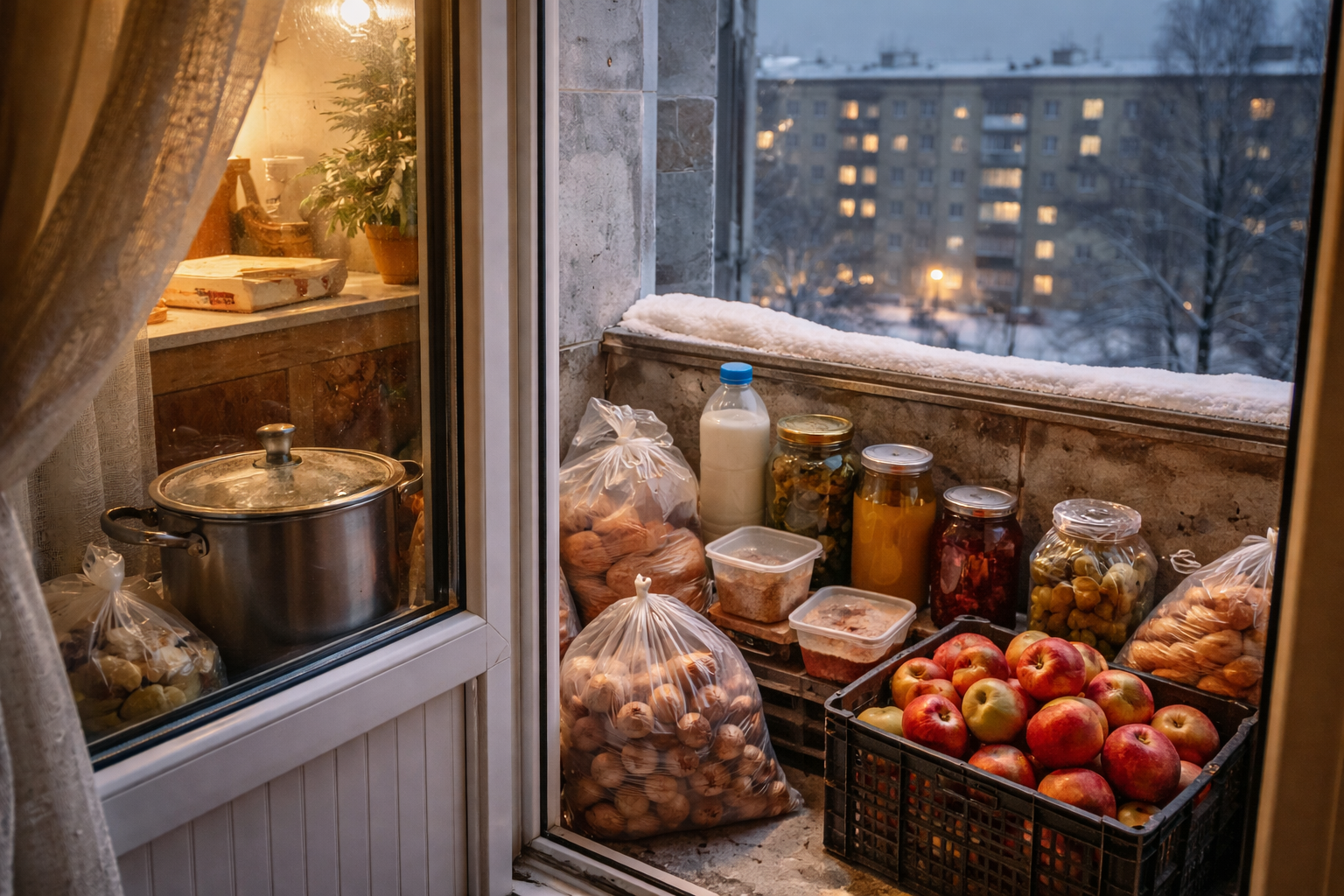
A Russian balcony is never just a balcony, because in a country where winter can last half the year and apartments have always demanded a certain level of creative survival, that narrow strip of concrete between the kitchen and the outside world becomes a second refrigerator, a pantry, a temporary storage unit, and sometimes even a philosophical statement about how Russians treat space, food, and life itself.
If you’re a foreigner, you might step into a Russian apartment, glance through the glass door, and do a double-take—because there, on the balcony, you see a box of apples, a bag of potatoes, a giant pot of soup, maybe some milk, maybe a plastic container of salad, and in the colder months even raw meat wrapped in newspaper like it’s being prepared for some kind of secret mission.
And nobody treats this like it’s unusual.
This isn’t a quirky trend, or a “Russian TikTok thing,” or a weird personal habit. It’s not even something Russians really think about.
It’s just… logical.
The balcony is cold.
Cold preserves food.
The fridge is small.
The kitchen is smaller.
Therefore: balcony = fridge.
Welcome to one of the most wonderfully practical and culturally revealing habits in Russian daily life—keeping food on the balcony.
At first, it’s funny. Then it becomes fascinating. And eventually, if you spend enough time in Russia, it becomes impossible to imagine living without it.
Because the “balcony fridge” isn’t just about storage. It’s about climate. It’s about architecture. It’s about the Soviet experience. It’s about the Russian relationship with abundance, scarcity, planning, and hospitality. It’s about how people adapt without complaining, create comfort out of limitations, and treat food as something deeply serious—almost sacred—while still laughing at life when it gets absurd.
So let’s talk about the balcony.
Let’s talk about the soup outside.
And let’s talk about what it all reveals about Russia.
The Balcony as a Second Refrigerator
If you’ve grown up in places with large kitchens and modern appliances, the idea of leaving food outside might feel reckless. But the Russian balcony often functions as a perfectly stable cold storage environment for months at a time.
In winter, especially in cities like Moscow, St. Petersburg, Novosibirsk, Yekaterinburg, or anywhere deep inland, balcony temperatures naturally hover at the ideal range for preservation:
cold enough to keep food safe
not necessarily cold enough to freeze (depending on the day)
naturally ventilated
separated from the warmth of the apartment
It’s basically a built-in walk-in refrigerator… if you accept that it comes with snow.
And Russians do accept that.
“But Isn’t That Unsafe?” The Russian Approach to Risk
There’s a certain Western mindset that says: food belongs inside sealed environments, controlled to the degree of laboratory science. And of course, modern food safety standards exist for a reason.
But Russian food culture was shaped by a different reality—one where people relied on their senses, experience, and community knowledge far more than labels and apps.
Russians will often judge food by:
smell
texture
instinct
family wisdom
whether it “still tastes normal”
And in winter, a balcony simply feels safer than a warm kitchen counter.
Cold air is not danger in this case—it’s protection.
The Real Reason: Russian Kitchens Are Tiny
The most obvious reason Russians store food on balconies is simple:
There is no space.
Many Soviet-era apartments—especially in Khrushchyovkas (хрущёвки)—were built quickly and cheaply, with efficiency as the priority. Kitchens were often 5–7 square meters. That’s not a kitchen; that’s a hallway with a stove.
Even in newer apartments, kitchen space tends to be limited compared to American standards.
So where do you put:
a 10-kilo bag of potatoes?
jars of pickles?
the watermelon you impulse-bought at the market?
the enormous pot of borscht you cooked “for a few days”?
You put it on the balcony.
Because if you put it inside, you won’t be able to breathe.
The Soviet Legacy: When Stockpiling Was Smart
To understand the balcony fridge, you have to understand the Soviet relationship with food.
For much of the 20th century, food supply was unpredictable. Even when there was enough food overall, access wasn’t guaranteed. You might walk into a store and find nothing, and then next week you might find a miracle: butter. Sausage. Oranges.
So people learned to buy in bulk when something appeared.
That survival instinct didn’t disappear after the USSR.
Even today, many Russians still carry the mental rhythm of:
“If it’s available now, get it now.”
And if you’re getting it now, you need a place to store it.
Enter: balcony.
Russian Winters Make This Habit Possible
Climate shapes culture more than people realize.
A Mediterranean balcony is for plants, coffee, and sunsets.
A Russian balcony is for:
frozen pelmeni
extra meat
apples
fermented cabbage
five jars of something mysterious
Because in Russia, winter provides free refrigeration. For months.
It’s nature cooperating with the household budget.
And the Russian mind loves this kind of cooperation.
The “Big Pot” Lifestyle
Russians don’t just cook. They cook like the apocalypse is coming, even on a Wednesday.
A normal dinner in many Russian homes is not “two servings.” It’s:
soup for three days
a salad that can feed a volleyball team
buckwheat “just in case”
tea with sweets until someone passes out
Because food isn’t merely fuel.
Food is:
care
hospitality
control
love
a way to manage anxiety
a way to protect the future
So when a Russian cooks, there’s always extra. And extra needs storage.
The balcony becomes a staging zone for abundance.
Balcony Food Is Also Social
If you’re visiting a Russian family and they casually say:
“Возьми на балконе…”
(“Take it from the balcony…”)
They might mean:
the cake
the salad
the drinks
the watermelon
the leftovers they want you to take home
The balcony becomes a shared storage space in the household, almost like a small communal pantry.
It’s part of the domestic map.
The Russian Balcony: Not Just Food, But Life
In Russia, the balcony often contains everything.
Not just food—but:
winter boots
old furniture
boxes of “maybe useful later”
empty glass jars
tools
an ancient bicycle
a rolled-up carpet
17 plastic bags inside one plastic bag
So why not food too?
The Russian balcony is the physical manifestation of a mindset:
Nothing is wasted. Everything might be needed.
The Jar Culture: Pickles, Jam, and the Power of Preservation
If the balcony is the fridge, the pantry, and the storage unit—then the jars are the Russian soul.
Russians are famous for:
pickled cucumbers (солёные огурцы)
pickled tomatoes
mushrooms
jam (варенье)
компот
marinated cabbage
homemade sauces
These jars are often stored in the pantry, under the bed, in the closet, or yes—on the balcony.
Why?
Because preservation is a culture.
It’s a way of saying:
“I have prepared for the future.”
In the West, Fridges Are Big. In Russia, Winters Are Bigger.
In many Western countries, the kitchen evolved around appliances.
In Russia, domestic life evolved around nature and necessity.
A Russian doesn’t always assume the system will support them. So they support themselves.
And storing food outside is a small daily act of independence.
It’s also economical.
Why waste electricity on refrigeration when the air outside is doing it for free?
The Balcony Refrigerator Has Rules
This isn’t chaos. Russians have an internal system.
Most Russians know:
✅ what can go outside
✅ what should not
✅ what needs to be protected from freezing
✅ what should stay inside
Typically safe on the balcony (winter):
sealed soup in a pot
cheese (if not too freezing)
vegetables
fruit (apples, pears)
butter
drinks
packaged food
Not safe or risky:
eggs (they can freeze and crack)
delicate dairy
anything open/unsealed
food that can attract animals if the balcony is open
anything that can freeze into a solid brick
Some families even cover items with towels like they’re tucking them in for the night.
The Emotional Logic: Warm Home, Cold Balcony
One of the most Russian things is this contrast:
Inside the apartment: tropical heat
Outside: arctic reality
Russian heating systems often produce intense indoor warmth. So the balcony becomes the perfect “temperature balance zone.”
It’s neither fully outside nor fully inside.
It’s the cold room you didn’t know you needed.
Why This Habit Shocks Foreigners
Foreigners tend to react in one of two ways:
“That’s genius!”
“That’s insane!”
But here’s the thing: Russians often think Westerners are insane for other reasons, like:
putting ice in every drink
walking around without hats in winter
trusting that stores will always have everything
wasting food instead of preserving it
storing nothing “just in case”
The cultural gap goes both ways.
Balcony Food and Russian Hospitality
There’s a reason Russian hospitality feels intense.
A Russian host doesn’t want you to be “fine.”
They want you to be overfed and protected.
If food is stored on the balcony, it’s often because:
there is too much food
the host prepared too much food
and now they will insist you take it home
Balcony storage supports generosity.
It enables the Russian host’s greatest dream:
feeding you beyond your capacity.
The Language Lesson: Words You’ll Hear
If you want to sound like you’ve actually lived in Russia, these phrases will show up constantly:
На балконе холодно — It’s cold on the balcony
Поставь на балкон — Put it on the balcony
Там как в холодильнике — It’s like a fridge there
Суп на балконе стоит — The soup is sitting on the balcony
Убери на балкон — Put it away on the balcony
Замёрзнет — It’ll freeze
Не замёрзнет — It won’t freeze
Проверь, не испортилось — Check it didn’t go bad
Even the casual verb “стоит” (sits/stands) is used with food like it’s a physical object quietly existing in a location, living its own life.
The Balcony as a Symbol of Russian Practical Genius
Russia is full of tiny innovations that come from constraints.
When systems are imperfect, people get creative.
The balcony fridge is one of those solutions that feels so natural it becomes invisible—until you notice it and realize:
This is a culture shaped by adaptation.
A Funny Truth: Balcony Food Creates Drama Too
Of course, it’s not always perfect.
There are classic Russian balcony food catastrophes:
soup freezing solid in a pot
a watermelon exploding from freezing
milk becoming strange and lumpy
forgetting food for two weeks
someone accidentally leaving the balcony door open and causing… yes… сквозняк
Sometimes, Russian domestic life feels like a sitcom written by the weather.
Seasonal Balcony Life: Winter vs Summer
Winter:
Balcony = fridge paradise
Food stays fresh, drinks stay cold, everything works.
Summer:
Balcony = danger zone
Some Russians still store potatoes or onions there, but anything perishable has to move inside.
In summer, the balcony goes back to being:
storage
plants
drying clothes
smoking corner
“we should clean this someday” zone
What This Habit Says About Russian Psychology
This is where things get interesting.
Keeping food on the balcony reflects deeper cultural patterns:
1) Respect for the harsh environment
Russians don’t pretend nature is gentle. They adapt to it.
2) Practical optimism
Life is hard, but you can still solve things creatively.
3) Preparedness mindset
The future is uncertain. Better have запас (reserves).
4) Food as security
A full pantry is emotional stability.
5) Frugality without shame
Saving resources isn’t “cheap,” it’s intelligent.
The Balcony Is a Russian Superpower You Learn To Love
Eventually, foreigners living in Russia start doing it too.
At first, it’s ironic.
Then it’s convenient.
Then it’s essential.
You start thinking:
“Why am I wasting fridge space on this?”
“It’s literally colder outside.”
“This is brilliant.”
And that’s the moment you realize:
You didn’t just copy a habit.
You absorbed a piece of cultural logic.
That’s what living in a language does to you.
FAQs: Why Russians Keep Food on the Balcony
1) Is it really common in Russia?
Yes—especially in winter and especially in apartment buildings.
2) What foods do Russians store on balconies?
Soups, vegetables, fruits, drinks, leftovers, bulk items, sometimes meat, sometimes dairy (carefully).
3) Is it safe?
In winter, it can be safe if food is sealed, temperatures are stable, and freezing is managed. In warmer weather, it becomes risky.
4) Why don’t they just use a bigger fridge?
Many apartments have small kitchens and smaller fridges. Also, balcony storage costs nothing.
5) Do people do this in Moscow and St. Petersburg?
Absolutely. It’s common in major cities and smaller towns alike.
6) Is it a Soviet thing?
It’s strongly connected to Soviet apartment design and food supply history, but it’s still a modern habit too.
7) Do Russians in other countries do this?
Many do—especially in colder climates. Some adapt by using garages or window ledges.
8) What is the Russian word for balcony?
балкон (balkón)
9) How do Russians say “Put it on the balcony”?
Поставь на балкон. (Postav’ na balkón.)
10) What’s the funniest thing stored on a balcony?
Besides food? Old skis, a broken chair, empty jars, and a mysterious bag nobody remembers owning.
Learn Russian Through Real Culture (Not Just Textbooks)
If you love these little cultural details—the balcony fridge, the obsession with drafts, the intensity of hospitality—then you’re already learning Russian the smart way: through real life.
At Polyglottist Language Academy, we teach Russian with culture built into every lesson. You won’t just memorize grammar charts—you’ll learn how Russians actually speak, what they mean, and how daily life shapes the language.
✅ Small group Russian classes
✅ Individual Russian lessons
✅ Online and in-person options
✅ Real conversation + real cultural insight
👉 Sign up for Russian classes with Polyglottist Language Academy and start learning Russian in a way that feels alive, practical, and unforgettable.
You Might Also Enjoy These Articles (8 Links)
If you liked this post, check out our other Russian language + culture articles:
How Russians Really Dress Indoors (Layering, Home Clothes, Slippers Culture)
Walking In Saint Petersburg In December: A Winter City That Has Adapted
My First Morning In St. Petersburg: Snow, Silence, And The Smell Of Fresh Bread
MY FIRST 24 HOURS IN ST. PETERSBURG: NEVSKY PROSPECT, TOO MUCH TEA, AND RUSSIAN DONUT “PISHKA”