
Street Russian vs. Textbook Russian: What You’ll Actually Hear
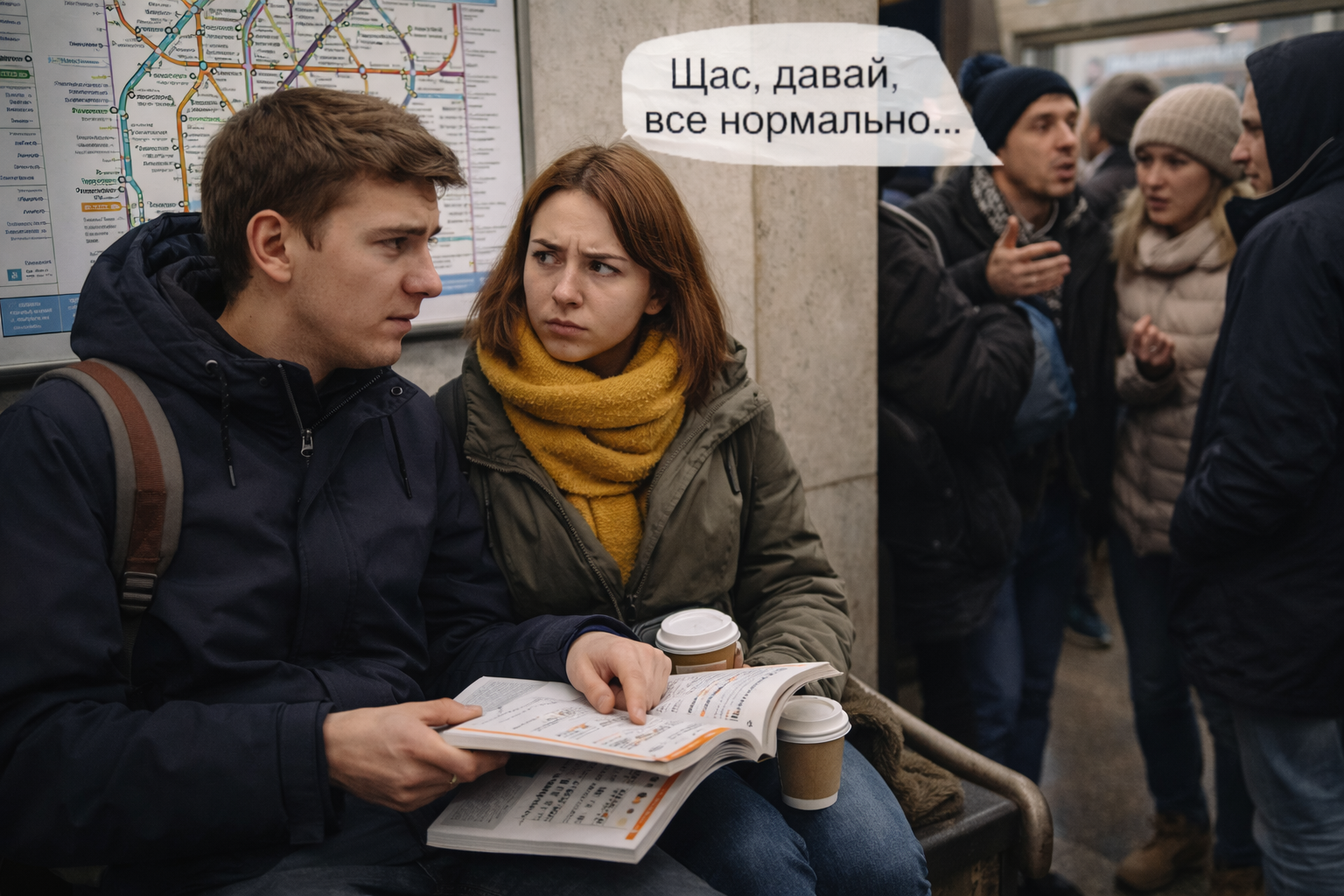
The first time you realize that your carefully memorized Russian phrase—polite, grammatically perfect, and delivered with the confidence of someone who survived twelve chapters of a textbook—has absolutely nothing to do with what people are actually saying around you on the street, it feels like stepping out of a museum and into a busy kitchen where everyone is talking at once, half the words are disappearing, and the meaning lives in tone, rhythm, and implication more than in the sentences themselves.
This is one of the most confusing and most thrilling moments in language learning.
Because it’s not just that Russians speak fast. It’s not just that they use slang. It’s that real spoken Russian obeys a different logic than the Russian you learn in many classrooms. It’s compressed, emotional, sarcastic, and full of invisible particles that don’t translate neatly into English. It’s a language built for speed, understatement, and attitude.
If you’re learning Russian, you’ve probably experienced at least one of these situations:
You understand every word on the page, but you understand nothing in the café.
You know how to conjugate verbs, but you don’t know how to sound like a human being.
You say “Здравствуйте” and someone replies with something that sounds like “Здрасте” and disappears into the metro.
You try to buy coffee and the barista hits you with: “Вам как обычно?” (As usual?) even though you’ve never been there in your life.
Someone says “Щас” and you think it means “now”… and then they come back 20 minutes later.
You ask “How are you?” and instead of “I’m fine,” you get a philosophical shrug: “Нормально…”
Textbook Russian is real Russian, yes. It’s correct Russian. It’s the foundation.
But street Russian—the Russian you actually hear in everyday life—is the language in motion. It’s messy and alive. It’s full of shortcuts, expressions, and cultural assumptions.
And once you start understanding it, Russian becomes less like a difficult academic subject and more like what it actually is: a living voice.
This article will show you the gap between textbook Russian vs. street Russian, and more importantly, it will show you how to bridge it—so the Russian you speak isn’t just correct, but believable.
Why Textbook Russian Feels “Too Clean”
Most textbooks teach a version of Russian that is:
✅ polite
✅ complete sentences
✅ grammatically symmetrical
✅ perfect pronunciation
✅ vocabulary that is useful but often overly formal
✅ structured dialogues that don’t reflect real timing
For example, here’s textbook Russian:
— Здравствуйте. Как поживаете?
Hello. How are you doing?
— Спасибо, хорошо. А вы?
Thanks, I’m well. And you?
This is correct. But in real life, this exchange feels almost theatrical—like two diplomats greeting each other at a conference.
Street Russian, meanwhile, is about speed and efficiency.
Real Russians rarely speak in long complete sentences unless they are:
giving a speech
telling a story
arguing passionately
being deliberately formal
Most of the time, Russians communicate in fragments—because context does a lot of the work.
Textbook Greeting vs. Real Greeting
Textbook:
Здравствуйте!
Hello.
Street:
Привет! (Hi)
Здрасьте / Здрасте (fast “hello,” semi-formal)
Здорово (casual, “hey”)
О, привет-привет! (friendly + warm)
Ну привет. (loaded; can mean “well, hello there…”)
Textbook:
Как дела?
How are things?
Street:
Как ты? / Как ты сам? (How are you?)
Ну как оно? (So how’s it going?)
Чё как? (super casual: “what’s up?”)
Как жизнь? (how’s life?)
Ну что? (the classic: “so?” / “well?”)
Textbook response:
Хорошо. Спасибо.
Good, thank you.
Street responses:
Нормально. (normal = fine)
Да так… (so-so)
Пойдёт. (it’ll do)
Живём. (“we’re alive”)
Да ничего. (“not bad” but vague)
Более-менее. (more or less)
Отлично! (great — but said with tone, sometimes ironic)
Cultural note: Russians often avoid overly enthusiastic positivity unless it’s truly sincere. “I’m great!” every day can sound fake.
The Biggest Shock: Russians Drop Words Constantly
Textbooks teach:
Я хочу заказать кофе.
I want to order coffee.
Street Russian:
Мне кофе.
Coffee for me.
Or even:
Кофе, пожалуйста.
Coffee, please.
Or in a hurry:
Кофе. (just “coffee.”)
Russian is highly context-based. In many situations, the sentence is optional.
Textbook:
Я не понимаю. Повторите, пожалуйста.
I don’t understand. Repeat, please.
Street:
Не понял. (didn’t get it)
Чего? (what?)
Повтори. (repeat)
Ещё раз. (once more)
А? (huh?)
The “Invisible Words” That Control Everything
Street Russian contains tiny words that textbooks often ignore, but they’re everywhere.
Ну
This one word can mean:
okay
so
well
come on
here we go
mild annoyance
transition to a new topic
Examples:
Ну что? — So? / Well?
Ну да. — Yeah, sure (can be sarcastic)
Ну ладно. — Alright then
Ну понятно. — Well, I see (sometimes “sure, whatever”)
Вот
This word is like pointing with language:
Вот так. — Like that
Вот и всё. — That’s it
Вот именно. — Exactly
Вот тебе и… — And there you have it…
Типа
Means:
like
kind of
sort of
basically
But also functions as a filler word.
Я типа не понял. — I kind of didn’t get it.
Короче
Means:
in short
basically
But often introduces a long story anyway.
Короче, я пришёл… — Long story short, I came…
These particles don’t translate directly—but if you don’t understand them, you miss the emotional structure of speech.
“Щас” Does Not Mean “Now”
Textbook:
Сейчас = now.
Street:
Щас = “now-ish” (but not necessarily now)
Щас, щас.
“Hold on.” / “Yeah, one sec.”
Sometimes “one sec” means 20 minutes.
It’s not lying. It’s a cultural relationship with time.
Russians Use Shortened Forms All the Time
Textbooks give you the full, proper words. Real life gives you shortened versions.
Common reductions:
сейчас → щас
здравствуйте → здрасте / здрасьте
пожалуйста → пажалста (informal pronunciation)
что → чё
ничего себе → ничё себе
тебе → те (very casual speech)
меня → мя (in fast casual speech)
Example:
Textbook:
Что ты делаешь? — What are you doing?
Street:
Чё делаешь?
or even
Ты чё? (What’s wrong with you? / Are you serious?)
“Ты чё?”: A Tiny Phrase With Many Meanings
This is one of the most street Russian expressions ever.
Ты чё? can mean:
what are you doing?
are you okay?
are you serious?
what’s your problem?
why would you do that?
Tone decides everything.
Textbook Politeness vs. Russian Real Politeness
Textbooks often teach politeness as:
longer sentences
more “please”
extra formal phrasing
But Russian politeness is usually about:
tone
not being dramatic
not demanding
acknowledging the other person
So instead of:
Не могли бы вы, пожалуйста, помочь мне?
Could you please help me?
Russians often say:
Скажите, пожалуйста… (Tell me, please…)
Извините… (Excuse me…)
Можно…? (Can I…?)
Подскажите… (Can you tell me / advise me…)
These are the real-life polite tools.
The Power of “Можно…?”
This single word unlocks most daily interactions.
Можно кофе?
Can I have coffee?
Можно сюда?
Can I sit here?
Можно спросить?
Can I ask?
Можно оплатить картой?
Can I pay by card?
If you master “можно,” you will survive in Russia.
“Давайте” Is Everywhere (And Not Always “Let’s”)
Textbook:
Давайте = “let’s.”
Street:
It can mean:
let’s
okay
go ahead
give me
deal
come on
Examples:
Давайте. = okay / sure
Давайте сюда паспорт. = give me your passport
Давайте быстрее. = hurry up
Давайте, удачи! = alright, good luck!
Russian “Yes” Isn’t Always Yes
Textbook:
Да = yes.
Street:
Да can also mean:
I’m listening
okay, continue
yeah right (sarcastic)
“yeah… sure…” (doubtful)
And sometimes Russians respond with:
Ну да. which can mean:
yes
“obviously”
“sure, whatever”
Tone matters.
Street Russian is Full of Understatement
One of the biggest cultural differences is how Russians express intensity.
Textbook language tends to be balanced and neutral.
Street Russian uses understatement like a weapon.
Нормально can mean:
fine
good
“I’m surviving”
“I’m not okay but I won’t say it”
Ничего can mean:
not bad
it’s okay
decent
actually great (sometimes)
Russians often avoid overselling emotion unless they trust you.
Real Russian Listening: What You’ll Hear in Public
Let’s look at common real-life environments and what Russians actually say.
1) In a café
Textbook:
Я хотел бы заказать капучино, пожалуйста.
I would like to order a cappuccino, please.
Street Russian:
Мне капучино.
Cappuccino for me.
С собой или здесь?
To-go or here?
Здесь.
Here.
Сахар?
Sugar?
Не надо.
No.
Оплата картой?
Card?
Да.
Yeah.
Sometimes it’s almost like telegrams. Efficient. No fluff.
2) In a store
Textbook:
Сколько это стоит?
How much does it cost?
Street:
Сколько?
How much?
Почём? (more market-style)
How much?
А это?
And this?
Дорого.
Expensive.
Скидка есть?
Any discount?
Пакет нужен?
Need a bag?
3) In a taxi / Yandex Go
Textbook:
Вы можете отвезти меня по этому адресу?
Can you take me to this address?
Street:
Мне вот сюда.
Here.
Тут остановите.
Stop here.
Поехали.
Let’s go.
Пробки.
Traffic.
Нормально. Доедем.
It’s fine, we’ll get there.
4) On the street (asking directions)
Textbook:
Извините, пожалуйста, как пройти к метро?
Excuse me, how do I get to the metro?
Street:
Извините, метро где?
Excuse me, where’s the metro?
You’ll get:
Туда. (there)
Прямо и налево. (straight then left)
Вон там. (over there)
Пять минут. (five minutes)
Russians don’t over-explain. They assume you’ll figure it out.
The “Russian shrug vocabulary”
Russian has entire clusters of phrases that communicate “whatever” with nuance.
Да ладно.
Oh come on / no way / it’s fine
Да ну.
Nah / really? / I don’t believe it
Ну такое…
Meh / kind of so-so
Да как-то…
Sort of / not really / awkward
These phrases are the emotional bloodstream of street Russian.
Slang vs. Normal Spoken Russian
Street Russian isn’t only slang.
A lot of it is simply informal spoken Russian, which is not the same thing as trendy youth slang.
Some examples of normal spoken Russian:
реально = really / actually
вообще = at all / in general / basically
просто = just
ну, типа = well, like
слушай = listen (used to start a thought)
кажется = it seems
вроде = kind of / like
These are safe words, not “cool slang.” You can use them without sounding weird.
The Problem With Literal Translations
Textbook learners often try to speak Russian by translating English patterns.
Example:
English: “I’m good.”
Learner says: Я хороший.
This means: “I’m a good person.” (like morally good)
Natural Russian:
Всё нормально.
Я в порядке.
Норм. (very casual)
Or English: “I miss you.”
Textbook: Я скучаю по тебе. (correct)
Street Russian might also be:
Скучаю. (I miss you — implied “you”)
Or:
Без тебя скучно. (Without you it’s boring/lonely)
Street Russian depends on context.
Swearing: The Elephant in the Room
You will hear swearing in Russia. Sometimes loudly. Sometimes casually. Sometimes as punctuation.
But here’s the key:
Russian swearing (мат) is culturally powerful. It is not the same as English casual swearing.
Using it incorrectly can:
sound aggressive
sound low-class
shock people more than you expect
So your goal as a learner isn’t to speak мат early.
Your goal is to recognize it so you’re not lost.
Understanding is power. Speaking it is optional.
The Hidden Grammar of Speech
Street Russian uses real grammar… but often not the grammar you expect.
Example: dropping subjects
Textbook:
Я хочу… (I want…)
Street:
Хочу… (Want…)
Subject is implied.
Example: using “у меня” instead of “I have”
Textbook teaches this, but street Russian relies on it constantly.
У меня есть. — I have it.
У меня нет. — I don’t have it.
У тебя как? — How about you?
Example: short answers
Instead of full sentences, Russians answer with:
Да.
Нет.
Конечно.
Не знаю.
Наверное.
Возможно.
Скорее всего.
Fast. Efficient. Minimal.
How to Actually Learn Street Russian (Without Living in Russia)
Here’s the good news: you don’t need to move to Russia to learn real spoken Russian.
You need to train differently.
1) Listen to real dialogue, not scripted textbook audio
Use:
vlogs
street interviews
podcasts
TV shows with everyday speech
casual YouTube channels
2) Learn chunks, not isolated words
Instead of learning “делать = to do,” learn:
Что делаешь?
Я щас.
Ну всё, пока.
Давай, увидимся.
This is how fluency forms.
3) Copy rhythm, not perfection
Russians will forgive mistakes if your rhythm feels natural.
4) Practice micro-reactions
Street Russian is full of reactions:
Да ладно!
Офигеть. (wow — informal)
Ничего себе.
Серьёзно?
Капец. (mess / wow)
5) Learn polite informal Russian
You want friendly and natural, not rude.
Your First “Street Russian Survival Kit”
Here are 25 phrases you will actually use:
Привет! — Hi
Пока! — Bye
Спасибо! — Thanks
Пожалуйста. — You’re welcome / please
Извините. — Excuse me
Можно? — Can I?
Мне, пожалуйста… — For me, please…
Я не понял(а). — I didn’t understand
Повторите, пожалуйста. — Repeat please
Ещё раз. — Once again
Где…? — Where is…?
Сколько? — How much?
Вот. — Here you go
Вот так. — Like this
Ну да. — Yeah / sure
Ну ладно. — Okay then
Давай. — Okay / let’s go
Щас. — One sec
Нормально. — Fine
Пойдёт. — It’ll do
Да так… — So-so
Ясно. — Got it
Понятно. — I understand
Серьёзно? — Seriously?
Не надо. — No need
If you can use these naturally, you’ll feel a massive shift in confidence.
Why This Matters More Than Grammar
Yes, grammar is important. Russian cases matter.
But if you only know textbook Russian, you’ll have a strange experience:
You’ll sound polite… but distant.
Correct… but stiff.
Intelligent… but foreign in a way you can’t control.
Street Russian isn’t about being cool.
It’s about being real.
And once you start speaking more naturally, Russians will respond differently. Warmer. Faster. More relaxed.
Because you’re not performing Russian.
You’re living it.
FAQs: Street Russian vs. Textbook Russian
1) Is textbook Russian useless then?
Not at all. It’s the foundation. Without it, street Russian is just noise.
2) Why do Russians speak so differently from textbooks?
Because spoken language evolves for speed and emotion. Textbooks teach clarity and correctness.
3) Is it rude to speak informal Russian?
Not if you use it appropriately. With friends, classmates, and younger people it’s normal. With strangers, use polite informal phrases like “Извините” and “Можно.”
4) What’s the fastest way to understand real spoken Russian?
Train listening with real media and learn high-frequency phrases (chunks), not isolated vocabulary lists.
5) Should I learn slang?
Learn recognition first. Use minimal slang until you understand social context.
6) Why do Russians shorten words like “сейчас” → “щас”?
Spoken Russian compresses frequently used words. It’s efficiency.
7) How can I stop sounding like a textbook?
Practice rhythm + filler words (ну, вот, типа, короче), and practice everyday micro-dialogues.
8) What are the most important “street words”?
Ну, вот, давай, щас, нормально, понятно, короче.
9) What should I say instead of “Как поживаете?”
Say “Как дела?” or “Как ты?” depending on formality.
10) Do Russians judge foreigners for mistakes?
Usually no—especially if you’re friendly and trying. But they love when you sound natural.
Learn Real Russian (The Kind You’ll Actually Hear)
If you want to understand Russians in real life—not just in the textbook dialogues—then you need more than grammar drills. You need conversation practice, cultural context, and guided exposure to how Russian is actually spoken.
At Polyglottist Language Academy, our Russian classes combine:
✅ real conversation practice
✅ listening skills that match real-life Russian
✅ street-level vocabulary and natural phrasing
✅ grammar support that makes spoken Russian feel easy
✅ small groups + individual lessons (online and in person)
Whether you’re a complete beginner or already stuck at intermediate, we help you cross the gap between “I studied Russian” and “I can actually speak Russian.”
👉 Sign up for Russian classes with Polyglottist Language Academy and start speaking the kind of Russian you’ll hear on the street, in cafés, on the metro, and in real friendships.
You Might Also Enjoy These Articles (8 Links)
If you liked this article, check out our other Russian language + culture posts: