
Russian Wedding Traditions: What Happens at a Traditional Russian Wedding
The bride and groom have just signed their marriage documents in an elegant ceremonial hall. A formal voice has declared them husband and wife. Their parents are wiping away tears. Music is playing, everyone is dressed carefully, and the atmosphere feels almost solemn.
A few hours later, the same couple may be biting into a large decorated loaf while relatives judge who took the bigger piece. Guests are shouting «Горько!» until the newlyweds kiss. Someone may steal the bride’s shoe. An energetic master of ceremonies is organizing a contest, an uncle is preparing a toast, and the dinner table appears to contain enough food for several weddings.
This movement from official seriousness to noisy collective celebration is one of the most distinctive features of a Russian wedding.
There is no single ceremony that every Russian couple follows. What people call a “traditional Russian wedding” today is usually a modern civil marriage combined with selected family customs, Soviet-era rituals, religious elements, humorous games, and newer international wedding trends. Some couples include almost everything. Others keep only the parts that feel meaningful to them.
In other words, a Russian wedding is not a museum performance. It is a living mixture of law, family, hospitality, emotion, humor, and personal choice.
First, the couple must go to ZAGS
In the United States, couples may associate the wedding ceremony with a church, a hotel, a garden, or another venue. In Russia, the legal center of the wedding is traditionally ЗАГС, pronounced roughly “zaks.”
The name is an abbreviation connected with the state registration of civil acts. A ZAGS office records marriages, births, divorces, deaths, and other changes in civil status.
For a marriage to be legally recognized, the couple must complete the civil registration process. A church wedding alone does not normally replace it.
The actual ZAGS ceremony is often brief. The bride and groom enter a ceremonial room, listen to a formal speech, confirm their intention to marry, sign the official register, exchange rings, and receive their marriage certificate. Depending on the location and the couple’s preferences, there may be music, flowers, photographers, family members, and a ceremonial first kiss.
Some registry offices are simple government buildings. Others are known as дворцы бракосочетания, or “wedding palaces.” These can have grand staircases, chandeliers, elaborate halls, and carefully staged ceremonies. The setting may look romantic, but the legal registration remains at the heart of the event.
For adult Russian learners, this is a useful example of how one word can carry both practical and emotional meaning. ЗАГС sounds bureaucratic because it is bureaucratic. Yet for generations of Russian families, it is also associated with wedding photographs, nervous parents, formal dresses, flowers, and the moment a couple officially becomes a family.
You may also hear the informal word роспись, which literally refers to signing. Someone might say:
У нас роспись в пятницу.
U nas rospis’ v pyatnitsu.
“Our civil wedding registration is on Friday.”
Why Russians usually wear wedding rings on the right hand
One small detail often surprises American wedding guests: in Russia, the wedding ring is commonly worn on the right hand rather than the left.
This custom is widespread in Russia and in several other countries influenced by Eastern Christian traditions. Engagement-ring customs are less standardized than they are in the United States. Some women wear an engagement ring, some move it after marriage, and some couples do not treat a separate engagement ring as important at all.
The Russian expression for a wedding ring is:
обручальное кольцо
obruchalnoye koltso
The word кольцо means “ring.” The adjective обручальное identifies it as a marriage or wedding ring.
Older customs placed much greater emphasis on family negotiations, matchmaking, and parental approval. Modern couples usually choose one another independently, although asking the parents for their blessing may still be emotionally important in some families.
Before the ceremony, the groom may have to “buy” the bride
One of the most misunderstood Russian wedding traditions is выкуп невесты, usually translated as “bride ransom.”
The phrase can sound alarming in English. At a modern wedding, however, it is generally a comic performance rather than an actual financial transaction.
The groom arrives to collect the bride, but her friends and relatives block his way. To reach her, he may have to answer questions, solve riddles, sing, dance, identify the bride from childhood photographs, or explain important dates in their relationship.
He may be asked:
Where did the couple first meet?
What is the bride’s favorite food?
What color are her eyes?
When is her mother’s birthday?
Which shoe belongs to the bride?
How many steps will he take to reach her?
Wrong answers may require him to pay a small amount of money, offer sweets, perform another task, or ask his friends for help.
The older roots of the custom are connected to a time when marriage represented an agreement between families and the bride moved from one household into another. Today, the ritual is usually playful theater. It gives the bridesmaids a role, creates opportunities for photographs, and allows everyone to tease the groom before the serious ceremony begins.
Not every couple enjoys it. Some consider it funny and affectionate. Others find it childish, embarrassing, overly gendered, or simply too time-consuming. Like many Russian wedding customs, it is optional rather than universal.
A church wedding is beautiful—but it is not automatic
Some couples also have an Orthodox wedding ceremony called венчание.
This is not merely a decorative version of the civil wedding. It is a religious sacrament with its own requirements, prayers, symbols, and spiritual meaning.
During the ceremony, the couple may hold candles, receive blessed rings, drink from a shared cup, and walk around a lectern. The priest places or holds crowns over the bride and groom. These crowns are among the most visually recognizable elements of an Orthodox wedding.
They can symbolize dignity, sacrifice, responsibility, and the spiritual seriousness of marriage. The couple is not simply celebrating romance. They are entering a religious union and accepting a shared path.
The word венчание is related to венец, meaning “crown” or “wreath.”
Because this is a church sacrament, preparation may include conversations with the priest, proof of baptism, confession, communion, fasting, or specific rules about clothing and religious eligibility. Practices can vary by parish.
Many Russians never have an Orthodox wedding. Some are not religious. Some belong to another faith. Others identify culturally with Orthodoxy but do not practice it. A couple may also complete the civil marriage first and arrange the church ceremony later—sometimes months or even years afterward.
The important distinction is simple:
ЗАГС creates the legal marriage.
Венчание is a religious ceremony.
They may be part of the same wedding period, but they do not serve the same purpose.
After ZAGS, the wedding may move through the city
Once the civil ceremony ends, the newlyweds do not always go directly to the reception.
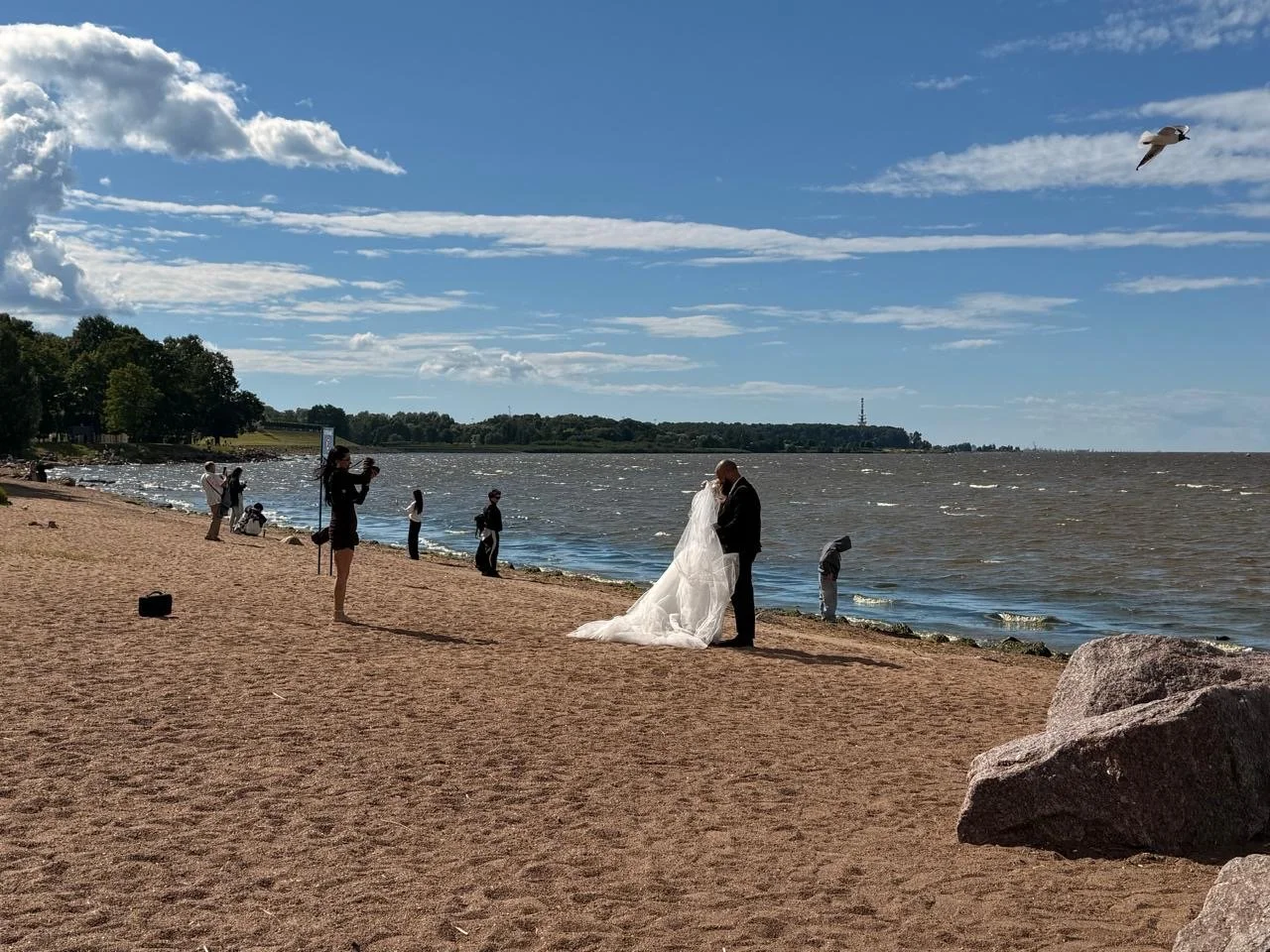
Instead, they may spend several hours taking photographs at parks, monuments, bridges, scenic overlooks, memorials, or famous city landmarks. A decorated line of cars may travel together, sometimes announcing itself with enthusiastic horn-honking.
Champagne may appear. Guests may join for some of the photographs. In certain cities, couples attach locks to bridges as a symbol of lasting love. Other weddings include doves, flower petals, coins, sweets, or the breaking of glasses.
These customs are not all ancient, and they are certainly not universal. Some are relatively modern fashions. Others are local traditions or simply attractive opportunities for photographs.
But the wedding route reveals something important: a Russian wedding is often not confined to a single venue. It moves through public space. The couple is presented not only to the guests but, symbolically, to the city itself.
For travelers, this explains why you may encounter a wedding party posing near a war memorial, beside a statue, in a central square, or along a river embankment. The location may not seem romantic to an outsider, but it can carry historical, civic, or family significance.
Bread, salt, and the question of who will rule the house
When the newlyweds arrive at the reception, their parents may greet them with bread and salt.
The Russian phrase is:
хлеб-соль
khleb-sol’
“bread and salt”
Bread-and-salt hospitality is not limited to weddings. It is an old ceremonial way of welcoming an honored guest.
At a wedding, the bread is often a large, round, decorated loaf called a каравай. The parents hold it on an embroidered cloth while offering a blessing or words of welcome.
Then comes the playful part.
The bride and groom may each take a bite without using their hands. According to the joke, the person who takes the larger piece will become the head of the household.
Naturally, this can become surprisingly competitive.
The bread represents abundance, life, and prosperity. Salt represents hospitality, endurance, and preservation. Together, they express the hope that the new family will have both material security and the strength to survive difficult moments.
For many families, this is one of the most emotionally meaningful parts of the wedding. The civil ceremony joins two individuals legally. The bread-and-salt ritual symbolically joins two families.
At the reception, guests are not expected to remain passive
An American wedding guest may expect to eat, listen to speeches, dance, and watch the couple follow a schedule.
At a more traditional Russian reception, simply watching may not be enough.
Guests may be invited to participate in games, shout responses, perform small tasks, offer spontaneous toasts, sing, dance, or help the bride and groom complete a challenge. Even shy guests can find themselves involved.
The person responsible for managing this energy is traditionally called the тамада.
A tamada is more than a wedding announcer. This person may act as toastmaster, comedian, entertainer, organizer, referee, and social conductor. A skilled tamada reads the room, decides when the guests need food, when they need music, when a toast should happen, and when the celebration needs to become more energetic.
The role has historical associations with the Caucasus and with elaborate traditions of feasting and toasting, but the term became widely familiar throughout the Russian-speaking world.
Modern couples may hire a professional host with a carefully planned program. Others prefer a DJ and a less structured dinner. Younger couples are often selective: they may keep the toasts and dancing while rejecting games they consider embarrassing.
Still, the participatory spirit remains important. A wedding is understood as something created collectively by the guests, not merely presented to them.
“Gorko!” Why is everyone shouting that the wedding is bitter?
At some point during the reception, the guests may begin shouting:
Горько! Горько! Горько!
Gor’ko! Gor’ko! Gor’ko!
The literal meaning is “Bitter!”
The newlyweds are expected to stand and kiss, making the moment—or according to one popular explanation, the drink—sweet again.
Guests may begin counting the seconds of the kiss. If they decide it was too short, another round of Горько! may begin.
The custom is instantly recognizable to many Russian speakers, although explanations of its exact historical origin vary. It is better to treat the “sweetening the bitter drink” story as a popular cultural explanation rather than an indisputable historical fact.
Some couples love the tradition. Some tolerate it. Some establish limits in advance because they do not want to be ordered to kiss repeatedly throughout the evening.
This is an excellent example of how language can be culturally encoded. A beginner who learns that горький means “bitter” would not automatically understand why the word is being shouted at a joyful event. Vocabulary alone gives the literal meaning. Cultural knowledge explains the joke.
The toast is often more important than the drink
Russian weddings are famous for toasts, but the purpose is not simply to encourage alcohol consumption.
A toast is a public wish. It may be sincere, humorous, philosophical, sentimental, or all four at once.
Parents may speak about family and responsibility. Friends may tell stories about how the couple met. Older relatives may offer wishes for health, patience, children, prosperity, and a long life together.
Useful short wedding toasts include:
За молодых!
Za molodykh!
“To the newlyweds!”
За любовь!
Za lyubov’!
“To love!”
За ваше счастье!
Za vashe schast’ye!
“To your happiness!”
За родителей!
Za roditeley!
“To the parents!”
The preposition за is commonly used in Russian toasts. In this context, it means “to” or “in honor of.”
A guest does not have to drink vodka. Champagne, wine, juice, water, or another drink can be used. The meaningful action is raising the glass and joining the wish.
A foreign guest who says a few warm words in Russian will often be appreciated, even if the pronunciation is imperfect. At a wedding, sincerity usually matters more than grammatical precision.
The bride may disappear—and everyone may pretend to panic
Russian wedding games sometimes include a staged “kidnapping” of the bride.
Friends hide her, and the groom must complete a task or offer a symbolic payment to get her back. In another version, someone steals the bride’s shoe. The groom, his witness, or his friends must negotiate for its return.
Other games may ask the couple to predict who will handle household responsibilities, who will control the family budget, or whether their first child will be a boy or a girl. Guests may place money into different containers to “vote.”
These games function as social theater. They give guests permission to joke about marriage, gender roles, money, family expectations, and the transition into adult life.
They can also become uncomfortable.
Some people dislike jokes about controlling husbands, obedient wives, producing children, or “buying” the bride. A professional host who does not understand the couple’s preferences can make the celebration feel dated rather than festive.
That is why modern Russian weddings vary so widely. One couple may enthusiastically include every playful ritual. Another may ban them entirely. A third may keep only a short, updated version.
Tradition survives not because everyone repeats it identically, but because each generation decides what to preserve, reinterpret, or quietly abandon.
The table is part of the celebration
Russian hospitality is often expressed through abundance. At a wedding, an empty table would feel almost unimaginable.
The meal may begin with закуски, or cold appetizers. These can include salads, sliced meats, fish, pickled vegetables, cheese, bread, mushrooms, and other small dishes arranged across the table.
More substantial courses may follow: meat, poultry, fish, potatoes, or regional specialties. Caviar may appear at an expensive wedding, but it should not be treated as an automatic feature of every celebration.
Guests may encounter both a каравай and a wedding cake. They are not the same thing.
The karavay belongs to the symbolic welcome and family ritual. The cake is a dessert and a visual centerpiece, often cut later in the evening.
Food also controls the rhythm of the reception. Guests eat, pause for a toast, eat again, dance, return to the table, and discover that more dishes have appeared.
To an outsider, the quantity may seem excessive. Within the cultural logic of hospitality, however, abundance tells the guests: you are welcome, you are valued, and no one will leave hungry.
The white dress is modern; the history is more colorful
Today, many Russian brides wear the same styles seen across Europe and North America: white or ivory dresses, veils, formal hairstyles, and carefully coordinated bouquets.
Historically, however, bridal clothing varied by region and social class. Traditional garments could include embroidered fabrics, elaborate headdresses, and strong colors.
Red had important festive and aesthetic associations in older Russian culture. You may sometimes hear that the Russian words красный (“red”) and красивый (“beautiful”) are connected. There is a real historical linguistic relationship in older Slavic usage, but it should not be simplified into the claim that the two modern words mean the same thing.
Modern wedding customs also borrow freely from international trends. Bouquet tossing, coordinated bridesmaid dresses, elaborate destination photography, first dances, and Western-style bachelor or bachelorette parties may appear alongside ZAGS, bread and salt, and Горько!
Russian weddings have never stopped changing.
Does the wedding really last for several days?
Historically, weddings could be long communal events involving preparation, ritual songs, visits, meals, and ceremonies stretching across several days.
The idea of a “second wedding day” remains familiar. It may involve a smaller group, more food, informal clothing, jokes, visits, or time with relatives who have traveled from far away.
Modern multi-day weddings are often shaped by practical considerations rather than strict ritual. A couple may hold the legal ceremony on one day, the reception on another, and a family lunch the next morning.
Many city weddings, however, last only one day.
The stereotype that every Russian wedding is a three-day marathon filled with vodka, singing, and dramatic relatives is entertaining, but not accurate.
“Russian wedding” does not mean one tradition for an entire country
Russia is multiethnic, multilingual, and multireligious.
Tatar, Bashkir, Chechen, Dagestani, Jewish, Buddhist, Indigenous Siberian, and other communities may have wedding traditions that differ greatly from those associated with ethnic Russian families.
Expectations around prayer, clothing, music, alcohol, gender roles, dancing, family participation, and the number of guests can vary significantly.
Even among ethnic Russians, a wedding in central Moscow may look different from a celebration in a village, a Siberian city, or a conservative Orthodox family.
Whenever we teach culture in a language class, this distinction matters. Culture is not a list of rules followed by every member of a country. It is a collection of patterns, memories, habits, expectations, and choices.
A useful phrase is not “Russians always do this,” but “This is a tradition many Russian families recognize.”
A small wedding vocabulary guide
Here are several useful words a beginner may encounter:
свадьба — svad’ba — wedding
The general word for the event.
жених — zhenikh — groom
невеста — nevesta — bride
молодожёны — molodozhyony — newlyweds
Notice the letter ё, which is pronounced “yo.”
брак — brak — marriage
This is the formal or legal word for marriage. Interestingly, брак can also mean “defect” in another context, which creates many opportunities for jokes.
обручальное кольцо — obruchalnoye koltso — wedding ring
выкуп невесты — vykup nevesty — bride ransom
венчание — venchaniye — Orthodox wedding ceremony
каравай — karavay — ceremonial wedding loaf
тамада — tamada — wedding host or toastmaster
тост — tost — toast
Горько! — Gor’ko! — “Bitter!”
The wedding chant asking the couple to kiss.
медовый месяц — medovyy mesyats — honeymoon
Literally, “honey month.”
These words do more than label objects. They reveal how marriage is discussed as a legal act, religious commitment, family event, and communal performance.
What should a foreign guest expect?
A Russian wedding invitation can be an exciting experience, but it helps to arrive prepared.
Dress neatly and confirm the level of formality with the couple. Some weddings are highly elegant; others are relaxed family gatherings.
Money in an envelope is a common and practical gift, especially when the couple has not created a gift registry. The amount depends on your relationship with the couple, your circumstances, and local expectations.
Flowers may be appropriate, although Russian flower etiquette traditionally favors odd numbers for celebrations. Even numbers are strongly associated with funerals. When uncertain, ask someone close to the couple or buy a professionally arranged bouquet.
Be prepared to stand, clap, toast, take photographs, and possibly participate in a game. You do not have to drink alcohol. Raising a nonalcoholic drink is enough.
Most importantly, do not disappear immediately after dinner unless you have explained that you need to leave. Weddings may continue late, and staying to dance or participate is one way guests show warmth toward the couple.
Why wedding traditions are so useful for language learners
Weddings bring together several kinds of language that students do not always encounter in a textbook.
There is formal bureaucratic language at ZAGS. There are religious words in an Orthodox ceremony. There are affectionate family terms, jokes, commands, congratulations, toasts, songs, and expressions of hospitality.
A learner may understand the dictionary meaning of горько, yet completely miss the social meaning of the chant. Someone may know that за means “for” or “behind,” but not realize how naturally it appears in a toast. A student may translate выкуп невесты literally and imagine something far more serious than the playful ritual taking place.
This is why learning a language is never only about grammar. The real goal is to understand what people mean, what they expect, when they are joking, and why a familiar word suddenly carries an unfamiliar emotion.
At Polyglottist Language Academy, our Russian classes help adult students connect vocabulary and grammar with the cultural details that make real conversations understandable—from family celebrations and food traditions to etiquette, humor, and everyday expressions. Readers interested in going beyond isolated phrases can explore our Russian classes online.
Frequently asked questions about Russian weddings
Are Russian couples required to marry at ZAGS?
A legally recognized civil marriage is registered through the state civil-registration system. A religious ceremony by itself does not normally replace the official registration.
Do all Russian couples have an Orthodox wedding?
No. Many couples have only a civil ceremony. An Orthodox wedding is a religious sacrament chosen by couples who meet church requirements and want a church marriage.
Why do Russians wear wedding rings on the right hand?
The right-hand custom is associated with Eastern Christian tradition and is widespread in Russia. Individual practices still vary.
Do guests have to drink vodka?
No. Guests can participate in a toast with wine, juice, water, or another drink. The social gesture and good wishes are more important than alcohol.
How long does a Russian wedding last?
Some receptions continue late into the night, while others are shorter. Multi-day celebrations still happen, but they are not required or universal.
What is the best Russian phrase for a wedding guest to learn?
A simple and useful toast is За ваше счастье!, meaning “To your happiness!” Another safe choice is Поздравляю!, meaning “Congratulations!”
Related reading
Russian Blini: History, Recipes, And Why They're More Than Just Pancakes
Russian Black Bread: What It Is And Why Russians Are So Proud Of It
Moscow: The Most Beautiful Winter City I’ve Ever Walked Through
What It’s Like To Take The Saint Petersburg Metro For The First Time
Walking In Saint Petersburg In December: A Winter City That Has Adapted
Beginner Russian Classes In Berkeley: Where To Start Learning
Learn Russian In San Francisco: The Best Classes For Real Conversation
A Russian wedding may begin with a signature in a government building, but it becomes meaningful through everything that surrounds that signature: the parents holding the bread, the friend raising a glass, the crowd shouting one unexpected word, and the couple deciding which traditions belong in the life they are building together.
That is what cultural fluency gives us. It allows us to hear «Горько!» and understand that nobody is complaining. They are asking two people to make the moment sweeter.