
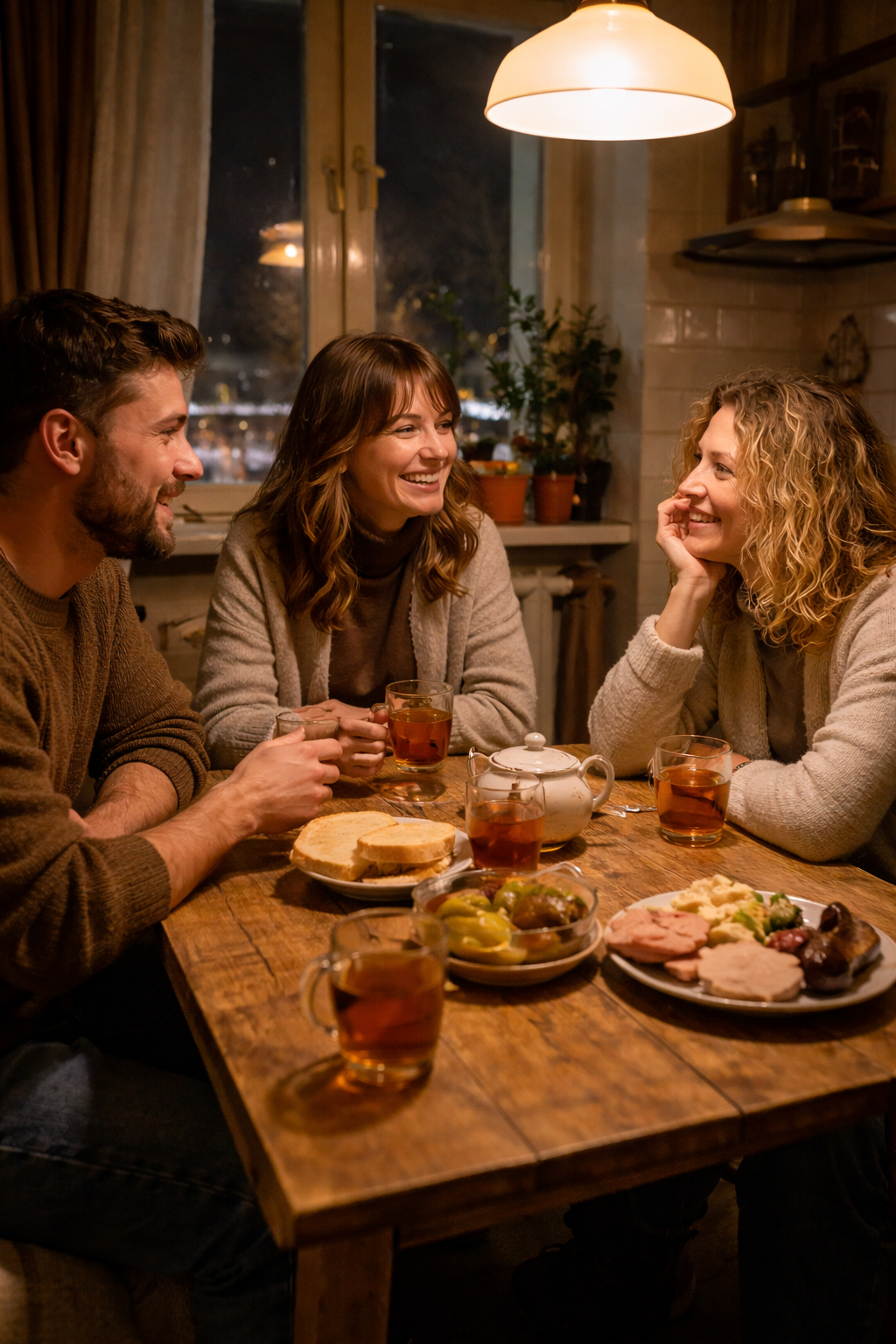
As daylight fades over Russian cities and the last traces of winter light dissolve into long blue twilight, an almost imperceptible shift takes place behind apartment windows glowing softly across courtyards and avenues — a transition from public endurance to private life, from outward composure to emotional warmth — revealing that the true rhythm of Russian culture does not unfold in restaurants, offices, or tourist landmarks, but in the quiet, deeply human rituals that begin each evening at home.
To understand Russia, one must understand the evening.
The Russian evening is not simply the end of a workday. It is a psychological reset, a social ritual, and often the most meaningful part of the day. While many cultures treat evenings as downtime or entertainment hours, in Russia they function as something richer: a return to authenticity.
Inside apartments across Moscow, Saint Petersburg, Kazan, Novosibirsk, and countless smaller cities, kitchens come alive, kettles begin to hum, slippers replace outdoor shoes, and conversations gradually unfold — sometimes lively, sometimes philosophical, sometimes silent but deeply shared.
Evenings reveal how Russians truly live.
The Transition From Outside to Inside
The first ritual begins at the door.
Entering a Russian home involves a clear boundary between the outside world and domestic space. Shoes come off immediately. Coats are hung carefully. Slippers appear almost automatically.
This small act carries symbolic meaning.
Outside represents responsibility, stress, and social formality. Inside represents safety and honesty.
Many Russians describe the feeling of arriving home as finally exhaling.
Unlike cultures where people remain partially connected to work throughout the evening, Russian domestic life traditionally emphasizes separation. Home becomes a protected emotional environment.
Tea: The Beginning of the Evening
Before dinner, before television, before conversation — there is usually tea.
Tea is not merely a drink; it is an anchor of daily life.
A kettle boiling signals the evening has begun.
Tea may be served in:
glass holders (podstakanniki),
simple mugs,
inherited porcelain cups.
Sugar, lemon slices, jam, or sweets often accompany it. Tea invites slowing down. It creates a pause between work and rest.
Guests arriving at any hour will almost certainly hear the same phrase:
“Let’s have tea.”
And tea rarely means only tea.
The Kitchen as the Emotional Center
In many Russian homes, the kitchen — even when small — becomes the heart of evening life.
Unlike open-plan Western living rooms, Russian kitchens historically served as intimate gathering spaces. Limited apartment sizes encouraged closeness, and that closeness shaped social behavior.
At the kitchen table people:
discuss their day,
share frustrations,
debate ideas,
tell stories,
plan the future.
Important conversations rarely happen formally; they emerge naturally over food and tea.
Many Russians say the real life of a family happens in the kitchen, not the living room.
Dinner: A Shared Ritual
Dinner tends to be the main meal of the day.
Unlike rushed eating habits common elsewhere, dinner often unfolds slowly. Even simple meals become occasions for connection.
Typical evening foods may include:
soups such as borscht or chicken broth,
potatoes or grains,
salads,
bread,
homemade dishes prepared earlier.
Food reflects care rather than performance. Even modest meals carry emotional significance because they are shared.
Conversation flows alongside eating. Silence is also accepted — not awkward but comfortable.
Conversation: Depth Over Small Talk
One striking aspect of Russian evenings is conversational style.
Small talk rarely dominates for long. Discussions often move toward meaningful topics quickly:
personal experiences,
literature,
social issues,
philosophy,
memories.
Foreign visitors sometimes feel surprised by emotional openness. Russians may discuss serious subjects early in friendships because sincerity is valued more than social politeness.
Even disagreements can feel intellectually engaging rather than confrontational.
Conversation becomes a form of connection.
Television and Media — Background, Not Center Stage
Television often plays quietly in the background during evenings, but it rarely replaces interaction completely.
Many households treat TV as atmosphere rather than primary entertainment.
Modern evenings may include:
streaming series,
news programs,
films,
online videos.
Yet conversation frequently continues simultaneously. Watching together becomes another shared experience rather than isolated screen time.
Reading and Intellectual Evenings
Reading remains deeply embedded in Russian domestic culture.
Bookshelves filled with literature are common features of apartments. Evening reading may include:
classic novels,
poetry,
history,
contemporary fiction.
This tradition reflects centuries of cultural emphasis on literature as intellectual and emotional exploration.
For many Russians, reading at night feels natural — a quiet continuation of the day’s thinking.
Visits From Friends
Russian evenings often expand beyond family.
Friends may visit without extensive planning. Hospitality activates instantly:
tea is prepared,
food appears,
chairs rearrange around the table.
Guests are encouraged to stay long. Conversations extend late into the night.
Unlike cultures focused on scheduled socializing, Russian gatherings often feel spontaneous and deeply personal.
The evening becomes communal.
Winter Evenings: The Height of Domestic Life
Winter amplifies evening rituals.
Long darkness encourages indoor intimacy. Snow outside enhances the warmth of interior spaces.
Activities include:
cooking together,
board games,
storytelling,
listening to music,
long philosophical discussions.
Many foreigners discover that Russian winter evenings feel unexpectedly cozy rather than isolating.
The contrast between cold exterior and warm interior creates emotional intensity.
Silence as Part of Togetherness
Not all evenings are filled with conversation.
Russians often share silence comfortably.
Family members may sit together:
reading,
scrolling phones,
drinking tea,
simply resting.
Silence signals comfort rather than distance. Presence matters more than constant communication.
This ability to share quiet time surprises visitors accustomed to continuous conversation.
Technology and Modern Changes
Modern Russian evenings increasingly resemble global urban routines:
messaging friends online,
video calls,
social media browsing,
gaming.
Yet traditional rhythms persist. Tea, conversation, and shared meals remain central.
Technology has changed tools, not emotional priorities.
Late-Night Reflection
Many Russians stay awake later than people in some Western countries.
Evenings extend gradually into night. Discussions deepen. Thoughts become reflective.
Topics may shift toward existential questions:
purpose,
relationships,
future hopes,
personal challenges.
This cultural comfort with introspection has roots in literature, philosophy, and historical experience.
Night invites honesty.
The Meaning of Home Evenings
The Russian word uyut describes a feeling difficult to translate — warmth, coziness, emotional safety, and belonging combined.
Evenings at home aim to create this feeling.
It is not luxury that matters but atmosphere:
warm lighting,
familiar objects,
shared presence.
Home becomes a refuge from external pressures.
What Foreigners Learn From Russian Evenings
Visitors often notice unexpected lessons:
slowing down increases connection,
conversation matters more than entertainment,
rituals create stability,
simplicity can feel rich.
Russian evenings demonstrate that meaningful life often happens quietly.
Evening Language: How Speech Changes at Home
Russian spoken at home differs from formal speech.
Language becomes softer and more expressive:
diminutives,
affectionate nicknames,
humor,
emotional nuance.
Understanding these shifts helps language learners grasp cultural context behind vocabulary.
Why Evenings Matter for Understanding Russian Culture
Public Russian culture can appear reserved or serious. Evenings reveal another side:
warmth,
humor,
openness,
emotional depth.
To understand Russians fully, one must see them not only in public spaces but in domestic ones.
The evening is where authenticity lives.
FAQs: Russian Evenings at Home
Do Russians spend evenings mostly at home?
Yes, especially during colder months. Home life remains culturally important.
Is tea really that common?
Extremely. Tea is central to evening routines.
Are dinners formal occasions?
Usually not. They are relaxed but meaningful.
Do Russians entertain guests often?
Yes, hospitality plays a major role in evening life.
Are evenings family-focused?
Often, though friends frequently join.
Is silence normal during gatherings?
Yes. Comfortable silence signals closeness.
Do younger generations follow these traditions?
Many traditions continue alongside modern lifestyles.
What defines a “cozy” Russian evening?
Warm lighting, tea, conversation, and shared presence.
Discover Russian Culture Through Language
Understanding how Russians spend their evenings reveals something essential: language and culture cannot be separated. Words gain meaning through daily life — through shared meals, conversations, and quiet moments at home.
At Polyglottist Language Academy, we believe language learning should open a window into real cultural experiences. Our Russian classes go beyond grammar and vocabulary, helping students understand communication styles, traditions, and everyday life.
Our experienced instructors guide learners step by step in supportive, engaging classes designed specifically for adult students.
👉 Ready to begin your Russian journey?
Join our Russian language classes at Polyglottist Language Academy and discover the culture behind the language.
Continue Exploring Russian Language & Culture
You may also enjoy these articles: