
Russian Black Bread: What It Is and Why Russians Are So Proud of It
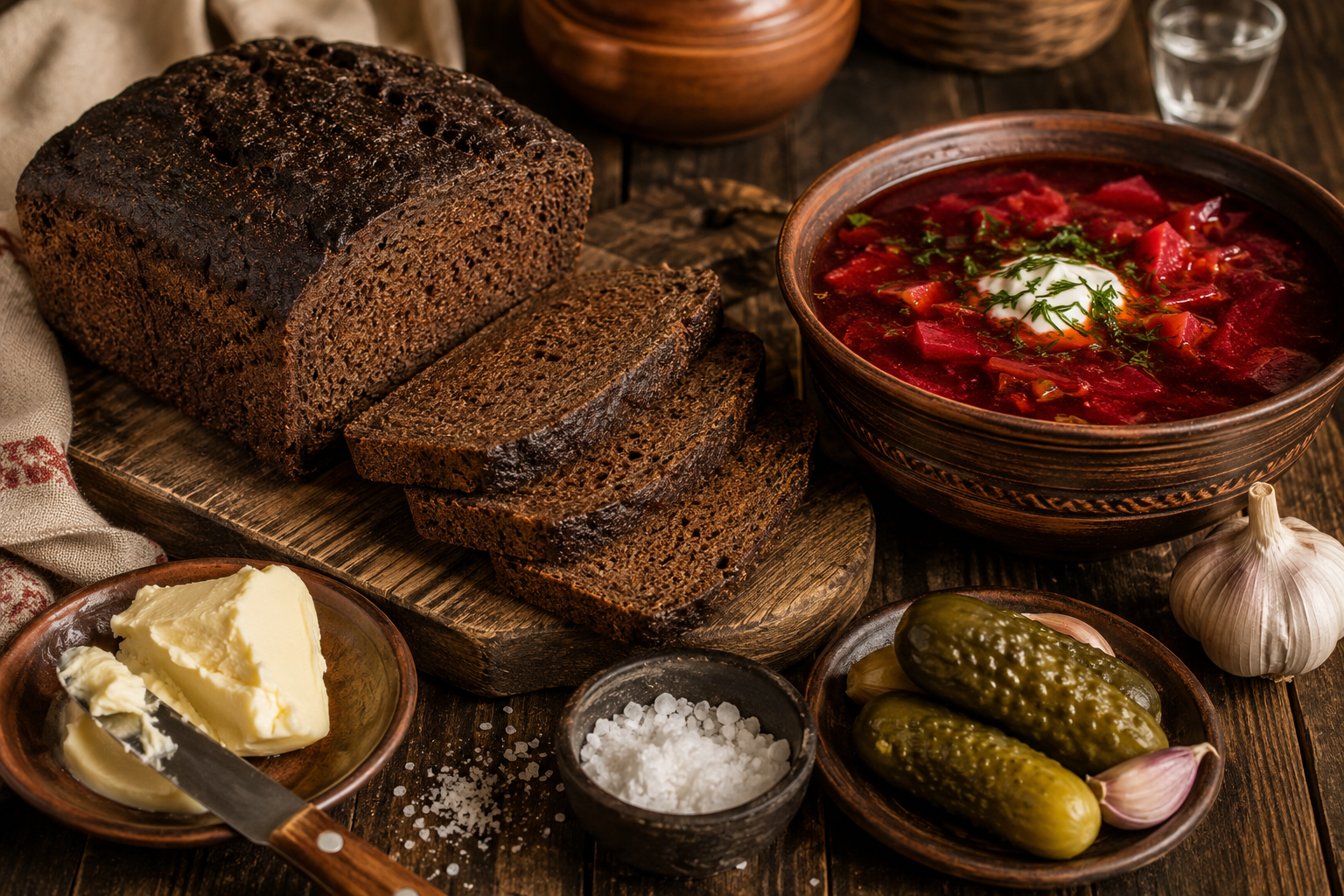
If you have ever sat at a Russian table—whether in a family kitchen in Moscow, a small apartment in St. Petersburg, a dacha outside the city, or the home of Russian-speaking friends abroad—you may have noticed that the bread is not treated like a casual side dish, not placed there as an afterthought beside the soup or salad, but given a quiet position of honor, as if the whole meal would feel incomplete without a dark, dense, fragrant loaf waiting to be sliced, shared, buttered, dipped into soup, or eaten plain with nothing more than salt.
That bread is often called Russian black bread, or чёрный хлеб in Russian. To someone raised on soft white sandwich bread, it can be surprising at first. It is not fluffy. It is not pale. It is not mild in the usual American supermarket sense. It is dark brown, sometimes almost black, with a moist, dense crumb and a flavor that can be earthy, sour, malty, slightly sweet, and deeply satisfying all at once.
But Russian black bread is not just a food. It is a cultural symbol.
For many Russians, black bread represents home. It represents childhood lunches, school cafeterias, grandmother’s kitchen, soup on cold days, wartime memory, Soviet shortages, peasant endurance, hospitality, and the idea that simple food can carry the weight of an entire civilization. It is humble, but not insignificant. In fact, part of the Russian pride in black bread comes precisely from its humility. It is not a luxury food. It is not glamorous. It is made from rye, water, salt, sourdough, sometimes malt or molasses, and time. Yet for centuries, it helped people survive in one of the harshest climates in Europe.
To understand Russian black bread, you have to understand more than a recipe. You have to understand Russian history, Russian agriculture, Russian hospitality, Russian memory, and even the Russian language itself. A slice of black bread tells a story about poor soil, long winters, war, famine, communal meals, religious customs, Soviet canteens, and the emotional power of food that is shared across generations.
This is why Russians can be so particular about it. A Russian person abroad may say, “You cannot find real black bread here.” They may taste a Western rye bread and shake their head. Too soft. Too sweet. Too light. Not sour enough. Not dense enough. Not the right smell. Not the right crumb. Not home.
So what exactly is Russian black bread? Why is it so dark? How is it different from American rye bread or German pumpernickel? What is Borodinsky bread? And why are Russians so proud of something so simple?
Let’s begin at the table.
What Is Russian Black Bread?
Russian black bread is a dark rye bread traditionally made with rye flour, water, salt, and a sourdough starter. In Russian, it is called чёрный хлеб — literally “black bread.” It may also be called ржаной хлеб, meaning “rye bread.”
The word “black” does not usually mean that the bread is truly jet black. It refers to its deep brown color, especially in contrast to white wheat bread. Some loaves are dark chocolate brown; others have a reddish-brown or almost coffee-colored interior. The color comes from rye flour, rye malt, long fermentation, and sometimes ingredients like molasses, dark syrup, or treacle.
Traditional Russian black bread is usually:
Dense rather than airy
Moist rather than dry
Sour from fermentation
Earthy from rye flour
Slightly sweet if malt or molasses is used
Filling and substantial
Able to stay fresh longer than many white breads
If American white bread is soft, mild, and neutral, Russian black bread is serious. It has personality. It asks you to pay attention.
A good slice has a chewy crust and a compact crumb. It may smell sour, malty, nutty, or slightly spicy. Some varieties include coriander seeds or caraway, while others are plain and austere. You do not need much of it to feel satisfied. One or two slices with soup can feel like a meal.
For centuries, this was exactly the point. Russian black bread was not invented as a fashionable artisanal product. It was daily fuel.
Why Rye Became Russia’s Bread Grain
To understand black bread, you need to start with rye.
Rye grows well in climates where wheat struggles. It tolerates cold weather, poorer soil, and shorter growing seasons. In much of northern and central Russia, rye was simply more reliable than wheat. It could survive where wheat failed, and for a country with long winters and difficult agricultural conditions, reliability mattered more than elegance.
This is one reason rye became deeply associated with Russian life. Wheat bread, especially refined white bread, was historically more expensive and less common. It was associated with wealth, cities, feast days, or special occasions. Rye bread was the bread of peasants, workers, soldiers, and ordinary families.
That distinction shaped Russian food culture for centuries.
White bread may have been softer and more prestigious, but black bread was what kept people alive. It was the bread of the field, the village, the army ration, the winter table. It was not delicate, but it was dependable. In Russian cultural memory, that dependability became part of its dignity.
This is very different from the way many Americans think about bread. In the United States, soft white bread became a symbol of convenience and modernity. In Russia, black rye bread remained tied to survival, land, work, and the basic moral seriousness of food.
That is why Russians often treat bread with respect. Bread is not just a carbohydrate. Bread is life.
Russian Black Bread vs. American Rye Bread
Many Americans hear “rye bread” and think of deli sandwiches: pastrami on rye, corned beef on rye, a light brown loaf with caraway seeds and a soft crumb. That bread can be delicious, but it is usually quite different from Russian black bread.
American rye bread is often made mostly from wheat flour, with rye added for flavor. It may be light in color, soft in texture, and leavened with commercial yeast. It often has caraway seeds and a relatively mild taste.
Russian black bread, by contrast, is usually much higher in rye content. It is darker, denser, sourer, and more intense. The fermentation is central to the flavor. The crumb is tighter. The loaf feels heavier in the hand. It is not designed to disappear politely under sandwich fillings. It has its own presence.
If American rye bread says, “I am a nice base for your sandwich,” Russian black bread says, “I am the meal’s foundation.”
Russian Black Bread vs. German Pumpernickel
Russian black bread is also often compared to German pumpernickel, but they are not the same.
Traditional German pumpernickel, especially Westphalian pumpernickel, is made from coarse rye meal and baked for a very long time at a low temperature. This long bake gives it a dark color and a sweet, deep flavor. It is often dense, compact, and almost cake-like in slices.
Russian black bread is usually sourdough-based and relies more on fermentation for its tangy flavor. It may include rye malt, molasses, or coriander, especially in Borodinsky bread. It tends to have a more recognizable crust and a different balance of sourness, sweetness, and spice.
Both breads belong to the broad world of dark rye breads, but Russian black bread has a very particular cultural meaning. In Russia, it is not simply a regional specialty. It is a national symbol.
Borodinsky Bread: Russia’s Most Famous Black Bread
The most famous type of Russian black bread is probably Borodinsky bread, or бородинский хлеб.
Borodinsky bread is dark, aromatic, and slightly sweet, with a distinctive flavor from coriander seeds. It is usually made with rye flour, some wheat flour, rye malt, molasses or dark syrup, sourdough, and coriander. The top is often sprinkled with whole coriander seeds, which give the bread its unmistakable fragrance.
Borodinsky is the kind of bread that many Russians recognize immediately. It has a deep color, a moist crumb, a glossy crust, and a flavor that is both sour and sweet. It pairs beautifully with butter, herring, pickles, soup, cheese, smoked fish, or simply tea.
But part of Borodinsky bread’s appeal comes from its legend.
Several stories connect Borodinsky bread to the Battle of Borodino, the famous 1812 battle between Napoleon’s army and Russian forces. One popular legend says that Margarita Tuchkova, the widow of a Russian general killed at Borodino, founded a convent on the battlefield and that the nuns created a dark memorial bread. According to this story, the coriander seeds on top symbolized cannonballs or grapeshot.
Another version claims that a food cart carrying rye flour and spices was hit during the battle, accidentally creating the mixture that became Borodinsky bread.
Are these stories historically certain? Not exactly. Food historians often point out that the name “Borodinsky” appears much later and that the standardized Soviet recipe developed in the 20th century. But legends do not have to be literally true to be culturally meaningful. The fact that Russians connect this bread with battle, memory, mourning, and endurance tells us a great deal about how the bread is imagined.
Borodinsky bread tastes like history, even when the history is partly myth.
Bread as Survival: War, Famine, and Memory
One reason Russians are proud of black bread is that it is connected with survival.
Throughout Russian history, bread shortages were not minor inconveniences. They were crises. Harvest failures, famine, war, siege, and political instability often turned bread into the central question of daily life. Who had bread? How much? What was it made from? How long would it last?
Black bread appears again and again in stories of hardship. In difficult times, bread could be stretched with bran, peas, or other fillers. In extreme conditions, even worse substitutes were used. But even poor-quality bread remained a symbol of life.
The most painful example is the Siege of Leningrad during World War II. During the siege, residents received tiny bread rations, and the bread itself was often mixed with substitutes because real flour was scarce. Yet those small pieces of bread became symbols of survival, memory, and human endurance.
For many families, stories of war and hunger are not abstract history. They are family history. A grandmother or great-grandfather may have remembered standing in line for bread, saving crumbs, or treating every piece as precious.
This helps explain why older Russians may be especially strict about not wasting bread. Throwing away bread can feel almost immoral. It is not just about thrift. It is about memory. Bread was once the difference between life and death.
When a culture has lived through hunger, bread becomes sacred.
“Bread Is the Head of Everything”
One of the most famous Russian sayings is:
Хлеб — всему голова.
Bread is the head of everything.
This proverb is difficult to translate perfectly because “head” here means something like foundation, leader, source, or most important thing. The idea is that bread stands at the center of life. Without bread, a meal is incomplete. Without bread, prosperity is uncertain. Without bread, society itself is unstable.
Another common saying is:
Без хлеба нет обеда.
Without bread, there is no lunch.
These sayings reveal a cultural attitude. Bread is not optional. Bread makes the meal real.
Russian has many expressions connected to bread. Хлеб means bread. Чёрный хлеб means black bread. Ржаной хлебmeans rye bread. Хлеб-соль means bread and salt, the traditional symbol of hospitality.
The expression хлеб-соль is especially important. In Russian tradition, bread and salt are offered to guests as a sign of welcome, respect, and abundance. At weddings, official ceremonies, and cultural events, guests may be greeted with a loaf of bread and a dish of salt placed on an embroidered towel.
Bread represents life and prosperity. Salt represents preservation, value, and protection. Together, bread and salt say: You are welcome here. We honor you. We share what is essential.
This custom shows why bread has such emotional force in Russian culture. To offer bread is not only to feed someone. It is to recognize them.
How Russians Eat Black Bread
Russian black bread is not limited to one meal. It can appear at breakfast, lunch, dinner, and celebrations.
At breakfast, Russians may eat black bread with butter, cheese, sausage, or smoked fish. Open-faced sandwiches, called бутерброды, are common. A slice of black bread with butter and cheese can be simple, filling, and comforting.
At lunch, black bread often appears beside soup. It is especially good with borscht, shchi, mushroom soup, rassolnik, or other hearty soups. A bowl of hot soup and a slice of dense rye bread is one of the most classic combinations in Russian home cooking.
At dinner, it may be served with salads, potatoes, fish, meat, pickles, or leftovers. It is also eaten with salty foods: herring, sauerkraut, pickled cucumbers, garlic, onions, salo, caviar, smoked fish, and various spreads.
Some of the simplest combinations are the most beloved. A slice of black bread with butter. Black bread with salt. Black bread rubbed with garlic. Black bread with herring and onion. Black bread with pickles. Black bread with hot tea.
To a foreigner, these combinations may sound plain. To a Russian person, they can be deeply satisfying.
This is another reason black bread is so culturally powerful: it does not need luxury to taste complete. It belongs with humble foods. It makes salty foods taste better, sour soups more balanced, butter richer, and tea more comforting.
The Taste of Home for Russians Abroad
Ask Russians living abroad what foods they miss, and black bread often appears near the top of the list.
It is not that dark rye bread does not exist elsewhere. Germany, Finland, Denmark, Sweden, Poland, Lithuania, Latvia, Estonia, and other countries all have rich rye bread traditions. But for many Russians, those breads still do not taste exactly right. The sourness is different. The crumb is different. The sweetness is different. The spices are different. The smell is different.
Food memories are precise. A person may not be able to explain technically what is missing, but the body knows. The bread of childhood has a specific texture, weight, and aroma.
For Russian emigrants, black bread can become a symbol of homesickness. It is one of those foods that carries more emotion than its ingredients suggest. A loaf of Borodinsky from an Eastern European shop can feel like a small rescue. A homemade rye sourdough starter can become a link to the past. A slice with butter and tea can bring back an entire kitchen, an entire language, an entire family history.
This is true for many immigrant cultures, of course. Food becomes memory. But black bread has an especially strong role because it was never just a treat. It was daily life.
Why Black Bread Feels So Russian
Russian black bread feels Russian because it combines several central themes in Russian culture.
First, it represents endurance. It is a bread made for cold climates, poor soils, and difficult times. It is not fragile. It keeps well. It fills the stomach. It belongs to a country that learned to survive hardship.
Second, it represents humility. Black bread is not aristocratic food. It is peasant food, worker food, soldier food, family food. Yet this humility gives it moral strength. It suggests honesty, labor, and connection to the land.
Third, it represents hospitality. Bread is placed on the table for guests. Bread and salt welcome visitors. Sharing bread creates a bond.
Fourth, it represents memory. It recalls famine, war, queues, Soviet canteens, grandmother’s kitchen, childhood breakfasts, and the taste of home.
Fifth, it represents identity. Russians may disagree about many things, but black bread is widely recognizable as part of Russian cuisine. It belongs to the emotional vocabulary of the culture.
This is why Russians can be proud of black bread without making grand speeches about it. The pride is quiet but deep. It says: This is ours. This sustained us. This is what home tastes like.
Modern Russian Black Bread
Today, black bread is still widely eaten in Russia, though the modern bread landscape is more varied than it once was. Supermarkets sell many kinds of bread: white loaves, wheat rolls, seed breads, packaged sandwich bread, baguettes, “fitness” breads, and artisan sourdoughs. Younger Russians may eat more international-style bread than previous generations did.
But black bread has not disappeared. Far from it.
Borodinsky, Darnitsky, rye-wheat loaves, seeded rye breads, and other dark breads remain common. Some are inexpensive industrial loaves; others are marketed as premium, traditional, or health-conscious products. As in many parts of the world, sourdough and whole-grain breads have gained renewed attention among people interested in nutrition and heritage foods.
Rye bread is often valued because it is filling and high in fiber. It has a stronger flavor than white bread and pairs well with traditional Russian foods. It also fits beautifully into the modern interest in fermented foods and old-fashioned baking.
In other words, black bread has moved through several cultural stages. It began as necessity. It became a symbol of survival. It became a Soviet staple. Now it is also a heritage food and, in some contexts, an artisanal product.
But the emotional core remains the same. It is still bread with memory.
The Language Lesson Hidden in a Loaf of Bread
For students learning Russian, black bread offers a wonderful doorway into the language.
Start with the word:
хлеб — bread
This is one of the most important words in Russian food culture. Then you can learn:
чёрный хлеб — black bread
ржаной хлеб — rye bread
бородинский хлеб — Borodinsky bread
хлеб-соль — bread and salt
буханка хлеба — a loaf of bread
кусок хлеба — a piece of bread
ломтик хлеба — a slice of bread
These are not abstract vocabulary words. They belong to real meals, real customs, and real conversations. If you visit a Russian-speaking home, bakery, or grocery store, you may hear them immediately.
Learning food vocabulary is powerful because it connects language to the senses. You are not just memorizing a word on a flashcard. You are learning what a culture values, how people eat, how they welcome guests, and what they miss when they are far from home.
This is one of the great joys of studying Russian. The language is not only grammar, cases, verbs of motion, and the Cyrillic alphabet. It is also soup, tea, bread, jokes, songs, gestures, proverbs, and family tables.
A loaf of black bread can teach you more about Russian culture than a long list of cultural facts.
Is Russian Black Bread Healthy?
Many people also wonder whether Russian black bread is healthier than white bread.
In general, rye bread can be a nutritious choice, especially when made with whole-grain rye flour and traditional fermentation. Rye is rich in fiber and tends to be more filling than refined white bread. Sourdough fermentation can also affect flavor, texture, and digestibility.
However, not every black bread is automatically healthy. Some modern industrial loaves contain added sugar, refined flour, colorings, or preservatives. Some Borodinsky-style breads include molasses or syrup. The nutritional value depends on the exact recipe.
Still, compared with fluffy white bread, traditional rye-based black bread is usually more substantial and less likely to feel like empty calories. It is the kind of bread that makes you slow down. You chew it. You taste it. You notice it.
That, too, may be part of its appeal.
Why Russian Black Bread Matters
Russian black bread matters because it sits at the intersection of food, language, memory, and identity.
It is a food made from practical necessity, but it became a cultural treasure. It is associated with peasants and poverty, but also with dignity and pride. It is simple, but emotionally complex. It is ordinary, but symbolic.
To understand Russian black bread is to understand something essential about Russian culture: the ability to find meaning in endurance, beauty in simplicity, and emotional depth in everyday rituals.
A Russian table without bread feels unfinished because bread is not only there to be eaten. It is there to hold the meal together. It is there to say that people are gathered, that food is shared, that history is present, and that no one should leave hungry.
That is why Russians are proud of black bread.
Not because it is fancy.
Because it survived.
Because it nourished.
Because it remembers.
Because it tastes like home.
FAQs About Russian Black Bread
What is Russian black bread made of?
Traditional Russian black bread is made mainly from rye flour, water, salt, and sourdough starter. Some varieties also include wheat flour, rye malt, molasses, dark syrup, coriander, caraway, or other spices. Borodinsky bread, one of the most famous types, is especially known for its rye malt, molasses-like sweetness, and coriander seeds.
Why is Russian black bread so dark?
Russian black bread gets its dark color from rye flour, rye malt, fermentation, and sometimes dark sweeteners such as molasses or treacle. The color is not simply decorative. It reflects the ingredients and baking tradition.
Is Russian black bread the same as pumpernickel?
No. Russian black bread and German pumpernickel are both dark rye breads, but they are different. Traditional pumpernickel is often made from coarse rye meal and baked for a very long time at low temperature. Russian black bread is usually sourdough-based, often more tangy, and may include rye malt, molasses, and spices such as coriander.
What is Borodinsky bread?
Borodinsky bread is a famous Russian black bread made with rye flour, rye malt, sourdough, molasses or dark syrup, and coriander. It is dark, aromatic, slightly sweet, and mildly sour. It is one of the most iconic Russian breads.
Why do Russians eat bread with soup?
Bread makes soup more filling and balanced. Dense rye bread pairs especially well with borscht, shchi, mushroom soup, and other Russian soups. It can be used to accompany salty, sour, or rich flavors and helps make the meal feel complete.
What does “bread and salt” mean in Russian culture?
“Bread and salt,” or хлеб-соль, is a traditional symbol of hospitality. Offering bread and salt to guests means welcome, respect, abundance, and goodwill. It is still seen at weddings, cultural events, and formal ceremonies.
Why do Russians not like wasting bread?
Bread has deep emotional and historical significance in Russian culture. Because many families remember famine, war, shortages, or poverty, wasting bread can feel disrespectful. Older generations especially may treat bread as something almost sacred.
Is Russian black bread still popular today?
Yes. Although modern Russians eat many kinds of bread, black rye bread remains widely available and culturally important. Borodinsky, Darnitsky, rye-wheat breads, and seeded rye loaves are still common in stores and bakeries.
Can I find Russian black bread in the United States?
You may be able to find it in Russian, Ukrainian, Polish, Baltic, or Eastern European grocery stores. Some artisan bakeries also make dark rye sourdoughs, but they may not taste exactly like traditional Russian black bread.
Is Russian black bread good for language learners to know about?
Absolutely. Food is one of the best ways to understand a culture. Learning words like хлеб, чёрный хлеб, ржаной хлеб, and хлеб-соль helps Russian learners connect vocabulary to real customs, meals, and cultural values.
Learn Russian Through Culture with Polyglottist Language Academy
Russian black bread is a perfect example of why language learning should never be separated from culture. When you learn Russian, you are not only learning grammar rules, the Cyrillic alphabet, and vocabulary lists. You are also learning how people think, eat, welcome guests, remember history, tell stories, and express identity through everyday life.
At Polyglottist Language Academy, we believe language learning becomes more meaningful when students understand the culture behind the words. Our Russian classes help students build practical language skills while also exploring Russian traditions, food, literature, history, and daily life.
Whether you are a complete beginner, returning to Russian after a long break, or hoping to deepen your connection to Russian-speaking culture, our small-group and online classes can help you learn in a supportive, structured, and engaging environment.
If this article made you curious about Russian food, Russian words, or Russian culture, we invite you to take the next step. Sign up for Russian classes with Polyglottist Language Academy and discover how much more alive the language becomes when you learn it through real cultural experience.
You May Also Enjoy These Articles
If you enjoyed learning about Russian black bread, you may also like these related articles from our language and culture blog: