
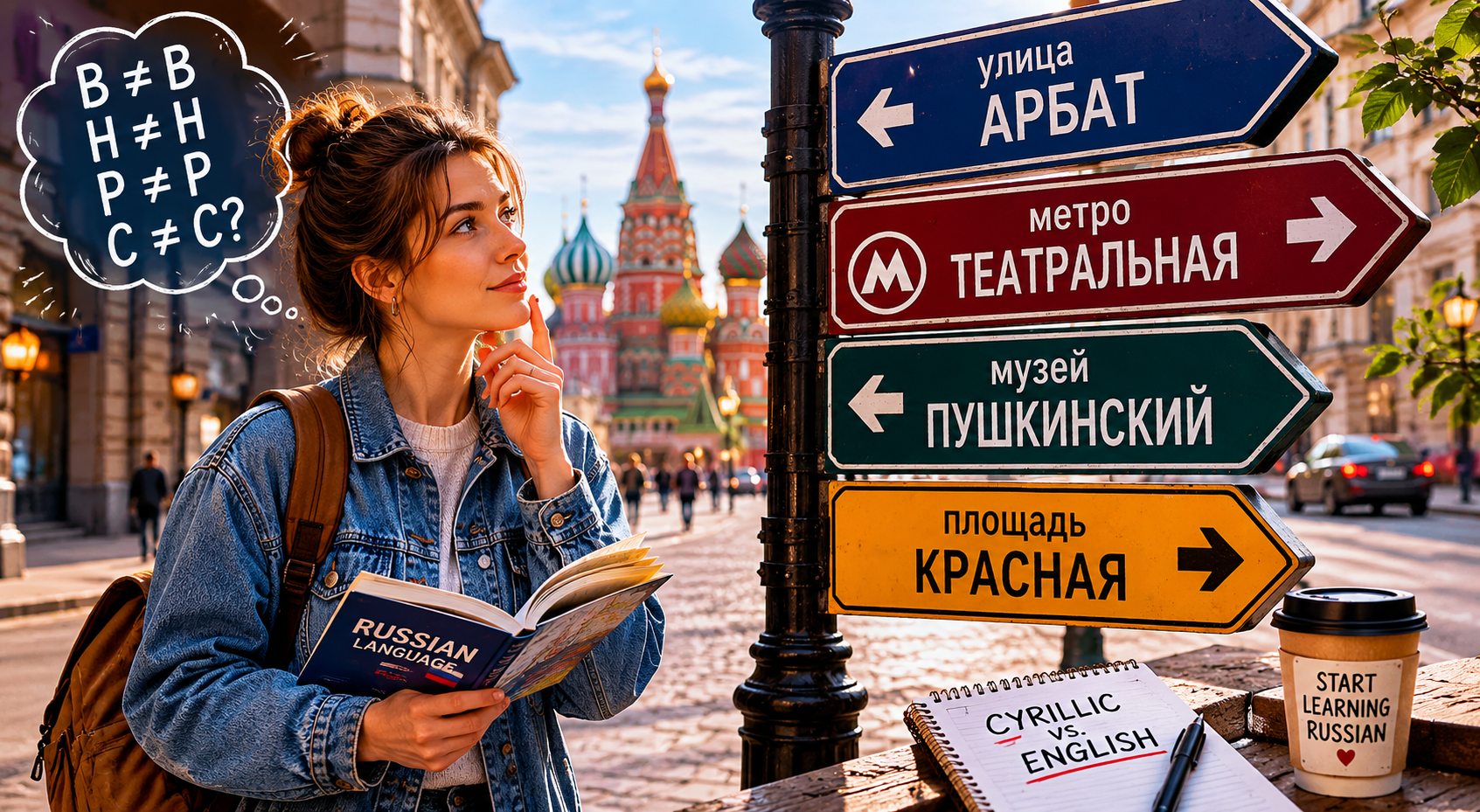
When English speakers first look at Russian, the alphabet often feels like a strange mirror: some letters look beautifully familiar, almost comforting, as if they have been borrowed from English, but the moment you try to read them aloud, they suddenly betray you, turning a word that seemed simple into something completely unexpected.
That is one of the most fascinating parts of learning Russian. The Cyrillic alphabet is not actually as intimidating as it first appears. It has 33 letters, many of which are quite logical once you understand the system. Some letters look completely unfamiliar at first—Ж, Ц, Ш, Щ, Ю, Я—and because they look foreign, learners expect them to be difficult. But strangely, those are not always the letters that cause the biggest mistakes.
The real trouble often comes from the letters that look familiar.
For an English speaker, a Russian word like РОМА, СОН, МОЙ, or ВЕРА can look deceptively readable. Your brain sees what it already knows. It wants to treat Р like English “P,” С like English “C,” В like English “B,” and Н like English “H.” But Russian does not follow English rules. These letters belong to a different alphabet, a different sound system, and a different history.
This is why many beginners have the strange experience of being able to “recognize” Russian letters before they can actually read Russian. They feel close, but not quite close enough. Russian gives you just enough familiarity to be dangerous.
The good news is that this problem is very fixable. In fact, once you train your eyes and ears to recognize these “false friends,” Cyrillic becomes much less mysterious. You stop guessing. You stop reading Russian words through English habits. You begin to see Russian on its own terms.
In this article, we will look at ten Russian Cyrillic letters that can confuse English speakers because they look like familiar English letters but sound different—or at least behave differently enough that beginners often misread them. We will go slowly, with examples, pronunciation tips, and memory tricks. By the end, you will not only understand the most common Cyrillic traps, but you will also be able to approach Russian words with much more confidence.
Why Russian Letters Can Look Familiar but Sound Different
Before we look at the ten letters, it helps to understand why this happens in the first place.
The Russian alphabet uses Cyrillic, which developed from earlier writing systems connected to Greek and the Slavic Christian tradition. English uses the Latin alphabet. These writing systems are different, but they share some older roots and visual similarities. That means several letters look alike even though they do not always represent the same sound.
For English speakers, this creates a special problem: your brain is trained to read automatically. When you see the symbol P, you do not stop and think, “What sound does this represent?” You simply hear /p/ in your head. When you see C, you might hear /k/ or /s/, depending on the word. When you see H, you hear /h/.
But in Russian, those symbols may not mean what your English-trained brain thinks they mean.
That is why the first stage of learning Cyrillic is not just memorization. It is retraining. You are teaching your eyes to stop assuming that a familiar shape equals a familiar sound.
This is similar to learning to drive on the opposite side of the road. The car may look the same. The road may look the same. But your instincts need to be adjusted. Once they are adjusted, everything becomes easier.
1. В — Looks Like English B, Sounds Like V
One of the most important Cyrillic false friends is В.
To an English speaker, В looks exactly like the capital letter B. But in Russian, В sounds like English V.
For example:
Вера = Vera
Pronounced roughly: VEH-rah
вода = water
Pronounced roughly: vah-DAH
Москва = Moscow
Pronounced roughly: mahs-KVAH
This letter appears constantly in Russian, so learning it early is essential. If you read В as English B, you will mispronounce many basic words.
A useful memory trick is to think: Russian В has the shape of B but the voice of V.
You can also connect it to names. The Russian name Виктор is Viktor, not “Biktor.” The word виза is visa, not “bisa.” The word вино is wine, pronounced roughly vee-NOH.
This letter is especially important because Russian has another letter for the English B sound: Б. So:
В = V
Б = B
For beginners, the pair В / Б can be confusing, but with a little practice, it becomes automatic.
2. Е — Looks Like English E, Often Sounds Like “Ye” or “Eh”
The Russian letter Е looks like English E, but it does not behave exactly like English E.
In many positions, especially at the beginning of a word or after another vowel, Е sounds like ye.
For example:
Елена = Elena
Pronounced roughly: yeh-LEH-nah
есть = to eat / there is
Pronounced roughly: yest’
Европа = Europe
Pronounced roughly: yev-ROH-pah
But after many consonants, Е usually softens the previous consonant and sounds closer to eh. For example:
нет = no
Pronounced roughly: nyet
мел = chalk
Pronounced roughly: myel
This is why Russian Е is tricky. It is not simply the English short E in “bed,” and it is definitely not the English letter name “ee.” It often carries a little y sound or changes the consonant before it.
A good beginner rule is this:
At the beginning of a word, think Е = ye.
After a consonant, think Е = softening + eh.
The famous Russian word нет is a great example. English speakers may want to read it as “net,” like the English word. But Russian нет is closer to nyet. That small difference matters.
3. Н — Looks Like English H, Sounds Like N
The Russian letter Н is one of the most classic Cyrillic traps.
It looks like English H, but it sounds like English N.
For example:
нет = no
Pronounced roughly: nyet
нос = nose
Pronounced roughly: nohs
она = she
Pronounced roughly: ah-NAH
If you see Н and read it as English H, Russian words become very strange very quickly. The word она, meaning “she,” would look like “oha” to an English speaker, but it is pronounced ah-NAH.
A helpful way to remember this is:
Н has two vertical lines, just like the sound N has two legs.
You can also associate it with the word нет, one of the first Russian words most learners encounter. Once you know that нет is “nyet,” you will remember that Н cannot be H. It has to be N.
Russian does have a sound similar to English H in some borrowed words, but it is not represented by Н. The letter Х, which we will discuss later, is closer to a rough “kh” sound.
4. Р — Looks Like English P, Sounds Like R
Russian Р looks like English P, but it sounds like R.
This is one of the most important letters to master because it appears in countless Russian words.
For example:
Россия = Russia
Pronounced roughly: rah-SEE-yah
работа = work
Pronounced roughly: rah-BOH-tah
ресторан = restaurant
Pronounced roughly: res-tah-RAHN
Роман = Roman
Pronounced roughly: rah-MAHN
The Russian Р is usually rolled or tapped, depending on position and speaker. It is not exactly the same as the English R. English R is often produced farther back in the mouth and can sound softer or more rounded. Russian R is made with the tongue near the ridge behind the teeth. In many cases, it has a brief trill or tap.
Do not panic if you cannot roll your R perfectly at first. Many learners need time. The most important beginner step is to stop reading Р as P.
A useful phrase:
Russian Р is not P. It is R with energy.
And remember: the Russian letter for the P sound is П, not Р.
So:
Р = R
П = P
This distinction is essential for reading Russian accurately.
5. С — Looks Like English C, Sounds Like S
Russian С looks exactly like English C, but it sounds like S.
For example:
сок = juice
Pronounced roughly: sohk
сын = son
Pronounced roughly: sihn
спасибо = thank you
Pronounced roughly: spah-SEE-bah
This can actually feel easier than English once you get used to it. In English, C can sound like /k/ as in “cat,” /s/ as in “city,” or even combine with H to make /ch/ as in “chair.” Russian С is much more consistent. It simply represents the S sound.
The problem is that English speakers often hesitate because they see a familiar C and wonder whether it should be “k” or “s.” In Russian, do not overthink it. С is S.
A great memory word is спасибо, meaning “thank you.” It begins with С, and it is pronounced with an S sound: spah-SEE-bah.
Once you know this word, you will remember the letter.
6. У — Looks Like English Y, Sounds Like “Oo”
Russian У looks like English Y, but it sounds like oo, as in “food” or “moon.”
For example:
утро = morning
Pronounced roughly: OO-trah
музыка = music
Pronounced roughly: MOO-zi-kah
урок = lesson
Pronounced roughly: oo-ROHK
This letter is especially confusing because English Y can represent several sounds: the consonant sound in “yes,” the long vowel in “my,” or the short vowel in “system.” Russian У is much simpler. It is the oo sound.
A helpful memory trick:
У looks like Y, but it says “oo.”
Think of someone looking at a confusing Russian word and saying, “Ooh!” That sound is У.
Also notice that Russian has another letter for the “ya” sound: Я, and another for the “yu” sound: Ю. So do not expect Уto behave like English Y. It has its own job.
7. Х — Looks Like English X, Sounds Like “Kh”
Russian Х looks like English X, but it does not sound like the English X in “box” or “exit.”
Instead, Х sounds like a rough kh, similar to the sound in the Scottish “loch” or the German “Bach.” It is made in the back of the throat, but it should not be exaggerated into a harsh cough.
For example:
хорошо = good / well
Pronounced roughly: khah-rah-SHOH
хлеб = bread
Pronounced roughly: khlyep
Москва does not contain Х, but Михаил does:
Михаил = Mikhail
Pronounced roughly: mee-khah-EEL
This letter can feel strange for English speakers because standard English does not use this sound very often. However, many learners can produce it after some practice.
Try this: say English “h,” but make it slightly stronger and farther back in your mouth. Do not make it too aggressive. Russian Х should be clear but not theatrical.
A useful memory phrase:
Х looks like X, but it breathes like “kh.”
This sound appears in many common Russian words, so it is worth practicing early.
8. О — Looks Like English O, but Russian O Changes When Unstressed
Russian О looks like English O, and sometimes it sounds similar to “o.” But this letter deserves a place on the list because English speakers often expect it to behave like English O, and it does not.
In Russian, stressed О sounds like a clear o, somewhat like “aw” or “oh,” depending on the word and accent.
For example:
дом = house
Pronounced roughly: dohm
кот = cat
Pronounced roughly: koht
But when О is not stressed, it often sounds more like a or a reduced “uh” sound.
For example:
молоко = milk
Pronounced roughly: mah-lah-KOH
There are three written O’s in молоко, but only the last one is stressed and pronounced clearly as O. The first two sound closer to A.
Another famous example:
Москва = Moscow
Pronounced roughly: mahs-KVAH
The first written О is not pronounced like a clear English O. It is reduced.
This is one of the big differences between reading Russian letters and speaking Russian naturally. The alphabet itself is quite logical, but stress matters. If you do not know where the stress falls, you may pronounce vowels too clearly.
A beginner rule:
Stressed О sounds like O. Unstressed О often sounds like A or a reduced vowel.
This does not mean Russian spelling is chaotic. It means Russian pronunciation has patterns that go beyond the individual letter.
9. А — Looks Like English A, but Sounds Like “Ah,” Not “Ay”
Russian А looks like English A, but it is usually pronounced like ah, not like the English letter name “ay.”
For example:
мама = mom
Pronounced roughly: MAH-mah
Анна = Anna
Pronounced roughly: AHN-nah
Америка = America
Pronounced roughly: ah-MYE-ree-kah
English A is extremely flexible. It can sound different in “cat,” “cake,” “father,” “about,” and “any.” Russian А is much more stable. It generally represents an open ah sound.
This is not the most dramatic false friend on the list because English does sometimes use A for an “ah” sound, as in “father.” But many beginners still misread Russian А because they unconsciously use English vowel habits.
The key is to avoid the English “ay” sound. Russian А is open, simple, and direct.
Think:
А = ah, as in “spa.”
That one small adjustment can make Russian words sound much more natural.
10. Т — Looks Like English T, but Sounds Cleaner and Less Aspirated
Russian Т looks like English T, and it does represent a T sound. So why include it here?
Because the sound is not always identical to English T.
In English, especially at the beginning of stressed words, T is often aspirated. That means we release a small puff of air. Say the English word “top” while holding your hand in front of your mouth. You may feel a burst of air after the T.
Russian Т is usually less aspirated. It is cleaner, shorter, and often produced with the tongue closer to the teeth. This gives Russian T a slightly different quality.
For example:
там = there
Pronounced roughly: tahm
ты = you
Pronounced roughly: tih
театр = theater
Pronounced roughly: tyeh-AH-tr
English speakers can usually be understood if they pronounce Russian Т like English T, but reducing the puff of air makes the pronunciation sound more Russian.
This is a more advanced point than В, Н, or Р, but it matters for learners who want to sound clearer and more natural.
A good beginner reminder:
Russian Т is T, but keep it crisp and controlled.
The “False Friend” Problem: Why Your Brain Keeps Making the Same Mistakes
Even after you learn these letters intellectually, you may still misread them when you read quickly. This is normal.
Your brain has spent years connecting visual symbols with English sounds. It sees P and instantly thinks /p/. It sees H and instantly thinks /h/. It sees B and instantly thinks /b/. These reactions are automatic.
Learning Cyrillic requires building a second automatic system.
At first, you may need to pause and translate the letter in your head:
В — not B, V.
Н — not H, N.
Р — not P, R.
С — not C, S.
У — not Y, oo.
This feels slow, but it does not stay slow forever. With enough exposure, the Russian values become automatic too. Eventually, you will see Ресторан and read restoran, not “pestopan.” You will see нет and read nyet, not “het.” You will see сок and read sok, not “cock” or “kock.”
The transition from confusion to fluency happens through repeated, calm practice.
A Simple Practice Method for These 10 Letters
If you are just starting Russian, do not try to memorize the whole alphabet in one sitting. Instead, practice the false friends separately.
Take five minutes a day and read short Russian words that contain these letters.
Start with words like:
мама — mom
там — there
дом — house
кот — cat
сок — juice
нет — no
она — she
вода — water
работа — work
урок — lesson
хорошо — good / well
Read them slowly. Say the sounds out loud. Do not worry about speed. Accuracy matters more.
Then mix the words together and test yourself. Can you see В and immediately say V? Can you see Н and immediately say N? Can you see Р and immediately say R?
This kind of practice is small but powerful. It teaches your brain to stop relying on English.
Why Cyrillic Is Easier Than It Looks
Many people avoid Russian because they assume the alphabet will be too hard. But Cyrillic is not the real enemy. In many ways, Russian spelling is more consistent than English spelling.
English spelling is full of surprises. Think about the pronunciation differences in “though,” “through,” “tough,” “thought,” and “bough.” The same combination of letters can produce completely different sounds.
Russian has its own challenges, especially stress and vowel reduction, but the alphabet itself is manageable. Once you learn the letters, you can usually sound out words much more reliably than in English.
The first few days are the hardest because everything looks unfamiliar or misleading. But after that, progress can be surprisingly fast. Many learners can learn the basic Cyrillic alphabet in a week. With daily practice, they can begin reading simple Russian words and signs soon after.
The key is not to be intimidated by the appearance of the script. Cyrillic looks difficult before it becomes familiar. Once it becomes familiar, it feels like a doorway into the language.
The Cultural Reward of Reading Russian
Learning Cyrillic is not just a technical step. It changes your relationship with Russian culture.
Before you can read Cyrillic, Russian may feel distant. Signs, book titles, menus, names, songs, poems, and film credits all look closed off. But once you learn the alphabet, the language starts to open.
You begin recognizing names like Толстой, Достоевский, Чехов, and Пушкин. You can read city names like Москва, Санкт-Петербург, and Казань. You can recognize simple words on menus, maps, and websites. Even if you do not understand everything yet, you are no longer completely outside the language.
That is a powerful moment for a beginner.
It also gives you confidence. Russian has a reputation for being difficult, and yes, Russian grammar can be challenging. Cases, verb aspect, motion verbs, and pronunciation all take time. But learning Cyrillic gives you an early victory. It proves that what looked impossible can become readable.
And that feeling matters. Language learning is not only about memorizing information. It is about building courage.
Common Beginner Mistakes with Cyrillic False Friends
Here are some of the most common mistakes English speakers make:
They read В as B instead of V.
They read Н as H instead of N.
They read Р as P instead of R.
They read С as K or C instead of S.
They read У as Y instead of oo.
They pronounce every О as a clear O, even when unstressed.
They pronounce А like English “ay.”
They make Т too aspirated.
They forget that Е can sound like “ye.”
They pronounce Х like English X instead of kh.
The best way to fix these mistakes is not to shame yourself. They are natural mistakes. Your English-reading brain is doing exactly what it has been trained to do.
You simply need to train it differently.
A Mini Reading Challenge
Try reading these words slowly. Use the rules from this article.
Вера
нет
сон
сок
урок
работа
хорошо
Москва
молоко
театр
Now check the approximate pronunciation:
Вера — VEH-rah
нет — nyet
сон — sohn
сок — sohk
урок — oo-ROHK
работа — rah-BOH-tah
хорошо — khah-rah-SHOH
Москва — mahs-KVAH
молоко — mah-lah-KOH
театр — tyeh-AH-tr
If you caught yourself misreading one or two letters, that is perfectly normal. That is exactly why focused alphabet practice helps.
The 10 Letters at a Glance
Here is a quick summary:
Russian LetterLooks Like EnglishRussian SoundExampleВBVвода — waterЕEye / ehнет — noНHNнос — noseРPRработа — workСCSсок — juiceУYooурок — lessonХXkhхорошо — goodОOO when stressed; often A/uh when unstressedмолоко — milkАAahмама — momТTcrisp, less aspirated Tтам — there
FAQs About Russian Cyrillic and English Speakers
Is the Russian alphabet hard to learn?
The Russian alphabet is much easier to learn than many beginners expect. It has 33 letters, and many of them are consistent once you know their sounds. The most confusing part for English speakers is not usually the unfamiliar letters, but the familiar-looking letters that sound different.
How long does it take to learn Cyrillic?
Many learners can learn the basic Cyrillic alphabet in a few days to a week with regular practice. Reading comfortably takes longer, especially because your brain needs time to stop applying English letter habits to Russian words.
Why does Russian Р look like English P?
Russian uses Cyrillic, not the Latin alphabet. Some Cyrillic letters resemble Latin letters because of historical connections among writing systems, but they do not always represent the same sounds. Russian Р represents the R sound.
Is Russian С always pronounced like S?
Yes, Russian С is pronounced like English S. Unlike English C, it does not switch between K and S sounds.
Why is Russian О sometimes pronounced like A?
Russian vowel pronunciation depends heavily on stress. A stressed О is pronounced clearly as O, but an unstressed О is often reduced and sounds closer to A or a neutral vowel.
Do I need to roll my Russian R?
A rolled or tapped R is part of standard Russian pronunciation, but beginners should not worry too much if they cannot do it perfectly at first. It is more important to recognize that Russian Р is an R sound, not a P sound.
What is the hardest Cyrillic letter for English speakers?
Many English speakers struggle with Ы, Х, Р, and the false friends В, Н, and С. The hardest letter depends on whether the challenge is visual recognition or pronunciation.
Can I learn Russian without learning Cyrillic?
You can learn a few phrases through transliteration, but you should learn Cyrillic as early as possible. Relying on English spelling makes pronunciation harder and keeps you dependent on an artificial version of Russian.
Learn Russian with Polyglottist Language Academy
Learning Cyrillic is one of the most satisfying first steps in Russian. At first, the alphabet may look mysterious, but once you understand the logic behind it, you begin to see Russian differently. Words that looked impossible become readable. Sounds that felt strange become familiar. And little by little, Russian stops feeling like a wall and starts feeling like a language you can actually enter.
At Polyglottist Language Academy, we help adult learners build that confidence step by step. Our Russian classes are designed for real beginners as well as continuing students who want to improve their speaking, listening, reading, and grammar skills in a structured and supportive environment. Whether you are learning Russian for travel, family, literature, culture, personal interest, or professional reasons, studying with an experienced instructor can make the process much clearer and more enjoyable.
If you are ready to move beyond guessing at Cyrillic and start learning Russian properly, we invite you to sign up for Russian classes with Polyglottist Language Academy. A good class gives you structure, feedback, accountability, and the encouragement you need to keep going.
Check Out Our Other Russian Learning Articles
To continue learning, you may also enjoy these related articles from our blog.