
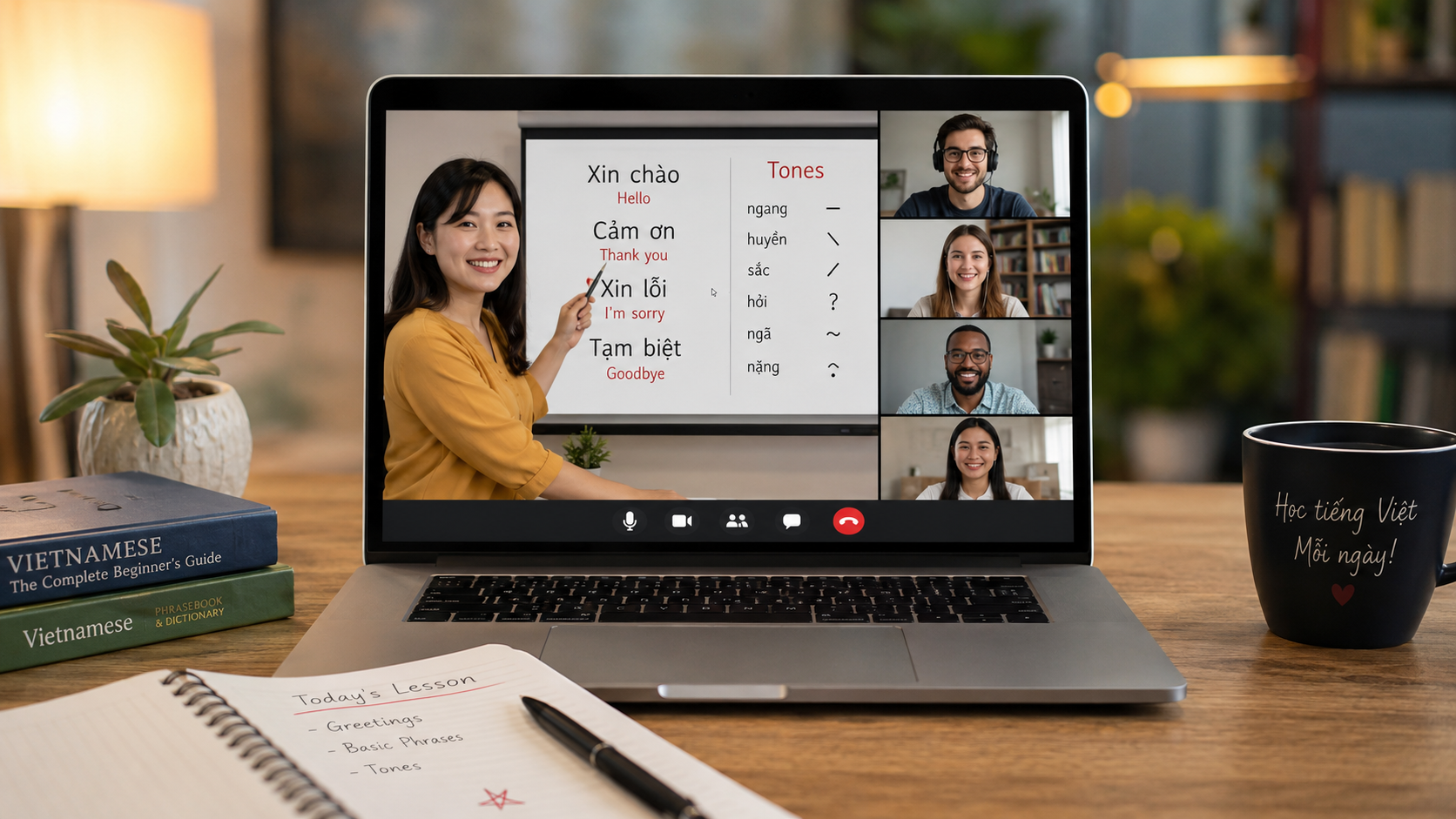
Introduction: Why Vietnamese Belongs in San Jose
In a city where you can move from a Silicon Valley office tower to a family-owned phở restaurant, from English to Spanish to Vietnamese in the space of a single afternoon, San Jose is not just a place where Vietnamese is spoken—it is one of the most meaningful places in the United States to learn it.
Vietnamese is not a distant or abstract language in San Jose. It lives in the rhythm of daily life. You hear it in restaurants, markets, family gatherings, cultural festivals, temples, churches, beauty salons, cafés, community centers, and small businesses. You feel it in the deep cultural presence of the Vietnamese American community, one of the most important and visible communities in the Bay Area.
For some students, learning Vietnamese begins with family. Maybe your parents or grandparents speak Vietnamese, but you grew up answering in English. Maybe you understand a little but feel shy speaking. Maybe you want to talk more naturally with relatives, ask better questions, understand family stories, or reconnect with a part of your identity that has always been present but not fully accessible.
For others, Vietnamese begins with travel. Vietnam has become one of the most exciting destinations in Asia, known for its food, landscapes, cities, history, hospitality, and energy. A few words of Vietnamese can transform a trip from simply visiting a country to actually engaging with it.
For professionals, especially in a diverse region like Silicon Valley, Vietnamese can also be a bridge. It can help build relationships with clients, colleagues, families, patients, students, customers, and community members. In a place like San Jose, language is not only about grammar. It is about trust, respect, and connection.
And for many adult learners, Vietnamese is simply fascinating. It is tonal, musical, elegant, compact, and deeply tied to culture. It may look approachable because it uses the Latin alphabet, but it quickly reveals a sound system and rhythm very different from English. That challenge is exactly what makes learning Vietnamese so rewarding.
If you have been searching for Vietnamese classes in San Jose, Vietnamese lessons online, Bay Area Vietnamese classes, or Vietnamese for beginners, live online lessons may be one of the best ways to start. You can learn from home, avoid traffic, study with a real instructor, receive immediate pronunciation feedback, and build confidence step by step.
At Polyglottist Language Academy, we believe Vietnamese should be taught as a living language—not as a list of isolated words, but as a real tool for speaking, listening, cultural understanding, and human connection.
Why San Jose Is One of the Best Places to Learn Vietnamese
San Jose has a unique relationship with Vietnamese language and culture. It is home to one of the largest Vietnamese communities outside Vietnam, and Vietnamese culture is woven into the city’s identity in a way that few American cities can match.
This matters for language learners.
When you study a language in a place where that language has a real presence, your learning becomes more alive. Vietnamese is not something you only encounter in a textbook or app. In San Jose, it surrounds you. You can study a phrase in class, then recognize it on a menu. You can learn how to order coffee, then practice at a Vietnamese café. You can learn food vocabulary, then walk into a restaurant and suddenly understand more than you did before.
San Jose’s Little Saigon and Vietnam Town areas are especially powerful for learners. These neighborhoods offer restaurants, bakeries, shops, markets, cultural spaces, and community institutions where Vietnamese is part of everyday life. Even beginner learners can benefit from this exposure. You may not understand everything, but you start noticing sounds, signs, greetings, family terms, honorifics, and patterns.
Language learning becomes easier when your brain has a reason to care. San Jose gives Vietnamese learners that reason every day.
You are not learning a random foreign language with no local context. You are learning a language that can help you understand your own city better.
Who Should Take Vietnamese Classes in San Jose?
Vietnamese classes can benefit many different kinds of learners. You do not need to have a family connection to Vietnam, and you do not need previous language-learning experience. What matters most is curiosity, consistency, and the willingness to practice.
Heritage Learners
Heritage learners are often some of the most emotionally motivated Vietnamese students. Many grew up hearing Vietnamese at home but did not receive formal instruction. They may understand common family phrases but struggle to respond. They may know food words, greetings, or emotional expressions, but feel lost in longer conversations.
For heritage learners, studying Vietnamese can feel deeply personal. It can help you speak with grandparents, understand your parents’ stories, participate more fully in family events, and connect with cultural traditions. It can also bring a sense of confidence. Instead of feeling embarrassed about what you do not know, you begin building the language step by step.
A good Vietnamese class for heritage learners should be patient, respectful, and practical. It should not assume that you know nothing, but it also should not shame you for gaps. Many heritage learners need help with pronunciation, tones, sentence structure, spelling, and confidence. Live online lessons are especially helpful because an instructor can hear what you already know and help you organize it into stronger communication.
Complete Beginners
Many adults begin Vietnamese with no background at all. They may be interested in travel, culture, food, history, business, or personal enrichment. Complete beginners need a clear, structured introduction that does not overwhelm them.
Vietnamese can feel intimidating at first because of tones and pronunciation. However, beginners can make real progress when they learn the sound system carefully from the beginning. A good beginner class should introduce greetings, basic sentence patterns, numbers, family terms, polite expressions, food vocabulary, and everyday questions. Most importantly, it should give students frequent opportunities to speak.
Vietnamese is not a language you can master by silently reading. You need to hear it, repeat it, receive correction, and try again.
Travelers to Vietnam
Vietnam is one of the most rewarding countries to visit, and even basic Vietnamese can make travel more meaningful. You do not need to become fluent before your trip. Learning greetings, numbers, directions, polite phrases, restaurant language, transportation vocabulary, and common travel questions can make a major difference.
When you speak even a little Vietnamese, you show respect. You also become less dependent on translation apps. You can greet people warmly, thank them properly, ask simple questions, and recognize common signs. In markets, restaurants, taxis, hotels, and cafés, basic Vietnamese can help you feel more confident and engaged.
Professionals and Community Workers
In San Jose and the greater Bay Area, Vietnamese can be useful in many professional contexts. Teachers, healthcare workers, social workers, legal professionals, customer service workers, business owners, nonprofit staff, and community organizers may all interact with Vietnamese-speaking families or clients.
Even if you are not fluent, learning Vietnamese can help you pronounce names more respectfully, understand basic greetings, and build stronger relationships. Language learning sends a message: I care enough to meet you partway.
In professional environments, that message can matter deeply.
Families and Teens
Vietnamese classes can also be valuable for families who want to preserve language across generations. Many Vietnamese American families worry that younger generations are losing the language. Teens may understand some Vietnamese but answer in English, or they may avoid speaking because they are afraid of making mistakes.
A structured class can help teens and adults gain confidence together. It can also make Vietnamese feel less like pressure and more like discovery.
Is Vietnamese Hard for English Speakers?
Vietnamese is challenging for English speakers, but it is not impossible. The difficulty comes from specific features of the language, especially tones, pronunciation, and listening comprehension.
The good news is that Vietnamese grammar is often more straightforward than many students expect. Vietnamese does not have verb conjugations in the way Spanish, French, Italian, or German do. You do not need to memorize different verb endings for “I go,” “he goes,” “we went,” or “they will go.” Vietnamese also does not have grammatical gender like French or Spanish, and it does not use noun cases like Russian or German.
So why does Vietnamese feel difficult?
The answer is sound.
Vietnamese is a tonal language, which means that tone affects meaning. A syllable can change meaning depending on pitch contour. For English speakers, this can be unfamiliar because English uses intonation to express emotion or emphasis, but not usually to distinguish completely different words.
Vietnamese also has vowel and consonant distinctions that require careful listening and practice. Some sounds may seem similar at first but are clearly different to native speakers. This is why pronunciation should not be treated as a minor detail. In Vietnamese, pronunciation is central.
A strong Vietnamese class should train your ear from the beginning. Students need to hear the differences, repeat them, receive correction, and learn how to physically produce the sounds. Apps can help with vocabulary, but they often cannot give the kind of precise, human correction that Vietnamese learners need.
Vietnamese Dialects: Northern, Central, and Southern
One important question for Vietnamese learners is dialect.
Vietnamese has several regional varieties, with three major categories often described as Northern, Central, and Southern Vietnamese. These varieties share the same writing system and core grammar, but they differ in pronunciation, vocabulary, and sometimes everyday expressions.
Northern Vietnamese, especially the Hanoi variety, is often presented as a standard form in many textbooks and formal learning materials. Southern Vietnamese, especially associated with Ho Chi Minh City and southern communities, is extremely common among Vietnamese speakers in the United States, including many Vietnamese American families. Central Vietnamese has its own distinctive features and can sound quite different to learners.
For students in San Jose, dialect can be especially important because many families and community members may speak Southern Vietnamese or another regional variety. Heritage learners often come to class wanting to understand the Vietnamese spoken by their own relatives. Travelers may want to focus on the variety most useful for the region of Vietnam they plan to visit.
The best approach is not to panic about dialects. Beginners should first build a foundation: tones, pronunciation, greetings, common vocabulary, sentence patterns, listening skills, and confidence. Over time, students can learn how dialects differ and become more flexible listeners.
A good instructor can explain which dialect is being taught and help students recognize major differences. This is one of the advantages of live instruction. Instead of guessing from an app or video, you can ask questions and receive practical explanations.
Why Live Online Vietnamese Lessons Work
Many students wonder whether online Vietnamese classes can really be effective. The answer is yes—if the class is live, interactive, and taught by a skilled instructor.
Online learning is not the same as passive video watching. A live online Vietnamese lesson gives you real-time interaction. You hear your instructor speak, respond to questions, practice pronunciation, read aloud, listen to classmates, and receive correction. This is very different from studying alone.
For San Jose students, online classes are especially convenient. Bay Area traffic can make in-person classes difficult, especially after work. A live online class allows you to study from home while still receiving structure and accountability.
You do not have to drive across the city. You do not have to search for parking. You do not have to choose between language learning and a busy schedule. You can log in from your home, office, or quiet study space and spend your class time actually learning.
Live online Vietnamese lessons offer several major benefits:
They give you immediate pronunciation feedback.
They keep you accountable.
They allow you to practice speaking regularly.
They provide structure and progression.
They help you avoid bad habits.
They make learning possible even with a busy schedule.
They connect you with classmates who share your goals.
For a tonal language like Vietnamese, feedback is especially important. If you practice tones incorrectly for months, those mistakes can become harder to fix. A live instructor can catch problems early and help you adjust.
Why Apps Are Not Enough
Language apps can be useful. They can introduce vocabulary, help with repetition, and make daily practice easier. However, apps are limited, especially for Vietnamese.
Vietnamese pronunciation requires careful attention. You need to know whether your tones are understandable. You need to hear subtle differences. You need someone to explain what your mouth, tongue, breath, and pitch should be doing. An app may tell you that an answer is right or wrong, but it usually cannot diagnose why your pronunciation sounds unclear.
Apps also tend to isolate language into small exercises. Real conversation is different. You need to understand people at natural speed. You need to respond. You need to form sentences, ask questions, make mistakes, recover, and keep speaking.
That is why live online classes are so valuable. They combine structure with interaction. You still learn vocabulary and grammar, but you learn them in a communicative environment.
The goal is not just to recognize Vietnamese. The goal is to use it.
What You Learn in a Beginner Vietnamese Class
A beginner Vietnamese class should give you a foundation that feels practical and encouraging. Students should not be buried in abstract grammar before they can say anything useful. At the same time, they need enough structure to understand how the language works.
In a complete beginner Vietnamese course, you may learn:
Basic greetings and polite expressions
How to introduce yourself
Numbers and simple counting
Family terms
Common questions and answers
Pronunciation and tones
Food and restaurant vocabulary
Basic sentence structure
Everyday verbs and useful phrases
How to ask for clarification
Cultural etiquette and polite forms of address
One of the most important parts of Vietnamese is learning how people address each other. Vietnamese uses kinship terms and social relationships in ways that are very different from English. The word you use for “you” or “I” may depend on age, relationship, and context. This can feel confusing at first, but it is also one of the most culturally rich parts of the language.
Learning Vietnamese helps you understand not only how to speak, but how Vietnamese society organizes respect, closeness, family, and politeness.
Vietnamese and Culture: Why Language Opens the Door
You cannot separate Vietnamese from Vietnamese culture. Every language carries a worldview, and Vietnamese is deeply connected to family, respect, hospitality, food, history, and community.
In San Jose, this cultural dimension is especially visible. Vietnamese food culture alone offers a powerful reason to learn the language. Many students already love phở, bánh mì, bún bò Huế, cơm tấm, gỏi cuốn, bánh xèo, Vietnamese coffee, and countless regional dishes. But when you learn Vietnamese, food becomes more than something you order. You begin to understand names, ingredients, regional identities, and social rituals.
Vietnamese also gives you deeper access to holidays and traditions, especially Tết, the Vietnamese Lunar New Year. Tết is not only a celebration. It is a time of family reunion, honoring ancestors, giving blessings, visiting relatives, sharing food, and beginning the year with intention. Learning Vietnamese helps you understand the greetings, wishes, and customs that surround this holiday.
For heritage learners, culture may be the strongest motivation of all. Language can unlock family stories, jokes, memories, songs, prayers, recipes, and emotional expressions that do not translate easily into English.
For non-heritage learners, Vietnamese offers a way to engage more respectfully with a culture that has shaped San Jose and the Bay Area in profound ways.
How Long Does It Take to Learn Vietnamese?
The timeline depends on your goals, schedule, background, and consistency.
If your goal is to learn basic greetings, simple travel phrases, numbers, and restaurant language, you can begin using Vietnamese fairly quickly. Within a few weeks of focused study, many students can introduce themselves, recognize common words, and participate in simple guided conversations.
If your goal is everyday conversational comfort, expect a longer journey. Vietnamese pronunciation and listening skills take time. You may understand written phrases before you can catch them in natural speech. You may know vocabulary but struggle to hear tones clearly. This is normal.
For most English speakers, Vietnamese requires months of consistent study to feel comfortable in basic conversations, and longer to reach strong fluency. The key is not to rush. The key is to build accurate habits early.
A good study routine might include one live class per week, short daily pronunciation practice, listening to Vietnamese audio, reviewing vocabulary, and trying small real-world interactions when possible.
Consistency matters more than intensity. Ten minutes a day can be more effective than two hours once a month.
Why Small-Group Classes Are Ideal
Small-group Vietnamese classes offer a strong balance between structure, affordability, and personal attention.
Private lessons are excellent for students who need fully customized instruction, but they can be more expensive. Large classes may be cheaper, but students often receive less speaking time and less correction. Small groups offer the best of both worlds.
In a small group, you can:
Practice speaking every class
Hear other learners’ questions
Receive individual feedback
Stay motivated through group energy
Learn in a supportive environment
Build confidence gradually
Benefit from structure without feeling anonymous
For adult learners, this matters. Many adults feel nervous about speaking a new language. They worry about sounding foolish, mispronouncing words, or being slower than others. A small, friendly group helps reduce that anxiety. You realize that everyone is learning, everyone makes mistakes, and mistakes are part of the process.
Vietnamese requires courage because you have to use your voice in a new way. A supportive class makes that possible.
Learning Vietnamese for Travel
If you are planning a trip to Vietnam, Vietnamese classes can make your experience much richer. Vietnam is full of extraordinary places: Hanoi, Ho Chi Minh City, Hội An, Huế, Đà Nẵng, Sapa, Ninh Bình, Phú Quốc, the Mekong Delta, Hạ Long Bay, and countless smaller towns and villages.
English may be available in tourist areas, but Vietnamese is still incredibly useful. It helps you greet people, order food, ask prices, understand directions, and show respect. Even when people respond in English, they often appreciate the effort.
For travelers, the most useful Vietnamese includes:
Greetings
Thank-you phrases
Numbers
Food words
Directions
Transportation phrases
Hotel vocabulary
Shopping expressions
Emergency phrases
Polite requests
Learning the language also helps you behave more respectfully. You understand how to address people, how to soften requests, and how to avoid sounding too abrupt.
Travel becomes less transactional and more human.
Learning Vietnamese for Family Connection
For Vietnamese American students, the language can carry emotional weight. Many heritage learners have memories of hearing Vietnamese at home, at family parties, in kitchens, in temples or churches, at community events, or during phone calls with relatives. But understanding is not always the same as speaking.
Some students feel embarrassed that they cannot respond fluently. Others feel that learning Vietnamese as an adult is somehow “too late.” It is not too late.
In fact, adult heritage learners often bring deep motivation. They know exactly why the language matters. They want to ask grandparents about the past. They want to understand family humor. They want to speak to relatives during visits to Vietnam. They want to pass something on to their children. They want to feel more whole.
A Vietnamese class can be a gentle way to begin reclaiming that connection. You do not need to become perfect. Every phrase matters. Every conversation matters. Every step brings you closer.
Learning Vietnamese for Work and Community
San Jose is a multilingual, multicultural city. In many fields, Vietnamese can be a meaningful professional skill.
Teachers may work with Vietnamese-speaking families. Healthcare providers may interact with Vietnamese-speaking patients. Business owners may serve Vietnamese-speaking customers. Nonprofit workers may support community members. Lawyers, real estate professionals, social workers, and public service employees may all benefit from basic Vietnamese knowledge.
Even limited language ability can improve communication. Being able to greet someone, pronounce a name correctly, or understand basic cultural expectations can create trust.
Language is not only a technical skill. It is a relationship skill.
How to Choose the Right Vietnamese Class
When searching for Vietnamese classes in San Jose or online Vietnamese classes for adults, look for a program that offers more than vocabulary lists.
A strong Vietnamese class should include:
Live instruction
A native or highly proficient instructor
Pronunciation and tone correction
Speaking practice
Clear structure
Cultural context
Small class size
Beginner-friendly pacing
Opportunities for questions
Supportive feedback
You should also ask about dialect. Does the class teach Northern Vietnamese, Southern Vietnamese, or another variety? Does the instructor explain dialect differences? Can heritage learners focus on the Vietnamese spoken by their family?
The best class is one that matches your goals. A traveler, a heritage learner, and a professional may all study Vietnamese, but they may need different examples, vocabulary, and cultural explanations.
Why Start Now?
Many adults postpone language learning because they are waiting for the perfect time. They tell themselves they will start when work slows down, when the kids are older, before the next trip, after the holidays, or when they have more energy.
But language learning does not require a perfect life. It requires a beginning.
One live class per week can create momentum. A few phrases can become a conversation. A few minutes of practice can become a habit. A language that once felt distant can begin to feel familiar.
Vietnamese rewards patience. It also rewards humility. You will make mistakes. You will mispronounce words. You will confuse tones. You will forget vocabulary. Then, slowly, you will improve.
One day you will understand a phrase you used to miss. You will order something with more confidence. You will recognize a word on a sign. You will speak to a relative and feel less blocked. You will hear Vietnamese not as noise, but as language.
That moment is worth the effort.
Learn Vietnamese with Polyglottist Language Academy
At Polyglottist Language Academy, we offer live online Vietnamese classes designed for adult learners, beginners, heritage learners, travelers, and curious students throughout San Jose, San Francisco, Oakland, Berkeley, and beyond.
Our classes are small, interactive, and taught with attention to real communication. We believe language learning should be practical, personal, and culturally rich. Students do not simply memorize words. They learn how to speak, listen, understand, and connect.
Whether you are starting from zero, reconnecting with your heritage, preparing for travel to Vietnam, or looking for meaningful language study from home, our online Vietnamese lessons can help you build a strong foundation.
We also offer a wide range of other language classes, including French, Italian, Spanish, German, Japanese, Korean, Mandarin Chinese, Portuguese, Russian, Dutch, Tagalog, and more depending on instructor availability and student demand.
If you are in San Jose and looking for Vietnamese classes that are convenient, live, supportive, and beginner-friendly, we invite you to join Polyglottist Language Academy.
Start speaking Vietnamese with a real instructor. Build confidence in pronunciation. Learn the culture behind the words. Join a small online class and take the first step today.
FAQs About Vietnamese Classes in San Jose
How long does it take to learn Vietnamese?
It depends on your goals and consistency. Beginners can learn greetings, numbers, simple phrases, and basic conversations fairly quickly. However, becoming comfortable in everyday conversation usually takes many months of steady practice. Vietnamese pronunciation and tones require time, so regular live feedback is very helpful.
Is Vietnamese hard for English speakers?
Vietnamese can be challenging because it is tonal and has sounds that do not exist in English. However, the grammar is often more approachable than students expect. Vietnamese does not have verb conjugations like many European languages, and it does not use grammatical gender. The biggest challenge is usually pronunciation and listening.
Can I learn Vietnamese online effectively?
Yes. Live online Vietnamese lessons can be very effective when they include real-time speaking practice, pronunciation correction, listening exercises, and interaction with an instructor. Online classes are especially convenient for San Jose and Bay Area students who want to avoid commuting.
Are Vietnamese classes good for complete beginners?
Yes. A beginner Vietnamese class is ideal for students with no previous experience. A good class will start with pronunciation, tones, greetings, basic sentence patterns, and practical vocabulary.
Are Vietnamese classes helpful for heritage learners?
Absolutely. Heritage learners often understand some Vietnamese but need help speaking, reading, writing, or organizing what they know. A live class can help heritage learners build confidence and reconnect with family language in a structured way.
What dialect of Vietnamese should I learn?
Vietnamese has Northern, Central, and Southern varieties. The best dialect depends on your goals. Heritage learners may want to focus on the dialect their family speaks. Travelers may choose based on where they plan to visit in Vietnam. A good instructor can explain dialect differences and help students understand the variety most relevant to them.
Can Vietnamese help me travel in Vietnam?
Yes. Even basic Vietnamese can make travel more enjoyable and respectful. You can learn greetings, restaurant phrases, numbers, directions, shopping expressions, and polite requests. Speaking even a little Vietnamese often creates warmer interactions.
Are small-group Vietnamese classes better than private lessons?
Both can be effective. Private lessons offer full personalization, while small-group classes provide structure, interaction, motivation, and affordability. For many adult learners, small groups are an excellent choice because they offer speaking practice and personal feedback in a supportive setting.
Will I practice speaking in class?
Yes. Speaking practice is essential for Vietnamese, especially because tones and pronunciation matter so much. A strong class should give students regular opportunities to speak, repeat, ask questions, and receive correction.
Continue Reading on the Polyglottist Blog
If you are interested in language learning, pronunciation, online classes, or beginner-friendly study strategies, you may also enjoy these articles from the Polyglottist Language Academy blog: