
The Fastest Way to Start Speaking Russian as an Absolute Beginner
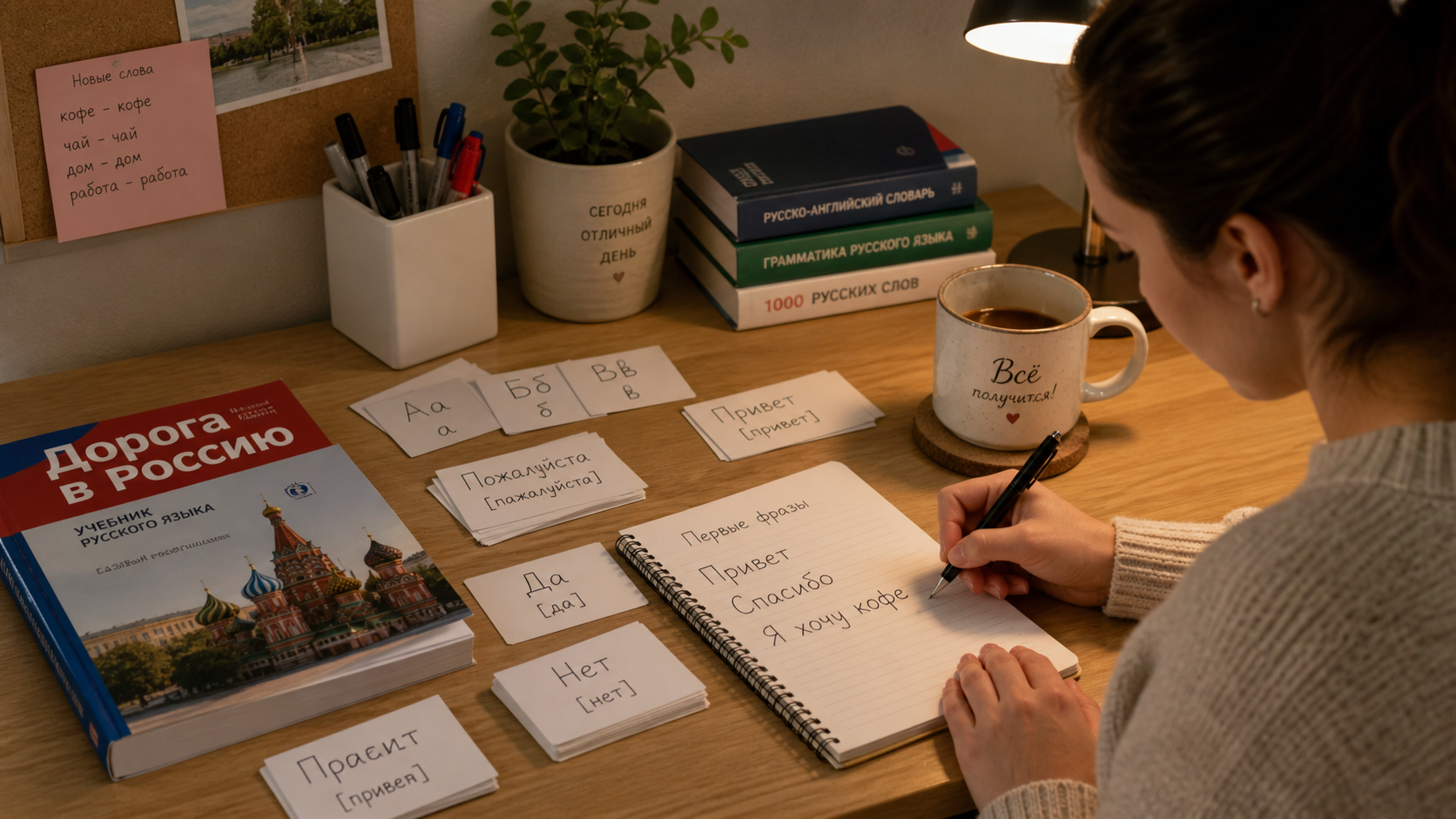
If you have ever looked at a Russian word, seen a row of unfamiliar Cyrillic letters staring back at you like a secret code, heard someone say that Russian has six cases, unpredictable stress, difficult pronunciation, and verbs of motion, and then quietly wondered whether you should choose an “easier” language instead, you are not alone. Russian has a reputation for being intense. It looks different. It sounds different. It does not give English speakers the comfortable familiarity of Spanish, French, Italian, or even German. There is no immediate sense of, “Oh, I can guess this.” Instead, many absolute beginners feel as though they are standing outside a heavy wooden door with no key, listening to a beautiful but mysterious language happening somewhere on the other side.
But here is the good news: you do not need to master Russian before you start speaking Russian.
In fact, waiting until you “understand the grammar” before speaking is one of the slowest ways to begin. Russian grammar is deep, fascinating, and important — but it is not something you conquer before you say your first sentence. It is something you gradually grow into. If your goal is to start speaking as quickly as possible, the fastest path is not to memorize every declension table. It is to learn a small number of useful tools and begin using them immediately.
An absolute beginner can start speaking Russian within days by focusing on four things: the Cyrillic alphabet, high-frequency phrases, simple sentence patterns, and short daily speaking practice. You will not sound elegant at first. You will make mistakes. You will forget endings. You may pronounce a few words strangely. That is completely normal. The goal in the beginning is not perfection. The goal is movement.
The first breakthrough in Russian is not fluency. It is the moment you realize: “I can actually say something.”
That moment matters. It changes the way you feel about the language. Russian stops being an impossible wall and becomes a system you can enter, one small sentence at a time.
Why Russian Feels So Intimidating at the Beginning
Russian is often classified as one of the more difficult languages for English speakers. That does not mean it is impossible. It means that it requires more time, structure, and patience than languages that are closer to English. The Cyrillic alphabet, the case system, verb conjugations, grammatical gender, unfamiliar sounds, and flexible word order can all make Russian feel overwhelming at first.
For an absolute beginner, the first emotional obstacle is usually the alphabet. Before you even begin grammar, you are faced with letters like Ж, Щ, Ы, Ю, and Я. Some letters look like English letters but sound different. For example, Russian В sounds like English “v,” Н sounds like “n,” and Р sounds like a rolled or tapped “r.” This can create a strange feeling: you think you recognize the letters, but they betray you.
Then comes pronunciation. Russian has sounds that English speakers often find difficult: ы, х, the rolled р, and the difference between hard and soft consonants. Russian also has mobile stress, which means the stressed syllable is not always predictable. Stress matters because it affects vowel pronunciation. A word may look simple, but if you stress the wrong syllable, it may sound unnatural or even become hard to understand.
And then there is grammar. Russian has six cases, which means nouns, pronouns, and adjectives change form depending on how they are used in a sentence. Beginners often hear this and panic. They imagine that they must learn all the endings before speaking. But this is not true.
In the first week, you do not need to master the full case system. You do not need to understand every verb of motion. You do not need to explain perfective and imperfective aspect. You do not need to read Tolstoy in the original. What you need is much simpler.
You need to learn how to say hello.
You need to introduce yourself.
You need to say what you want.
You need to say what you like.
You need to ask where something is.
You need to say that you do not understand.
You need to get comfortable hearing your own voice in Russian.
That is where speaking begins.
The Fastest Realistic Path to Speaking Russian
The fastest way to start speaking Russian is not to study randomly. It is to follow a very specific order:
Learn the Cyrillic alphabet well enough to read basic words.
Learn a small set of essential phrases.
Memorize a few flexible sentence patterns.
Practice speaking out loud every day.
Add grammar gradually when it helps you say more.
This order matters. Many beginners make the mistake of starting with grammar as an abstract system. They begin with noun genders, then cases, then verb conjugations, then adjective endings, and by the time they reach actual speaking, they are exhausted and insecure. They know rules, but they cannot say anything spontaneously.
A communication-first approach works better for absolute beginners. This does not mean ignoring grammar. It means learning grammar through useful sentences.
For example, instead of beginning with a full explanation of the accusative case, you can learn:
Я хочу чай.
Ya khochu chai.
I want tea.
Я хочу кофе.
Ya khochu kofe.
I want coffee.
Я хочу воду.
Ya khochu vodu.
I want water.
You can use this pattern immediately. Later, you can learn why вода becomes воду in this sentence. But you do not need the full explanation before you can say it.
The same is true with:
У меня есть телефон.
U menya yest’ telefon.
I have a phone.
Мне нравится музыка.
Mne nravitsya muzyka.
I like music.
Где метро?
Gde metro?
Where is the metro?
These sentence patterns give you speaking power. They allow you to substitute new words and create new sentences before you fully understand every grammatical mechanism behind them.
That is how real beginner progress happens: not by memorizing the whole language, but by learning small pieces you can actually use.
Should You Learn Cyrillic First?
Yes — but do not let Cyrillic delay your speaking.
The best approach is to learn Cyrillic early while also beginning to speak simple phrases. You do not need to read quickly at first. You simply need to begin recognizing the letters and connecting Russian sounds with Russian spelling.
Some beginners want to avoid Cyrillic and use transliteration only. Transliteration means writing Russian words with Latin letters, such as spasibo for спасибо or privet for привет. This can be useful for the first few days, especially if it helps you say phrases without freezing. But transliteration should be temporary.
The problem with relying too long on transliteration is that it teaches Russian through English spelling habits. Russian pronunciation is not English pronunciation. If you keep reading Russian through Latin letters, your pronunciation may become worse, and real Russian texts will continue to feel intimidating.
A practical compromise looks like this:
During the first week, use transliteration when needed, but always place it next to the Cyrillic. For example:
Здравствуйте
Zdravstvuyte
Hello / Good day
Спасибо
Spasibo
Thank you
Я не понимаю.
Ya ne ponimayu.
I don’t understand.
Your goal is not to become a fast reader immediately. Your goal is to stop being afraid of the alphabet. With 15–20 minutes of focused practice per day, many learners can begin reading simple Russian words within one or two weeks.
Start with letters that are familiar or nearly familiar:
А, О, К, М, Т look and sound similar to English.
Then learn the “false friends”:
В = v
Н = n
Р = r
С = s
У = u
Х = kh
Then move into the uniquely Cyrillic letters:
Ж, Ц, Ч, Ш, Щ, Ы, Ю, Я, Ё
Do not try to perfect everything in one sitting. Learn the alphabet in layers. Every day, read a few real words. Your brain will adjust faster than you expect.
The Essential Russian Phrases to Learn First
In the beginning, you need phrases that help you enter real interactions. You do not need obscure vocabulary. You need words and expressions that you can imagine using in a classroom, café, airport, shop, or conversation with a Russian speaker.
Start with greetings:
Привет.
Privet.
Hi.
Здравствуйте.
Zdravstvuyte.
Hello. / Good day. Formal.
Доброе утро.
Dobroye utro.
Good morning.
Добрый день.
Dobryy den’.
Good afternoon.
Добрый вечер.
Dobryy vecher.
Good evening.
Then learn polite phrases:
Спасибо.
Spasibo.
Thank you.
Пожалуйста.
Pozhaluysta.
Please. / You’re welcome.
Извините.
Izvinite.
Excuse me. / Sorry.
Да.
Da.
Yes.
Нет.
Net.
No.
Then learn survival phrases:
Я не понимаю.
Ya ne ponimayu.
I don’t understand.
Повторите, пожалуйста.
Povtorite, pozhaluysta.
Repeat, please.
Медленнее, пожалуйста.
Medlenneye, pozhaluysta.
More slowly, please.
Вы говорите по-английски?
Vy govorite po-angliyski?
Do you speak English?
Как это сказать по-русски?
Kak eto skazat’ po-russki?
How do you say this in Russian?
Then learn basic interaction phrases:
Меня зовут…
Menya zovut…
My name is…
Я из Америки.
Ya iz Ameriki.
I am from America.
Я учу русский.
Ya uchu russkiy.
I am learning Russian.
Я немного говорю по-русски.
Ya nemnogo govoryu po-russki.
I speak a little Russian.
These phrases are not just vocabulary. They are confidence builders. When you can say “I don’t understand” or “Please repeat,” you are no longer helpless. You have tools to manage conversation.
The First Sentence Patterns That Give You Speaking Power
The fastest way to start speaking Russian is to learn patterns, not isolated words. A pattern is a sentence frame that you can reuse again and again.
Pattern 1: “My name is…”
Меня зовут Ольга.
Menya zovut Olga.
My name is Olga.
This is one of the first phrases every beginner should learn. Notice that Russian does not literally say “my name is.” It says something closer to “they call me.” Do not worry about the grammar yet. Memorize the phrase as a whole.
Pattern 2: “I am from…”
Я из Калифорнии.
Ya iz Kalifornii.
I am from California.
Я из Нидерландов.
Ya iz Niderlandov.
I am from the Netherlands.
Я из США.
Ya iz SShA.
I am from the USA.
This gives you an easy way to talk about yourself.
Pattern 3: “I want…”
Я хочу кофе.
Ya khochu kofe.
I want coffee.
Я хочу чай.
Ya khochu chai.
I want tea.
Я хочу билет.
Ya khochu bilet.
I want a ticket.
This is one of the most useful beginner structures. You can use it in cafés, shops, train stations, and simple conversations.
Pattern 4: “I need…”
Мне нужно такси.
Mne nuzhno taksi.
I need a taxi.
Мне нужен врач.
Mne nuzhen vrach.
I need a doctor.
Мне нужна помощь.
Mne nuzhna pomoshch’.
I need help.
This pattern introduces gender agreement, but you can learn the most common phrases as chunks first. Later, your teacher can explain why нужно, нужен, and нужна change.
Pattern 5: “I have…”
У меня есть телефон.
U menya yest’ telefon.
I have a phone.
У меня есть вопрос.
U menya yest’ vopros.
I have a question.
У меня есть билет.
U menya yest’ bilet.
I have a ticket.
Russian does not use “I have” the same way English does. It literally says something like “At me there is…” But again, do not start with the abstract explanation. Learn the pattern first.
Pattern 6: “I like…”
Мне нравится кофе.
Mne nravitsya kofe.
I like coffee.
Мне нравится музыка.
Mne nravitsya muzyka.
I like music.
Мне нравится русский язык.
Mne nravitsya russkiy yazyk.
I like the Russian language.
This is a beautiful and useful structure. It also helps you begin expressing preferences.
Pattern 7: “Where is…?”
Где туалет?
Gde tualet?
Where is the restroom?
Где метро?
Gde metro?
Where is the metro?
Где кафе?
Gde kafe?
Where is the café?
With one word — где — you can ask many useful questions.
Pattern 8: “Can I…?”
Можно?
Mozhno?
May I? / Is it allowed?
Можно здесь сидеть?
Mozhno zdes’ sidet’?
Can I sit here?
Можно кофе?
Mozhno kofe?
Can I have coffee?
Можно открыть окно?
Mozhno otkryt’ okno?
Can I open the window?
This is one of the most useful words in Russian. Beginners can use можно constantly.
What Vocabulary Should You Learn First?
The best beginner vocabulary is not a random list of 500 words. It is vocabulary that fits inside the sentence patterns you are learning.
For example, if you learn Я хочу…, then learn words you might actually want:
вода — water
кофе — coffee
чай — tea
суп — soup
хлеб — bread
билет — ticket
такси — taxi
номер — room / number
помощь — help
If you learn Где…?, then learn places:
дом — house / home
кафе — café
магазин — store
метро — metro
аптека — pharmacy
отель — hotel
ресторан — restaurant
улица — street
вокзал — train station
If you learn Мне нравится…, then learn things you might like:
музыка — music
кино — cinema / movies
книга — book
город — city
еда — food
русский язык — Russian language
This is how vocabulary becomes active. You are not just memorizing “coffee” as an isolated word. You are learning how to say, “I want coffee,” “I like coffee,” “Where is the café?” and “Can I have coffee?”
The fastest beginners are not the ones who memorize the most words. They are the ones who know how to use the words they learn.
Pronunciation: What to Fix Early and What Can Wait
Russian pronunciation does not need to be perfect at the beginning, but you should pay attention to it from day one. Bad habits are easier to prevent than to correct later.
The first priority is stress. Russian stress can fall on different syllables, and it is not always predictable from spelling. For example, the word хорошо is pronounced khorosho, with stress on the final syllable: kharaSHO. If you stress the wrong syllable, the word may sound strange.
When you learn a new word, learn its stress. Say it out loud. Listen to audio. Repeat it several times.
The second priority is difficult sounds.
The Russian р is rolled or tapped. You do not need a perfect dramatic trill immediately, but you should avoid using a heavy English “r.” Even a light tapped sound is better.
The Russian х is like the sound in Scottish “loch” or German “Bach.” It is not the English “h.” Practice it gently from the back of your throat.
The Russian ы is one of the hardest vowels for English speakers. It is not “ee.” It is pronounced with the tongue pulled back. Beginners often struggle with it, and that is normal. Do not panic. Practice it slowly, especially in words like вы (vy, you formal/plural) and мы (my, we).
Soft and hard consonants also matter, but you do not need to master all of them immediately. Start by noticing that Russian consonants can have a “plain” version and a softened version. Over time, your ear will improve.
The best beginner pronunciation methods are simple:
Listen.
Repeat.
Shadow.
Record yourself.
Compare with native audio.
Repeat again.
Five minutes of pronunciation practice per day is better than one long session once a month.
How to Practice Speaking as a Complete Beginner
Many beginners think they need a conversation partner before they can practice speaking. A teacher or tutor is extremely helpful, but you can begin speaking alone.
Start with listen-and-repeat practice. Take one short phrase, listen to it, and repeat it five to ten times. Focus on rhythm, not just individual sounds.
Then do shadowing. Shadowing means you play a short audio phrase and speak along with it or immediately after it. This trains your mouth and ear together.
Next, practice self-talk. This may feel silly, but it works. Say simple things out loud:
Меня зовут…
My name is…
Я из…
I am from…
Я учу русский.
I am learning Russian.
Я хочу кофе.
I want coffee.
Мне нравится музыка.
I like music.
You can also create mini-dialogues:
Здравствуйте.
Hello.
Здравствуйте. Как вас зовут?
Hello. What is your name?
Меня зовут Анна.
My name is Anna.
Очень приятно.
Nice to meet you.
Practice both sides. Ask and answer. This helps you prepare for real conversations.
If you are studying with a teacher, ask for controlled speaking practice. Absolute beginners do not need open-ended conversations about politics or literature. They need structured speaking: introductions, simple questions, short answers, role plays, and pronunciation correction.
Low-pressure speaking is key. You should not feel as though every mistake is a disaster. The first stage of speaking Russian is not about sounding smart. It is about building the habit of producing the language.
What Grammar Should Beginners Learn First?
Russian grammar is important. But the order matters.
In the beginning, learn “just enough grammar” to support the sentences you are actually using.
Start with pronouns:
я — I
ты — you informal
он — he
она — she
мы — we
вы — you formal / plural
они — they
Then learn a few common verbs in the present tense:
говорить — to speak
понимать — to understand
хотеть — to want
любить — to love / like
учить — to learn / study
You do not need every verb form at once. Start with forms you can use:
Я говорю. — I speak.
Я понимаю. — I understand.
Я не понимаю. — I don’t understand.
Я хочу. — I want.
Я учу русский. — I am learning Russian.
Next, learn noun gender. Russian nouns are masculine, feminine, or neuter. This matters for adjectives and some sentence patterns. But again, do not turn this into a month-long grammar prison. Learn the basic idea:
Many masculine nouns end in a consonant: дом — house.
Many feminine nouns end in -а or -я: книга — book.
Many neuter nouns end in -о or -е: окно — window.
Then learn cases gradually through useful phrases. Do not try to memorize all six cases before speaking. Start with phrases you need:
Я из Америки. — I am from America.
Я хочу воду. — I want water.
Я живу в Москве. — I live in Moscow.
У меня есть вопрос. — I have a question.
Each of these contains grammar. But you learn it in context.
Grammar should make you more powerful, not more afraid.
A 7-Day Plan to Start Speaking Russian
Here is a realistic one-week plan for an absolute beginner. You can spend 20–30 minutes per day. More is helpful, but consistency matters most.
Day 1: Meet the Alphabet and Say Your First Words
Learn 10–15 Cyrillic letters. Focus on letters that look familiar and a few common new ones.
Practice reading:
мама — mama
там — there
кот — cat
дом — house
Learn:
Привет. — Hi.
Пока. — Bye.
Спасибо. — Thank you.
Да. — Yes.
Нет. — No.
Speaking task: Say each phrase five times out loud.
Day 2: Introduce Yourself
Review the alphabet. Add more letters.
Learn:
Меня зовут… — My name is…
Я из… — I am from…
Я учу русский. — I am learning Russian.
Speaking task: Create a three-sentence self-introduction.
Example:
Привет. Меня зовут Мария. Я из Калифорнии. Я учу русский.
Day 3: Say What You Want
Learn:
Я хочу… — I want…
Add useful nouns:
кофе — coffee
чай — tea
вода — water
хлеб — bread
билет — ticket
Speaking task: Say five sentences beginning with Я хочу…
Day 4: Say What You Have
Learn:
У меня есть… — I have…
Add nouns:
телефон — phone
вопрос — question
книга — book
билет — ticket
друг — friend
Speaking task: Say five true or imaginary sentences.
У меня есть телефон.
У меня есть вопрос.
Day 5: Ask Where Things Are
Learn:
Где…? — Where is…?
Add places:
метро — metro
кафе — café
магазин — store
отель — hotel
туалет — restroom
Speaking task: Ask five questions.
Где метро?
Где кафе?
Day 6: Make Polite Requests
Learn:
Можно…? — May I? / Can I?
Пожалуйста. — Please.
Извините. — Excuse me.
Practice:
Можно кофе? — Can I have coffee?
Можно здесь сидеть? — Can I sit here?
Можно открыть окно? — Can I open the window?
Speaking task: Practice a short café dialogue.
Day 7: Review and Record Yourself
Review all phrases from the week.
Record a 60-second self-talk:
Say your name, where you are from, that you are learning Russian, what you want, what you like, and one question.
Example:
Привет. Меня зовут Анна. Я из США. Я учу русский. Я хочу кофе. Мне нравится музыка. Где кафе? Спасибо.
It will not be perfect. That is fine. The goal is to speak.
Common Mistakes Beginners Make
The first mistake is trying to learn all Russian grammar before speaking. This creates a false sense that speaking is something you earn only after months of study. In reality, speaking should begin early, even if it is simple.
The second mistake is using apps silently. Apps can be helpful, but if you only tap, swipe, and recognize words, you are not training your mouth to speak. Say everything out loud.
The third mistake is learning isolated vocabulary. A list of 100 Russian nouns is less useful than 20 words you can use in real sentence patterns.
The fourth mistake is ignoring pronunciation. You do not need a perfect accent, but you do need to listen carefully and imitate early.
The fifth mistake is depending too long on transliteration. Use it briefly if needed, but move toward Cyrillic as soon as possible.
The sixth mistake is expecting fast fluency. You can start speaking quickly, but fluency takes time. There is a difference between “I can say useful things” and “I can discuss complex topics naturally.” Both are valuable milestones, but they are not the same.
The seventh mistake is fear. Many adults are terrified of sounding foolish. But every fluent speaker once sounded like a beginner. Mistakes are not proof that you are bad at Russian. They are proof that you are using it.
What Can You Realistically Say After One Week, One Month, and Three Months?
After one week, a motivated beginner can usually say basic greetings, introduce themselves, ask a few simple questions, say what they want, and recognize some Cyrillic. You will still be slow, but you will have started.
After one month, you may be able to read simple words, understand classroom phrases, handle basic introductions, talk about what you like, ask where things are, and participate in short scripted dialogues. You may also begin understanding basic grammar patterns.
After three months of consistent study, especially with a teacher or structured class, you may be able to hold simple beginner conversations: introducing yourself, talking about your routine, ordering food, asking basic questions, describing likes and dislikes, and understanding slow, clear Russian in familiar contexts.
You will not be fluent in three months. But you can become much less afraid. You can build a foundation that makes future progress possible.
Why a Russian Class Can Help You Speak Faster
Self-study can take you far, especially if you are disciplined. But a good Russian class can accelerate your progress because it gives you structure, correction, and speaking practice.
A teacher can help you pronounce difficult sounds before bad habits become permanent. A class gives you a clear sequence, so you are not wasting time wondering what to study next. You also get accountability. It is much easier to stay consistent when someone expects you to show up and practice.
Most importantly, a class gives you guided speaking. Absolute beginners often do not know how to practice conversation alone. A skilled instructor can create simple, manageable speaking tasks that match your level: greetings, short dialogues, question-and-answer practice, pronunciation drills, and role plays.
The right beginner Russian class should not bury you in grammar from the first minute. It should give you enough grammar to understand what you are saying, but also encourage you to speak early and often.
Russian is challenging, but it becomes much more manageable when you are not learning it alone.
Final Thoughts: The Fastest Way Is the Most Practical Way
The fastest way to start speaking Russian is not magic. It is not a secret app, a perfect textbook, or a promise of fluency in ten days. It is a practical sequence:
Learn the alphabet early.
Memorize useful phrases.
Practice flexible sentence patterns.
Speak out loud every day.
Use grammar as a tool, not a wall.
Accept mistakes as part of the process.
Russian may be difficult in the long run, but your first steps do not have to be complicated. You do not need to wait until you understand every case ending. You do not need to read literature. You do not need to sound like a native speaker. You simply need to begin.
Say Привет.
Say Меня зовут…
Say Я учу русский.
Say Я хочу кофе.
Say Я не понимаю.
Say something.
That is how Russian begins: not with perfection, but with your first brave sentence.
Learn Russian with Polyglottist Language Academy
If you want to start speaking Russian with structure, guidance, and real support, Polyglottist Language Academy offers Russian classes for adults in small, interactive groups. Our classes are designed to help students build practical communication skills while also developing a strong foundation in grammar, pronunciation, reading, and listening.
Whether you are an absolute beginner or returning to Russian after time away, studying with an experienced instructor can help you avoid confusion, stay motivated, and begin speaking with more confidence. Instead of trying to figure out the alphabet, pronunciation, grammar, and speaking practice alone, you can follow a clear path with a teacher who knows how to guide adult learners step by step.
If you are ready to begin your Russian journey, we invite you to explore our Russian classes and sign up for the level that fits you best.
FAQs About Starting to Speak Russian as a Beginner
Can I start speaking Russian before I know the alphabet?
Yes, but you should learn Cyrillic early. You can use transliteration for a few essential phrases at the very beginning, but relying on it too long will slow your reading and pronunciation. The best approach is to speak simple phrases while gradually learning to read Cyrillic.
How long does it take to learn the Russian alphabet?
Many beginners can learn to recognize the alphabet within a few days and begin reading simple words within one or two weeks. Reading smoothly takes longer, but the first breakthrough usually comes faster than expected if you practice daily.
Do I need to learn Russian grammar before speaking?
No. You need some grammar, but you do not need to master the entire system before speaking. Start with useful phrases and sentence patterns, then learn grammar gradually as it becomes relevant.
What is the first Russian phrase I should learn?
A good first phrase is Здравствуйте for formal “hello” or Привет for informal “hi.” Soon after, learn Меня зовут…meaning “My name is…” and Я учу русский, meaning “I am learning Russian.”
Is Russian pronunciation hard for English speakers?
Some sounds are challenging, especially ы, р, х, and soft consonants. Russian stress can also be difficult. However, you can improve significantly with regular listening, repetition, shadowing, and teacher feedback.
Can I learn Russian by myself?
Yes, you can begin by yourself with good resources, audio, flashcards, and consistent practice. However, a class or tutor can help you progress faster by correcting pronunciation, explaining grammar clearly, and giving you structured speaking practice.
What should I learn in my first week of Russian?
In your first week, focus on the alphabet, greetings, politeness phrases, self-introduction, “I want…,” “I have…,” “Where is…?” and “Can I…?” Practice saying short sentences out loud every day.
How many Russian words should I learn as a beginner?
Do not focus only on the number of words. It is better to learn 50 words you can use in real sentences than 300 isolated words you cannot speak with. Learn vocabulary through patterns and phrases.
Is Russian harder than Spanish or French?
For most English speakers, yes, Russian is generally more difficult than Spanish or French because it uses a different alphabet, has a more complex case system, and has fewer familiar cognates. But difficulty does not mean impossibility. With structure and consistency, beginners can make real progress.
How soon can I have a basic conversation in Russian?
With consistent study, you may be able to have very simple scripted conversations within a few weeks. More natural beginner conversations usually take a few months of regular practice, especially if you are speaking with a teacher or classmates.