
How to Learn Russian Online Effectively
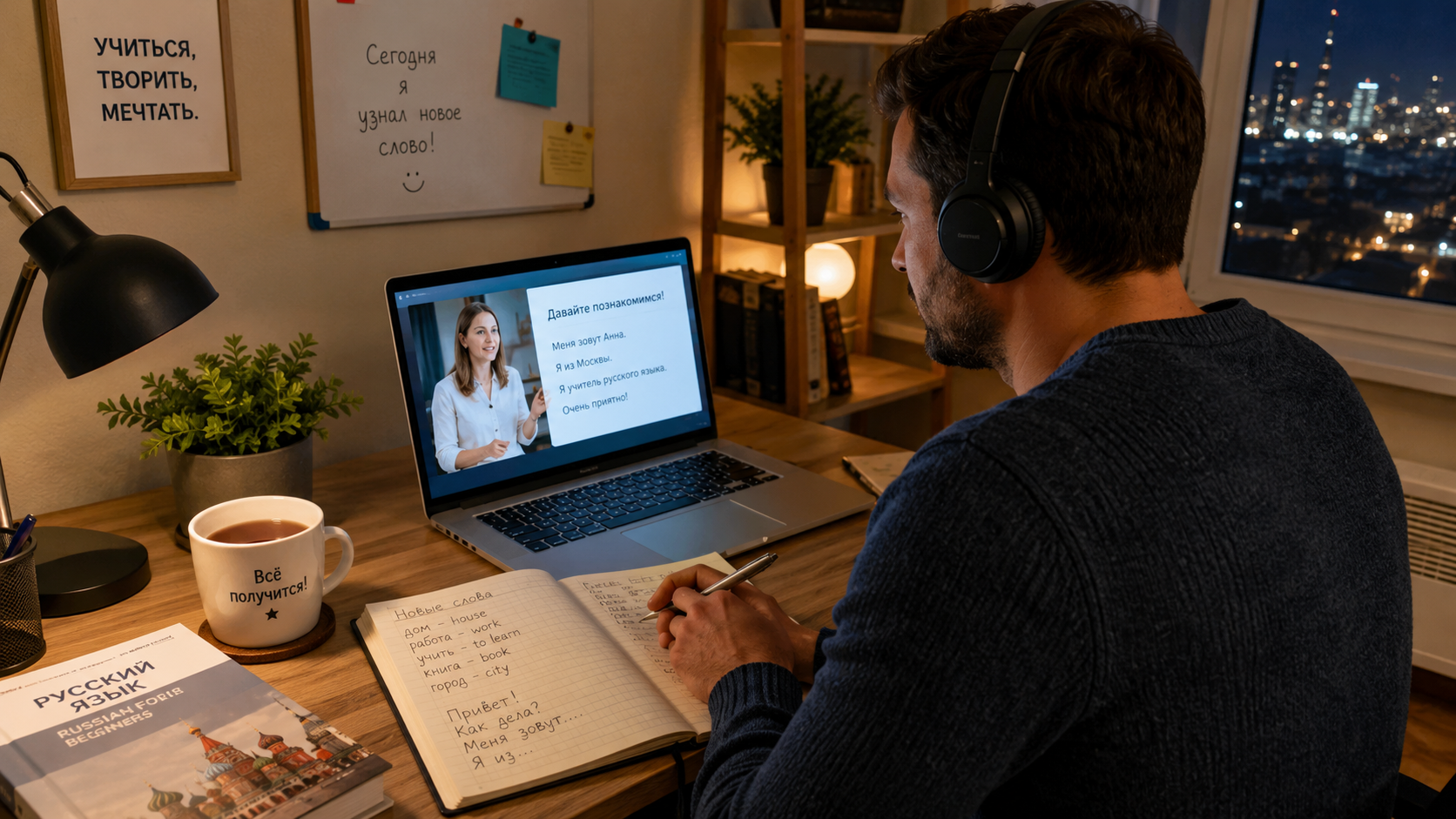
There comes a moment in many adult lives when a language that once seemed distant, mysterious, or impossibly difficult suddenly begins to feel personally relevant—perhaps because of travel, family history, literature, or simply the deep intellectual satisfaction of entering a world that does not organize itself in English—and for many people, Russian is exactly that kind of language: intimidating from the outside, powerful once you step inside, and surprisingly learnable when approached with the right structure.
Russian has a reputation. People hear that it has a different alphabet, complicated grammar, unpredictable word stress, and six cases, and they immediately imagine themselves buried under grammar charts before they can even say hello. They picture a language that belongs only to diplomats, translators, heritage speakers, scholars, or unusually disciplined polyglots. They assume that if they did not study Russian in college, move abroad, or grow up around it, the door has somehow closed.
But that is not true.
Adults can learn Russian. Busy adults can learn Russian. Adults with full-time jobs, children, businesses, travel schedules, and imperfect memories can learn Russian. And today, many of them are doing it online.
The real question is not whether Russian can be learned online. It can. The better question is: what kind of online learning actually works?
Because there is a huge difference between casually opening an app once every few days and following a serious, structured online Russian course. There is a difference between memorizing isolated words and learning how Russian sentences are built. There is a difference between watching grammar videos passively and speaking with a teacher who can correct your pronunciation, explain why the sentence works, and help you build confidence one small step at a time.
Online Russian learning is effective when it is not random. It works when it combines live instruction, regular speaking practice, intelligent self-study, review, listening, reading, and realistic expectations. It works when you understand what makes Russian challenging and stop treating those challenges as personal failures. It works when you study consistently, even in short sessions, instead of waiting for the mythical day when you suddenly have two free hours and unlimited motivation.
Russian is not a language you should try to “hack” in a weekend. But it is also not a language that needs to overwhelm you. With the right approach, the alphabet becomes readable. The grammar begins to make sense. The sounds become more familiar. The sentences that once looked like code start to feel human. And little by little, Russian stops being “that impossible language” and becomes a language you can actually use.
This article will walk you through how to learn Russian online effectively as an adult beginner or returning learner. We will look at why Russian feels difficult at first, why online learning can work extremely well, which mistakes to avoid, how to structure your study, what role apps and tutors should play, and how to choose an online Russian class that gives you real progress instead of frustration.
Why Russian Feels Difficult at First
Before talking about how to learn Russian online, it helps to understand why so many English speakers feel intimidated by it.
Russian is not difficult because it is chaotic. In fact, Russian is often very logical. The problem is that its logic is different from English.
English relies heavily on word order. In a sentence like “The woman sees the man,” we know who is doing the seeing because of the order of the words. Russian works differently. Russian uses endings to show the role of a noun in a sentence. That means the endings of words change depending on whether someone is doing an action, receiving an action, going somewhere, being located somewhere, owning something, or being described in relation to something else.
This is where cases come in.
For English speakers, Russian cases are often the first serious grammar shock. Instead of saying “to Moscow,” “in Moscow,” “from Moscow,” and “about Moscow” with separate little words doing most of the work, Russian changes the form of the word itself and often combines that change with a preposition. This means beginners must learn to pay attention to endings in a way that English does not usually require.
Then there is the Cyrillic alphabet. Russian uses 33 letters, and while many of them are easy to learn, some look deceptively familiar. The Russian letter Р sounds like English “r.” The Russian С sounds like English “s.” The Russian Н sounds like English “n.” At first, your brain wants to read these letters as if they were English or Latin letters. That confusion is normal. It usually fades quickly with practice.
Russian pronunciation also has its own challenges. Some consonants are hard or soft. Word stress can move. Unstressed vowels often change their sound. A word may look one way on the page and sound slightly different in real speech. This can make listening comprehension difficult at first, especially when native speakers talk quickly.
Russian verbs bring another layer of complexity. English speakers are used to thinking about tense: past, present, future. Russian also has tense, but it places enormous importance on aspect: whether an action is ongoing, repeated, completed, or viewed as a whole. This is why many Russian verbs come in pairs. One verb may describe the process of doing something, while another describes the completed result.
And then there is register: formal and informal speech. Russian has both ты and вы for “you,” and choosing the right one matters. Russian also has cultural expectations around politeness, directness, greetings, names, patronymics, and forms of address. You are not only learning vocabulary; you are learning how people relate to each other through language.
All of this can feel like a lot. But here is the important point: Russian is difficult when you try to learn everything at once. It becomes manageable when you learn it in the right order.
A good online Russian course does not throw the entire grammar system at you in week one. It helps you build a foundation. First, you learn to read. Then you learn useful phrases. Then you learn how basic sentences work. Then you gradually add cases, verbs, pronunciation, listening, and conversation. Step by step, what seemed impossible becomes familiar.
Can You Really Learn Russian Online?
Yes, you can absolutely learn Russian online. In many cases, online Russian learning can be more practical for adults than traditional in-person study.
The reason is simple: adults need flexibility. Most adult learners are not full-time students. They have work, family responsibilities, appointments, travel, and unpredictable schedules. Online classes remove one of the biggest obstacles: commuting. Instead of driving across town after work, parking, rushing into a classroom, and getting home late, you can study from your own home.
But convenience alone is not enough. An online Russian class is effective only if it is interactive and structured.
A strong online Russian program should include live speaking practice, teacher feedback, grammar explanations, homework, review, listening, reading, and a clear path from one level to the next. It should not feel like a random collection of videos. It should not leave you wondering what to study next. It should not rely only on passive watching or multiple-choice exercises.
The best online Russian learning combines the advantages of technology with the human guidance of a real teacher.
Technology helps because you can use shared documents, digital flashcards, online dictionaries, recorded materials, audio clips, pronunciation tools, and homework platforms. You can review after class. You can listen again. You can practice vocabulary on your phone. You can type in Russian. You can receive written corrections.
But the teacher matters because Russian is not just information. It is a living language. You need someone to hear you speak, correct your pronunciation, explain why your sentence sounds unnatural, help you choose the right form, and encourage you when the grammar feels heavy. You need interaction.
This is especially true for beginners. At the beginning, you do not yet know what you do not know. You may not realize that you are pronouncing a letter incorrectly. You may not hear the difference between a hard and soft consonant. You may memorize a phrase without understanding how it changes when you speak about yourself, another person, or several people. A teacher helps you notice these patterns before bad habits become permanent.
Online Russian learning works best when it is not isolated self-study. It works when it gives you structure, accountability, and human feedback.
The Biggest Mistake: Relying Only on Apps
Apps can be useful. They are not the enemy. In fact, a good Russian learning routine can include apps for vocabulary, alphabet practice, listening drills, and review.
The mistake is believing that an app alone will make you conversational.
Apps are often designed to keep you engaged. They use points, streaks, reminders, colorful screens, and quick exercises. That can be helpful for building a habit. But Russian requires more than recognition. You need production. You need to form sentences. You need to speak. You need to understand why endings change. You need to listen to real speech. You need correction.
An app might teach you that кошка means “cat” and дом means “house.” It might even show you a sentence like Это кошка or Я вижу дом. But will it explain clearly why one noun changes and another does not? Will it help you pronounce ы? Will it tell you whether your intonation sounds natural? Will it notice that you understand vocabulary but cannot form your own sentences?
Usually not.
Apps are best used as supplements. They can support your learning between classes. They can help you review vocabulary while waiting in line or drinking coffee. They can make repetition less boring. But they should not be the entire plan.
Think of apps as the gym equipment, not the coach. Equipment can help you train, but you still need a program. You need to know what to do, how often to do it, and how to correct your form.
For Russian, that “form correction” is especially important.
Start with Cyrillic—but Don’t Get Stuck There
Many beginners ask: “Should I learn the Russian alphabet first?”
Yes. You should learn Cyrillic early.
Trying to learn Russian through transliteration—using English letters to represent Russian sounds—can create confusion later. It may feel easier for the first few days, but it quickly becomes limiting. Russian spelling, pronunciation, grammar, and vocabulary all make more sense when you can read the actual alphabet.
The good news is that Cyrillic is not as hard as it looks. Many learners can recognize most letters within a few days and begin reading simple words within one or two weeks of consistent practice. You do not need to read quickly at first. You do not need perfect handwriting. You do not need to master Russian cursive immediately. You simply need to start connecting letters with sounds.
The danger is spending too long on the alphabet in isolation.
Some learners delay speaking because they think they must “finish” the alphabet first. But language learning does not work in neat boxes. You can learn Cyrillic and basic phrases at the same time. You can practice reading words like мама, метро, ресторан, такси, and кофе while also learning how to greet someone or introduce yourself.
A good beginner course should introduce Cyrillic quickly and practically. Instead of treating it like an abstract code, it should connect letters to real words, useful phrases, and pronunciation.
The goal is not to become a beautiful reader in week one. The goal is to remove the fear. Once Cyrillic becomes familiar, Russian already feels less mysterious.
Speak from the Beginning
Many adults wait too long to speak.
They tell themselves, “I’ll start speaking when I know more grammar.” Or, “I don’t want to sound stupid.” Or, “I need more vocabulary first.”
This is understandable, but it is also one of the biggest obstacles to progress.
You do not need to speak perfectly to begin speaking. You need to speak in small, controlled ways from the start. That might mean saying:
Здравствуйте.
Меня зовут Anna.
Я из Калифорнии.
Я живу в Беркли.
Я изучаю русский язык.
Я люблю кофе.
Я немного говорю по-русски.
These sentences are simple, but they are powerful. They teach pronunciation, rhythm, word order, verb forms, and confidence. They also make Russian feel like communication instead of a puzzle.
Speaking early helps your brain understand that Russian is not just something to decode. It is something to use.
In an effective online Russian class, students should speak every session. This does not mean being thrown into advanced conversation before you are ready. It means answering questions, practicing mini-dialogues, introducing yourself, describing your day, reading aloud, role-playing simple situations, and gradually building fluency through repetition.
For adults, speaking practice also reduces fear. The first time you speak Russian, it may feel awkward. The tenth time, it feels less strange. The fiftieth time, you begin to trust yourself.
Confidence is not something you wait for. It is something you build through use.
Learn Grammar Gradually and in Context
Russian grammar is famous for overwhelming beginners, but grammar itself is not the problem. The problem is bad sequencing.
If you try to memorize all six cases, all noun endings, all adjective endings, all pronouns, all verb conjugations, and all aspect pairs at once, you will probably feel defeated. That does not mean you are bad at languages. It means the method is bad.
Russian grammar should be learned gradually.
A beginner does not need every case immediately. A beginner needs to understand the basic idea that Russian words change form depending on their role. Then the learner can start with the most useful patterns.
For example, you might first learn simple nominative sentences:
Это книга.
Это мой друг.
Москва большая.
Анна студентка.
Then you might learn basic present tense verbs:
Я читаю.
Ты говоришь.
Мы работаем.
Они живут в Москве.
Then you might learn accusative case through useful phrases:
Я люблю музыку.
Я читаю книгу.
Я пью чай.
Я вижу друга.
Then prepositional case:
Я живу в Америке.
Мы говорим о семье.
Она работает в школе.
This is much easier than memorizing a giant table with no context.
Grammar becomes meaningful when it is attached to sentences you might actually use. You do not learn cases because “Russian has cases.” You learn them because you want to say where you live, what you like, who you see, where you are going, what you are talking about, and what belongs to whom.
A good online Russian teacher knows how to introduce grammar at the right pace. They can tell you what matters now and what can wait. This is one of the biggest advantages of structured classes over self-study. Left alone, many learners either avoid grammar completely or drown in it. A teacher helps you find the middle path.
Build Vocabulary with Spaced Repetition
Vocabulary matters, but not all vocabulary study is equally effective.
Many adults try to memorize long lists. They spend one evening learning 50 words, feel productive, and then forget most of them a week later. This is normal. The brain needs repeated exposure over time.
That is why spaced repetition is so useful.
Spaced repetition means reviewing words at increasing intervals: soon after learning them, then a little later, then a few days later, then a week later, and so on. Tools like Anki and other flashcard systems can help with this. But you do not need to become obsessed with flashcards. The principle matters more than the tool.
For Russian, vocabulary should be learned in phrases whenever possible.
Instead of memorizing only стол, learn на столе, за столом, большой стол, мой стол. Instead of learning only работать, learn я работаю, где вы работаете, она работает дома. Instead of learning only любить, learn я люблю чай, ты любишь музыку, мы любим русский язык.
Russian words change, so learning them in context helps you understand how they behave.
A practical online routine might include 10–15 minutes of vocabulary review per day. That is enough to build momentum if you are consistent. You can review after class, before bed, during lunch, or while drinking coffee in the morning. Short sessions are often better than rare, exhausting study marathons.
Train Your Ear with Slow Russian
Many Russian learners discover that reading becomes easier before listening does.
This can be frustrating. You may recognize a word on the page but completely miss it when a native speaker says it. That does not mean you have failed. Listening is a separate skill.
Russian listening is difficult at first because of vowel reduction, word stress, intonation, connected speech, and unfamiliar sound patterns. Native speakers do not pause between words the way beginners wish they would. They reduce sounds. They speak rhythmically. They use expressions you may not see in textbooks.
The solution is not to wait until you “know enough.” The solution is to listen regularly at the right level.
Beginners should use slow, clear Russian audio. This might include textbook dialogues, teacher recordings, beginner podcasts, short videos, or audio that matches what you are studying in class. The key is comprehensible repetition. You should listen to material where you understand some of what is being said, especially after reading or studying the transcript.
One useful method is:
Listen once without reading.
Read the transcript.
Listen again while reading.
Listen a third time without reading.
Repeat aloud one or two sentences.
This trains both your ear and your mouth.
Do not worry if natural Russian still sounds fast. It will. Listening comprehension grows gradually. The goal at the beginner level is not to understand Russian movies without subtitles. The goal is to recognize familiar words, hear sentence rhythm, and become less shocked by the sound of the language.
Read Short Texts Early
Reading is one of the best ways to make Russian grammar feel less abstract.
Once you know Cyrillic and some basic vocabulary, start reading very short texts. These can be dialogues, beginner stories, descriptions of people, simple cultural notes, or class materials.
Reading helps you see patterns repeatedly. You notice endings. You see how verbs are used. You recognize prepositions. You become familiar with word order. You also build confidence because written Russian gives you more time to think than spoken Russian.
At the beginner level, reading should be short and manageable. A paragraph can be enough. A dialogue of six lines can be enough. You do not need to start with literature. In fact, starting with literature too early can be discouraging unless it is adapted for learners.
Good reading practice includes:
Reading aloud
Underlining familiar words
Guessing meaning from context
Identifying grammar patterns you know
Re-reading the same text several times
Using new words in your own sentences
Reading aloud is especially helpful in Russian because it connects the alphabet, pronunciation, stress, and meaning. It also prepares you for speaking.
Create a Weekly Russian Routine
The most effective online learners are not always the ones with the most talent. They are usually the ones with the best routine.
For busy adults, consistency beats intensity.
A realistic weekly plan might look like this:
One live online Russian class per week
Two or three short vocabulary review sessions
One listening session with slow Russian audio
One homework or writing assignment
A few minutes of speaking practice aloud at home
If you have more time, wonderful. But even a modest routine can produce progress if you stick with it.
The key is to make Russian part of your week, not a vague aspiration. Schedule it. Put it on your calendar. Attach it to existing habits. Review vocabulary after breakfast. Listen to Russian while walking. Do homework the day after class instead of the hour before the next class. Read one short dialogue on Sunday.
Adults often wait for motivation. But motivation is unreliable. Structure is more dependable.
This is one reason online classes help. A weekly class gives your learning a rhythm. You know when you will speak. You know when homework is due. You know someone will notice whether you are progressing. That accountability matters.
Compare Your Options: Apps, Tutors, Classes, and Self-Study
There are many ways to learn Russian online. The best choice depends on your goals, budget, schedule, and personality.
Apps
Apps are convenient and useful for daily exposure. They can help with alphabet practice, basic vocabulary, and review. They are especially good for building a habit.
But apps rarely provide enough speaking practice or grammar depth. They also cannot fully correct your pronunciation or explain your specific mistakes. Use them as support, not as your entire Russian education.
YouTube
YouTube is excellent for exposure. You can find alphabet lessons, pronunciation explanations, cultural videos, grammar tutorials, slow Russian content, and teacher-led playlists.
The problem is that YouTube is not a curriculum. It is easy to watch a lot and practice very little. You may jump from topic to topic without building a foundation. Use YouTube to clarify and enrich your learning, but do not let it replace structure.
Podcasts
Podcasts are great for listening practice, especially once you have some basics. Beginner podcasts can help you hear Russian regularly and absorb rhythm.
However, podcasts are usually not interactive. You still need speaking, correction, reading, and grammar support.
Private Tutors
Private online lessons can be extremely effective, especially if you have specific goals. A tutor can personalize lessons, correct you intensively, and move at your pace.
The downside is cost. Private lessons are usually more expensive than group classes. Also, quality varies. A native speaker is not automatically a good teacher. Look for someone who understands how to teach Russian as a foreign language, especially to adults.
Small Group Online Classes
Small group classes are often the best balance for adult learners. They provide structure, teacher guidance, interaction, and accountability at a lower cost than private lessons. You also learn from hearing classmates speak, make mistakes, and ask questions.
The group must be small enough for everyone to speak. A class of 3–6 students can feel personal and interactive. A class of 20 can easily become passive.
Self-Paced Digital Courses
Self-paced courses can be useful if you are disciplined and need maximum flexibility. They often include videos, exercises, and quizzes.
But without live feedback, it is easy to develop gaps. Self-paced courses work best for review, preparation, or supplementing live instruction.
What You Can Expect in the First 3–6 Months
A realistic adult beginner should not expect fluency in three months. But you can expect meaningful progress.
With consistent study, you may be able to:
Read Cyrillic slowly but confidently
Introduce yourself
Talk about where you live, what you do, and what you like
Use basic greetings and polite expressions
Understand simple classroom Russian
Recognize common verbs in the present tense
Understand gender and basic noun endings
Use simple accusative and prepositional forms
Read short beginner texts
Understand slow speech on familiar topics
Ask and answer simple questions
This is real progress. It may not feel glamorous, but it is the foundation for everything else.
Russian rewards patience. The early months are about building the system in your mind. You are learning how the language sounds, how it is written, how words change, and how sentences are formed. Once that foundation is in place, future progress becomes easier.
How to Choose a Good Online Russian Class
Not all online classes are equal. Before enrolling, look for a few key features.
First, the class should be small. You need speaking time. If the group is too large, you may spend most of the class listening rather than participating.
Second, the class should have a clear level. A complete beginner should not be placed with students who already read Cyrillic and know basic grammar. A false beginner should not have to start from zero if they already know the alphabet and simple phrases.
Third, the teacher should be experienced with adult learners. Teaching adults is different from teaching children or university students. Adults often want clear explanations, practical goals, cultural context, and efficient use of time.
Fourth, speaking should happen every class. Even grammar-heavy lessons should include oral practice.
Fifth, the atmosphere should be supportive. Russian is challenging enough without feeling embarrassed or rushed. A good class allows mistakes and uses them productively.
Finally, there should be homework and review. One hour per week is not enough by itself. The class should guide your self-study so you know what to practice between sessions.
FAQs About Learning Russian Online
Can I really learn Russian online?
Yes. You can learn Russian online if your course includes structure, interaction, feedback, and regular practice. Online learning works especially well for adults who need flexibility but still want serious instruction.
Is Russian hard for English speakers?
Russian is challenging because it has Cyrillic, cases, verb aspect, flexible word order, and unfamiliar pronunciation patterns. But it is not impossible. The key is to learn it step by step instead of trying to master everything at once.
Should I learn Cyrillic first?
Yes, you should learn Cyrillic early. It usually takes much less time than people fear. Once you can read the alphabet, Russian becomes more logical and less intimidating.
Are apps enough to learn Russian?
Apps are helpful for vocabulary and review, but they are usually not enough for real conversation. You need speaking practice, grammar explanations, listening work, and correction from a teacher or tutor.
How often should I study Russian?
Short, frequent study sessions are best. Many adults do well with one or two classes per week plus 15–30 minutes of review several days a week.
Is it better to take private lessons or group classes?
Private lessons are best if you want complete personalization. Small group classes are often a great balance because they provide structure, interaction, and teacher feedback at a more affordable price.
How long does it take to learn Russian?
It depends on your goals and study schedule. Basic conversation can begin within months, but higher-level fluency usually takes years of consistent study. Russian is a long-term project, but you can feel progress much earlier than full fluency.
Can adults learn Russian successfully?
Absolutely. Adults can be excellent language learners because they understand patterns, ask thoughtful questions, and often have strong motivation. The key is consistency, structure, and realistic expectations.
Learn Russian Online with Polyglottist Language Academy
If you want to learn Russian online effectively, you do not need more random resources. You need a clear path, a supportive teacher, and a class that helps you actually speak.
At Polyglottist Language Academy, we offer Russian language classes for adults who want structured, serious, and encouraging instruction. Our classes are designed for real learners with real schedules—not people who have unlimited time or perfect confidence.
Our Russian program emphasizes:
Small group learning
Experienced instructors
Clear grammar explanations
Speaking practice from the beginning
Cultural context
Supportive correction
A realistic path from beginner to more advanced levels
Whether you are a complete beginner, a returning learner, or someone who has tried apps and realized you need more structure, our Russian classes can help you build confidence step by step.
Russian is not a language you need to fear. It is a language you need to approach intelligently. With the right teacher, the right class, and the right routine, you can make steady progress online—and enjoy the process much more than you expected.
If you are ready to begin, we invite you to explore our Russian classes at Polyglottist Language Academy and sign up for a course that fits your level and schedule.
Continue Exploring Russian Language and Culture
If you enjoyed this article, you may also like these related posts from our blog:
The Fastest Way To Start Speaking Russian As An Absolute Beginner
How To Introduce Yourself In Russian Like A Beginner Who Actually Prepared
Russian Printed Vs. Handwritten Letters: What Beginners Need To Know
Why Russian Feels So Hard At First And How To Make It Easier
How To Learn The Russian Alphabet Fast Without Feeling Overwhelmed