
Russian Printed vs. Handwritten Letters: What Beginners Need to Know
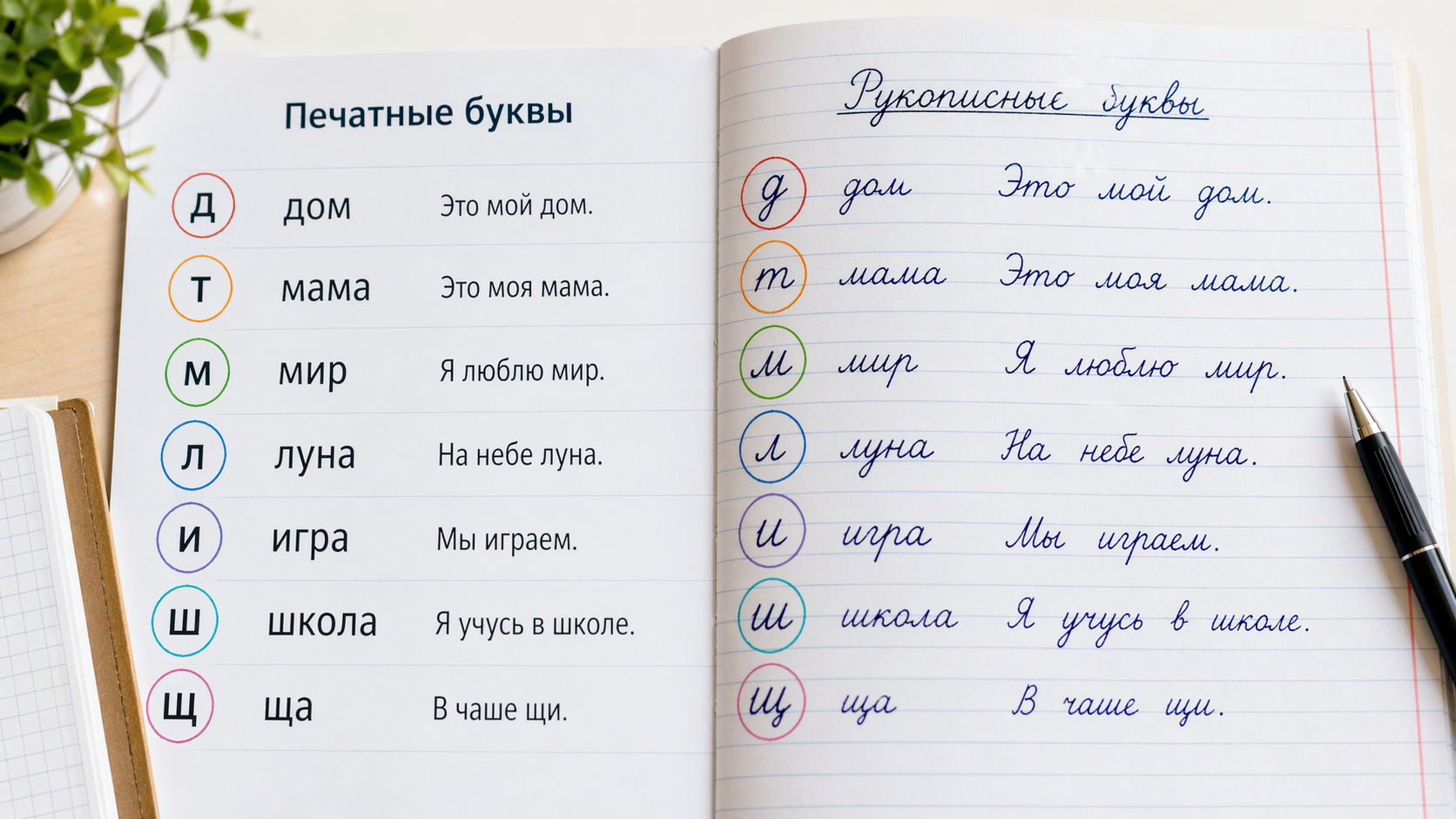
For many beginners, the first shock of learning Russian does not come from grammar. It comes from handwriting.
You spend a few days learning the printed Cyrillic alphabet. You begin to recognize words on signs, in apps, and in your textbook. You feel encouraged. Then your teacher writes something on the board, or you see a handwritten Russian note online, and suddenly it feels as if you are staring at a completely different language.
This is one of the most common early frustrations in Russian. Many English-speaking learners can handle printed Cyrillic reasonably quickly, but handwritten Russian feels like a wall. Letters that looked clear in print turn into loops, hooks, and humps. Whole words seem to collapse into a line of little hills. You know it is supposed to be Russian, but it no longer looks like the alphabet you studied.
The good news is simple: handwritten Russian is not a different alphabet. It is the same 33 letters written in a faster, connected style. The spelling does not change. The sounds do not change. What changes is the visual form of certain letters, especially in lowercase cursive.
That distinction matters because it immediately makes the problem feel more manageable. You are not starting over. You are not learning “real Russian” after learning “fake Russian.” You are simply learning a second visual version of the same script, much like the difference between printed English letters and cursive handwriting. The difference is that in Russian, some cursive forms change more dramatically, so the gap feels bigger.
For adult beginners, this is the key idea to hold onto: you do not need to master beautiful Russian cursive right away to make real progress in the language. First, get comfortable with printed Cyrillic. Then learn to recognize the main handwritten forms. Only after that, if your goals require it, should you worry about writing cursive neatly yourself.
That approach is not lazy. It is smart. It reduces overwhelm, builds confidence, and matches how most learners actually encounter Russian today.
Printed and handwritten Russian are the same alphabet
The most important thing a beginner needs to know is this: printed Russian and handwritten Russian use the same alphabet.
There is no separate “handwritten Cyrillic alphabet” with different spellings or different rules. Russian cursive is simply a handwriting style. It exists because handwriting is naturally faster when letters connect and flow into one another. Just as English handwriting often looks different from the printed alphabet in a book, Russian handwriting has its own traditional cursive forms.
The problem is that in Russian, some of those cursive forms are much less obvious to an English-speaking learner than English cursive is. In English, most adults can still usually tell what printed and handwritten letters correspond to, even if the shapes vary. In Russian, several lowercase letters shift enough that beginners feel betrayed by the alphabet chart they just memorized.
So yes, the confusion is real. But the interpretation is often wrong. The issue is not that Russian suddenly changed into something else. The issue is that beginners have not yet learned which printed letters change shape most when written by hand.
Once you know that, the whole topic becomes much less mysterious.
Why handwritten Russian feels so difficult at first
There are three main reasons handwritten Russian feels much harder than printed Russian.
1. Some letters change shape dramatically
A few Russian letters stay fairly recognizable in cursive. Others do not. That second group causes most of the panic.
For example, printed д has a very distinctive shape in block letters, but in cursive it often looks much more like a loopy Latin handwritten form. Printed л can turn into a pointed shape that resembles a small Latin “v.” Printed и becomes something that can look like a handwritten “u.” Printed т may stop looking like “T” and start looking like a compact row of humps.
If you meet these forms before anyone explains them, you naturally assume you are seeing a new script.
2. Letters connect into one flowing line
Printed Russian gives each letter its own clear boundary. Handwritten Russian often does not.
Instead of separate symbols standing cleanly next to each other, cursive Russian links letters together. That means your eye can no longer rely on neat visual separation. The letters blend. Strokes share momentum. A word becomes a continuous shape rather than a row of distinct units.
This is especially hard in words containing letters like м, и, ш, щ, п, т, л. These can create a repeating wave pattern that looks almost identical from one letter to the next. Beginners often describe it as “a line of bumps,” and that is exactly what it feels like.
3. Real handwriting is messier than textbook handwriting
Even after you learn the official cursive alphabet, real handwritten Russian can still surprise you.
Textbook charts show ideal forms. Real people do not write that way all the time. Native speakers write quickly. They simplify strokes. They slant letters differently. They join things in personal ways. Some mix cursive and print. Some write very neatly. Some write like exhausted doctors everywhere on earth.
So the difficulty is not only the standard cursive forms themselves. It is also the fact that actual human handwriting introduces variation on top of those forms.
That is why many beginners feel fine when they study a beautiful alphabet chart, then feel lost again when they see a real note from a native speaker.
The letters that cause the most trouble
Not all Russian letters deserve equal attention here. One mistake beginners make is treating the whole handwritten alphabet as a giant undifferentiated problem. It is not. A small group of letters causes most of the difficulty.
If you focus on that group, you will get much faster results.
The biggest “problem letters”
г
Printed г is visually simple, but cursive г often becomes a small hooked form that can be easy to miss inside a word.
д
This is one of the biggest shocks for beginners. Printed д and cursive д can feel like distant relatives. In handwriting it often takes on a looped form that no longer resembles the printed version at all.
т
Printed т is straightforward. Cursive т often looks more like a compact handwritten shape built from humps. In fast handwriting, it can blend dangerously with м or even with sequences involving ш.
м
Printed м looks solid and familiar. Cursive м often becomes a three-hump pattern. When several similar letters appear together, this can become hard to count.
л
In cursive, л often looks pointed, like a narrow angle or a Latin “v.” Inside words it can be especially easy to confuse with neighboring hump-like letters.
и / й
Cursive и often looks like a small “u”-style shape. й is similar, but with an added mark above, which is often subtle in real handwriting. If that mark is tiny or rushed, the distinction can be easy to miss.
п
Printed п is clear. In cursive it can look much more like a small connected form similar to a Latin handwritten “n.”
ш / щ
These are classic troublemakers. In cursive they become long hump sequences, and щ adds an extra tail. When written quickly, the difference can be tiny.
The “line of bumps” problem
The hardest handwritten Russian words are often not hard because of one bizarre letter. They are hard because several hump-like letters appear together in a row.
Take a word like машина. In print, it is clear. In cursive, the middle of the word can begin to look like a landscape of repeated rises and falls. The same thing happens with words like миша, лишний, or шишки.
To decode such words, beginners often need a new strategy: instead of trying to identify every letter instantly, slow down and look for patterns.
Count the humps. Look for tails. Look for dots or marks above. Consider which letters are likely in that word. Use context. Ask yourself what the word could plausibly be.
This is not cheating. It is exactly how reading develops. Even in your native language, you rarely process handwriting by isolated letter analysis alone. You use pattern recognition and context together.
What beginners should learn first
This is where many learners make their lives harder than necessary.
Because handwritten Russian feels intimidating, they assume it must be mastered immediately. But for most adult beginners, that is not the best approach.
Step 1: Get solid with printed Cyrillic
Your first goal should be comfort with the printed alphabet.
That means recognizing the letters quickly, connecting them to sounds, and reading simple words without mentally translating every symbol one by one. Printed Cyrillic appears in books, websites, apps, subtitles, menus, signs, messages, and almost every beginner learning resource. It is the version of Russian you will see most often at first.
If printed reading still feels shaky, adding cursive too early usually creates unnecessary overload.
Step 2: Learn to recognize cursive forms
Once you are reasonably comfortable with printed Russian, start learning handwritten recognition.
Notice the order here. Recognition comes before production.
You do not need to produce perfect cursive the moment you begin studying it. You need to learn what the major handwritten forms look like so that teacher notes, handwritten labels, and examples stop feeling like a total blur.
This is a much more realistic goal for beginners. It also brings faster practical rewards.
Step 3: Write by hand only when it serves your goals
Eventually, you may want to write Russian yourself. That can be useful, especially if you are taking notes in class, working with tutors who write by hand, living in a Russian-speaking environment, or filling out handwritten forms.
But the priority should be function, not elegance.
You do not need beautiful school-style penmanship. You need writing that is consistent and readable. Many native speakers do not write like handwriting-workbook models either. Some mix print and cursive. Some simplify capital letters. Some switch styles depending on context.
For many adult learners, the goal is not to become a calligrapher. The goal is to stop feeling helpless when handwriting appears.
Where handwritten Russian matters in real life
Some learners hear that cursive is difficult and decide to ignore it completely. Others panic and treat it as the central challenge of beginning Russian. Neither extreme is ideal.
The better question is: where will you actually encounter handwritten Russian?
Printed Russian dominates most daily input
If you are reading online articles, using language apps, texting, reading subtitles, watching Russian media, or working through beginner textbooks, you will mostly see printed Cyrillic.
This is one reason printed reading deserves priority. It gives you immediate access to far more material.
Handwritten Russian still matters
At the same time, cursive has not disappeared.
You are likely to see handwritten Russian in notebooks, classroom boards, tutor notes, personal notes, greeting cards, labels, and some handwritten forms. If you study with Russian teachers, especially in a more traditional setting, cursive may appear sooner than you expect. Russian children still learn cursive systematically in school, and many adults use it naturally for note-taking.
So cursive is not obsolete. It is just not the first battle every beginner must fight.
Your context determines urgency
If you are a casual self-learner focused on online reading and listening, cursive can wait a little.
If you plan to live in a Russian-speaking country, attend classes in Russian, or work with handwritten materials, cursive recognition becomes more important sooner.
That is why there is no one universal deadline. The right timing depends on your real-life goals.
How to learn handwritten Russian without overwhelm
The good news is that handwritten Russian becomes much less frightening when you study it the right way.
Separate recognition from writing
This is the single most helpful mindset shift.
First, train your eye. Then train your hand.
If you try to decode cursive and produce it beautifully at the same time, you are doing two difficult tasks at once. That often creates frustration. But if you first learn to recognize the main forms, your writing practice later becomes much easier.
Focus on the problem group
Do not spend equal time on all 33 letters. That is inefficient.
Target the letters that change most and the combinations that create confusion: г, д, т, м, л, и, й, п, ш, щ. If you learn these well, the rest of handwritten Russian becomes much less intimidating.
Use side-by-side comparison
One of the most effective exercises is simple comparison.
Take a printed letter and its cursive form and study them together. Then do the same with short words. Do not learn cursive in total isolation. Always anchor it to what you already know from print.
This turns cursive from “mysterious new script” into “alternative shape of a familiar letter.”
Practice decoding real words, not just isolated letters
Alphabet charts are useful, but they are not enough.
Once you know the main shapes, move quickly to short real words such as миша, машина, где, люди, делать, шишки, and лишний. These give you pattern experience. They teach your eye how letters behave inside actual handwritten words.
That is where real progress happens.
Trace, copy, and transcribe in small doses
If you do want to write, short regular practice works much better than long occasional sessions.
Trace model letters. Copy short words. Transcribe a handwritten word into print. Write a few simple words yourself. Ten focused minutes a day is often more useful than one long frustrated session once a week.
Accept variation
This matters emotionally as much as technically.
Many beginners think, “I learned the chart, so why can’t I read this person’s handwriting?” The answer is that real handwriting varies. That does not mean you failed. It means handwriting is human.
The goal is not to understand every messy handwritten note instantly. The goal is to build enough familiarity that handwriting no longer feels like total chaos.
Common myths that confuse beginners
“Handwritten Russian is a different alphabet”
False. It is the same alphabet written differently.
“You must learn cursive immediately”
Also false. For most adult beginners, this creates more stress than benefit. Printed reading should come first.
“If you only read print, you are not a serious learner”
Not true. Printed Russian covers a huge amount of real-world reading. Cursive is useful, but it is not the entry ticket to legitimate learning.
“Native speakers always write neat textbook cursive”
Definitely false. Native handwriting varies widely. Many people simplify, mix styles, or write messily.
“Block letters are wrong or childish”
Not necessarily. Even native speakers sometimes use more printed forms for clarity, especially in forms or when writing for someone who may struggle with cursive.
A realistic action plan for beginners
If this topic has been stressing you out, here is the practical takeaway.
First, keep building confidence with printed Cyrillic. Read it until it feels normal.
Second, learn the major handwritten troublemakers. Do not try to conquer the entire cursive system all at once.
Third, practice recognizing handwritten words before worrying about writing them elegantly yourself.
Fourth, decide how much cursive writing you truly need based on your goals. If you mainly read typed Russian, recognition may be enough for quite a while. If you plan deeper immersion, add writing gradually.
Most importantly, stop interpreting your confusion as failure.
When beginners first see Russian cursive, they often think, “Maybe Russian is just too hard for me.” Usually that is not the real issue. The real issue is that nobody explained that Russian handwriting has a few dramatic shape shifts that need separate training.
Once you know that, the mystery shrinks. The wall becomes a set of patterns. The “secret code” turns back into a language.
And that is exactly the point. Handwritten Russian is not a different alphabet waiting to ambush you. It is simply the same Cyrillic script in a more flowing, human, handwritten form. You do not have to master it perfectly on day one. You only have to approach it in the right order.
If you do that, what looks impossible at first becomes readable much faster than you think.
FAQ: Russian printed vs. handwritten letters
Is Russian cursive a different alphabet?
No. Russian cursive uses the same 33 Cyrillic letters and the same spelling rules as printed Russian. The main difference is the handwritten shape of certain letters and the way they connect.
Do beginners need to learn Russian cursive immediately?
Usually no. Most adult beginners should first become comfortable with printed Cyrillic and basic reading, then learn to recognize cursive forms.
Which handwritten Russian letters are hardest to read?
The letters that often cause the most trouble are г, д, т, м, л, и, й, п, ш, and щ, especially when several of them appear together in one word.
Is it okay to write Russian in block letters?
Yes, especially as a beginner. Cursive is common, but block letters are acceptable for clarity, and many native speakers also mix print and cursive depending on context.
How often will I see handwritten Russian in real life?
You will mostly see printed Russian in digital and published material, but handwritten Russian still appears in notes, classrooms, forms, and personal writing. How important it is depends on your learning goals.
If you are learning Russian and want a more guided, beginner-friendly path, structured lessons can make a huge difference. At Polyglottist Language Academy, students build confidence step by step, so even topics that look intimidating at first, like the Cyrillic alphabet and Russian handwriting, become manageable and clear.
If you are interested in learning Russian, here are a few other articles from the Polyglottist Language Academy blog that pair well with this topic:
Beginner Russian Classes In San Francisco: Start Speaking Faster
How To Start Learning Russian In Portland Without Leaving Home
Learn Russian with more structure and less overwhelm
If you want to go beyond random phrase lists and start learning Russian in a clear, structured way, Polyglottist Language Academy can help.
We currently offer online and in-person Russian classes in Berkeley, California for students at different levels, from complete beginners to more advanced learners. Our classes are designed to help adults build practical communication skills while also developing pronunciation, vocabulary, and confidence step by step. You can explore our Russian class options here: Russian Classes at Polyglottist Language Academy .
We are also currently developing a digital Russian course for beginners, expected to launch in approximately 3 to 4 months. The course is being created for learners who want a practical, structured, and encouraging way to start. If you would like to hear when it launches, you can join the waitlist here: Subscribe to our mailing list.
If your goal is to build a real foundation in Russian, a structured course can save you a huge amount of time and confusion.