
10 Russian Letters That Confuse Beginners the Most
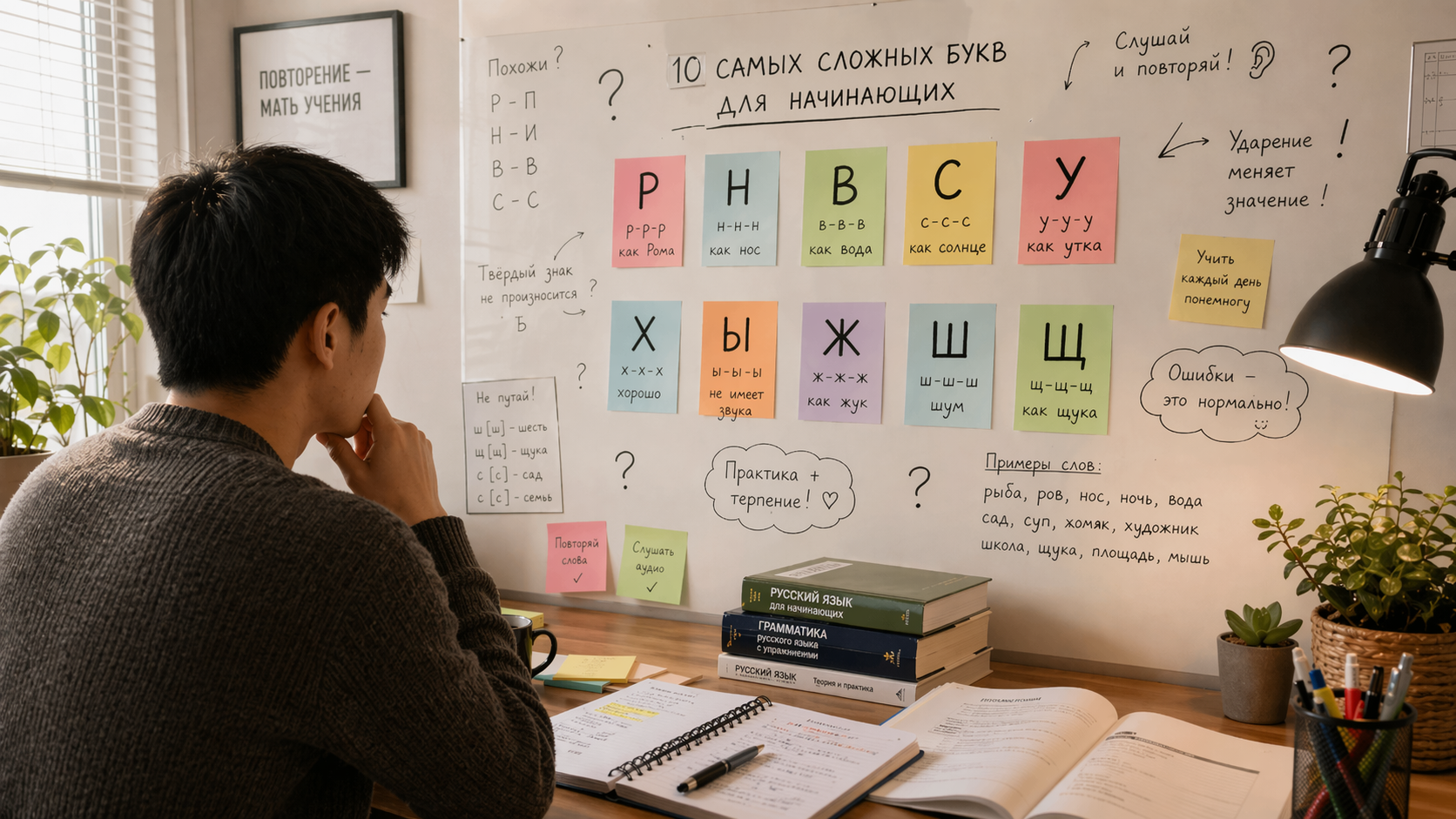
If you are an English speaker learning Russian, the alphabet can feel like the first big shock. You sit down to study, look at a simple Russian word, and suddenly your brain starts panicking. Why does what looks like a P sound like R? Why does something that looks like H sound like N? Why are there letters that seem familiar, yet betray you the moment you try to read them out loud?
This is exactly why the Russian alphabet feels harder than it really is.
The good news is that most Russian letters are not truly difficult. What makes them confusing is usually one of three things: they look like English letters but sound different, they represent sounds that English does not use in the same way, or they change behavior depending on their position in the word. Once you understand these patterns, the alphabet stops looking like a wall of symbols and starts becoming a system you can actually trust.
In fact, for many learners, the biggest psychological obstacle is not the Russian alphabet itself. It is the feeling that it must be impossible because it looks unfamiliar. But once you target a small number of deceptive letters and practice them deliberately, reading Russian becomes much more manageable much faster than most beginners expect.
In this article, we will look at the 10 Russian letters that confuse beginners the most, why they cause trouble, and how to remember them. By the end, you will see that Cyrillic is not chaos. It is simply a new pattern your brain has not learned yet.
Why the Russian alphabet looks scarier than it is
Before we look at the letters themselves, it helps to understand why the Russian alphabet creates so much anxiety in the first place.
The first reason is visual deception. Some Russian letters look exactly like English letters, but they do not sound the same. This creates instant confusion because your eyes send one signal and the language sends another. You see a familiar shape, trust it, and get the pronunciation wrong.
The second reason is unfamiliar sound categories. Russian has a few sounds that do not line up neatly with English. They are not impossible, but they do not feel natural right away. This is why letters like Ы, Ж, or Щ often seem more intimidating than they really are.
The third reason is that beginners often rely too much on transliteration. They try to keep one foot in English while learning Russian, which makes everything slower. Transliteration feels helpful at first, but it often reinforces the wrong sound associations. The sooner you start reading real Cyrillic, even slowly, the sooner the alphabet begins to feel normal.
And here is the reassuring part: many Russian letters are actually very straightforward. Letters like А, К, М, О, Т are easy wins for English speakers. So the alphabet is not one giant problem. It is mostly learnable, with a small cluster of predictable traps.
Let’s look at the biggest ones.
1. Р р: the fake P that is really R
This may be the single most famous trap in the Russian alphabet.
The uppercase Р looks exactly like the English P, and the lowercase version can also fool beginners at a glance. Naturally, English speakers want to pronounce it as p. But in Russian, Р is an r sound, usually stronger and more rolled or tapped than in English.
That means a learner may see a Russian word and misread it instantly because their eyes are still using English rules.
Take the word Россия. A beginner may look at the first letter and momentarily want to process it through English. But Рis not p. It is r.
A simple memory trick is this: Р is the road letter. In Russian, this letter rolls. Think of a road with a rolling r sound.
Common words:
рука (hand)
Россия (Russia)
Once you master Р, you eliminate one of the biggest sources of “ghost English” in your reading.
2. Н н: the H that says N
Another classic beginner trap is Н.
In uppercase, it looks exactly like the English H, so learners instinctively want to give it an h sound. But in Russian, Н is pronounced like n.
This is why words like нет confuse beginners. Your eye sees something like an English H, but the word is pronounced nyet, not “het.”
This letter is frustrating only because it looks so familiar. The actual sound is easy. It is just n.
A helpful memory trick: the Russian H never says h. It is secretly N every time.
Common words:
нет (no)
ночь (night)
This letter is a perfect example of why Russian feels hard at first. The challenge is not the sound. The challenge is unlearning your visual reflex.
3. В в: the B that is actually V
The Russian В often looks like a version of the English B, so beginners want to pronounce it as b. But the real sound is v.
This causes problems immediately in common words. A learner may see вода and want to read it with a b sound, even though the correct pronunciation begins with v.
The confusion here is almost entirely visual. Once you know the rule, it becomes simple and predictable.
A useful trick is to think: В is a vase-shaped B, but it says v.
Common words:
вы (you, formal or plural)
вода (water)
Because В appears in many very common Russian words, learning it early gives you a big confidence boost.
4. С с: the C that is always S
This one looks harmless, but it causes a lot of hesitation.
The Russian С looks just like the English C, but in Russian it is always pronounced s. Not k, not sometimes s, not a mystery. Just s.
For English speakers, that consistency is actually good news. English uses the letter c in multiple ways, depending on the word. Russian does not do that here. But beginners still carry over English habits and second-guess themselves.
A learner might see сок and hesitate, even though the word is simply sok.
Memory trick: Russian C is simple C. It always says s.
Common words:
спасибо (thank you)
сахар (sugar)
This is one of those letters that feels confusing only because English spelling trained you to expect inconsistency.
5. У у: the Y-shaped letter that says “oo”
The Russian У often misleads beginners because it resembles the English Y. So learners want to pronounce it like y, when in fact it makes an oo sound, like in “boot.”
This leads to strange readings of very basic words. If you see рука, for example, you must not let the У pull you toward an English-style sound. It is oo, not y.
A good visual memory trick is this: У looks like someone diving into a pool. Pool gives you the oo sound.
Common words:
ура (hooray)
улица (street)
This is another letter that becomes easy once you stop treating it like English.
6. Х х: the X that comes from the throat
The Russian Х is another major false friend. It looks exactly like English X, but it does not sound like ks.
Instead, it is a rough throat sound often written as kh. If you know German, think of the sound in Bach. If you know Scottish pronunciation, think of loch.
English speakers often misread this letter because the visual shape is so familiar. But once you hear it a few times, you realize it is not random. It is a stable consonant with a consistent sound.
Memory trick: Х is the harsh letter. It looks like X, but it comes from the throat.
Common words:
хорошо (good)
хлеб (bread)
This is one of the first letters that reminds beginners that Russian is not just a visual challenge. It also asks your mouth to do something slightly new.
7. Ы ы: the vowel English speakers love to fear
Among Russian vowels, Ы has a special reputation. It scares beginners because there is no exact English equivalent, and visually it looks odd too.
The sound is often described imperfectly. Some say it is between the vowel in “bit” and something deeper in the mouth. Others say you should start with an “ee” sound and pull your tongue back slightly. No explanation is perfect, which is why learners often get frustrated.
But here is the key: Ы does not need to be perfect on day one. It just needs to become recognizable and repeatable.
Many learners build up this letter so much in their minds that it becomes bigger than it really is. In practice, if you hear it regularly and imitate it consistently, it becomes much more natural.
Memory trick: think of Ы as the “awkward vowel.” It feels unusual at first, but that is exactly why you remember it.
Common words:
вы (you, formal or plural)
сыр (cheese)
This is one of those letters that proves a crucial point: unfamiliar does not mean impossible.
8. Ж ж: the buzzing “zh” sound
The Russian Ж looks unusual and makes a sound that English speakers do not usually associate with a single letter. It is pronounced like the sound in measure or vision.
Many beginners either replace it with z or j, because they are not used to hearing zh treated as a stable category. But once you notice the sound in English words like pleasure or beige, it becomes much less mysterious.
Its shape may look intimidating, but the sound itself is not rare in the real world. What is new is simply the fact that Russian gives it its own letter.
Memory trick: Ж buzzes. The sound is soft and buzzing, almost like an insect humming.
Common words:
жить (to live)
жена (wife)
This letter is a good example of something that looks strange but is actually learnable very quickly with a few good examples.
9. Ш ш and Щ щ: the pair that beginners mix up
These two are best learned together because much of the confusion comes from their visual similarity.
Ш is pronounced like sh in “ship.”
Щ is traditionally described as a softer or longer shch, though in modern speech it is often closer to a softer long sh than English speakers expect.
The problem is not just the sound. It is that the letters look so similar. Щ is basically Ш with an extra tail, which means beginners often confuse them visually before they even get to the pronunciation question.
The best approach is not to panic about producing a perfect textbook Щ right away. First learn the contrast: Ш is the basic sh, and Щ is a softer, more complex version.
Memory trick: Ш has three sticks for sh. Щ has the extra tail, which reminds you it is the more complicated one.
Common words:
школа (school)
ещё (still, yet)
Once you treat these as a pair instead of two isolated problems, they become easier to organize in your mind.
10. Й й: the little glide that beginners underestimate
The Russian Й is not usually the first letter people fear, but it causes a surprising amount of confusion later on.
That is because learners are often unsure whether it is a vowel, a consonant, or something in between. The easiest way to think about it is as a short y glide, like the sound in “boy” or “yes” depending on the context.
It often appears in combinations that change the rhythm of the word, so beginners sometimes miscount syllables or fail to hear how it interacts with surrounding vowels.
Memory trick: Й is the yoga letter. Small, flexible, and always gliding.
Common words:
мой (my)
йога (yoga)
This letter is less visually deceptive than Р or Н, but it teaches an important lesson: in Russian, some letters are best understood through sound patterns, not just shapes.
Honorable mentions: Ь and Ъ
No list of confusing Russian letters is complete without mentioning the soft sign Ь and the hard sign Ъ.
These letters are unsettling for beginners because they do not have their own sound. Instead, they modify the consonant before them or affect how the following sound is pronounced.
That sounds abstract at first, but it becomes easier when you stop expecting every letter to behave like an English letter. Think of Ь and Ъ as pronunciation tools, not sound-makers. They are not there to be heard independently. They are there to shape what happens around them.
Once you accept that, they become far less mysterious.
What all these confusing letters have in common
If you step back, you can see that beginner confusion comes from a few recurring patterns.
First, some Russian letters are visual traitors. They look like English letters but sound different. These include В, Н, Р, С, У, Х. This is the most dangerous group for beginners because your eyes think they are helping you, but they are actually leading you astray.
Second, some letters are sound challenges. They do not really trick your eyes, but they represent sounds that feel unusual at first. This includes Ы, Ж, Ш, Щ, Й.
Third, some letters are scary-looking but actually simple. Once you practice them a few times, they become more reliable than many English spelling patterns.
This is why the Russian alphabet is not as hard as it first appears. The confusion is front-loaded. Once you identify the traps, much of the fear disappears.
How to make these letters easier fast
If you want to master confusing Russian letters quickly, do not study them randomly. Use a sequence.
Start with the easy confidence-builders: А, К, М, О, Т, Е. This helps your brain realize that not everything is strange.
Then learn the false-friend group together: В, Н, Р, С, У, Х. Treat them as a danger set. Put them on one page, compare them directly, and drill them until your eye stops interpreting them through English.
Then add the unfamiliar-sound group: Ы, Ж, Ш, Щ, Й. These need audio, repetition, and patience. They make more sense when you hear them in real words than when you stare at them in isolation.
Most importantly, move from letters to syllables to words. Do not get stuck memorizing abstract shapes forever. Read short, real words as early as possible. That is where the alphabet begins to feel alive.
And drop transliteration as soon as you can. The longer you depend on English spellings of Russian words, the longer these letters will keep confusing you.
Learn Russian with more structure and less overwhelm
If you want to go beyond random phrase lists and start learning Russian in a clear, structured way, Polyglottist Language Academy can help.
We currently offer online and in-person Russian classes in Berkeley, California for students at different levels, from complete beginners to more advanced learners. Our classes are designed to help adults build practical communication skills while also developing pronunciation, vocabulary, and confidence step by step. You can explore our Russian class options here: Russian Classes at Polyglottist Language Academy .
We are also currently developing a digital Russian course for beginners, expected to launch in approximately 3 to 4 months. The course is being created for learners who want a practical, structured, and encouraging way to start. If you would like to hear when it launches, you can join the waitlist here: Subscribe to our mailing list.
If your goal is to build a real foundation in Russian, a structured course can save you a huge amount of time and confusion.
Related blog articles
If you enjoyed this article, you may also want to read these related posts:
Beginner Russian Classes In San Francisco: Start Speaking Faster
How To Start Learning Russian In Portland Without Leaving Home
FAQs
Which Russian letters are most confusing for English speakers?
The most confusing letters are usually Р, Н, В, С, У, Х, Ы, Ж, Ш, Щ, and Й. Some of these look like English letters but sound different, while others represent unfamiliar sounds.
Why does the Russian letter P sound like R?
Because the Russian letter Р is not the English letter P. It only looks the same in uppercase. In Russian, it represents an rsound.
How do you pronounce the Russian letter Ы?
There is no exact English equivalent, but it is a deep vowel sound made farther back in the mouth than English “ee.” It becomes easier with listening and repetition.
What is the difference between Ш and Щ?
Ш is a standard sh sound, like in “ship.” Щ is a softer and often slightly longer sound. Many beginners first learn it as a softer, more complex version of sh.
Do I need to learn the Cyrillic alphabet, or can I rely on transliteration?
You really do need to learn Cyrillic. Transliteration may feel helpful at first, but it usually slows progress and reinforces wrong pronunciation habits.
How long does it take to learn the Russian alphabet?
Many learners can become familiar with the Russian alphabet in a few days of focused study. The confusing letters may take longer to feel automatic, but the system itself is learnable much faster than most people think.
What are the easiest Russian letters for English speakers?
Letters like А, К, М, О, Т are usually the easiest because they look familiar and sound close to what English speakers expect.