
Best Japanese Classes in Berkeley for Beginners and Busy Adults
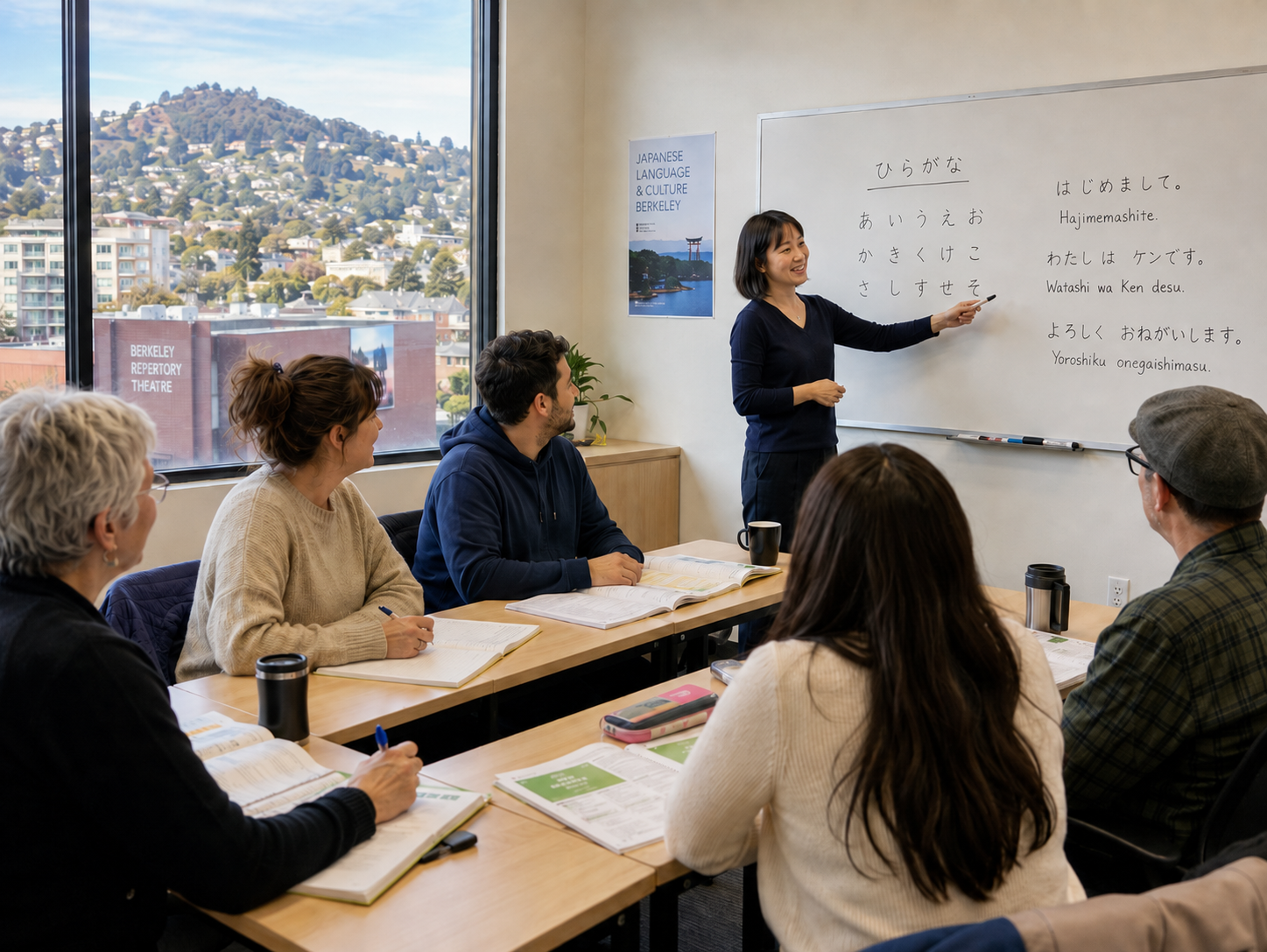
Learning Japanese as an adult in Berkeley often begins with a spark that feels both deeply personal and slightly intimidating: maybe you are planning your first trip to Tokyo or Kyoto, maybe you work in tech, design, research, or international business, or maybe you simply want the rare pleasure of learning a language that asks your brain to move in a completely new direction.
Whatever brings you to Japanese, one thing becomes clear very quickly: Japanese is not a language most English speakers can casually “pick up” in the background. It is beautiful, logical, elegant, and surprisingly pronounceable—but it also has three writing systems, a different sentence structure, particles that do not translate neatly into English, and levels of politeness that shape how people speak in real life. For a motivated beginner, that combination can feel exciting one day and overwhelming the next.
That is exactly why choosing the right Japanese class matters so much.
For busy adults in Berkeley, Oakland, Albany, Emeryville, Alameda, San Francisco, and the wider East Bay, the ideal Japanese class is not necessarily the most intense course, the most academic program, or the flashiest app. The best option is usually the one that gives you structure, human support, regular speaking practice, cultural explanation, and a realistic pace that fits into an already full life.
Adult beginners are not usually looking for a college-style workload. They are not trying to spend three hours a day memorizing kanji after work. They may have jobs, families, errands, travel, businesses, creative projects, or simply limited energy at the end of the day. What they need is a class that respects their schedule while still helping them make real progress.
That is where small-group Japanese classes can be especially powerful. A well-designed beginner Japanese class gives you the foundation you cannot easily build alone: pronunciation, basic conversation, hiragana, katakana, sentence structure, particles, everyday phrases, and cultural confidence. It helps you understand not just what to say, but when to say it, how formal to be, and why Japanese works the way it does.
In Berkeley, where people are curious, international, intellectually engaged, and often very busy, Japanese classes for adults should feel practical, welcoming, and serious without being intimidating. You should leave class feeling challenged, but not crushed. You should speak from the first weeks, but not be embarrassed when you make mistakes. You should learn the writing systems, but not feel as if kanji has swallowed your entire life.
This guide will help you understand what to look for in the best Japanese classes in Berkeley for beginners and busy adults, why Japanese is worth learning, what makes it challenging, how small-group classes compare with apps and university courses, and how to choose a learning path that actually fits your real life.
Why Japanese Is So Popular Among Adults in Berkeley and the East Bay
Japanese has always attracted learners for cultural reasons, but in recent years the interest has become broader and more practical. Adults in Berkeley and the East Bay often come to Japanese from several directions at once: travel, anime, manga, food, design, technology, film, literature, martial arts, architecture, and curiosity about Japanese social life.
For some students, the motivation is travel. Japan has become one of the world’s most desirable destinations, especially for travelers interested in food, trains, temples, city life, nature, hot springs, fashion, and pop culture. A trip to Japan is absolutely possible with English and translation apps, especially in major cities, but even basic Japanese changes the experience. Being able to greet someone, read kana on signs, order food more confidently, ask simple questions, and understand small social cues makes the trip feel richer and less passive.
For others, Japanese begins with anime, manga, video games, J-pop, Japanese cinema, or literature. At first, subtitles are enough. Then, slowly, you start noticing repeated words. You hear characters using different levels of politeness. You realize that translations cannot always capture the humor, softness, rudeness, or emotional nuance of the original. That curiosity often becomes the first step toward serious study.
There are also professional reasons. The Bay Area has deep connections to international business, research, technology, design, engineering, education, and creative industries. Japanese may not be required in most local jobs, but it can be a meaningful differentiator for people who work with Japanese companies, travel to conferences, collaborate internationally, or simply want a language that signals discipline and cultural range.
And then there is the Berkeley factor itself. Berkeley and the East Bay attract adults who enjoy lifelong learning. People here take classes not only to advance a career, but to expand their world. Japanese appeals to that kind of learner because it offers more than vocabulary. It offers a new way to think about communication, context, respect, indirectness, rhythm, and social relationship.
Japanese is not just a language you memorize. It is a language that teaches you to notice.
Why Japanese Feels Difficult at First
Japanese has a reputation for being hard, and for English speakers, that reputation is not completely wrong. But “hard” does not mean impossible. It usually means unfamiliar.
The difficulty of Japanese comes from the fact that several parts of the language feel new at the same time. A beginner does not just learn new words. A beginner also has to adjust to a new writing system, new grammar logic, new sentence order, and new cultural expectations around politeness.
Japanese Uses Three Writing Systems
One of the first things beginners notice is that Japanese does not use only one writing system. It uses three: hiragana, katakana, and kanji.
Hiragana is usually the first script beginners learn. It is used for native Japanese words, grammatical endings, and particles. Katakana is often used for foreign loanwords, names, emphasis, and certain sounds. Both hiragana and katakana are phonetic, which means they represent sounds rather than meanings. This part is very manageable with regular practice.
Kanji is more complex. Kanji characters come historically from Chinese characters, and each character carries meaning. Many kanji also have multiple readings depending on the word. This can feel intimidating, but beginners do not need to master thousands of kanji immediately. A good beginner Japanese class introduces kanji gradually, while focusing first on kana, pronunciation, basic grammar, and conversation.
The key is order. If you try to learn everything at once, Japanese feels impossible. If you learn it step by step, it becomes much more approachable.
Japanese Sentence Structure Is Different from English
English usually follows subject–verb–object order:
“I eat sushi.”
Japanese often follows subject–object–verb order:
“I sushi eat.”
That means the verb often comes at the end of the sentence. For English speakers, this can feel backwards at first. You may understand every word in a sentence but still feel confused because the structure works differently.
The good news is that Japanese grammar is often more regular than English grammar. Once you understand the pattern, you start seeing how sentences are built. A teacher can make this much easier by showing you the structure clearly instead of expecting you to guess it from examples.
Particles Take Time to Understand
Japanese uses small grammatical markers called particles. Common particles include は, が, を, に, で, の, and へ. These tiny words show the role of each part of the sentence: topic, subject, object, location, direction, possession, and more.
For beginners, particles can be frustrating because they often do not translate cleanly into English. They are small, but they carry a lot of meaning. A sentence can change subtly or dramatically depending on which particle is used.
This is one of the strongest arguments for taking a structured Japanese class. Apps can show you example sentences, but a teacher can explain why one particle appears instead of another, what nuance it creates, and how to use it in your own speech.
Politeness Levels Matter
Japanese has different levels of formality. You speak differently to a close friend, a teacher, a customer, a stranger, a boss, or someone older. Beginners usually start with polite Japanese because it is widely useful and socially safe. Later, they learn casual forms, honorific language, humble forms, and more nuanced registers.
This can feel scary for adults who do not want to sound rude. But in reality, beginners are not expected to speak perfectly. What matters first is learning a polite, clear foundation. A good Japanese teacher helps you understand what is appropriate without making you afraid to speak.
Pronunciation Is More Encouraging Than You Might Think
Japanese pronunciation is often less chaotic than English pronunciation. The sounds are fairly consistent, and once you learn hiragana, you can usually pronounce written words with reasonable accuracy.
That said, pronunciation still deserves attention. Long and short vowels can change meaning. Double consonants matter. Pitch accent can affect how natural you sound. But compared with the writing system or particles, pronunciation is often one of the more encouraging parts of Japanese for beginners.
This is why speaking practice from the beginning is so important. You do not want Japanese to remain something you only recognize on a screen. You want it to become something your mouth can produce.
Why Busy Adults Should Not Rely Only on Apps
Language apps are useful. They can help you review vocabulary, practice kana, build a daily habit, and stay connected to Japanese between classes. For busy adults, they are convenient because they fit into small pieces of time: a BART ride, a lunch break, a waiting room, or ten minutes before bed.
But apps are not a complete solution.
Most apps are strongest at recognition. They help you recognize words, match sentences, choose answers, and repeat patterns. That is valuable, but it is not the same as conversation. Real Japanese requires listening, responding, adjusting, asking questions, making mistakes, and receiving correction.
A beginner might spend months on an app and still freeze when asked a simple question in Japanese. Why? Because the app did not create enough real-time interaction. It did not require the learner to produce language spontaneously. It did not correct pronunciation in a meaningful way. It did not explain cultural context deeply. It did not notice when the learner misunderstood a grammar pattern.
A human-taught class fills those gaps.
In a good Japanese class, you hear the teacher pronounce words naturally. You practice with classmates. You ask questions. You learn why a sentence works. You get corrected before mistakes become habits. You also build accountability, which is one of the biggest challenges for adults studying independently.
Apps are best used as supplements. They are excellent for review, drilling kana, and keeping momentum between classes. But if your goal is to actually speak Japanese, understand the structure, and feel confident using the language with people, you need human interaction.
What Adult Beginners Should Look for in a Japanese Class
Not all Japanese classes are designed for the same type of learner. A university course, a private tutor, a self-paced app, and a small-group adult class can all be useful—but they serve different needs.
If you are a beginner and a busy adult in Berkeley or the East Bay, here is what you should look for.
1. A Beginner-Friendly Structure
A true beginner class should not assume you already know hiragana, grammar, or basic phrases. It should start from the beginning and build gradually. You should know what you are learning each week and why it matters.
The first weeks should usually include pronunciation, greetings, self-introductions, classroom phrases, hiragana, basic sentence patterns, and simple polite forms. The class should feel organized, not random.
2. Small Group Size
Small groups are ideal for many adults. You get enough classmates to practice with, but not so many that you disappear into the room. In a large class, it is easy to sit quietly and avoid speaking. In a small group, you participate more naturally.
Small groups also give the teacher more room to notice your mistakes, answer your questions, and adjust examples to the students in the room. This matters especially in Japanese, where beginners often need help with pronunciation, particles, word order, and politeness.
3. Speaking Practice from the Beginning
Some adult learners worry that they need to “study first” and speak later. But if you wait too long to speak, speaking becomes scary.
A good beginner Japanese class should include simple speaking practice from the start: greetings, names, nationalities, occupations, hobbies, ordering food, asking where something is, and talking about likes and dislikes. You do not need advanced grammar to begin speaking. You need useful patterns and repetition.
4. Cultural Explanation
Japanese cannot be separated from culture. Politeness, indirectness, greetings, gift-giving, restaurant etiquette, workplace behavior, and everyday phrases all reflect social expectations.
A class that teaches only vocabulary and grammar can leave students confused when they encounter real Japanese. A better class explains cultural context as part of the language. Why do people say this phrase in this situation? Why is this expression too casual? Why would a direct translation sound strange? Why does a Japanese speaker avoid saying “no” directly in some situations?
These explanations are especially useful for adult learners, who usually want to understand the “why” behind the language.
5. A Realistic Workload
Busy adults need consistency, not perfection. A class that expects two hours of homework every night may be excellent for full-time students, but unrealistic for working professionals.
For most adult beginners, a manageable target is regular class attendance plus short study sessions during the week. Even 15 to 30 minutes most days can make a major difference if the practice is focused. The best Japanese classes for adults understand that students have real lives and help them build sustainable habits.
6. An Encouraging Atmosphere
Adults often bring a surprising amount of fear into language classes. They worry about looking foolish, mispronouncing words, forgetting things, being slower than other students, or not having studied enough.
A good class lowers that anxiety. It should feel structured but warm. Mistakes should be treated as part of learning, not as embarrassment. The teacher should be patient, clear, and experienced with adult beginners.
This matters because confidence is not a bonus in language learning. Confidence is part of the method. Students who feel safe speaking will speak more. Students who speak more will improve faster.
Comparing Japanese Learning Options in Berkeley and the East Bay
Berkeley and the surrounding East Bay offer several ways to learn Japanese. The right choice depends on your goals, schedule, budget, and learning style.
Community College Classes
Community college Japanese classes can be a good option for learners who want a formal academic structure and can commit to a semester schedule. They may offer a clear curriculum and lower tuition compared with private instruction.
However, community college classes may meet multiple times per week, include exams and grades, and move according to an academic calendar. They may also include younger students, which can make the environment feel less adult-focused. Also, there are usually 25-30 students per class which is not ideal.
Best for: learners who want an academic course and have time for regular homework, tests, and a semester-long commitment.
University Courses
University Japanese programs can be rigorous, well-organized, and academically strong. They are excellent for students who want intensive study and long-term progression.
But for busy adults, they can be too demanding. University language classes often require frequent meetings, heavy homework, and fast pacing. That can be wonderful for full-time students but overwhelming for someone with a job, family, or unpredictable schedule.
Best for: full-time students or highly motivated adults who want a demanding academic experience.
Private Tutors
A private Japanese tutor offers maximum customization. You can focus on travel, conversation, JLPT preparation, business Japanese, pronunciation, anime, or whatever matters most to you. Scheduling may also be more flexible.
The downside is cost and lack of group energy. Some students thrive one-on-one, while others feel more motivated when they learn with classmates. Quality also varies widely depending on the tutor’s training and experience.
Best for: learners with specific goals, unusual schedules, or a need for individual attention.
Apps and Self-Study
Apps are affordable, flexible, and useful for daily practice. They can help you learn kana, review vocabulary, and build a habit.
But apps usually do not provide enough speaking practice, correction, cultural explanation, or accountability. Many adults start enthusiastically and then slowly stop because there is no class, teacher, or community pulling them forward.
Best for: supplementary practice or casual learners who are not yet ready for a class.
Large Commercial Schools or Intensive Programs
Larger schools may offer many levels, intensive programs, and brand recognition. Some students like the energy of a bigger institution.
However, larger programs can feel less personal. They may also require commuting, especially if they are in San Francisco rather than Berkeley or the East Bay.
Best for: learners seeking intensive study or a larger school environment.
Small-Group Japanese Classes in Berkeley
For many busy adults, small-group Japanese classes offer the best balance. You get structure, a teacher, classmates, speaking practice, and cultural explanation without the pressure of a full academic program.
This format is especially helpful for complete beginners because it provides guidance at the exact moment when Japanese can feel most confusing. You are not left alone with hiragana charts, particle lists, and app exercises. You have someone explaining the system and helping you use it.
Best for: adult beginners who want practical progress, human support, and a manageable schedule.
Why Small-Group Japanese Classes Work So Well for Busy Adults
Small-group classes are powerful because they solve several common adult-learning problems at the same time.
First, they create accountability. When you know you have class every week, you are more likely to review. You do not have to rely entirely on motivation, which naturally comes and goes.
Second, they create rhythm. Language learning works best when it becomes part of your weekly life. A class gives structure to that rhythm: learn, practice, review, return, ask questions, and build.
Third, small groups make speaking less intimidating. You are not performing in front of a huge room, but you are also not alone. You get used to hearing other beginners make mistakes too, which is strangely comforting. Everyone is learning. Everyone is trying. That shared experience helps adults relax.
Fourth, small classes allow teachers to give more targeted feedback. In Japanese, small corrections matter. A teacher can help you distinguish long vowels, choose the right particle, use polite forms correctly, or make your sentence sound more natural.
Finally, small-group classes create community. Adult learners often underestimate how motivating this can be. When classmates are also planning trips, watching Japanese shows, exploring Japanese restaurants, or struggling with katakana, the language becomes social. It stops being just homework.
What You Can Expect in the First Few Weeks of Beginner Japanese
A complete beginner Japanese class should not throw you into the deep end. The first few weeks should help you build confidence and orientation.
Weeks 1–2: Sounds, Greetings, and First Sentences
In the first classes, you will usually learn Japanese pronunciation, basic greetings, and simple self-introductions. You might learn how to say your name, where you are from, what you do, and how to greet the teacher and classmates.
You will also begin hiragana. At first, the characters may look unfamiliar, but they become manageable with repetition. A good class will not expect instant mastery. Instead, you will practice reading, writing, recognizing patterns, and connecting sounds to symbols.
You may also learn classroom expressions such as “please say it again,” “I don’t understand,” or “how do you say this in Japanese?” These phrases are useful because they let you stay in the language even when you are confused.
Weeks 3–4: More Kana, Simple Grammar, and Everyday Phrases
By the third or fourth week, you may be reading more hiragana and beginning katakana. You will likely learn simple sentence patterns, basic particles, and polite verb forms.
You might practice saying what you like, asking simple questions, ordering something, or talking about your hobbies. You may also begin to notice how Japanese sentences organize information differently from English.
This is often the stage where learners feel both excited and humbled. You can say more than before, but you also realize how much there is to learn. That is normal. The purpose of a beginner class is not to make you fluent in a few weeks. It is to give you a foundation strong enough to keep building.
How Much Time Should Busy Adults Study Japanese?
The honest answer is: more than zero, less than perfection.
Many adult learners believe they must study for hours every day or they will fail. That belief often leads to burnout. A more realistic approach is to study consistently in small blocks.
For a busy adult, a good weekly rhythm might look like this:
One Japanese class per week
Three to five short review sessions of 15–30 minutes
One slightly longer weekend review session
Optional app practice during spare moments
That may not sound dramatic, but it works far better than cramming once and then ignoring the language for six days.
For Japanese specifically, short daily practice is especially useful for kana. Hiragana and katakana become easier when you see them often. Five minutes a day reviewing characters is usually better than one exhausting hour once a week.
The same is true for speaking. Repeating simple phrases aloud, even for ten minutes, helps your mouth become comfortable with Japanese sounds. Silent recognition is not enough. You need to produce the language.
The best study plan is the one you can actually maintain.
Practical Japanese Study Tips for Busy Adults
Practice Kana in Small Bursts
Do not wait until you have a perfect study setup. Review hiragana and katakana on your phone while commuting, waiting in line, or drinking coffee. Small repetitions add up.
Say Words Out Loud
Japanese needs to become physical. Repeat greetings, classroom phrases, and example sentences aloud. Whisper if you have to. Speaking activates a different kind of memory than reading silently.
Use Apps Strategically
Apps are excellent for review, but do not let them become your only method. Use them to reinforce what you learn in class: kana, vocabulary, simple sentences, and listening practice.
Make Japanese Visible
Put a hiragana chart somewhere you will see it. Label a few objects. Keep a notebook. Follow Japanese restaurants, travel accounts, or cultural pages. Let the language appear in your daily environment.
Review Before Class
Even ten minutes of review before class can make a difference. You will understand more, participate more, and feel less anxious.
Do Not Try to Learn All Kanji at Once
Kanji is a long-term project. Beginners should respect it, but not panic about it. Build your foundation first.
Connect Japanese to Your Real Interests
If you love food, learn menu words. If you love anime, notice repeated phrases. If you are traveling, practice station and restaurant language. If you enjoy design, learn words connected to aesthetics and objects. Motivation grows when the language connects to your life.
Japanese for Travel, Culture, Anime, and Real Life
Japanese is one of the most rewarding languages to learn because even beginner knowledge can change how you experience culture.
If you travel to Japan, you will notice signs, greetings, menus, ticket machines, announcements, and polite formulas everywhere. Even when you cannot understand everything, recognizing kana and basic phrases makes the environment less mysterious.
If you watch anime or Japanese films, you begin to hear the difference between formal and casual speech. You notice how characters address each other. You understand why subtitles sometimes simplify things. You hear emotion differently.
If you love food, Japanese opens up menus and dining etiquette. You begin to understand not only sushi and ramen vocabulary, but also the small phrases that make restaurant interactions smoother.
If you are interested in work or business, Japanese gives you insight into communication styles that are often more indirect, context-sensitive, and relationship-based than English. Even basic study can deepen your cultural awareness.
And if you are simply learning for personal growth, Japanese offers one of the best mental challenges available. It asks you to read differently, listen differently, and think about language differently.
Why Berkeley Is a Great Place to Learn Japanese
Berkeley is an ideal place to study Japanese because it combines intellectual curiosity with international culture. It is close to Oakland, San Francisco, Albany, Emeryville, Alameda, El Cerrito, and other East Bay communities, making it a natural gathering place for adult learners.
The East Bay also has access to Japanese restaurants, cultural events, bookstores, film screenings, university resources, and travel-minded communities. Students are often not learning Japanese in isolation. They are learning it as part of a broader interest in Japan and the world.
For busy adults, location matters. A Japanese class in downtown Berkeley, especially one accessible by BART or easy transit routes, can be much more realistic than commuting across the Bay after work. Online Japanese classes can also make study possible for students in Oakland, Alameda, San Francisco, or beyond who want the same structure without the commute.
The best Japanese class is not just the one with the best textbook. It is the one you can actually attend consistently.
Why Polyglottist Language Academy Is a Strong Choice for Japanese Beginners in Berkeley
At Polyglottist Language Academy, we understand that adult learners need a different kind of language class. Most of our students are not full-time college students. They are working adults, travelers, professionals, lifelong learners, and people returning to language study after many years.
Our Japanese classes are designed to be structured, supportive, and practical. We focus on helping beginners build a foundation step by step: pronunciation, basic conversation, hiragana, katakana, essential grammar, cultural context, and confidence speaking.
Because our classes are small, students have more opportunities to participate, ask questions, and receive feedback. You are not hidden in a large lecture hall. You are part of a group where the teacher knows your level and where classmates are learning alongside you.
We also understand that busy adults need realistic expectations. Learning Japanese takes time, but it does not require turning your entire life upside down. With regular class attendance, manageable review, and steady practice, you can make real progress.
Whether you live in Berkeley, Oakland, Albany, Emeryville, Alameda, San Francisco, or elsewhere in the Bay Area, Polyglottist Language Academy offers a welcoming place to begin Japanese in a way that is serious, human, and sustainable.
Check out our Japanese classes.
FAQs About Japanese Classes in Berkeley for Beginners
Is Japanese hard for English-speaking beginners?
Japanese is challenging because it has different grammar, three writing systems, particles, and politeness levels. However, it is also very logical in many ways, and pronunciation is often more consistent than English. With a structured beginner class, Japanese becomes much more manageable.
Do I need to know hiragana before joining a beginner Japanese class?
No. A true complete beginner class should introduce hiragana from the beginning. Some students like to preview hiragana before class starts, but it should not be required.
How long does it take to have a basic conversation in Japanese?
Many beginners can learn simple greetings, self-introductions, and everyday phrases within the first few weeks. Having a more comfortable basic conversation usually takes several months of consistent study, depending on practice time and class frequency.
How many hours per week should a busy adult study Japanese?
A realistic goal is one class per week plus several short review sessions. Even 15–30 minutes on most days can help a lot, especially for kana and vocabulary.
Are apps enough to learn Japanese?
Apps are useful for review and vocabulary, but they are usually not enough if you want to speak confidently. A class gives you structure, correction, listening practice, grammar explanation, and real interaction.
What is better: a private tutor or a small-group class?
A private tutor is best if you need a customized schedule or have very specific goals. A small-group class is often better for beginners who want structure, classmates, speaking practice, and a more affordable learning environment.
Can I take Japanese classes online if I live outside Berkeley?
Yes. Online Japanese classes can be a great option for students in Oakland, Alameda, San Francisco, or anywhere else who want structured instruction without commuting.
Will I learn kanji in a beginner Japanese class?
Yes, but gradually. Most beginner classes focus first on pronunciation, hiragana, katakana, basic grammar, and conversation. Kanji is introduced step by step so it does not overwhelm the rest of your learning.
Are Japanese classes good for travelers?
Absolutely. Even basic Japanese can make travel in Japan more enjoyable. You can learn greetings, restaurant phrases, transportation words, shopping expressions, and cultural etiquette that help you feel more confident.
Are Polyglottist Japanese classes suitable for complete beginners?
Yes. Polyglottist Language Academy offers beginner-friendly Japanese classes designed for adult learners, including students starting from zero.
Start Learning Japanese with Polyglottist Language Academy
If you are looking for the best Japanese classes in Berkeley for beginners and busy adults, Polyglottist Language Academy would be happy to help you begin.
Our small-group Japanese classes are designed for adults who want structure, encouragement, practical conversation, and cultural understanding. Whether your goal is travel, anime, personal enrichment, professional development, or simply the joy of learning something new, we can help you take the first step.
We offer language classes in Berkeley and online, serving students from Berkeley, Oakland, Albany, Emeryville, Alameda, San Francisco, and the wider Bay Area.
Visit Polyglottist Language Academy to check our current Japanese schedule and sign up for an upcoming beginner class.
You May Also Enjoy These Articles
If you are interested in Japanese, language learning, or studying as a busy adult, you may also enjoy these related articles from our blog:
The Best Way To Start Learning Japanese As A Complete Beginner
Japanese Pronunciation For Beginners: What English Speakers Get Wrong
How To Practice Japanese Every Day Even With A Busy Schedule
Hiragana, Katakana, And Kanji: What Japanese Learners Need To Know First
Japanese Lessons In Palo Alto: A Smarter Way To Learn The Language
Learn Japanese In Walnut Creek: Small Classes, Real Progress
Japanese Classes In San Francisco For Adults: Where To Start