
Can You Learn Basic Russian in 10 Days?
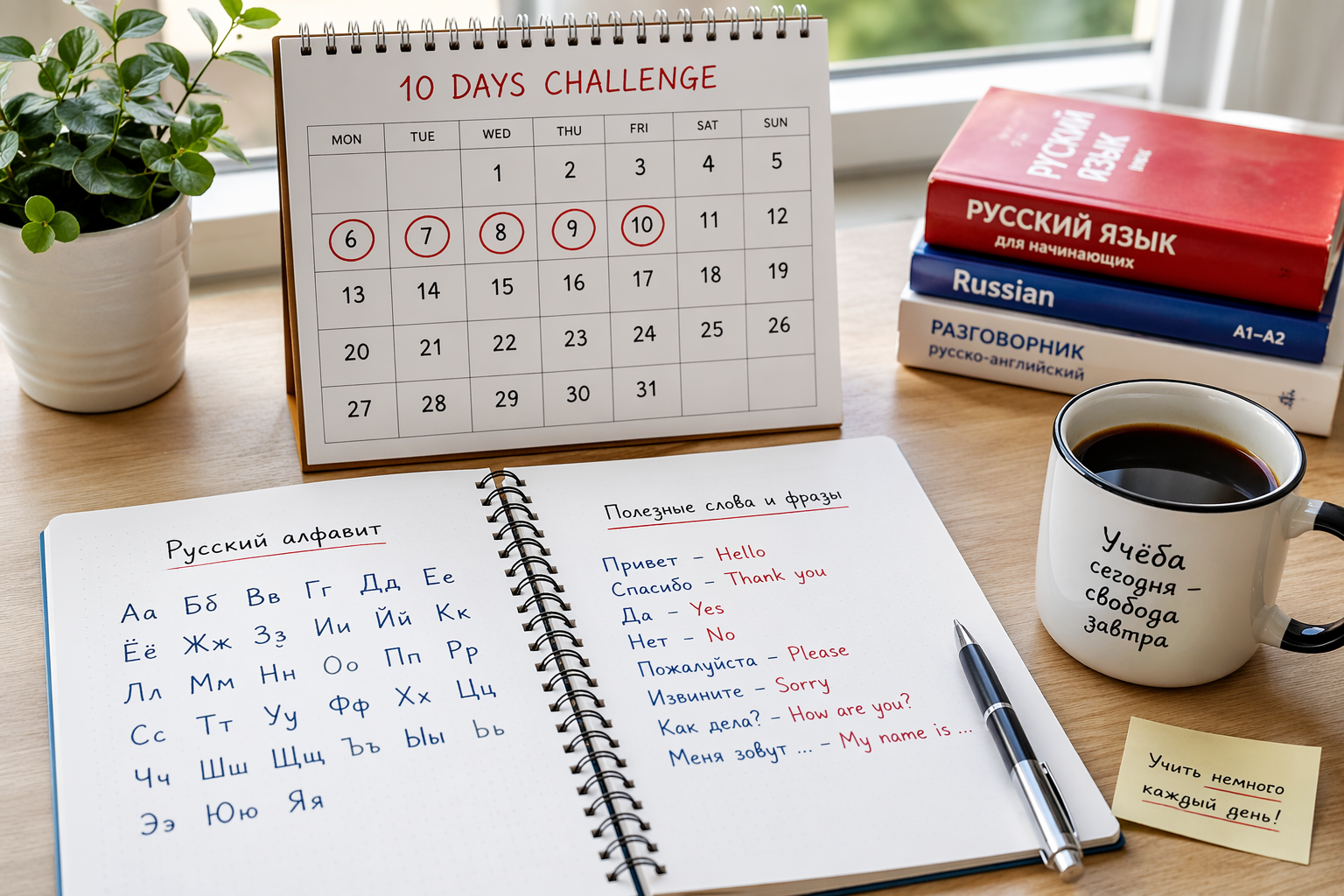
If you search online for phrases like learn Russian fast or Russian in 10 days, you will find a lot of bold promises. Some websites make it sound as if you can go from zero to fluent in a week and a half. That may be good marketing, but it is not reality.
Still, that does not mean 10 days is meaningless.
In fact, 10 focused days can be enough to make a very real start in Russian. You can learn the Cyrillic alphabet, read basic words, introduce yourself, use simple travel phrases, and begin to understand how the language works. You will not become fluent, and you will not master Russian grammar, but you can absolutely build a useful beginner foundation.
That is the key point. The answer depends entirely on what you mean by basic Russian.
If by “basic Russian” you mean greeting people, ordering food, asking where something is, reading signs, understanding common travel phrases, and recognizing a few core sentence patterns, then yes, that is realistic. If by “basic Russian” you mean having free-flowing conversations, understanding native speech at full speed, or feeling comfortable with cases and verb aspect, then no, 10 days will not get you there.
So let’s answer the question honestly. Can you learn basic Russian in 10 days? Yes, but only if your expectations are realistic and your study plan is smart.
What “basic Russian” really means
One of the biggest mistakes beginners make is using the word basic too loosely. To one person, basic Russian means being able to say hello and thank you. To another, it means holding a casual conversation. Those are two completely different levels.
A realistic 10-day goal is not fluency. It is not even full beginner-level competence. It is something more specific: survival Russian.
That means you can handle simple, predictable situations. You may be able to:
greet someone politely
introduce yourself
say where you are from
say that you speak a little Russian
ask simple questions
understand numbers and prices
read basic signs and labels
order food and drinks
This is not fake progress. It is real progress. In many travel situations, that level of Russian is already useful.
Basic Russian in 10 days is not about mastering the language. It is about building a small practical toolkit that allows you to interact, recognize patterns, and feel less intimidated.
What you can realistically learn in 10 days
If you study seriously for 10 days, especially if you spend 2 to 4 focused hours per day, you can learn more than many people think.
One of the fastest wins is often the alphabet. Cyrillic looks intimidating at first, but it becomes manageable surprisingly quickly when you approach it step by step. Some letters are familiar, some are misleading, and some are completely new. Once you get over the initial shock, reading Russian starts to feel much less impossible.
In 10 days, a motivated learner can often learn to:
recognize and read Cyrillic at a beginner level
sound out simple Russian words
memorize 50 to 100 useful survival phrases
introduce themselves
ask and answer very simple questions
use simple sentence patterns in real-life situations
navigate common travel interactions with help from context
That is already a meaningful amount of progress.
For example, after 10 days, you may be able to say things like:
Hello
My name is…
I am from…
I speak a little Russian
Where is the metro?
How much does this cost?
I would like tea, please
I need help
I do not understand
Do you speak English?
This is not fluency, but it is functional. More importantly, it creates momentum. The language starts to feel accessible instead of overwhelming.
What you probably will not learn in 10 days
This part is just as important.
You will not master Russian grammar in 10 days. You will not gain natural control over cases, word endings, or verb aspect. You will not understand films, news broadcasts, or rapid native conversation. You will not be able to talk comfortably about abstract topics or express yourself with nuance.
You also probably will not be able to create long spontaneous sentences without relying heavily on memorized phrases and basic patterns.
That is normal.
Russian is considered one of the more difficult major languages for English speakers. It takes a long time to reach a strong independent level. Ten days is enough for a useful start, but not enough for deep command.
This is why it helps to separate three different ideas:
1. Survival Russian
You can get through basic predictable situations using a limited set of phrases and patterns.
2. Conversational Russian
You can build your own sentences more flexibly and understand more than rehearsed material.
3. Fluency
You can communicate across a wide range of topics with confidence, accuracy, and strong comprehension.
Ten days can get you into the first category. It can give you the earliest building blocks of the second. It cannot give you the third.
Why Russian feels hard at the beginning
Russian has a reputation for being hard, and that reputation is not random. For English speakers, the first contact with Russian can feel overwhelming because multiple unfamiliar things appear at once.
First, there is the Cyrillic alphabet. Even before you start grammar, the writing system can make the language feel distant. Many beginners mentally confuse “different alphabet” with “impossible language.” But the alphabet is often one of the quickest barriers to overcome.
Second, there is pronunciation and stress. Russian word stress is not always predictable. Vowels can sound different when unstressed. Some consonants take time to hear and pronounce clearly. Beginners often feel uncertain because the spoken language does not always match what they expect from the spelling.
Third, there is grammar. Russian nouns change depending on their role in the sentence. Adjectives change too. Verbs come with patterns that may seem strange to English speakers. Word endings matter a lot, which means even familiar words can appear in unfamiliar forms.
But Russian is not difficult in every way.
It also has features that are easier than people expect. Once you learn the alphabet, reading becomes much less scary. Many everyday phrases are highly reusable. Russian also rewards pattern recognition. At the beginning it may look chaotic, but after a while you start noticing structure everywhere.
That is why a good beginner approach matters so much. If you try to learn everything at once, Russian feels impossible. If you focus on the most useful building blocks first, it becomes much more manageable.
Memorizing phrases is not the same as mastering Russian, but it still matters
Some learners worry that if they memorize phrases, they are not “really learning” the language. That is the wrong way to think about it.
Memorized phrases are a completely valid part of early language learning. The problem only comes when phrase memorization is the only thing you do.
For example, if you learn:
Здравствуйте — Hello
Меня зовут... — My name is...
Я из... — I am from...
Сколько стоит? — How much does it cost?
Где метро? — Where is the metro?
Я не понимаю — I do not understand
that is useful. Those phrases can help you immediately.
But deeper learning begins when you notice the patterns inside them. You realize that где means “where,” that я из can be followed by a place, that я не понимаю is something you can use in many situations, and that сколько стоит can be used for all kinds of items and services.
So the best 10-day learning plan combines two things:
memorizing high-frequency phrases
understanding the basic structure inside some of them
That way you are not just repeating sounds. You are beginning to build language awareness.
So, can you learn basic Russian in 10 days?
Yes, but the answer is not a dramatic yes. It is a practical yes.
You can learn useful basic Russian in 10 days if:
your goal is survival-level communication
you study consistently every day
you focus on the highest-frequency vocabulary and phrases
you practice listening and speaking, not just reading explanations
you do not waste time trying to master every grammar concept immediately
you accept that early progress is imperfect
Ten days is enough to break through the fear barrier. It is enough to prove to yourself that the alphabet is learnable, that the language has patterns, and that you can say more than you thought possible.
That matters.
For many adults, the hardest part of Russian is not the grammar. It is getting started. Once the language stops feeling like a wall of strange symbols and starts feeling like a system you can partially decode, motivation increases dramatically.
A good 10-day sprint can do exactly that.
A smart 10-day Russian study plan
If you want to learn as much useful Russian as possible in 10 days, your study plan needs to be focused. This is not the time to try to cover all beginner grammar. It is the time to learn what gives you the highest return.
Here is a much smarter structure.
Days 1 and 2: Learn Cyrillic and basic greetings
Start with the alphabet. Focus on letter recognition and reading aloud, not perfect handwriting. Pair that with survival phrases:
hello
goodbye
yes
no
please
thank you
excuse me
my name is…
I am from…
I speak a little Russian
Your goal is to feel that Russian is readable and pronounceable.
Days 3 and 4: Numbers, money, food, and basic needs
Next, learn numbers and practical vocabulary you can use right away:
numbers 1 to 100
tea, coffee, water, bread, soup
I want…
I would like…
how much?
this, that
I need…
where is…?
Now you are learning the language of basic transactions and everyday needs.
Days 5 and 6: Directions, transport, places
Travel language gives beginners a strong sense of progress because it feels immediately relevant.
Focus on:
left
right
straight
station
airport
hotel
ticket
metro
help
I am lost
where is…?
how do I get to…?
These are exactly the kinds of phrases that make short-term study worthwhile.
Days 7 and 8: Core sentence patterns
Now shift from isolated phrases to flexible patterns.
Practice structures like:
Я хочу... — I want...
Мне нужно... — I need...
У меня есть... — I have...
Мне нравится... — I like...
Я не понимаю... — I do not understand...
Вы можете помочь? — Can you help?
Take each pattern and plug in many different nouns and expressions. This helps move you beyond pure memorization.
Days 9 and 10: Listening, repetition, and role-play
At this stage, review is essential. Spend time listening, shadowing, repeating aloud, and acting out basic situations.
Role-play things like:
checking into a hotel
ordering in a café
buying a ticket
asking for directions
introducing yourself
asking for help
Many learners think they know something because they recognize it on paper. Role-play reveals whether you can actually use it.
What to ignore in your first 10 days
This may sound strange, but one of the smartest things you can do is deliberately ignore some topics at the beginning.
Do not spend your first 10 days drowning in case tables. Do not obsess over every grammatical exception. Do not worry about advanced verb aspect distinctions. Do not build your study around rare vocabulary or overly formal language.
At the beginner stage, more information is not always better. Very often it just creates confusion.
Your first 10 days should focus on:
recognition
pronunciation
basic communication
high-frequency vocabulary
a few core sentence patterns
repeated listening and speaking practice
You can always go deeper later. In fact, you will understand the grammar much better once you already have some real phrases and patterns in your head.
What you might genuinely be able to do after 10 days
Let’s make this concrete.
A successful beginner after 10 focused days might be able to do something like this:
“Hello. My name is Robert. I am from the United States. I live in the Netherlands. I speak a little Russian. Where is the metro? I need a ticket. How much does it cost? I would like tea and bread, please. Thank you. I do not understand. Can you help me?”
They might also be able to read common words on signs such as:
метро
ресторан
вход
выход
билет
аптека
They might not understand everything they hear, but they can begin to recognize familiar words. They may not know why every ending changes, but they can see that Russian is not random. That is a real achievement.
FAQs
Can you really learn Russian in 10 days?
You can learn useful survival-level Russian in 10 days, especially if you study seriously every day. You cannot become fluent in that amount of time.
How much Russian can I learn in 10 days?
You can learn the Cyrillic alphabet, common beginner vocabulary, simple travel phrases, and a few basic sentence patterns. You may also be able to handle simple predictable interactions.
Is Russian too hard for English speakers?
Russian is challenging, especially because of the alphabet and grammar, but it is not impossible. With the right approach, beginners can make strong early progress.
Do I need to learn all the Russian cases in 10 days?
No. In your first 10 days, it is much more effective to focus on practical phrases and common patterns than to try to master the full case system.
What is the best way to start learning Russian fast?
Focus on Cyrillic, pronunciation, high-frequency vocabulary, travel phrases, and a few reusable sentence patterns. A structured digital course can help you do this much more efficiently.
Is a digital Russian course better than random apps and videos?
Very often, yes. A structured course gives you the right material in the right order, which is especially important at the beginner stage.
Why a structured course helps much more than random self-study
Many beginners assume that learning basic Russian in 10 days is just a matter of finding enough apps, videos, and flashcards. The problem is that random materials rarely teach in the best order.
One source gives you colors. Another gives you the days of the week. Another throws you into grammar explanations. Another teaches isolated words with no context. The result is often confusion, not momentum.
What beginners usually need is not more content. They need better structure.
That is where a guided program can make a huge difference. Instead of wasting energy deciding what to study next, you move through a sequence that is designed for actual progress.
Learn Basic Russian with Polyglottist Language Academy
If your goal is to learn basic Russian in a short period of time, Polyglottist Language Academy offers a much smarter alternative than piecing together random online materials.
We are currently developing a digital Russian course for beginners, which is expected to launch in approximately 3 to 4 months. The course is being designed for learners who want a practical, structured, and encouraging way to start. Instead of overwhelming you with every detail of the language, it will focus on what matters most in the early stage: learning Cyrillic, building pronunciation confidence, understanding core vocabulary, mastering useful survival phrases, and beginning to recognize basic sentence patterns.
This will be especially valuable for learners who want to make fast early progress without feeling lost. A strong digital course helps you focus on the essentials in the right order. That means less time wandering through disconnected videos and apps, and more time actually learning.
At Polyglottist Language Academy, we believe beginners do best when learning feels clear, manageable, and motivating. Our upcoming digital Russian course is being created with exactly that philosophy in mind. If you would like to be among the first to hear when enrollment opens, you can join our waitlist here.
In the meantime, we already offer online and in-person Russian classes in Berkeley, California for students at all levels. You can explore our current Russian class options here: Russian Classes at Polyglottist Language Academy.
So if you are wondering whether you can learn basic Russian in 10 days, the answer becomes much more encouraging when you have the right structure behind you. Ten days may not make you fluent, but it can absolutely help you build a strong foundation and give you the confidence to keep going.Related articles you may also enjoy
If you are interested in learning Russian, here are a few other articles from the Polyglottist Language Academy blog that pair well with this topic: