
How to Stay Motivated When Learning Russian
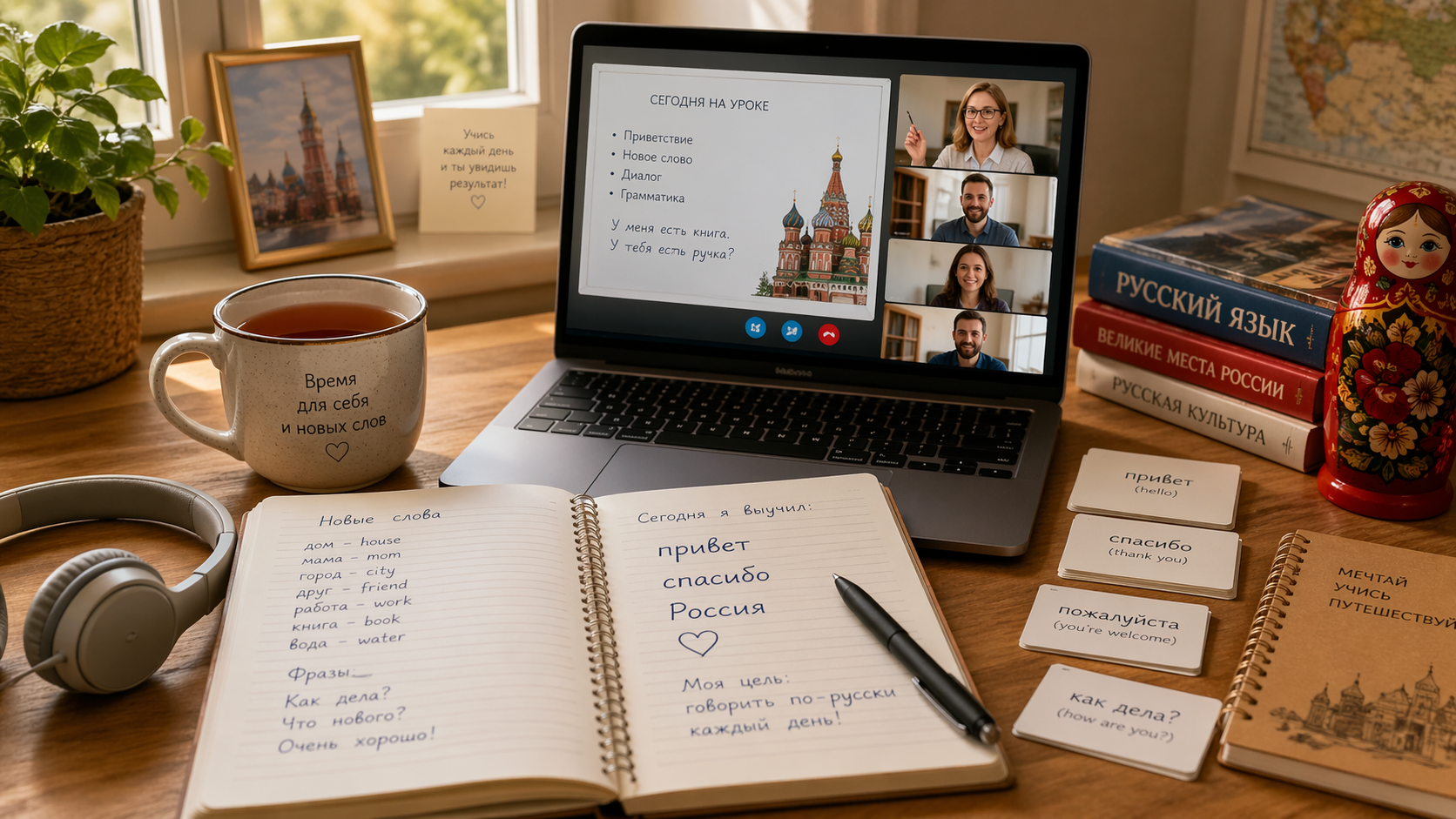
When you first decide to learn Russian, you may imagine yourself reading Dostoevsky without translation, understanding the emotional force of a Russian song, chatting confidently with native speakers, recognizing Cyrillic signs as if they had always belonged to your world, and stepping into one of the richest cultural traditions on earth — but then, almost immediately, you meet the alphabet, the cases, the pronunciation, the verbs of motion, and the strange feeling that even the simplest sentence seems to be built according to rules your English-speaking brain never had to notice before.
That moment can be exciting. It can also be intimidating.
Russian has a reputation. Many learners come to it with a mixture of fascination and fear. They have heard that the alphabet is hard, the grammar is complicated, the cases are endless, and the pronunciation is unforgiving. They may have tried a language app, completed a few lessons, memorized a handful of words, and then stopped when the first wave of enthusiasm disappeared. Others begin with a burst of energy, buy three textbooks, watch YouTube videos, download flashcard decks, and promise themselves they will become fluent in a few months — only to feel discouraged when real progress takes longer.
But this is not a sign that Russian is impossible. It is a sign that Russian needs a different kind of motivation.
Learning Russian is not like casually picking up a few travel phrases before a weekend trip. It is a deeper project. It asks you to change how you hear sounds, how you understand sentence structure, how you think about movement, time, politeness, emotion, and even silence. It introduces you to a language where endings carry meaning, where word order is flexible but not random, where one verb can open an entire world of nuance, and where a single phrase can sound practical, poetic, ironic, or deeply emotional depending on context.
That is exactly why Russian is so rewarding.
The challenge is real, but the reward is also real. When you begin to read Cyrillic without transliteration, you feel a door open. When you understand your first Russian sentence without translating every word, you feel your brain making new connections. When you recognize a case ending in a song lyric, when you understand a joke, when you introduce yourself in Russian and someone answers back, you realize that motivation does not come only from easy progress. Sometimes motivation comes from doing something difficult and watching it slowly become yours.
The key is not to wait until you magically feel motivated every day. The key is to build a system that keeps you moving even when motivation rises and falls. Russian becomes much easier to continue when you understand why it feels hard, set realistic goals, create routines, connect the language to culture, and surround yourself with enough structure and support that you do not have to rely on willpower alone.
Is Russian Really That Hard to Learn?
Russian is not the easiest language for English speakers, but it is also not the mysterious monster it is sometimes made out to be.
The first obstacle is usually visual. Cyrillic looks unfamiliar. Even before learning a single grammar rule, many beginners feel as if they are facing a wall. Some letters look like Latin letters but sound different. Some look completely new. Some printed letters change dramatically in handwriting. This can make beginners feel disoriented before they have even started.
But the alphabet is a finite challenge. It is not endless. You can learn it step by step. You do not need to master beautiful handwriting, read poetry, and type fluently before moving on. You need to learn the letters, connect them to sounds, practice with real words, and begin using them immediately.
The deeper challenge comes from grammar.
Russian uses six cases, which means nouns, pronouns, adjectives, and some numbers change their endings depending on their role in the sentence. English speakers are not used to thinking this way. In English, we mostly rely on word order: “The student reads the book” is different from “The book reads the student” because the order changes the meaning. Russian uses word order too, but endings do a great deal of the work.
Then there is grammatical gender. There are verb aspects. There are verbs of motion. There are soft and hard consonants. There are sounds like ы, which can feel impossible at first. There are formal and informal ways of saying “you.” There are expressions that do not translate neatly into English.
This can feel like a lot.
However, the biggest mistake is thinking you must understand all of Russian grammar before you can begin using Russian. You do not. A beginner does not need to master every case table. A beginner needs useful patterns. You can learn Мне нравится... for “I like...,” У меня есть... for “I have...,” Я хочу... for “I want...,” and Можно...? for “May I...?” long before you understand every grammatical detail behind them.
Russian feels hard when you treat it as a giant system you must conquer all at once. It becomes more manageable when you treat it as a language you enter gradually.
Why Learners Lose Motivation with Russian
Many learners do not quit Russian because they are incapable. They quit because they misunderstand the process.
One common reason is alphabet anxiety. Beginners sometimes believe that if Cyrillic does not feel natural immediately, they are already failing. But unfamiliar scripts always take time. The brain needs repeated exposure. Seeing a word once is not enough. Seeing it in a textbook, hearing it pronounced, writing it by hand, typing it, and recognizing it later in a different context all help turn a strange symbol into a familiar letter.
Another major motivation killer is grammar shock. Russian cases can feel especially discouraging because beginners often meet them in tables. A textbook may show six cases, singular and plural forms, masculine, feminine, neuter, hard stems, soft stems, spelling rules, exceptions, and suddenly the learner feels buried before they have spoken a sentence.
This is the wrong emotional introduction to Russian grammar.
Grammar should not be introduced as punishment. It should be introduced as a tool. The accusative case helps you talk about what you see, read, love, buy, and want. The prepositional case helps you say where you live, what you are thinking about, and what you are talking about. The genitive helps you express absence, quantity, possession, and relationships. Cases become much less frightening when they are connected to real communication.
Many learners also lose motivation because early Russian progress can feel slower than progress in Spanish, French, or Italian. English speakers recognize many Romance-language words quickly. In Russian, there are fewer familiar-looking cognates, and the alphabet hides even the words that are related. A beginner may feel they are moving slowly because they cannot immediately guess vocabulary.
This is normal. Russian front-loads more difficulty. The beginning may feel slower, but progress becomes more satisfying once the foundation is in place.
Apps can also create a motivation problem. They are useful for practice, vocabulary, and review, but they can give the illusion of progress without real communication. A streak feels good, but it does not necessarily mean you can introduce yourself, ask a question, understand an answer, or hold a conversation. Many learners spend months tapping answers on a screen and still feel terrified when asked to speak.
Finally, perfectionism destroys motivation. Russian attracts serious learners, and serious learners often want to be correct. They do not want to sound foolish. They do not want to mispronounce ы or use the wrong case ending. But waiting until you are “ready” to speak is one of the fastest ways to stay stuck. Speaking is not the final reward after perfect study. Speaking is part of how you learn.
What Makes Russian Worth the Effort?
If Russian were only difficult, nobody would stay with it. People stay with Russian because it gives back more than it takes.
Russian opens the door to one of the world’s great literary traditions. Even if you never read Tolstoy or Dostoevsky fully in the original, learning Russian changes how you encounter them. You begin to sense the rhythm of names, the emotional weight of certain words, the cultural atmosphere behind familiar translations. Poetry becomes more alive. Songs become more layered. Films become more intimate.
Russian also gives you access to a huge world of everyday culture: jokes, cartoons, recipes, interviews, YouTube channels, family stories, historical documentaries, street signs, travel conversations, and small human moments that never make it into textbooks. You do not need to be advanced to enjoy this. Even recognizing a phrase in a song or understanding a simple comment online can give you a powerful feeling of connection.
For heritage learners, Russian can be even more personal. It may connect them to parents, grandparents, family memories, childhood sounds, old photographs, food traditions, or cultural identity. For travelers, Russian can make parts of Eastern Europe, the Caucasus, and Central Asia more accessible. For intellectually curious adults, Russian offers the satisfaction of learning a language that works very differently from English but is not random.
There is also a special emotional reward in learning a language people call “hard.” When something once looked impossible begins to make sense, your relationship to yourself changes. You stop saying, “I could never learn this,” and start saying, “I am learning this.” That shift matters.
Motivation Begins with Better Expectations
One of the best ways to stay motivated when learning Russian is to stop expecting the wrong kind of progress.
Do not measure your Russian journey by whether you feel fluent after three months. That is not a useful standard. Instead, measure concrete changes.
Can you read Cyrillic faster than last month? Can you introduce yourself without looking at notes? Can you recognize the difference between я хочу and мне нравится? Can you understand five words in a song that used to sound like pure noise? Can you ask where something is? Can you write three sentences about yourself?
These are real milestones.
Motivation grows when progress becomes visible. The problem is that language progress is often invisible while it is happening. You may feel stuck because you still cannot speak freely, but meanwhile your listening is improving, your pronunciation is becoming more natural, your vocabulary is growing, and your brain is beginning to recognize patterns.
Keep evidence. Save your first written sentences. Record yourself speaking for one minute every few weeks. Keep a list of Russian words you now recognize automatically. Write down “firsts”: first time reading a sign, first time understanding a joke, first time writing a message, first time ordering food in Russian, first time recognizing a case ending without thinking.
These little records protect you from the false feeling that nothing is happening.
Build Habits, Not Just Motivation
Motivation is wonderful, but it is unreliable. Some days you will feel inspired. Some days Russian will feel exciting. Some days you will want to listen to music, review vocabulary, watch a film scene, and practice pronunciation. Other days you will be tired, busy, distracted, or discouraged.
That is why habits matter.
A habit is stronger than a mood. If Russian is connected to a daily routine, you do not need to decide from scratch every day whether to study. You simply do the next small thing.
For example:
Study Russian for 15 minutes after morning coffee.
Listen to a Russian podcast or slow audio while walking.
Review five phrases before bed.
Write one Russian sentence in a notebook after dinner.
Practice pronunciation for five minutes before opening your email.
The routine should be small enough that you can keep it even when life is busy. Many adults fail because they design fantasy schedules. They imagine studying for two hours every evening, then feel guilty when real life gets in the way. A better plan is smaller and more consistent.
Twenty minutes a day is powerful when repeated. Ten minutes a day is better than zero. Even five focused minutes can keep the connection alive.
Russian rewards repetition. The alphabet becomes familiar through repetition. Cases become less frightening through repeated patterns. Pronunciation improves through repeated speaking. Vocabulary sticks through repeated encounters in different contexts.
You do not need heroic effort. You need return.
Use Spaced Repetition Without Becoming a Flashcard Robot
Flashcards can be useful, especially for Russian vocabulary. Spaced repetition helps you review words before you forget them completely, which makes long-term retention easier. But flashcards should support your Russian learning, not replace it.
A word on a flashcard is not the same as a word in a sentence. A word you recognize is not always a word you can use. A word you can translate is not always a word you can pronounce naturally in conversation.
Use flashcards for useful vocabulary, but then put those words into life. If you learn the word книга, say У меня есть книга. If you learn ресторан, practice Я иду в ресторан or Где ресторан? If you learn красивый, describe something around you. If you learn думать, make it personal: Я думаю о...
Russian becomes more motivating when words are connected to meaning. Do not collect vocabulary like stamps. Turn words into phrases, phrases into sentences, and sentences into conversations.
Learn Cyrillic Early, But Do Not Get Stuck There
Cyrillic is one of the first big wins in Russian. Learn it early. Learn it confidently. But do not treat it as a gate you must pass through perfectly before touching the rest of the language.
A good beginner routine might combine alphabet practice with survival phrases. For example, instead of spending two weeks only memorizing letters, you might learn letters through words like мама, дом, такси, ресторан, музей, вода, and кофе. These words make the script feel useful.
Practice reading names, city names, food words, signs, and short phrases. Write by hand occasionally. Type words on your phone. Read slowly and aloud. The goal is not speed at first. The goal is familiarity.
Once you can sound out words, begin using Russian immediately. Say hello. Say your name. Ask simple questions. Learn numbers. Learn polite phrases. Let the alphabet become part of communication, not a separate academic project.
Speak Before You Feel Ready
Many Russian learners wait too long to speak.
They tell themselves, “I need more vocabulary first.” Then they say, “I need to understand the cases first.” Then they say, “I need better pronunciation first.” Years can pass this way.
You do not need to speak perfectly. You need to speak safely, regularly, and realistically.
At the beginning, speaking may mean repeating sounds aloud. It may mean reading a dialogue after your teacher. It may mean saying Я Роберт. Я изучаю русский. Я живу в... It may mean answering simple questions with one-word answers. That counts.
Speaking is physical. Your mouth needs practice. Russian sounds need muscle memory. Your brain needs to connect meaning, grammar, sound, and response under real-time pressure. You cannot build that only by reading explanations.
Low-pressure speaking is one of the best antidotes to fear. The more often you speak in a supportive environment, the less dramatic it feels. Mistakes become normal. Correction becomes helpful instead of humiliating. You begin to understand that speaking Russian badly is not failure; it is a stage on the way to speaking Russian better.
Connect Russian to Culture
A language is not just grammar. If Russian becomes only case endings and verb charts, your motivation will dry up. You need beauty, humor, music, food, stories, people, places, and emotion.
Choose cultural material that genuinely interests you. If you love literature, read bilingual poems or short excerpts. If you like history, watch short videos with subtitles. If you enjoy cooking, learn the names of dishes and ingredients. If you like music, choose one Russian song and learn the chorus. If you are interested in travel, learn phrases for cafés, hotels, trains, museums, and directions.
Do not wait until you are advanced to enjoy culture. Beginners can enjoy culture in beginner-friendly ways.
You might watch a cartoon and focus only on greetings. You might listen to a song and identify repeated words. You might read a poem in translation and then look at a few original Russian words. You might learn why Russians use certain polite formulas differently from Americans. You might practice how to say goodbye properly, how to make a toast, or how to talk about weather and mood.
Culture gives Russian emotional oxygen. It reminds you why the language matters.
Motivation Tips for Complete Beginners
If you are a complete beginner, your goal is not fluency. Your goal is orientation.
You are learning how Russian looks, sounds, and feels. You are building confidence. You are proving to yourself that the language is not unreachable.
Focus on small wins:
Read the alphabet.
Recognize familiar words in Cyrillic.
Introduce yourself.
Say where you are from.
Learn greetings and polite phrases.
Count to twenty.
Ask “What is this?”
Say “I don’t understand.”
Read a few simple words aloud.
Do not overload yourself with grammar theory. You can learn simple sentence patterns before you understand every rule. You can say Меня зовут... before analyzing the grammar. You can say Я хочу кофе before mastering verb conjugation. Communication can begin early.
The beginner stage is fragile. Protect your motivation by keeping goals small, practical, and encouraging.
Motivation Tips for Low Beginners
Low beginners often know some words and phrases but still feel unable to speak freely. This stage can be frustrating because you are no longer completely new, but you are not yet comfortable.
The best motivation at this level comes from routines and dialogues.
Practice everyday topics: family, work, hobbies, food, weather, travel, likes and dislikes, daily schedule. Learn reusable sentence frames. Build automatic phrases.
Instead of trying to create every sentence from scratch, learn patterns:
Я люблю...
Мне нравится...
У меня есть...
Я хочу...
Я могу...
Мне нужно...
Я был / была...
Я буду...
These patterns help you speak sooner. They also give grammar a home. Cases and verb forms become easier when they appear inside sentences you actually use.
Low beginners should also start listening regularly, even if comprehension is partial. Listening builds familiarity. Do not expect to understand everything. Recognizing a few words is progress.
Motivation Tips for Intermediate Learners
Intermediate Russian can be the most dangerous stage for motivation.
At the beginning, every new thing feels like progress. At the intermediate level, you know enough to notice how much you still do not know. You can communicate, but not as elegantly as you want. You understand slow speech, but real native speech feels fast. You know cases, but still make mistakes. You can read, but authentic texts remain demanding.
This is normal.
Intermediate learners need variety and depth. Add authentic materials, but choose them carefully. Use graded readers, short news clips, interviews, songs, film scenes, simple podcasts, and conversation practice. Do not throw yourself only into advanced literature and then feel defeated.
This is also the stage where speaking becomes essential. You need to tell stories, express opinions, ask follow-up questions, and survive imperfect conversations. Motivation grows when Russian becomes a tool for real thought, not just textbook exercises.
Set goals like:
Tell a three-minute story in Russian.
Describe a film scene.
Discuss your weekend.
Read one short article with help.
Write a paragraph about your opinion.
Have a 10-minute conversation with a teacher or classmate.
Intermediate progress may feel slower, but it is deeper. You are no longer just collecting pieces. You are learning to live inside the language.
Motivation Tips for Advanced Learners
Advanced learners need challenge, nuance, and identity.
At this stage, motivation often comes from refinement. You may want to sound more natural, understand humor, read literature, debate complex topics, write more elegantly, or distinguish between formal, informal, ironic, and emotional registers.
Advanced Russian is not only about correctness. It is about style.
Read essays, stories, and literary excerpts. Watch interviews. Discuss culture and current events. Write short reflections. Learn idioms. Notice tone. Ask why one word sounds warmer, colder, more bureaucratic, more poetic, or more sarcastic than another.
Advanced learners should also accept that there is no final finish line. Native speakers continue learning language throughout life too. The goal is not perfection. The goal is participation at a higher and higher level.
Common Mistakes That Destroy Motivation
One of the biggest mistakes is trying to memorize massive grammar tables too early. Tables can be useful, but they should not be your entire method. Learn patterns in context first, then use tables to organize what you already partly understand.
Another mistake is comparing yourself to native speakers. Native speakers have had thousands of hours of exposure since childhood. You are not competing with them. Compare yourself to yourself three months ago.
Resource-hopping is another problem. Many learners change textbooks, apps, YouTube channels, and methods every week. This creates the feeling of productivity but often prevents depth. Choose a main path and stay with it long enough to see results.
Passive learning is also dangerous. Watching videos about Russian is not the same as using Russian. Reading grammar explanations is not the same as producing sentences. You need active practice: speaking, writing, recalling, answering, asking, and correcting.
Another motivation killer is expecting Russian to behave like English. It will not. Some words will not translate perfectly. Some grammar will feel unnecessary until you understand what it does. Some expressions will reveal a different cultural logic. That is not a problem. That is the point.
Finally, do not interpret plateaus as failure. Plateaus are part of learning. Sometimes your brain is organizing information before visible progress appears. Sometimes you need a new kind of practice. Sometimes you need more speaking, more listening, more review, or more rest. A plateau does not mean you should quit. It means you should adjust.
Motivational Russian Activities You Can Start This Week
Choose one Russian song and learn the chorus. Do not try to understand every word. Find the lyrics, read a translation, mark ten useful words, and listen several times.
Watch one short cartoon or film scene. Use subtitles. Watch once for enjoyment, once for repeated words, and once to imitate one or two lines.
Write a one-minute self-introduction. Practice it aloud every day for a week. Record yourself on the first day and the seventh day.
Make a personal phrase journal. Do not fill it with random vocabulary. Fill it with sentences you might actually use: “I am tired today,” “I want tea,” “I am learning Russian,” “I live in...,” “I like old films,” “I don’t understand yet, but I’m trying.”
Practice handwriting Cyrillic for five minutes. Write your name, your city, your favorite foods, and a few short phrases.
Follow one Russian-language channel related to your interests. It could be cooking, travel, literature, gaming, history, music, or art. Motivation is easier when Russian appears in subjects you already care about.
Record a weekly voice note. Save each one. After two months, listen to the first recording again. You will hear progress you did not feel day by day.
Why Classes Help You Stay Motivated
Self-study can work, but it is difficult to sustain alone. Russian has enough complexity that many learners benefit from structure, feedback, and community.
A good class reduces decision fatigue. You do not have to spend all your energy wondering what to study next. The teacher creates the sequence. You show up, practice, ask questions, and keep moving.
Classes also provide accountability. When you know you have a class every week, Russian stays in your life. You prepare. You review. You speak. You return.
Most importantly, classes create a safe space to make mistakes. This matters enormously for Russian. Learners need correction, but they also need encouragement. They need someone to explain why a case ending changed, how to pronounce a difficult sound, and why a phrase sounds unnatural even if it is technically understandable.
Small-group classes are especially helpful because they combine structure with interaction. You are not alone with an app, but you are also not lost in a huge room. You hear other learners struggle and improve. You practice with real people. You learn that mistakes are normal. You build momentum together.
FAQs About Staying Motivated When Learning Russian
How long does it take to become conversational in Russian?
It depends on your goals, study habits, class frequency, and previous language-learning experience. For many adult learners, basic conversational ability takes months of consistent study, while stronger intermediate ability usually takes much longer. The important thing is not to measure progress only by “fluency.” Measure smaller milestones: reading Cyrillic, introducing yourself, asking questions, understanding slow speech, and holding short conversations.
Do I need to master the Russian alphabet before joining a class?
No. It helps to become familiar with Cyrillic early, but you do not need to master everything before beginning. A good beginner class will guide you through the alphabet, pronunciation, basic phrases, and simple sentence patterns step by step.
Is Russian harder than Spanish or French?
For most English speakers, Russian usually feels harder at the beginning because of Cyrillic, cases, verb aspect, and fewer immediately recognizable words. Spanish and French offer more familiar vocabulary and grammar patterns. However, Russian is highly learnable when taught clearly and practiced consistently.
Can I learn Russian if I only have 20 minutes a day?
Yes, especially if you are consistent. Twenty focused minutes daily can be more effective than one long study session once a week. Use short sessions for alphabet review, listening, speaking aloud, vocabulary, and sentence practice. The key is regular contact with the language.
How do I overcome fear of speaking Russian?
Start small. Repeat phrases aloud. Read short dialogues. Practice with a teacher or supportive classmates. Record yourself privately. Use simple sentences before attempting complex ones. Fear decreases through safe repetition, not through waiting until you feel perfect.
Should I use language apps to learn Russian?
Apps can be useful for vocabulary, review, and daily exposure, but they should not be your only method. Russian requires pronunciation practice, grammar explanation, listening, speaking, and correction. Use apps as one tool, not as a complete language-learning system.
What should I do when I feel stuck?
Change the type of practice instead of quitting. If grammar feels heavy, listen to music or review simple dialogues. If speaking feels scary, practice reading aloud. If vocabulary feels overwhelming, focus on one theme for a week. If self-study feels lonely, join a class. Feeling stuck is normal; staying stuck is optional.
Learn Russian with Polyglottist Language Academy
If you want to stay motivated when learning Russian, one of the best decisions you can make is to stop trying to do everything alone. Russian becomes far more approachable when you have a clear path, an experienced instructor, regular speaking practice, and a supportive group of learners moving with you.
At Polyglottist Language Academy, we offer Russian language classes for adults who want structure, encouragement, and real progress. Our classes are small, typically 3–6 students, so learners receive personal attention while still benefiting from group interaction. We offer Russian classes online and in person, with levels ranging from complete beginner to more advanced students.
Our approach combines grammar, pronunciation, vocabulary, conversation, reading, writing, and cultural understanding. We believe students learn best when they are guided step by step, encouraged to speak from the beginning, and shown how Russian works in real life — not just in abstract grammar charts.
Whether you are learning Russian for culture, family, travel, literature, career goals, personal challenge, or pure curiosity, we would love to help you stay consistent and build confidence.
Visit Polyglottist Language Academy today and sign up for a Russian class that will help you turn motivation into real progress.
Continue Exploring Russian on Our Blog
If you enjoyed this article, you may also like these related posts: