
Is the Russian Alphabet Hard to Learn?
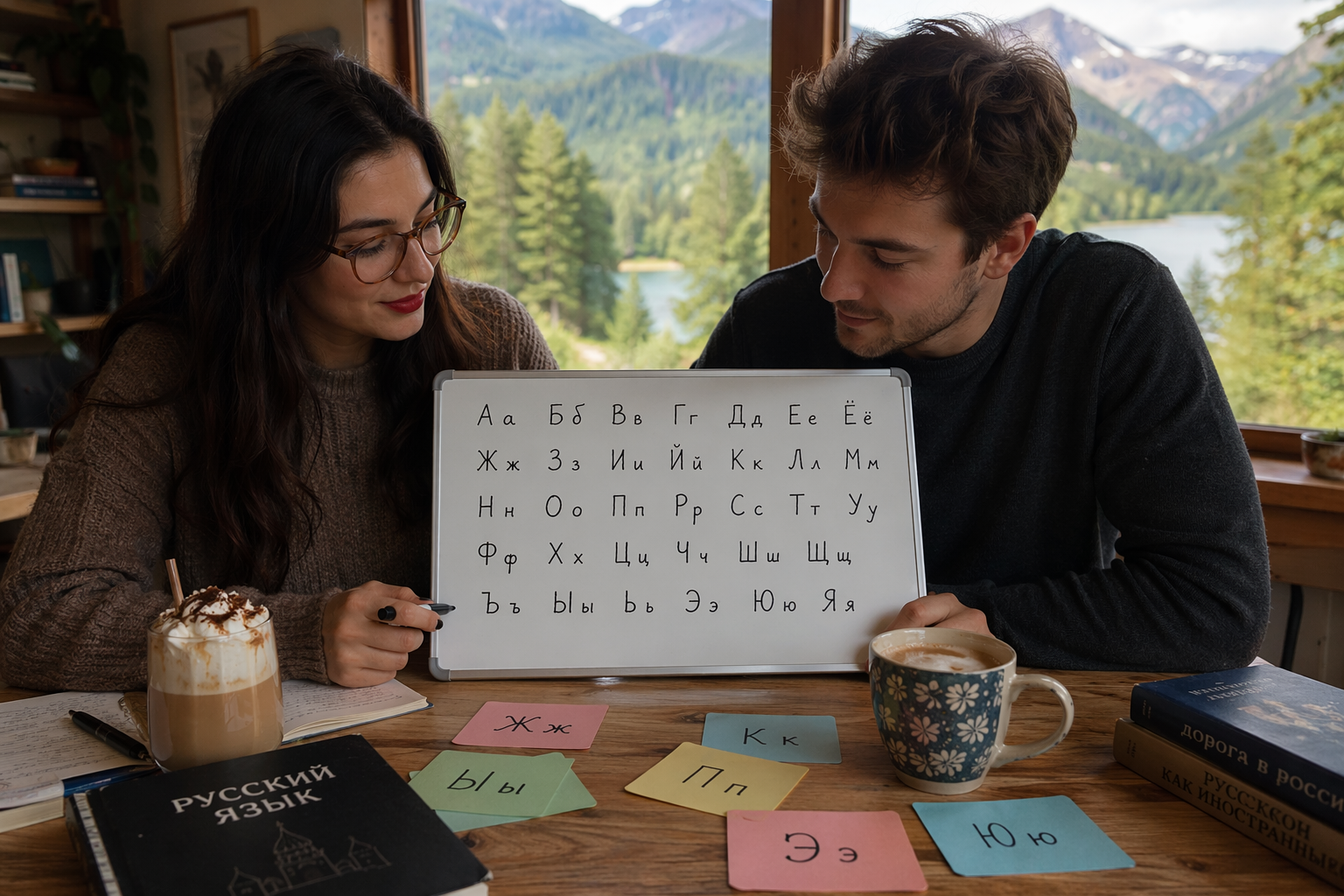
At first glance, the Russian alphabet can feel like a wall.
You open a textbook, see strange letters, notice that some symbols look familiar but somehow sound completely different, and then somebody shows you Russian cursive and your confidence collapses. What looked like a language suddenly looks like a code. For many English speakers, this is the moment when Russian starts to seem impossible.
But here is the truth: the Russian alphabet is not nearly as hard as it looks.
In fact, for most adult beginners, the alphabet is one of the easier parts of learning Russian. It is usually much easier than Russian grammar, easier than cases, easier than verb aspect, and much easier than the infamous verbs of motion. The script may look intimidating, but it is finite, structured, and learnable. Once you stop treating it like a mysterious puzzle and start approaching it as a system of sounds and symbols, it becomes much more manageable.
So, is the Russian alphabet hard to learn?
Not really. It looks harder than it is.
A motivated English-speaking adult can often recognize all 33 letters within a few focused study sessions and begin sounding out simple words within days. Reading comfortably takes longer, of course, but the first step, learning the alphabet itself, is very achievable. The main difficulty is usually not cognitive. It is psychological. The alphabet feels foreign, so people assume it must be extremely difficult. In reality, it is often one of the quickest early wins in Russian.
That is good news, because learning the alphabet opens the door to everything else. Once you can read Russian letters, even slowly, the language stops feeling sealed off. Street signs, menus, names, apps, websites, messages, and vocabulary lists all become more accessible. You are no longer standing outside the language. You are inside it.
What the Russian alphabet actually is
The Russian alphabet is a version of the Cyrillic script, a writing system developed for Slavic languages many centuries ago. Today, Cyrillic is used not only for Russian, but also for several other languages, including Bulgarian, Serbian, Ukrainian, and others in different forms.
Modern Russian uses 33 symbols. These include 10 vowels, 21 consonants, and 2 special signs: the soft sign (ь) and the hard sign (ъ). These two signs do not have their own sound, which often confuses beginners at first, but they are not as frightening as they seem. Their job is to affect the pronunciation of nearby sounds.
Compared to English, Russian has more letters, but there is also a major advantage: the relationship between spelling and pronunciation is often more consistent than in English. English is full of spelling traps. Think of words like “though,” “through,” “tough,” and “thought.” Russian has its own pronunciation challenges, especially stress and vowel reduction, but overall the writing system is much more systematic.
That means the beginner’s job is not to survive chaos. It is simply to learn a new set of symbols and the sounds they usually represent.
Why the Russian alphabet seems so hard at first
The Russian alphabet feels hard for a few very understandable reasons.
The first is visual unfamiliarity. If you grew up using the Latin alphabet, Cyrillic does not feel natural. Your eyes do not yet know what to do with letters like Ж, Щ, Ы, or Ю. They look foreign, so your brain automatically files them under “difficult.”
The second problem is false familiarity. Some Russian letters look like English letters but do not sound the same. This creates a particularly annoying kind of confusion because your brain keeps making incorrect guesses. For example:
В looks like B but sounds like V
Н looks like H but sounds like N
Р looks like P but sounds like R
С looks like C but sounds like S
У looks a bit like Y but sounds more like “oo”
This is why many beginners look at a simple Russian word and misread it completely. The issue is not that the word is objectively difficult. It is that the brain is applying English habits to a non-English system.
Then there is cursive. Printed Russian is manageable. Handwritten Russian can look like a small natural disaster. Beginners often see Russian handwriting online and conclude that the alphabet is impossible. But this is a bit like showing an English learner an unusually messy handwritten grocery list and asking whether the alphabet is hard. Cursive is a separate issue. It matters, but not on day one.
Finally, many learners bring trauma from English spelling. English has taught people to expect hidden rules, random pronunciations, and endless exceptions. So when they approach Russian, they assume the writing system will be even worse. But Russian spelling is not English spelling. Once you learn the letters, you can usually decode words far more logically than you can in English.
In other words, what makes the Russian alphabet feel hard is often not the alphabet itself. It is the shock of difference.
What makes the Russian alphabet easier than people expect
Now for the reassuring part.
The Russian alphabet has exactly 33 letters. That is a closed, manageable system. You are not dealing with endless combinations like English “th,” “sh,” “ough,” or silent letters everywhere. You are learning a fixed inventory.
Better yet, some of the letters give you immediate wins. Several Russian letters are either identical or very close to English ones in both shape and sound. These include:
А
Е
К
М
О
Т
That means you do not begin from zero. You begin with a little foothold.
There is also a limited number of truly confusing letters. Yes, some letters require extra attention. Yes, sounds like Ы or the difference between hard and soft consonants can take time. But the difficult part is not endless. It is a short list. And short lists can be mastered.
Most importantly, the alphabet is much easier than what comes later in Russian. Cases, declensions, verb aspect, stress patterns, and verbs of motion create difficulty over months and years. The alphabet is usually a front-loaded challenge. It feels dramatic at the beginning, but once it is learned, it stops being the main obstacle.
That is why many Russian teachers will tell you the same thing: the alphabet looks scary, but it is one of the easiest parts of the journey.
The letters that confuse beginners most
A helpful way to approach the Russian alphabet is not to think of it as one giant mass of strange symbols, but as three smaller groups.
1. Easy letters: same or almost same as English
These are confidence-builders:
А = a
М = m
К = k
О = o
Т = t
Е = ye/e depending on position
When a beginner reads мама, they often feel a small burst of excitement. It looks foreign, but suddenly it becomes readable: mama. That moment matters.
2. False friends: familiar shape, different sound
These are the real troublemakers:
В = v
Н = n
Р = r
С = s
У = oo
Х = kh or a rough h-like sound
These letters slow beginners down because they trigger wrong instincts. The solution is repetition, not panic. Once you see them often enough, the confusion fades.
3. New symbols: new shape, new sound or function
These are the letters that feel most “Russian” to beginners:
Ж = zh
Ц = ts
Ч = ch
Ш = sh
Щ = shch or a long soft sh sound
Ы = a vowel with no exact English equivalent
Ю = yu
Я = ya
Й = y
Ь = soft sign
Ъ = hard sign
Again, this is not an endless list. It is a manageable group. Once you isolate these letters and give each one examples, they stop feeling so alien.
Printed Russian vs handwritten Russian
One of the biggest sources of unnecessary fear is the difference between printed Russian and handwritten Russian.
Printed Russian is what beginners should focus on first. It is what you see in books, apps, menus, signs, websites, subtitles, text messages, and keyboards. It is the version that matters most for immediate reading ability.
Handwritten Russian, especially cursive, is another story. Letters connect. Shapes change. Some characters become loops and strokes that barely resemble their printed forms. To a beginner, it can look unreadable.
But here is the important point: you do not need to master cursive immediately.
If your goal is to begin reading Russian, typing Russian, learning vocabulary, and understanding basic texts, print comes first. Cursive can wait. In fact, obsessing over cursive too early is one of the fastest ways to make yourself feel overwhelmed for no reason.
A much saner path looks like this:
Stage 1: Learn printed Cyrillic and begin reading real words.
Stage 2: Learn to type comfortably.
Stage 3: Add cursive and handwriting later, once the alphabet is stable in your mind.
That sequence keeps motivation high and makes the process feel achievable.
How long does it take to learn the Russian alphabet?
This is where many people either become overly optimistic or unnecessarily discouraged.
Can you “learn the Russian alphabet” in a day or two? In one sense, yes. You can memorize the 33 letters surprisingly quickly. With a good chart, focused practice, and a bit of repetition, many adults can recognize most of the symbols within a few hours of concentrated effort.
But there is a difference between memorizing letters and actually reading.
A more realistic timeline looks like this:
Within 1 to 2 days, you can often become familiar with the full alphabet and recognize many letters with a cheat sheet.
Within 3 to 7 days of short daily practice, you can usually start sounding out simple words, especially if you focus on high-frequency examples.
Within 1 to 3 weeks, many learners can slowly decode signs, names, menus, and simple learner texts without feeling completely lost.
Within 1 to 2 months of consistent exposure, the alphabet usually stops being the main problem. At that point, reading may still be slow, but the script itself no longer feels intimidating.
That is a very encouraging reality. The alphabet is not a six-month mountain. It is an early hill.
The best way to learn the Russian alphabet
There are smart ways to learn it and frustrating ways to learn it.
The frustrating way is to stare at a chart, try to memorize all 33 letters at once, recite letter names, and then never read actual words.
The smart way is much more practical.
Start with easy wins
Begin with the letters that look familiar and sound familiar. This builds confidence immediately. If you can read мама, кот, том, or дом early on, the alphabet starts to feel useful instead of abstract.
Group letters by type
Instead of treating all 33 letters as equal, learn them in categories:
familiar letters
false friends
brand-new letters
special signs
This reduces mental chaos.
Learn sounds, not just names
Many beginners memorize the names of the letters but still cannot read. Why? Because reading depends on sound recognition, not on being able to recite the alphabet.
When you learn a letter, connect it to a sound and a real word:
М = m = мама
К = k = кот
Ч = ch = чай
Ж = zh = жук
That is much more powerful than dry memorization.
Read tiny words early
Do not wait until you “know the whole alphabet perfectly.” Start reading small words as soon as possible. Reading reinforces the alphabet far better than isolated flashcards ever will.
Good early examples include:
мама
дом
кот
чай
мы
там
Each successfully decoded word teaches your brain that Russian is readable.
Practice a little every day
Fifteen to twenty minutes per day is enough to make real progress. Short, repeated exposure works better than one exhausting marathon session followed by a week of nothing.
Write by hand in block letters
Even simple handwriting helps. When you write letters yourself, you build visual and physical memory at the same time. Just keep it in printed form at first. There is no need to dive into cursive immediately.
Use audio
Some Russian sounds need to be heard, not just described. This is especially true for sounds like Ы, rolled or tapped р, and the contrast between hard and soft pronunciation. Audio helps prevent bad habits from becoming permanent.
Mistakes beginners should avoid
Learning the Russian alphabet is not hard, but people can make it much harder than it needs to be.
The first mistake is relying on transliteration for too long. Writing “spasibo” instead of спасибо may feel comforting at first, but it delays real progress. Transliteration keeps you outside the script. You want to get into Cyrillic as soon as possible.
The second mistake is obsessing over perfection. Some learners want to master every sound, every rule, and every handwriting detail before they let themselves read simple words. That is backwards. Read first. Refine later.
The third mistake is treating the alphabet as a one-time task. Learners sometimes “finish” the alphabet and then stop actively using it. But the alphabet only becomes natural when you keep meeting it inside real words.
Another mistake is trying to learn everything at once. The alphabet, stress, vowel reduction, soft and hard consonants, cursive, cases, and pronunciation nuances do not all need to arrive on the same day. Layering matters.
And perhaps the biggest mistake is assuming that difficulty at the beginning means long-term difficulty. The first encounter with Cyrillic is awkward. That does not mean the system is beyond you. It means it is new.
Why learning the Russian alphabet is worth it
The Russian alphabet is not just a classroom exercise. It gives you access.
Suddenly, names start making sense. Menus become less mysterious. Street signs stop looking like decoration and start looking like information. You can type words into a dictionary correctly. You can read subtitles more accurately. You can use beginner apps and vocabulary decks without hiding behind English approximations.
It also improves pronunciation. Learners who begin with Cyrillic often develop a more accurate sense of Russian sounds than learners who stay too long in transliteration. They hear the language more clearly because they are seeing it more accurately.
And psychologically, it changes everything. Before you know the alphabet, Russian can feel like a sealed room. After you know it, even imperfectly, the door opens.
That is why the alphabet is worth learning early. It gives you momentum.
A few examples that show how quickly Russian becomes readable
One of the best ways to reduce fear is to show that Russian words can often be decoded sooner than expected.
Take мама. Even a beginner can often read that very early: mama.
Take кот, meaning “cat.” Once you know К, О, and Т, it becomes straightforward.
Take чай, meaning “tea.” Now you are already working with a less familiar letter, Ч, but the word is still very learnable.
Take жук, meaning “beetle.” That introduces Ж, which looks intimidating at first, but once you connect it to the sound “zh,” it becomes memorable.
Take день, meaning “day.” Here you meet the soft sign, ь. At first that can seem confusing, but it does not need to be mastered in full detail immediately. What matters is understanding that it changes pronunciation rather than adding a sound of its own.
This is how the alphabet becomes real. Not through endless charts, but through words.
So, is the Russian alphabet hard?
Here is the honest answer again: it is unfamiliar, but it is not especially hard.
It looks more intimidating than it actually is. Most adult English-speaking learners can get basic control of it surprisingly fast. The hardest part is often simply getting over the moment of visual shock.
Once you realize that the system is finite, logical, and much easier than later parts of Russian, the fear starts to fade. And when the fear fades, progress accelerates.
So no, the Russian alphabet is not the giant obstacle many people imagine. It is one of the first doors you open.
And once that door opens, the language starts to feel possible.
Learn Russian with structure, not guesswork
At Polyglottist Language Academy, we believe beginners do better when they are guided step by step instead of being left alone with random charts, confusing transliteration, and overwhelming grammar explanations.
That is exactly why the Russian alphabet should be taught in a practical, confidence-building way. You do not need to memorize everything at once. You need a clear sequence, real examples, and the right amount of repetition.
If you are curious about learning Russian, this is also why a focused beginner product can make such a difference. A structured mini-course on the Russian alphabet or a short “Russian in 10 Days” format can help you move from intimidation to real reading ability much faster than trying to piece everything together on your own.
And if you want live support, guided practice, and expert teaching, you can also explore our online Russian classes.
Related articles you may also enjoy
If this topic interests you, these are great next steps for your Russian learning journey:
FAQs
Is the Russian alphabet hard for English speakers?
Not as much as people think. It looks unfamiliar at first, but most English-speaking beginners can learn the basics relatively quickly.
How many letters are in the Russian alphabet?
The modern Russian alphabet has 33 letters.
How long does it take to learn the Russian alphabet?
Many learners can recognize the letters within a few days and begin slow reading within one to two weeks of consistent practice.
Is it possible to learn the Russian alphabet in two days?
You can become familiar with most of the letters in two days, but reading comfortably takes longer. Recognition and fluent use are not the same thing.
Do I need to learn Russian cursive right away?
No. Printed Russian should come first. Cursive can be added later.
Which letters confuse beginners the most?
Usually the false friends like В, Н, Р, and С, as well as new symbols like Ж, Щ, and Ы.
Is Russian spelling more regular than English spelling?
In many ways, yes. Russian spelling is generally more systematic than English spelling, even though stress and pronunciation still create some challenges.
Should I use transliteration when learning Russian?
Only minimally. It may help for a moment at the very beginning, but relying on it too long will slow down your progress.
Is it better to learn the alphabet before grammar?
Yes. You do not need to master every detail before starting vocabulary or basic phrases, but getting comfortable with the alphabet early makes everything else easier.
What is the best way to practice the Russian alphabet?
Short daily practice, real words, sound-based learning, and gradual exposure work much better than trying to memorize the entire alphabet in one sitting.