
Why Berkeley Residents Are Learning Spanish Later in Life
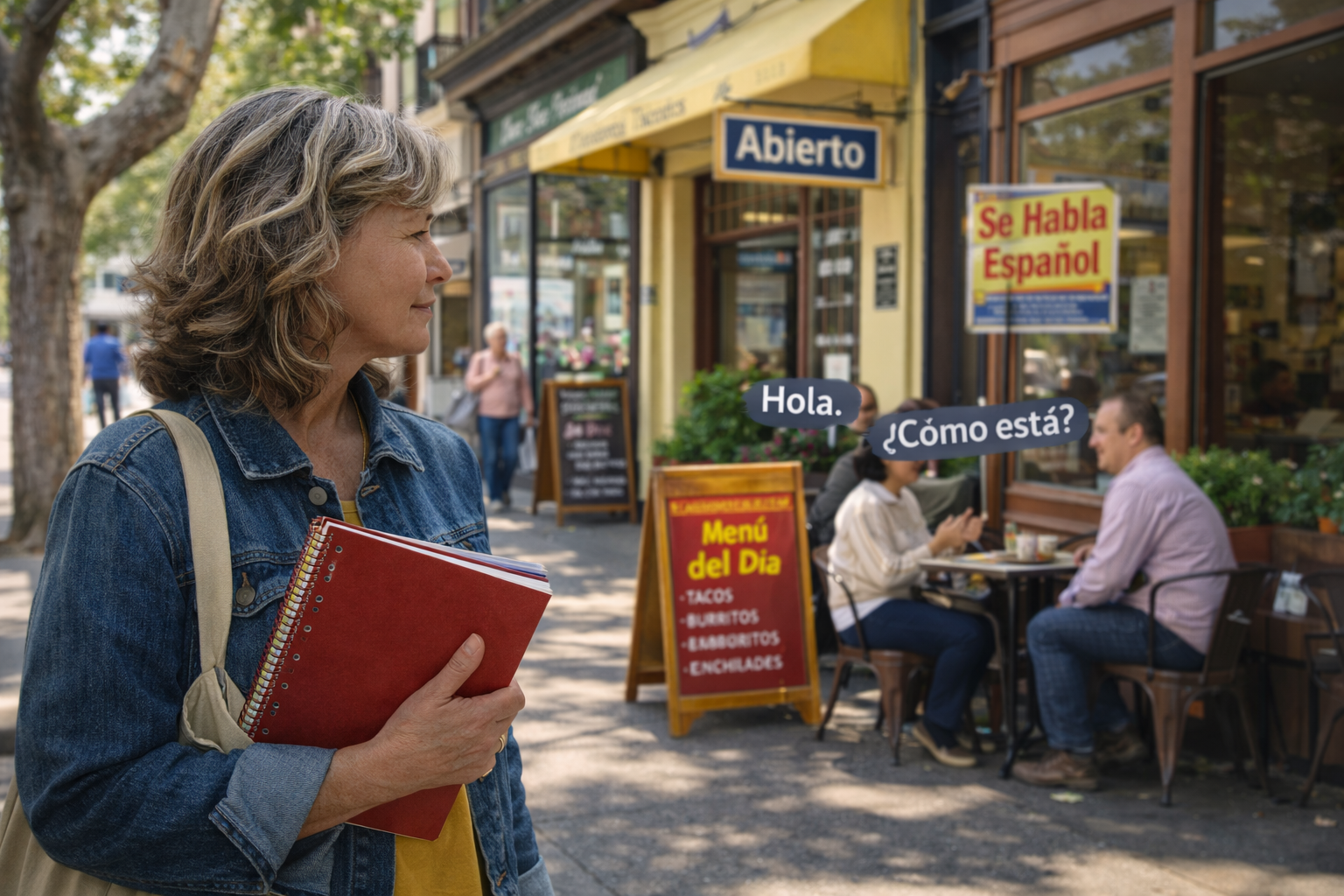
In Berkeley, learning does not stop at graduation. It does not stop at retirement either.
This is a city where people sign up for lectures for fun, debate politics over coffee, read difficult books on purpose, and think nothing of starting something new at 45, 58, or 72. So perhaps it should not be surprising that more Berkeley residents are choosing to learn Spanish later in life. But the reasons behind it are more interesting than a simple love of education.
Adults in Berkeley are not learning Spanish just because it sounds nice or because they missed their chance in school. They are learning it because it is useful, because it opens doors, because it helps them connect more deeply with the place they live, and because it gives shape to a part of adulthood that many people do not talk about enough: the desire to keep growing.
For some, Spanish begins as a practical decision. A nurse wants to communicate more directly with patients. A teacher wants to speak with parents without a translator. A nonprofit worker wants to build trust more naturally in the communities they serve. A parent wants to understand the families in their child’s school community. A professional in tech or business wants to work more effectively with clients or colleagues in Latin America.
For others, the decision is personal. They are traveling more. They are entering retirement and want a new challenge. They want to speak to neighbors, caregivers, or local business owners in a way that feels more human. They are tired of living in multilingual California while remaining locked inside English.
And in Berkeley, Spanish makes particular sense.
California is home to more than 10.5 million Spanish speakers, and across the Bay Area, 43% of residents speak a language other than English at home. Spanish is the most common non-English language in the region. Berkeley itself has a significant Hispanic and Latino population, and the wider East Bay places Spanish constantly within earshot: on BART, in neighborhood markets, in restaurants, in clinics, in schools, and in everyday conversation across the communities surrounding Berkeley.
That means adults here are not learning Spanish for some distant future. They are learning a language that is already woven into daily life.
Why More Adults Are Starting Spanish After 40
There is still a stubborn cultural myth that language learning belongs to the young. People imagine that if they did not become bilingual in college or move abroad at 23, then the window has closed. But adult learners know something that younger learners often do not: motivation matters.
A person in their 40s, 50s, or 60s usually does not begin Spanish casually. They begin because they have a reason.
Someone in their 30s or 40s may want more flexibility in a competitive job market. Someone in their 50s may be thinking about travel, cultural enrichment, or a second career. Someone in retirement may want intellectual stimulation, deeper community involvement, or simply the joy of finally doing something they postponed for decades.
That difference matters. Adults often come to language learning with more discipline, more patience, and more clarity than younger students. They may be busier, yes. They may be more self-conscious at first. But they are also much more likely to know exactly why they are there.
And Spanish rewards that kind of learner.
It is one of the most accessible languages for English speakers. The spelling is relatively phonetic, many words have recognizable cousins in English, and learners can begin using real sentences early. That early progress matters psychologically. Adults do well when they feel movement. They want to see that the effort is paying off. Spanish gives them that.
In Berkeley, this intersects with a culture that treats learning as a lifelong activity rather than a phase of youth. This is one reason adult Spanish classes fit so naturally into the city’s identity. Taking up a language later in life here does not feel eccentric. It feels normal.
Spanish Is Not Abstract in Berkeley. It Is Local.
One of the biggest reasons Berkeley residents choose Spanish is that they do not have to imagine when they will use it. They can see the answer immediately.
Spanish is not hidden away in a textbook or reserved for a vacation two years from now. It is present throughout the East Bay in the real world. You hear it on public transit. You encounter it in grocery stores, bakeries, restaurants, public services, schools, and healthcare settings. You hear it in Oakland, across the wider Bay Area, and in the multilingual social fabric that surrounds Berkeley every day.
That changes the emotional logic of learning.
Many adults fail to sustain language study when the language feels disconnected from life. They memorize vocabulary for hypothetical scenarios, then lose momentum because the whole project feels artificial. Spanish in Berkeley is different. It belongs to the region. It belongs to the social reality around you.
That gives learners a sense of relevance from the start. You are not learning Spanish only for travel to Mexico, Spain, or South America, though of course it helps there too. You are learning Spanish because it helps you understand the California you already live in.
This is especially meaningful in a place like Berkeley, where values such as openness, cultural literacy, and civic engagement matter. Learning Spanish can become part of how residents participate more fully in their own city. It is not only a skill. It is a way of noticing people more carefully.
The Berkeley Factor
Not every city produces the same kind of adult learner. Berkeley does.
Berkeley has long been shaped by education, intellectual curiosity, activism, and global awareness. It is a university city, but its culture extends far beyond the campus. Ideas circulate easily here. People discuss art, policy, literature, food, identity, and history with unusual seriousness. There is a strong local instinct toward self-development, but also toward community-mindedness.
That combination matters.
In some places, learning a language later in life may be seen as a luxury hobby. In Berkeley, it often feels like a coherent extension of how people already live. Residents who care about the world want to understand it more directly. Residents who care about community want to speak to more of it. Residents who value education tend not to believe that meaningful learning belongs only to the young.
Demographically, Berkeley also sits within a broader regional environment that makes Spanish especially relevant. The city has a notable Hispanic and Latino population, and among Berkeley’s Hispanic residents, people of Mexican origin make up a large share. Meanwhile, nearby communities across the East Bay deepen that Spanish-speaking presence even further.
So when Berkeley adults choose Spanish, they are responding to a local ecosystem. The city’s educational culture makes language study appealing. The Bay Area’s linguistic reality makes it practical. Together, those forces create the perfect conditions for adults to start.
The Social Side of Learning Spanish Later in Life
A lot of adults begin Spanish for practical reasons, but many stay with it for social and emotional ones.
Language learning changes how people move through public space. It changes what they hear, what they understand, and who they feel able to approach. That can be profound later in life, when many people are actively rethinking how they want to live and connect.
For a Berkeley resident, Spanish may become the difference between remaining a polite outsider and becoming a participant. It can deepen everyday interactions with neighbors, coworkers, local business owners, or members of a child’s school community. For older adults, it can also help with relationships involving caregivers, service providers, and health-related support networks.
This is not about performance. It is not about trying to impress people with perfect grammar. It is about reducing distance.
And Spanish also opens a door to culture in a particularly rich way. Berkeley residents often care deeply about literature, film, music, politics, history, and food. Spanish gives direct access to a huge world of cultural life extending across Latin America, Spain, and Spanish-speaking communities in the United States. It lets learners experience songs, books, films, and conversations with fewer filters.
For adults who feel that life has become overly narrow or overly routine, this matters. Beginning Spanish can reawaken curiosity. It can make the familiar city feel wider. It can create a beginner’s mind in people who may not have felt like beginners in a long time.
The Brain Benefits Are Real
One of the most compelling arguments for learning Spanish later in life is that it is not only enriching. It is also good for the mind.
Recent research on older adults suggests that language learning can improve cognitive control and support neuroplasticity. A 2024 study in Frontiers in Aging Neuroscience found that just four months of learning a new language improved performance on tasks related to attention and cognitive control, while also changing patterns of brain activation. Researchers increasingly view language learning as one possible contributor to cognitive reserve, the kind of mental resilience that may help delay age-related decline.
That does not mean Spanish is a miracle cure, and it should not be presented that way. But it does mean that taking up a language in your 50s, 60s, or beyond is far from frivolous. It is serious mental exercise.
And importantly, it is a kind of exercise many adults enjoy more than other forms of “brain training.” Language learning combines memory, attention, listening, speaking, reading, and social interaction. It is intellectually demanding, but it is also alive. It is not a puzzle detached from life. It is a skill that can immediately spill outward into travel, friendship, work, and culture.
That may be one reason so many adults find it deeply satisfying. After years spent in professional routines or family obligations, the act of learning something complex and beautiful can feel restorative. It reminds people that the mind remains expandable.
Spanish as a Career Advantage in the Bay Area
For many Berkeley residents, Spanish is not only personally meaningful. It is professionally smart.
California has seen an enormous rise in demand for bilingual workers. According to Bay Area economic research, bilingual job postings in California reached 2.4 million from August 2022 to August 2023, accounting for a striking share of bilingual job listings nationwide. Healthcare alone represented the largest portion of those postings. Education, public service, law, community work, hospitality, real estate, and customer-facing roles also continue to reward Spanish ability.
This matters in Berkeley and the broader Bay Area because so many professions here are relational. A healthcare worker who can explain clearly and build trust in Spanish is more effective. A teacher or administrator who can speak with families directly is more valuable. A counselor, nonprofit employee, or city-facing professional with Spanish skills can engage more humanely and more efficiently.
Even in sectors not traditionally associated with language study, Spanish can create advantages. Tech professionals often work with Latin American partners or markets. Business owners may serve a more diverse clientele. Consultants and freelancers may discover that bilingualism expands both their reach and their usefulness.
And later-life learners are often especially well positioned to benefit. They may already have deep expertise in a field. Adding Spanish to that expertise can make them more adaptable, more relevant, and more connected.
For some, this is about advancement. For others, it is about transition. A person entering a second career in education, healthcare, counseling, or nonprofit work may see Spanish as part of becoming the kind of professional they want to be.
Why Adults Actually Succeed in Spanish
A lot of adults worry they are too old, too busy, or simply “not language people.” These fears are understandable, but they are often wrong.
Research suggests that the barriers adults experience are not mainly about age itself. They are often about psychology, time, and method. Adults may hesitate because they dislike making mistakes publicly. They may compare themselves to idealized bilinguals. They may assume that because they do not absorb language passively like a child, they cannot learn well. But adults have their own advantages.
They are usually better at setting goals. They understand grammar explanations more consciously. They know how to maintain routines. They can connect what they learn directly to their work, travel, or relationships. They are also much more likely to value each hour they invest.
What tends to make adults fail is not adulthood. It is poor structure.
When learners rely only on apps, random videos, or passive exposure, progress often stalls. When they wait too long to speak, fear grows. When they jump constantly between methods, they never build momentum. But when adults study consistently, with guidance, structure, and regular speaking practice, they can make impressive progress.
Spanish is especially well suited to this because it allows learners to start producing meaningful speech relatively early. That early speaking matters. Fluency does not appear after years of silent preparation. It grows through imperfect use.
In other words, Berkeley adults do not need to be fearless to succeed. They need to begin, continue, and stay in contact with the language long enough for confidence to catch up.
What Works Best for Adult Learners in Berkeley
The most effective Spanish learning for adults is rarely flashy. It is steady, structured, and human.
Small-group classes tend to work particularly well because they give students repeated opportunities to speak while also providing accountability. In a class of three to six students, nobody disappears. Everyone participates. Everyone receives feedback. That is especially important for adults who want real progress rather than the illusion of progress.
A good curriculum also matters. Adults benefit from sequence. They do best when pronunciation, core grammar, useful vocabulary, guided speaking, and listening practice build on one another. Random conversation without foundation can be discouraging. Endless grammar without speaking can be deadening. The right balance is structure plus use.
Professional teaching matters too. Being a native speaker is not the same as being an effective teacher. Adult learners need explanations that are clear, intuitive, and efficient. They need instructors who understand common learner errors and can create an environment where mistakes feel normal rather than embarrassing.
Consistency may be the most underrated factor of all. Most adults do not need extreme intensity. They need regular contact. One or two classes per week, plus light review, often produces far better results than bursts of enthusiasm followed by long silence.
Berkeley adults also tend to thrive when language learning becomes social. A weekly class can become a ritual, a form of community, and a stabilizing part of adult life. That may sound secondary, but it is often the difference between quitting and continuing.
A Realistic Timeline
Adults often quit because their expectations are unrealistic, not because they are incapable.
If you begin Spanish later in life, you do not need to become instantly fluent. You need a believable path. With consistent study, many adults can handle basic conversations within a few months, navigate everyday interactions more comfortably by six months, and communicate with growing confidence within a year. Conversational fluency takes longer, often 18 to 24 months or more depending on intensity and exposure, but that is not a reason for discouragement. It is simply the nature of meaningful language acquisition.
The good news is that the benefits start long before fluency. You do not need to “finish” Spanish before it becomes rewarding. The first successful conversation, the first moment you understand a sentence on the street, the first time you order food or ask a question with confidence, those moments arrive much sooner.
And for many Berkeley residents, that is enough to keep going.
Learning Spanish With Polyglottist Language Academy
For adults in Berkeley who want a serious but encouraging way to learn Spanish, Polyglottist Language Academy is designed with exactly this kind of learner in mind.
Our approach is built around small-group language classes, live instruction, and long-term progress rather than one-off exposure. That matters especially for adults learning later in life. You need more than an app. You need structure, conversation, expert guidance, and a pace that allows confidence to grow.
At Polyglottist, Spanish learners can study in a format that supports real speaking ability while keeping the process personal and manageable. Small classes allow more participation and more feedback. A guided curriculum gives learners direction. And because the school is rooted in Berkeley, the experience reflects the local reality of learning Spanish here: not as an abstract subject, but as a language that belongs to the community around you.
You can explore our Spanish classes to find current options for adult learners in Berkeley and online.
Related Articles You May Also Enjoy
Small-Group Spanish Classes In Berkeley Vs Apps: What Produces Real Results?
Learning Spanish In Oakland: Connecting With The City Through Language
Best Spanish Classes In Berkeley For Adults (Complete 2026 Local Guide)
FAQs
Is Spanish hard to learn for adults over 40?
Spanish is one of the more accessible languages for English speakers. Many adults over 40 do very well because they bring discipline, motivation, and clear goals to the process.
Can I really learn Spanish in my 50s or 60s?
Yes. Research does not support the idea that adults are simply too old to learn a language. In fact, older learners can benefit cognitively and often approach study with greater commitment than younger students.
How long does it take to become conversational in Spanish?
That depends on consistency, but many adults can begin having simple conversations within a few months and handle everyday interactions more comfortably within six to twelve months.
Why is Spanish especially useful in Berkeley?
Because Spanish is already part of life across Berkeley and the East Bay. It is heard in schools, healthcare, restaurants, markets, public transit, and community spaces throughout the region.
Is Spanish useful for work in the Bay Area?
Very much so. It is especially valuable in healthcare, education, nonprofit work, public service, hospitality, and many client-facing roles.
Are online Spanish classes effective for adults?
They can be very effective when they are live, interactive, and taught by experienced instructors. What matters most is not the screen itself, but the quality of instruction and the opportunity to speak regularly.
What is better for adults: apps or classes?
Apps can be a helpful supplement, but most adults make much better progress through structured classes with real teachers and regular speaking practice.
Do I need a special talent for languages?
No. Adults often underestimate how much progress comes from consistency rather than talent. A clear routine and good teaching matter far more than some innate gift.
What is the biggest mistake adults make when learning Spanish?
Waiting too long to speak. Adults often want to feel ready before they begin using the language, but real progress happens through imperfect conversation.
Why are so many Berkeley residents learning Spanish later in life?
Because Spanish meets several needs at once. It supports travel, career growth, community connection, cultural curiosity, and healthy aging, all within a city that already values lifelong learning.
Final Thoughts
When Berkeley residents start learning Spanish later in life, they are doing more than taking a class.
They are responding to the city they live in. They are responding to California as it really is. They are responding to a stage of life in which growth becomes more deliberate and more meaningful.
Spanish offers something unusually powerful to adults: practical usefulness, intellectual challenge, social connection, and cultural access all at once. In Berkeley, where curiosity is part of the atmosphere and multilingual life is close at hand, it makes perfect sense that so many people are beginning now rather than wishing they had begun earlier.
Because the truth is simple. It is not too late. In many cases, later in life may be exactly the right time to start.