Learning Spanish in Berkeley: A Smart Beginner’s Roadmap
Learning Spanish in Berkeley: A Smart Beginner’s Roadmap
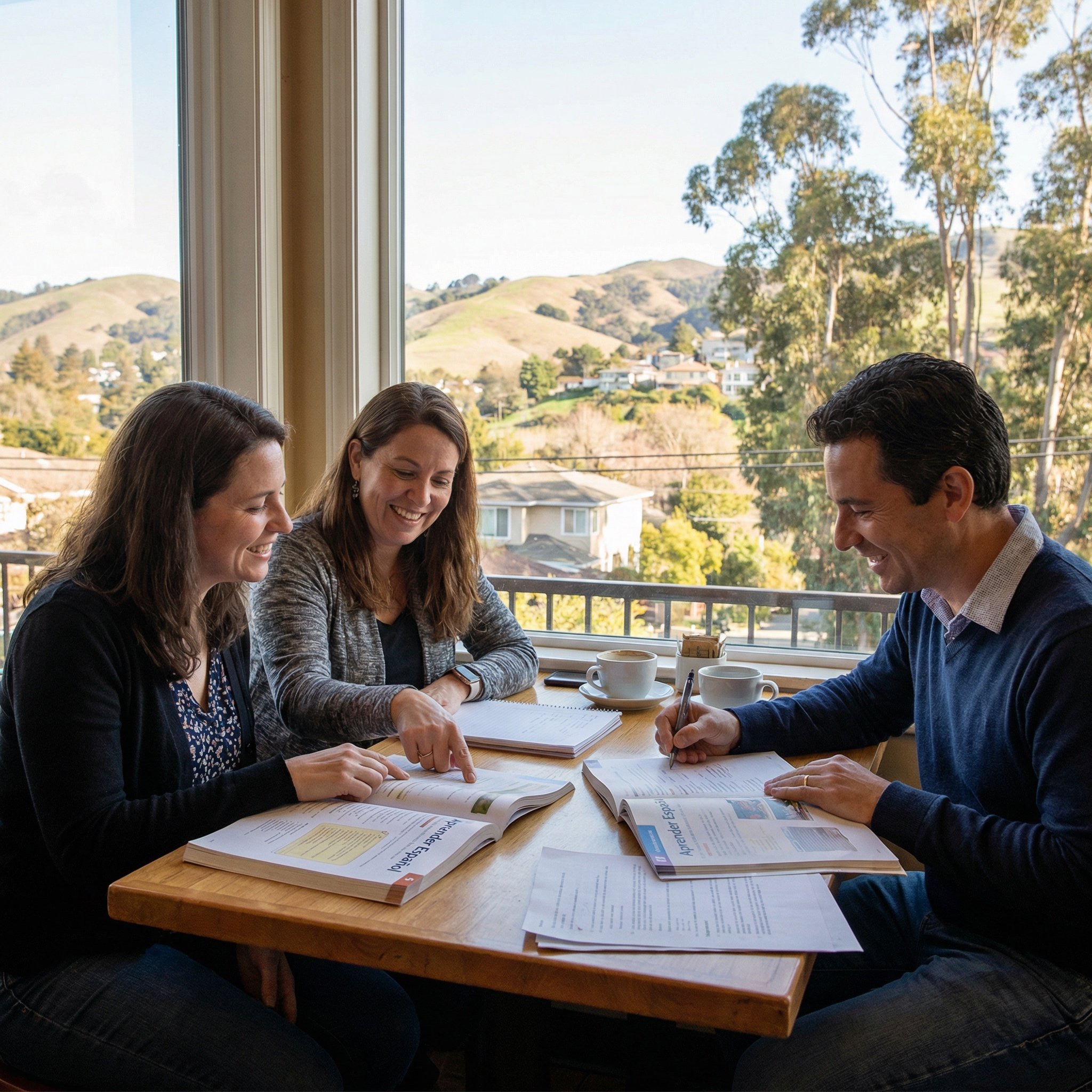
Spanish isn’t a distant classroom subject in Berkeley; it’s part of everyday life across the East Bay and the wider Bay Area. Learning it as an adult here is both a practical career move and a meaningful way to connect with your community and the broader Spanish‑speaking world. This article walks you through why Spanish makes so much sense for Berkeley‑based beginners, how to start effectively, and how structured classes—whether in‑person Spanish classes in Berkeley or online Spanish lessons—can give you a smart, realistic roadmap from “hola” to real conversations.
1. Why Learning Spanish in Berkeley Makes Sense
Spanish in California and the Bay Area
California is one of the epicenters of Spanish in the United States. Roughly a quarter to nearly a third of residents speak Spanish at home, making Spanish by far the most widely used language after English. In absolute numbers, that’s well over 10 million people—more Spanish speakers than many individual Spanish‑speaking countries have in total.
Zoom in on the Bay Area and you see the same pattern locally. The region is one of the most linguistically diverse in the country, with a large share of residents speaking a language other than English at home, and Spanish is the most common of those languages. In counties like Alameda, Contra Costa, and Santa Clara, many households use Spanish in family life, community spaces, and public services.
If you live in Berkeley or nearby in Oakland, this means Spanish is present on public transit, in neighborhood markets, in restaurants, in community centers, and in local media. You’re not just learning for a future trip—you’re learning to better understand what’s already around you.
Spanish in Work, Public Services, and Daily Life
In a state as diverse as California, Spanish skills are not just “nice to have” but actively useful in many professions. In healthcare, for instance, Spanish is heavily used by patients but still underrepresented among health professionals, which creates a strong demand for bilingual clinicians. Being able to communicate directly with patients in Spanish can improve outcomes, reduce misunderstandings, and build trust.
Education and public services follow the same pattern. Teachers, social workers, nonprofit staff, and city employees frequently interact with Spanish‑speaking families. Being bilingual can make those interactions smoother and more respectful, and in many roles it becomes a key hiring advantage.
In the private sector, Spanish is increasingly valuable in hospitality, tourism, real estate, customer support, and sales, especially in California where a large portion of customers may prefer or feel more comfortable using Spanish. Even if you work in a primarily English‑speaking office, being the person who can communicate with Spanish‑speaking clients or partners can set you apart.
Why Spanish Is One of the Most Useful U.S. Languages
Nationally, tens of millions of people speak Spanish at home in the United States, making it the second‑most spoken language in the country and by far the largest non‑English language community. Spanish speakers in the U.S. outnumber speakers of other major immigrant languages by a wide margin, which means your chances of using Spanish in daily life are much higher than with most other languages you might consider.
For East Bay residents, this means learning Spanish connects directly to local communities while also opening doors across Latin America and Spain. Whether your goals are career advancement, travel, or deeper cultural understanding, Spanish offers a uniquely strong return on your learning effort.
2. Why Spanish Is One of the Best Languages for Beginners
Spanish and the “Difficulty Scale”
For English speakers, not all foreign languages are equally difficult. The U.S. Foreign Service Institute (FSI), which trains diplomats, groups languages by how long it typically takes an English‑speaking adult to reach professional working proficiency. Spanish sits in the easiest group for English speakers.
The FSI estimates that Spanish takes roughly 24–30 weeks of intensive study, or around 600–750 classroom hours, to reach a high level of proficiency suitable for professional use. That may sound like a lot, but it’s significantly less than languages with very different grammar and writing systems such as Arabic, Mandarin, or Japanese, which can require several times that amount of study.
For a Berkeley‑based adult learner fitting Spanish around work and life, this means that with a steady weekly commitment you can reach a solid conversational level in a realistic timeframe—months, not decades.
Pronunciation and Phonetic Spelling
One of the biggest advantages of Spanish is its relatively consistent, phonetic spelling system. In most varieties, including the Mexican and Latin American Spanish you’re most likely to hear in California, words are pronounced very close to how they’re written. Once you learn the basic sound–letter rules—especially the vowels and a handful of consonants like r, rr, j, and ll—you can often pronounce new words correctly at first sight.
For a beginner, this takes away a lot of guesswork and builds confidence quickly. You can read menus, street signs, labels at the market, and messages from Spanish‑speaking colleagues without constantly wondering how the words should sound.
Vocabulary Bridges Between English and Spanish
English and Spanish share a huge number of cognates—words that look and mean the same or similar things, often due to shared Latin roots. Think of pairs like “animal/animal”, “hospital/hospital”, “important/importante”, “music/música”, “family/familia”.
Beyond individual examples, there are predictable patterns like English ‑tion becoming Spanish ‑ción (information/información, nation/nación), and English ‑ty becoming Spanish ‑dad (city/ciudad, activity/actividad). For beginners, these patterns function like vocabulary “shortcuts” that let you expand your word bank much faster than if you were starting from scratch in a more distant language.
How Long It Typically Takes to Reach Conversation
The FSI’s 600–750‑hour estimate is for a high level of professional proficiency, but you can reach conversational ability much earlier. Many learners achieve a solid intermediate conversational level at roughly 350–450 hours of focused study and practice.
If you’re taking one or two Spanish classes per week in Berkeley or online and combining that with a few hours of self‑study and practice, it’s realistic to handle everyday conversations within 6–12 months, assuming you stay consistent. For many adult beginners, that timeline feels both ambitious and doable: not instant, but clearly within reach.
3. The Best Way for Beginners to Start Learning Spanish
What to Focus on First
When you’re just starting out, it’s tempting to grab an app and follow wherever it leads. A smarter approach is to build on a clear foundation. For beginners in Berkeley, an effective starting sequence looks like this:
Pronunciation and sound system
Early on, invest time in getting comfortable with Spanish vowels (a, e, i, o, u), the rhythm of syllables, and key consonants like r, rr, ll, j, and ñ. Learning a broadly Latin American pronunciation standard makes sense in California, because it matches what you’ll hear from most local speakers.High‑frequency “survival” phrases
Learn greetings, introductions, polite expressions, asking for directions, ordering food, and handling simple transactions. This lets you use Spanish immediately at cafés, markets, or on trips, which is hugely motivating.Core grammar foundations
Start with the present tense of essential verbs (ser, estar, tener, ir, querer), basic sentence structure, and how gender and number work with nouns and adjectives. You don’t need every tense on day one, but you do need a clear structure for building simple sentences.Listening from day one
Even as a beginner, listening to level‑appropriate Spanish helps you develop an ear for the language’s rhythm and intonation. Short, slow dialogues and beginner‑level podcasts are ideal at this stage.
A structured beginner course—whether in‑person Spanish classes in Berkeley or small‑group online Spanish lessons—will typically follow this kind of progression and help you avoid gaps that can slow you down later.
Common Mistakes English Speakers Make
As an English speaker, you’ll bring certain habits into Spanish. A few common pitfalls are:
Literal translation and overusing pronouns
English relies heavily on pronouns like “I” and “you”, while Spanish often drops them because verbs already show who is doing the action. Beginners frequently translate word‑for‑word and end up with sentences that sound unnatural.Confusing “ser” and “estar”
Both translate to “to be”, but Spanish uses them differently for permanent traits versus temporary states or locations. It’s one of the classic early stumbling blocks.Ignoring Spanish rhythm and stress
Applying English stress patterns can make your Spanish hard to understand. Learning where to put the stress in words and sentences is essential for clear pronunciation.Mixing dialect features without realizing it
For example, copying “vosotros” forms from Spain‑focused resources, then using them with Latin American speakers who never use that form in daily life.
Having a teacher who knows these patterns and can point them out early makes a big difference. In small‑group classes at a school like Polyglottist Language Academy, you can get corrected gently and consistently so you build better habits from the start.
Why Speaking Practice and Structure Matter
Language is something you do, not just something you know. Regular interaction—actually speaking and receiving feedback—is crucial for building confidence and long‑term skills.
Group classes are especially effective because they:
Give you a safe, low‑pressure environment to try out new phrases.
Let you hear different speaking styles and questions from classmates.
Provide built‑in accountability—seeing the same faces each week makes it easier to keep going.
At the same time, structured courses provide a clear roadmap. Rather than jumping randomly between apps and videos, you follow a carefully sequenced curriculum, with grammar, vocabulary, and cultural content building on each other. Polyglottist Language Academy, for example, emphasizes small‑group instruction and experienced teachers who guide you step by step, whether you join Spanish classes in Berkeley or live online Spanish lessons from elsewhere in the Bay Area.
4. Spanish Learning Opportunities in Berkeley
A Local Landscape Rich in Spanish
Berkeley sits in the middle of a region where Spanish is a day‑to‑day language for many residents. Across the Bay Area, Spanish is the most common language after English, and large neighborhoods in cities like Oakland, San Francisco, and San Jose have strong Latino and Spanish‑speaking communities.
For a learner, this means you don’t need to leave the country to experience real‑world Spanish. You might hear it:
On BART or bus rides through multilingual neighborhoods.
In local markets, grocery stores, and bakeries where staff and customers use Spanish.
At community events, parades, and cultural festivals celebrating Latin American traditions.
Everyday Places to Hear and Use Spanish
Even if you’re just starting, Berkeley and nearby cities offer many chances to hear and practice the language informally:
Restaurants and cafés – Mexican, Central American, and South American eateries are prime spots to listen to natural conversations and practice simple phrases when ordering.
Markets and shops – Latino grocery stores, panaderías (bakeries), and carnicerías (butcher shops) often operate bilingually, giving you a chance to read labels, listen in on interactions, and use basic Spanish.
Cultural venues – Film screenings, art exhibitions, and cultural events featuring Latin American themes often incorporate Spanish in signage, talks, or performances.
When combined with structured classes at Polyglottist, these everyday spaces become an extension of your classroom. You can practice what you learned in class that week and bring your experiences back to discuss in the next session.
Latino Cultural Influence in California
Spanish is not a recent arrival in California. Hispanic communities have shaped the region for centuries, from the era of the Californios through waves of Mexican and Central American immigration. Place names, architecture, food, music, and festivals all bear this influence.
For many Californians, Spanish is deeply tied to identity, family history, and community life. By learning Spanish in Berkeley, you’re not only gaining a practical skill—you’re engaging more respectfully and thoughtfully with the people who share your city and state.
5. A Practical Beginner Roadmap for Learning Spanish
To move from enthusiasm to real progress, it helps to have a realistic roadmap. Here’s a practical plan for your first year, assuming you combine structured classes (for example, at Polyglottist Language Academy) with regular self‑study and local practice.
First Month: Foundations and “Survival” Communication
Objectives: Establish a solid sound system, learn essential phrases, and build simple sentences.
Focus on:
Pronunciation basics – Learn the vowel sounds, common consonant issues, and word stress. Practice reading simple words aloud and mimicking native audio.
Core survival phrases – Greetings, introductions, numbers, days, asking for prices and directions, ordering food and drinks, and politeness formulas like “please” and “thank you”.
Basic grammar – Subject pronouns, present tense of “ser”, “estar”, “tener”, “ir”, and how to form simple affirmative and interrogative sentences.
Listening habit – Begin with slow, learner‑oriented audio (short dialogues or beginner podcasts) for 5–10 minutes a day.
In practice, this might mean attending a weekly small‑group beginner class in Berkeley or online, doing a bit of homework, and adding a daily micro‑practice like a short podcast episode or vocabulary app session.
By the end of month one, you should be able to introduce yourself, ask and answer simple questions, and handle basic interactions like ordering a coffee or asking where something is.
First Three Months: Building Everyday Conversations
Objectives: Move beyond memorized phrases into flexible everyday conversation.
Focus on:
Expanded grammar – Regular and common irregular verbs in the present, basic past tense introduction, adjective agreement, and common question words.
Vocabulary expansion – Family, work, hobbies, food, daily routines, time and dates, and common places around town.
Listening and speaking practice – Participate in dialogues in class, role‑play everyday situations, and start telling short stories about your day or weekend.
Strategies:
Attend 1–2 structured classes per week, in person or online, to keep a steady pace.
Use an app or flashcard system to review vocabulary introduced in class, rather than learning random words unrelated to your coursework.
Once or twice a month, plan a “Spanish outing”—visit a Spanish‑speaking neighborhood, eat at a Spanish‑speaking restaurant, and deliberately use Spanish for small interactions.
After about three months, many learners can handle simple conversations about familiar topics, cope with basic travel situations, and understand the gist of slow spoken Spanish on everyday themes.
First Year: Toward Comfortable Conversation
Objectives: Consolidate foundations, broaden your grammar and vocabulary, and build the confidence to converse about a wide range of everyday topics.
Focus on:
Richer grammar – Solidify past tenses, learn common future constructions, and start using simple forms of the subjunctive in set phrases.
Thematic vocabulary – Work, studies, travel, health, housing, and cultural topics relevant to life in California and Latin America.
Authentic input – Gradually introduce graded readers, short articles, and podcasts at more natural speeds, as recommended by your teacher.
Cultural awareness – Learn about differences between Spanish‑speaking regions, common idioms, and etiquette when addressing people formally and informally.
Strategies:
Continue with small‑group or private classes, moving into higher beginner or intermediate levels at Polyglottist.
Incorporate Spanish media into your routine—YouTube channels for learners, Spanish‑language playlists, or series with Spanish subtitles—to make exposure a natural part of your week.
Look for opportunities to use Spanish beyond the classroom: language exchanges, volunteering in bilingual settings, or trips to Spanish‑speaking regions.
With a few hundred hours of cumulative study and practice over a year, many motivated adults can reach a level where they can comfortably discuss familiar topics, follow everyday conversations, and participate in Spanish‑speaking settings around Berkeley and the Bay Area.
6. Cultural Insights: Varieties of Spanish and Local Norms
Spain Spanish vs Latin American Spanish
One question beginners often have is: “Should I learn Spain Spanish or Latin American Spanish?” The answer depends largely on where you live and who you’ll talk to most.
In California and the Bay Area, most local Spanish‑speaking communities trace their roots to Mexico and Central America, so the varieties you’ll hear are overwhelmingly Latin American. These varieties share:
Use of “ustedes” for plural “you” in nearly all contexts, which simplifies verb conjugation compared to Spain’s use of “vosotros”.
Pronunciation where “c” and “z” before “e” or “i” are pronounced like “s”, as opposed to the “th” sound often used in much of Spain.
Some vocabulary differences compared to Spain—such as “carro” instead of “coche” for “car”, and “computadora” instead of “ordenador”.
The good news is that these varieties are mutually intelligible. Learning Latin American Spanish in Berkeley, with teachers who understand local usage, gives you a variety that matches your environment and still works well for travel and media across the Spanish‑speaking world.
Etiquette When Speaking Spanish
Beyond grammar and vocabulary, there are cultural norms that help you communicate respectfully:
Choosing between “tú” and “usted” – In many Latin American contexts, “usted” is widely used as a polite form, especially with older people, customers, or in formal situations. Starting with “usted” and switching to “tú” when invited is a safe strategy.
Being mindful of regional identity – Spanish speakers in California may come from Mexico, El Salvador, Guatemala, Colombia, Peru, and many other countries. Asking “¿De dónde eres?” (Where are you from?) can open up a respectful conversation about identity.
Expecting code‑switching – Many Spanish speakers here are bilingual and may occasionally switch between English and Spanish for comfort or clarity. This isn’t a sign that your Spanish is unwelcome; it’s often a gesture of support.
Spanish is tied to heritage and family history for many Californians, so approaching conversations with humility, curiosity, and respect goes a long way.
7. Recommended Resources to Support Your Classes
Structured classes at a school like Polyglottist Language Academy give you core teaching, feedback, and a clear path. Around that, a smart mix of supporting resources can accelerate your progress.
Podcasts
Podcasts are a powerful tool for Bay Area commuters and busy adults. Several are consistently recommended for beginners, including:
Coffee Break Spanish – Short, structured episodes that guide you from zero to basic conversations, ideal for learners who like clear explanations and practical dialogues.
SpanishPod101 – Graded audio lessons with cultural notes and transcripts from beginner to advanced; a good complement to classroom study.
Other learner podcasts that use stories or simplified news to bridge the gap between classroom listening and authentic media.
Teachers at Polyglottist can suggest specific episodes that align with what you’re covering each week.
YouTube Channels
YouTube makes it easy to watch structured lessons and natural Spanish, often for free. Popular channels for Spanish learners include:
Channels that offer short grammar and vocabulary lessons with explanations in English.
Channels centered on “slow Spanish” stories and dialogues, allowing you to follow along without feeling overwhelmed.
Teacher‑run channels that mirror live lessons and often provide extra exercises and PDFs.
Used strategically, these channels become a flexible extension of your Polyglottist classes: extra practice when you have 15 minutes, not a substitute for guided instruction.
Apps and Self‑Study Tools
Apps can be extremely useful for drilling vocabulary and basic grammar—as long as they’re framed as support tools, not a complete solution. The most effective learners mix apps with real content and interaction.
You might:
Use a gamified app daily for 5–10 minutes of vocabulary review.
Use a spaced‑repetition flashcard system to memorize words and phrases from your classes.
Follow your teacher’s recommendations on which app exercises complement the week’s lesson.
Beginner Books and Easy Reading
Graded readers and short story collections written for early‑level learners are a gentle introduction to reading real Spanish. They typically use controlled vocabulary and grammar, so you’re not constantly stopping to look up every word.
If your class uses a textbook or reader, start there. Once you’re comfortable, your teacher may recommend additional titles or online materials suited to your level.
Immersion Techniques for Berkeley Learners
Immersion doesn’t have to mean moving abroad. You can:
Change your phone or some apps to Spanish once you’re comfortable with basic menus.
Follow Spanish‑language social media accounts and musicians you enjoy.
Attend local events where Spanish is used, such as cultural festivals or film screenings, and treat them as listening practice.
When guided by experienced instructors, these techniques help you build a Spanish “bubble” around your existing life in Berkeley.
8. FAQs: Beginner Concerns Answered
Is Spanish hard to learn for English speakers?
Compared with many world languages, Spanish is relatively accessible. It is generally considered one of the easier options for English speakers, with a familiar alphabet, largely phonetic spelling, and significant shared vocabulary.
That doesn’t mean it’s effortless—you’ll still need consistency and practice—but it does mean that your effort yields results faster than with more distant languages.
How long does it take to become fluent?
“Fluency” is a flexible term, but if you combine regular classes with personal practice, you can expect:
Conversational ability on everyday topics after several hundred hours of study and practice, often achievable in 9–18 months with a steady weekly schedule.
Higher levels of proficiency, including nuanced professional communication, with continued study beyond that.
For a Berkeley learner taking regular Spanish classes and practicing a few hours per week, these are realistic targets—not promises, but solid benchmarks.
Can adults really learn Spanish successfully?
Yes. Adult learners absolutely can reach high levels in Spanish. While children may excel in accent acquisition, adults often have advantages in discipline, study strategies, and explicit understanding of grammar, all of which support sustained progress.
The key is not age, but method and consistency. Structured courses, supportive teachers, and regular contact with the language matter far more than starting at a particular age.
What is the best way to start learning Spanish?
The most effective route, especially for busy adults in Berkeley and the Bay Area, is a blended approach:
Enroll in structured Spanish classes—small‑group or private—so you have a clear curriculum, real speaking time, and feedback.
Add daily micro‑practice with podcasts, YouTube, apps, and reading to keep Spanish in your ears and eyes between classes.
Use your local environment: practice polite phrases with Spanish‑speaking staff, attend cultural events, and gradually stretch your comfort zone.
Polyglottist Language Academy, with its Spanish classes in Berkeley and flexible online Spanish lessons, is well positioned to provide this structured foundation while helping you choose the right mix of supporting resources for your goals.
Learning Spanish in Berkeley is more than an academic project—it’s a chance to participate more fully in a multilingual region, expand your career options, and build genuine connections with Spanish‑speaking communities locally and abroad. With a clear roadmap, thoughtful guidance, and the rich Spanish‑speaking environment of the Bay Area around you, your first steps into the language can be both realistic and deeply rewarding.
Spanish Classes at Polyglottist Language Academy
If you are looking for Spanish classes in Berkeley, Polyglottist Language Academy offers a supportive and structured environment designed for adult learners.
Our programs feature:
small-group classes
experienced instructors
conversation-focused teaching
both in-person and online learning options.
Whether you are beginning from scratch or returning to Spanish after many years, our courses provide a clear path toward real communication.
You can learn more about our program here:
Spanish Classes at PLA
More Articles From Our Language Blog
If you enjoy language learning, culture, and travel, you might also like these articles: