
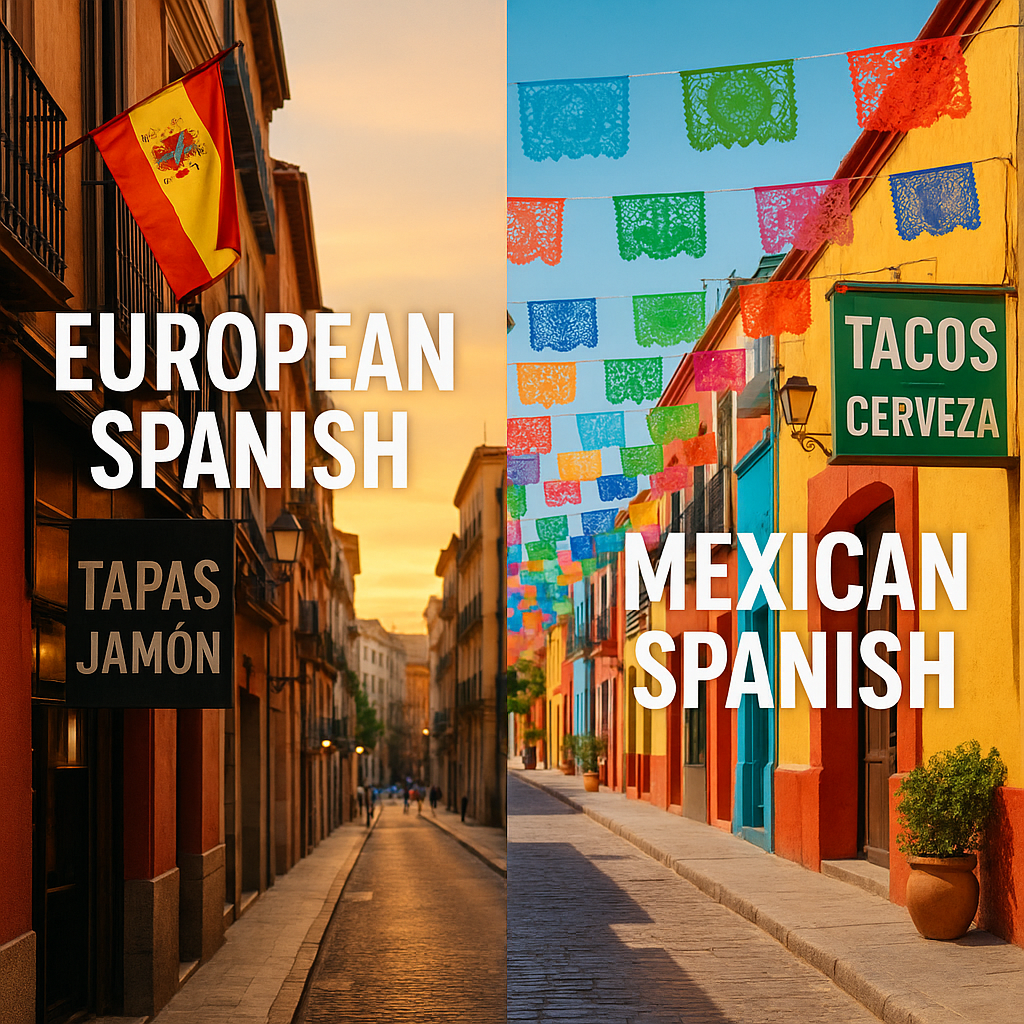
Spanish is everywhere—spoken by over 500 million people across the globe, it’s the second most widely spoken native language after Mandarin and one of the most useful languages for travel, business, and culture. But here’s the catch: Spanish is not the same everywhere. From Madrid to Mexico City, from Buenos Aires to Bogotá, the language wears different accents, expressions, and identities. Among these variations, two stand out for learners: European Spanish (Castilian) and Mexican Spanish.
If you’ve decided to learn Spanish, you’ll face this classic question early on:
“Should I learn the Spanish from Spain or the Spanish from Mexico?”
It’s not just a matter of accent—each variety carries distinct pronunciation, vocabulary, and cultural flavor. Both are official, both are correct, and both are deeply rooted in history. But which one suits your goals, your ear, and your dreams?
This comprehensive guide will walk you through every difference between European Spanish and Mexican Spanish: their history, sound, vocabulary quirks, grammar, idioms, and even pop culture. We’ll help you choose the right path and show you why, whichever you choose, Spanish opens a world of possibilities.
The Shared Origin: One Language, Two Destinies
Both varieties descend from Castilian Spanish, which emerged in medieval Spain. When Spanish explorers crossed the Atlantic in the early 16th century, they brought their language to the Americas. But once in the New World, Spanish began to evolve under the influence of indigenous languages like Nahuatl (Aztec), Maya, Zapotec, and later African languages brought by enslaved people. Meanwhile, in Spain, the language kept evolving in contact with French and Italian and under the influence of internal regional dialects like Andalusian.
The result? Two “standards” that share grammar and 80–90% of vocabulary, yet sound and feel very different.
How Different Are They Really?
They are mutually intelligible—if you learn one, you can understand the other with some effort. But here’s where learners stumble:
Pronunciation: Huge differences in sound.
Vocabulary: Everyday words can change.
Grammar & Usage: Subtle, but real.
Slang & Expressions: Entirely different cultural codes.
1. Pronunciation: The Sound of Spanish
The sound is the first big shock. Here’s why:
European Spanish (Castilian)
The famous “theta” (ceceo):
c and z before e or i are pronounced like English “th.”cielo → [ˈθjelo]
zapato → [θaˈpato]
Syllable compression: Words flow quickly; unstressed syllables can soften.
Final “s”: Pronounced clearly ([s]).
Mexican Spanish
No “th” sound—uses [s].
cielo → [ˈsjelo]
zapato → [saˈpato]
Vowels are crisp and consistent; sounds more “open” than Spain’s accent.
Slightly slower rhythm, easier for learners to follow.
Quick Comparison Sentence:
“Los zapatos están en el cielo.”
Spain: [los θaˈpatos esˈtan en el ˈθjelo]
Mexico: [los saˈpatos esˈtan en el ˈsjelo]
2. Vocabulary: 30 Words That Can Confuse You
Here’s a side-by-side table:
EnglishSpainMexicoCarcochecarroCell phonemóvilcelularComputerordenadorcomputadoraJuicezumojugoPotatopatatapapaBusautobúscamiónApartmentpisodepartamentoGlassesgafaslentesStrawpajitapopotePenbolígrafoplumaJacketchaquetachamarraJeansvaquerosjeansMoneypasta (slang)lana (slang)Friendcolega (formal)cuate (slang)CutemonolindoWorkcurro (slang)chamba (slang)
Important: Some words are not just different—they can be awkward or vulgar in another country.
Example: coger (to take) is normal in Spain but vulgar in Mexico. Use tomar there.
3. Grammar: Subtle but Significant
Vosotros vs. Ustedes
Spain:
Informal plural: vosotros vais
Formal plural: ustedes van
Mexico:
ustedes for both: ustedes van
Past Tense Usage
Spain: Uses present perfect for recent actions:
Hoy he comido paella.
Mexico: Prefers preterite:
Hoy comí tacos.
Pronoun Placement
Spain favors leísmo (using le for direct male objects):
Le vi ayer. (Spain) vs. Lo vi ayer. (Mexico)
4. Idioms & Slang: A World of Difference
Language lives in expressions. Here are 20 examples:
Spain: ¡Vale! (Okay) | Mexico: ¡Sale!
Spain: ¡Qué guay! (Cool) | Mexico: ¡Qué padre!
Spain: Tío / tía (dude) | Mexico: Güey
Spain: ¡Venga! (Come on) | Mexico: ¡Órale!
Spain: Currar (to work) | Mexico: Chambear
Spain: ¿Qué tal? | Mexico: ¿Qué onda?
These phrases aren’t just words—they carry identity. Using them signals where you “belong.”
5. Media & Pop Culture: Which Feeds Your Ear?
Spain: Known for La Casa de Papel (Money Heist), Almodóvar films, and Fito & Fitipaldis.
Mexico: Think Coco (Pixar drew heavily on Mexican culture), Roma (Oscar-winning film), and telenovelas like Rebelde.
Music matters too:
Spain: Flamenco, pop-rock.
Mexico: Mariachi, rancheras, and reggaetón collabs.
Choose the culture that excites you—you’ll stick with the language longer.
Which Spanish Should You Learn?
Choose European Spanish if:
You plan to live, study, or work in Spain.
You’re fascinated by Spanish literature, art, and European travel.
You like the challenge of mastering vosotros.
Choose Mexican Spanish if:
You travel to Mexico or Latin America often.
You want Spanish for the U.S. (Mexican influence dominates).
You love Latin music, food, and cinema.
Bottom line: Both are great. Start with one, add the other later.
Tips for Learning Either Variety
Pick a focus: Avoid mixing early on.
Listen daily: Podcasts, YouTube, radio.
Practice speaking: Use language partners or tutors.
Learn cultural phrases: Don’t sound like a textbook.
Immerse: TV shows, songs, even TikTok.
Extended FAQs
1. Are the two varieties mutually intelligible?
Yes, but slang and speed can confuse beginners.
2. Which is easier for English speakers?
Mexican Spanish—clear vowels, no vosotros.
3. Which is “better” Spanish?
Neither. Both are standard.
4. Is there a neutral Spanish?
Not really. “Neutral” often sounds unnatural.
5. Which is taught in schools?
Depends: U.S. schools lean Latin American; Europe leans Castilian.
6. Is pronunciation hard?
Spain’s theta and lisp-like sound surprise learners; Mexico’s is simpler.
7. Which helps with Latin America overall?
Mexican Spanish—it’s widely understood.
8. Do Spanish speakers watch each other’s shows easily?
Yes, though accents stand out.
9. Does grammar differ a lot?
Core grammar is the same; usage differs.
10. Which variety uses slang more?
Both—different slang, same creativity.
11. Can I learn one and travel to the other region?
Absolutely. You’ll adapt quickly.
12. Is European Spanish faster?
Often yes, due to syllable reduction.
13. Which accent sounds nicer?
Subjective! Many love Mexico’s smooth tone; others adore Spain’s crispness.
14. Is Mexican Spanish closer to Latin?
In vowel clarity, yes.
15. How hard is it to switch later?
Easy—once you know one, adapting is quick.
Ready to Start Speaking Spanish?
At Polyglottist Language Academy, we help you learn the Spanish that fits your goals—whether that’s exploring Spain’s plazas or Mexico’s mercados. Our courses cover both European Spanish and Mexican Spanish, taught by native instructors who bring culture to life.
Interactive online classes
Small groups and private lessons
Focus on pronunciation, slang, and real-life conversation
👉 Sign up today and start your Spanish journey with experts who make learning fun and effective.