
Why Russian Dachas Still Matter Today
When I think about summer as a child, I do not remember vacations in the way my own children understand them now. I remember the dacha. Once school ended, the city seemed to loosen its grip on us and life moved somewhere greener, slower, and much less organized. We packed clothes, books, food, old blankets, garden tools, and far more things than any child could understand the purpose of, and then we left for the country for weeks at a time. As children, we did not think of the dacha as a retreat from urban life. It was simply where summer happened, with the smell of warm pine boards, damp grass in the morning, dill growing beside the path, smoke from someone's fire, and mosquito repellent becoming as much a part of the season as sunlight.
I am in my late thirties now, and I still go to the dacha often in summer. The house has changed, the garden has changed, and the way we spend our time there has changed too. These days I arrive with two small children of my own and the absurd amount of luggage that seems to accompany them everywhere: snacks, sunscreen, toys, extra shoes, bicycles, books, sweaters they probably will not wear, and several things I inevitably forget. Yet within a few hours of arriving, the old rhythm comes back. Some of the friends I spent my childhood summers with still have dachas nearby. We grew up together almost accidentally because our parents happened to have plots along the same road, and every June we reappeared, slightly taller and different from the previous year, and resumed friendships that had simply been waiting through winter. Now our children are doing the same thing, spending their summers with the children of people I have known since I was their age, and sometimes I watch them and have the strange feeling that time has folded in on itself.
The Summers We Grew Up In
When I was little, the dacha felt enormous even though the plot itself was not particularly large. The world seemed bigger because adults were not organizing every hour of our day. We rode bicycles down dirt roads, wandered through the forest, climbed trees, picked berries, invented complicated games, and moved from one friend's house to another without anyone arranging a playdate. Someone's grandmother would feed us, someone else's mother would tell us to stop trampling the garden beds, and eventually somebody would stand by a gate and call our names. We would make our way home slowly, usually trying to negotiate another ten minutes outside.
Looking back now, that freedom feels almost luxurious. There were no scheduled activities and very little entertainment in the modern sense, so we created our own. A fallen tree could become a ship for an afternoon, a collection of boards could become a house, and a path through the forest could become territory that needed to be explored repeatedly even though we already knew exactly where it went. Of course, memory edits things beautifully. There were mosquitoes, muddy shoes, long rainy days, and chores we tried hard to avoid. Adults constantly needed something from us: carry this bucket, pick those currants, pull those weeds, go get dill. I remember being sent to the garden for dill and somehow taking twenty minutes to return with it. At the time, I thought the adults were hopelessly obsessed with vegetables. Now, unfortunately, I understand them.
The Garden Used to Mean Something Different
My grandparents' generation did not see the garden as decoration. Good soil was there to produce food, and an empty patch of it looked suspicious. There were potatoes, cucumbers, tomatoes, onions, carrots, zucchini, herbs, strawberries, raspberries, currants, and apple trees, and when one crop finished, attention immediately shifted to another. Summer had its own calendar, measured less by dates than by what was ripening.
For many families, this food genuinely mattered. Homegrown vegetables and preserved fruit helped through the winter and could make a real difference to the household budget. Even when shops became better stocked and people no longer needed the garden in quite the same way, the habits remained. By late summer, kitchens filled with jars. Cucumbers were salted or pickled, berries became varenye, tomatoes were preserved, and apples appeared in such quantities that everyone began giving them away.
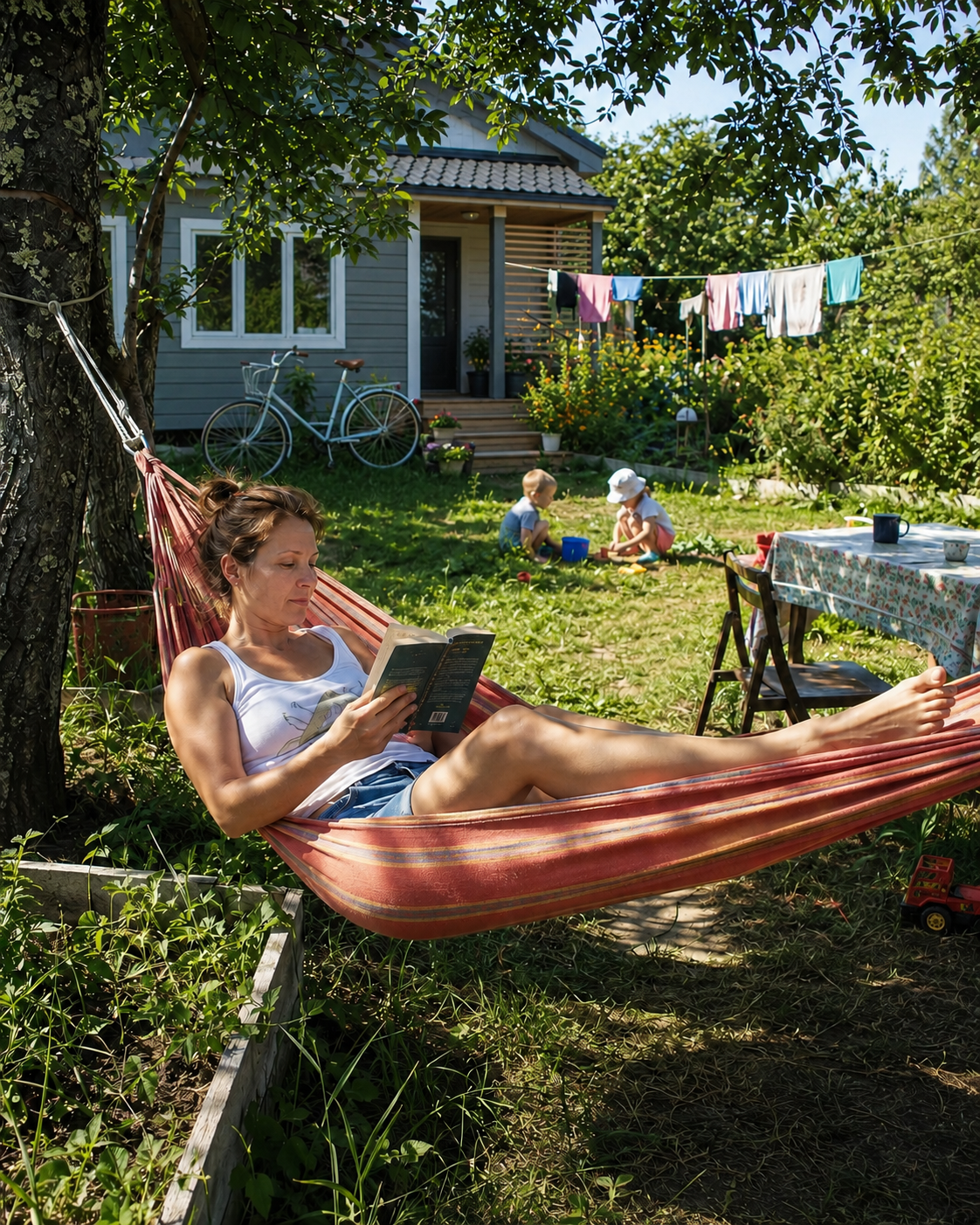
Our own garden is much less serious now. I still grow things because I genuinely like walking outside and picking a tomato that is still warm from the sun, but I no longer believe every square meter of land has to justify itself by producing food. There are flowers, more grass, a place for the children to play, and a hammock between two trees. One of my grandmothers would almost certainly have looked at the hammock, then at the ground beneath it, and asked why I was wasting perfectly good space where potatoes could be growing. I understand the question, but I no longer agree with it.
My Children's Summers Look Strangely Familiar
One of the loveliest things about returning to the dacha as an adult is watching my children develop their own dacha friendships. The friends I grew up with are still some of my closest friends. During the year, all of us have work, schools, appointments, obligations, and calendars that have to be consulted before anyone can meet for coffee, but at the dacha much of that disappears. Our children find one another in the morning and begin moving from house to house. They ride bicycles, collect sticks for mysterious projects, eat berries straight from the bushes, and invent games whose rules are so complicated that no adult could possibly follow them.
My friends and I sit nearby and watch them recreate versions of our childhood without knowing they are doing it. We remember exactly where we used to hide, which neighbor had the best raspberries, which grandmother always fed everyone without asking whose child was whose, and who had the most dramatic bicycle accident one particular summer. Now our children are making their own stories in the same places. There is something deeply comforting about that continuity. The world outside changes quickly, people move, cities become unrecognizable, and friendships can quietly disappear under the weight of adult life, but at the dacha I still know who lives three gates down.
Mornings in the Forest
Some of my favorite dacha mornings begin early, especially after several days of rain, because that is when we go looking for mushrooms. Mushroom picking is difficult to explain to someone who did not grow up with it. It is partly about food, but not entirely. There is a particular pleasure in knowing how to look. You begin reading the forest differently, noticing birch trees, pine needles, damp moss, small rises in the ground, and the particular way leaves gather around something that might be hidden beneath them.
When I was a child, older relatives seemed to possess supernatural mushroom-finding abilities. I could stare at the forest floor and see nothing while my grandmother would casually point to a beautiful mushroom practically beside my shoe. Now I find myself doing the same thing to my children. They get enormously excited when they find one, although occasionally I have pointed directly at it several times before the discovery becomes officially theirs.
We pick berries too, depending on where we are and what time of summer it is. Wild strawberries, blueberries, raspberries, and other forest berries may end up in small containers, although many never make it out of the forest because the children eat them immediately. Their fingers and mouths become stained, and they insist they have hardly eaten any. I used to do exactly the same thing, so I cannot complain. These mornings are among the parts of dacha life that have changed least for me. They are slow, repetitive, and not especially efficient, which may be precisely why I still like them.
The Evenings I Wait for All Year
If mornings at the dacha belong to the forest and the garden, evenings belong to people. One of my favorite summer evenings usually begins without anyone planning it very carefully. A message appears in our group chat sometime in the afternoon asking whether we should make shashlyk, and from that point everything organizes itself. Someone already has meat marinating, someone else brings vegetables and bread, another person arrives with wine, and somebody inevitably has far too many cucumbers from the garden and is delighted to give them away.
By the time everyone has gathered, the children are still running around barefoot or in sandals, disappearing into the garden and reappearing whenever food becomes interesting. The adults sit around a long table outside while somebody tends the coals, and soon the smell of shashlyk, begins drifting through the garden. There is always a debate about the fire. The coals are too hot, or not hot enough. The meat should have been marinated longer. Someone has cut the onions incorrectly. Several people have inherited completely different and equally unquestionable rules about how shashlyk should be made, and eventually the meat goes onto the skewers while everyone agrees to stop interfering for at least a few minutes.
Later, when it is properly dark, somebody brings out a guitar. This has happened in one version or another for as long as I can remember. At first, nobody wants to sing. Everyone claims to have forgotten the words. Someone plays the first chords of an old song, another person joins in quietly, and within a few minutes the same people who insisted they remembered nothing are singing entire verses. Some songs are old Soviet songs that everyone seems to know without remembering exactly when they learned them. Others are Russian rock songs from our teenage years, the kind that immediately bring back another decade. Somebody always starts a song in the wrong key, someone else complains that it is too high, and then everybody sings anyway.
At some point we put potatoes into the fire. They sit buried in the hot coals while we keep talking and singing, and later someone remembers them. Their skins are black by then, and opening them leaves soot all over your hands, but inside they are soft and steaming. We eat them with salt while standing around the dying fire, and the children hover nearby waiting for their share even though they were supposedly too tired to eat anything five minutes earlier.
The garden disappears into darkness except for the little circle of light around us. The air smells of smoke and grass, somebody is still playing the guitar, and the children are finally becoming sleepy enough to lean against their parents. These are people I have known almost my entire life. Some of us once sat around fires here as teenagers, long before we had jobs, marriages, divorces, mortgages, or children. Now our children are asleep inside the same houses while we sit outside and sing many of the same songs. On evenings like that, the distance between then and now feels very small.
And Sometimes the Dacha Is Quiet
I love those evenings, but I have also grown to appreciate something I never valued as a child: doing absolutely nothing. A dacha always offers work. Something needs watering, trimming, cleaning, fixing, painting, planting, picking, or moving. It has an almost supernatural ability to create new jobs as soon as the old ones are finished.
Sometimes I ignore all of them and take a book to the hammock. The children are somewhere nearby. I can hear them calling to one another, then suddenly nothing, then another explosion of laughter. Bees move through the flowers, a neighbor is cutting grass several houses away, and someone's radio is playing softly behind a fence. I read for a while, although not always very successfully, because the combination of a warm afternoon and a hammock makes sleep almost inevitable. For someone raised around adults who believed relaxation at the dacha should begin only after every possible task had been completed, lying there still feels mildly rebellious, but I have made peace with that.
The Dacha Has Become More Comfortable
The physical dacha of my childhood was simpler. Many houses had basic kitchens, outdoor toilets, old furniture, and water systems that required considerably more effort than turning on a tap. Nothing matched because nobody expected it to. Furniture that had become too old for the city apartment was sent to the dacha for another life, plates came from several different sets, towels survived for decades, and every shed contained a collection of objects that someone insisted might become useful one day.
Modern dachas can be very different. People install proper bathrooms, heating, modern kitchens, Wi-Fi, terraces, outdoor lighting, and sometimes even swimming pools. Some small Soviet summer houses have gradually turned into comfortable year-round homes. Our dacha has changed as well, and I am grateful for most of those improvements. I have no desire to preserve inconvenience simply for the sake of nostalgia.
At the same time, I hope it never becomes too polished. A real dacha should have a little disorder. There should be gardening gloves left somewhere inexplicable, children's shoes scattered near the door, chairs that do not match, a basket filled with objects nobody remembers putting there, and at least one cupboard containing things that have apparently belonged to the family since before anyone currently alive can remember. Otherwise it begins to feel like a rental house rather than a place with a history.
Why It Is So Hard to Let a Dacha Go
A dacha rarely makes sense purely as an investment. It requires money, maintenance, and endless work. The traffic leaving the city on a Friday can be terrible, something always needs repairing, and mosquitoes remain committed to the project no matter how modern the house becomes.
Yet selling a family dacha can be surprisingly painful because the building itself is only a small part of what would be lost. There is the apple tree someone planted when you were little, the corner where your grandmother always sat, the neighbors who have known your family for decades, and the path you could probably walk in complete darkness. At our dacha, one place can hold several versions of my own life at once. I remember myself as a child riding a bicycle down the road with my friends, then as a teenager who sometimes found the dacha painfully boring and wanted nothing more than to return to the city, and later as an adult who suddenly understood why my parents never seemed eager to leave on Sunday evening. Now my children run down that same road, and very few places allow you to experience time in quite that way.
Why I Still Go Back
My relationship with the dacha is very different from the one my grandparents had. I do not depend on it for food, I do not believe every patch of soil requires potatoes, and I am perfectly happy to have Wi-Fi and a proper bathroom. Still, every spring I begin waiting for summer. I want my children to know the forest paths and learn how to search for mushrooms. I want them to eat berries before we manage to bring them home, disappear down the road with the children of my oldest friends, and return dirty, hungry, and full of stories.
I want those long evenings when someone eventually brings out the guitar and people who have known one another for thirty years begin singing songs they somehow still remember. I want the smell of shashlyk, the potatoes hidden in the coals, the conversations that continue after dark, and the quieter afternoons when everyone is occupied and I can disappear into my hammock with a book.
The dacha has changed enormously since my childhood. It is more comfortable, less necessary, and less devoted to survival than it once was, while much of the hard practicality that shaped my grandparents' relationship with it has softened into something more voluntary. Yet when I sit beside a fire with the same friends I knew as a child while our children run through the darkness around us, I do not feel that the dacha has lost its purpose. It feels as if its purpose simply changed with us.
Russian Dacha Is Its Own Little World
For someone learning Russian, the dacha also explains a surprising amount of everyday vocabulary. A dacha is the country house or summer property itself, while an ogorod, usually refers to the vegetable garden. A sad, can mean a garden or orchard, a gryadka is a garden bed, and teplitsa, is a greenhouse. Then there is urozhay, the harvest, which becomes an increasingly important conversational topic once everything starts ripening at once.
People go “sobirat' griby, “to pick mushrooms,” or “sobirat' yagody, “to pick berries.” We make shashlyk, and “pech' kartoshku v kostre, “bake potatoes in the fire.” These expressions are easy enough to translate, but their cultural associations are harder to learn from a dictionary. Poyekhat' na dachu, “to go to the dacha,” might mean spending a peaceful weekend outside the city, but it could just as easily mean repairing a fence, pulling weeds for six hours, and returning home exhausted with three bags of cucumbers. Quite often, it means both.
For adults interested in learning Russian while also understanding more of the everyday life behind the language, Polyglottist Language Academy offers Russian classes for adults. Words connected with food, seasons, family, nature, and dacha life become much easier to remember once they belong to a real cultural world rather than appearing on a vocabulary list.