
Top Spanish Dialects Ranked by Difficulty (For Learners)
Spanish is often described as one of the most practical languages English speakers can learn. It is spoken across Spain, Latin America, the Caribbean, and large parts of the United States. It opens doors to travel, family communication, literature, music, film, work opportunities, and everyday conversations in many multilingual communities. But once students move beyond the first few lessons, they quickly discover something surprising: Spanish does not sound exactly the same everywhere.
The Spanish you hear in a beginner textbook may sound clear and organized. The Spanish you hear from a teacher may feel manageable. The Spanish you hear in a Mexican telenovela, a Colombian podcast, a Spanish film, an Argentine interview, a Puerto Rican song, or a Chilean street conversation may feel like several different languages at once. The words are still Spanish, the grammar is still Spanish, and native speakers from different countries can usually understand one another. But for learners, the differences can feel enormous.
A student may spend months learning present-tense verbs, direct object pronouns, and basic travel vocabulary, only to watch a movie from Argentina and wonder why “yo me llamo” suddenly sounds different. Another learner may understand a Colombian teacher perfectly but struggle with a Dominican friend speaking casually. Someone else may learn Spain Spanish and then feel confused when Latin American speakers never use vosotros. This is one of the most fascinating—and sometimes intimidating—parts of learning Spanish: dialects matter.
Before ranking Spanish dialects by difficulty, it is important to say something clearly: no Spanish dialect is “better,” “worse,” “more correct,” or “less correct” than another. Every dialect is a complete, legitimate, culturally rich form of Spanish. When we talk about difficulty, we are talking only from the learner’s perspective. Some dialects may feel easier because speakers tend to pronounce more consonants clearly, use vocabulary close to what students learn in class, or appear frequently in learning materials. Other dialects may feel harder because of speed, slang, sound reductions, or grammar features that beginners have not studied yet.
The best dialect for you is not always the “easiest” one. It depends on your goals. Are you learning Spanish for travel in Mexico? For family conversations with relatives from El Salvador? For work in California? For a trip to Spain? For music from Puerto Rico and Colombia? For literature from Argentina? For general communication across Latin America? The answer changes depending on your life.
Still, learners often want a practical guide. Which Spanish dialects are easiest to understand at first? Which ones are more challenging? Which dialect should a beginner start with? Which accent is best for Americans? And why do so many people say Chilean Spanish is hard?
Let’s rank the major Spanish dialects by difficulty for learners, from easiest to hardest, while remembering that every ranking is approximate. Within each country, there are many regional accents. Bogotá Spanish is not the same as coastal Colombian Spanish. Central Mexican Spanish is not the same as northern or coastal Mexican Spanish. Madrid Spanish is not the same as Andalusian Spanish. Caribbean Spanish includes Cuban, Puerto Rican, and Dominican varieties, each with its own rhythm and vocabulary. So this ranking is not absolute. It is a learner-friendly map of what you are likely to experience when you begin listening to real-world Spanish.
What Makes One Spanish Dialect Easier or Harder?
A Spanish dialect may feel easy or difficult for several reasons. The first is pronunciation. Dialects that pronounce final consonants clearly, especially the final “s,” are usually easier for beginners. If you hear “los amigos” clearly, you can connect the sound to the words you know. But if it sounds closer to “loh amigo,” “lo amigo,” or something even more reduced in fast speech, you need more listening experience to recognize it.
Speed is another factor. Some speakers talk quickly in every dialect, of course, but certain varieties have a reputation for faster rhythm and more compressed pronunciation. When speed combines with dropped consonants and local slang, comprehension becomes much harder.
Vocabulary also matters. Spanish has many shared words across the Spanish-speaking world, but everyday vocabulary can vary. A car might be carro, coche, or auto depending on the country. Juice might be jugo or zumo. A computer might be computadora or ordenador. The word guagua can mean “bus” in some places and “baby” in others. Slang can be even more local. If you learn Mexican Spanish, words like órale, güey, and chido may become familiar. If you listen to Argentine Spanish, you may hear che, boludo, and laburar. If you listen to Chilean Spanish, you may hear po, cachai, and fome.
Grammar also changes in small but important ways. In most Latin American Spanish, ustedes is used for plural “you.” In Spain, vosotros is used for informal plural “you,” which comes with its own verb endings: vosotros habláis, vosotros coméis, vosotros vivís. In Argentina and much of Central America, vos is used instead of tú, with forms like vos hablás, vos tenés, and vos querés. These differences are not impossible, but they can surprise learners who have only studied one system.
Finally, exposure matters. Mexican Spanish is easier for many U.S. learners not only because it can be relatively clear, but because it is everywhere: communities, media, music, restaurants, television, YouTube, and learning materials. A dialect you hear often becomes easier. A dialect you rarely hear feels harder, even if it is not linguistically more complicated.
Standard Spanish vs. Real-World Spanish
Most Spanish students begin with a kind of “standard” or “neutral” Spanish. This is useful. A beginner needs clear explanations, predictable grammar, and high-frequency vocabulary. Textbooks cannot teach every regional variation at once. They need to give students a foundation.
But no one actually speaks “neutral textbook Spanish” as their native dialect. Every speaker has an accent. Every community has favorite expressions. Every country has local humor, filler words, intonation, and informal shortcuts. This is not a problem—it is the beauty of language.
The gap between classroom Spanish and real Spanish can feel frustrating at first. You may understand your instructor perfectly but struggle with a movie. You may know the verb endings but miss half the words in a song. You may recognize every word in subtitles but not hear them in fast conversation. That does not mean you are bad at Spanish. It means your ear is still developing.
Learning Spanish dialects is not about memorizing every regional word in every country. It is about building flexibility. You start with a foundation, then gradually expose yourself to different accents. Over time, you stop panicking when Spanish sounds different. You begin to recognize patterns: final “s” may disappear here, “ll” may sound like “sh” there, vos may replace tú in another place. Suddenly, the Spanish-speaking world becomes less confusing and much more exciting.
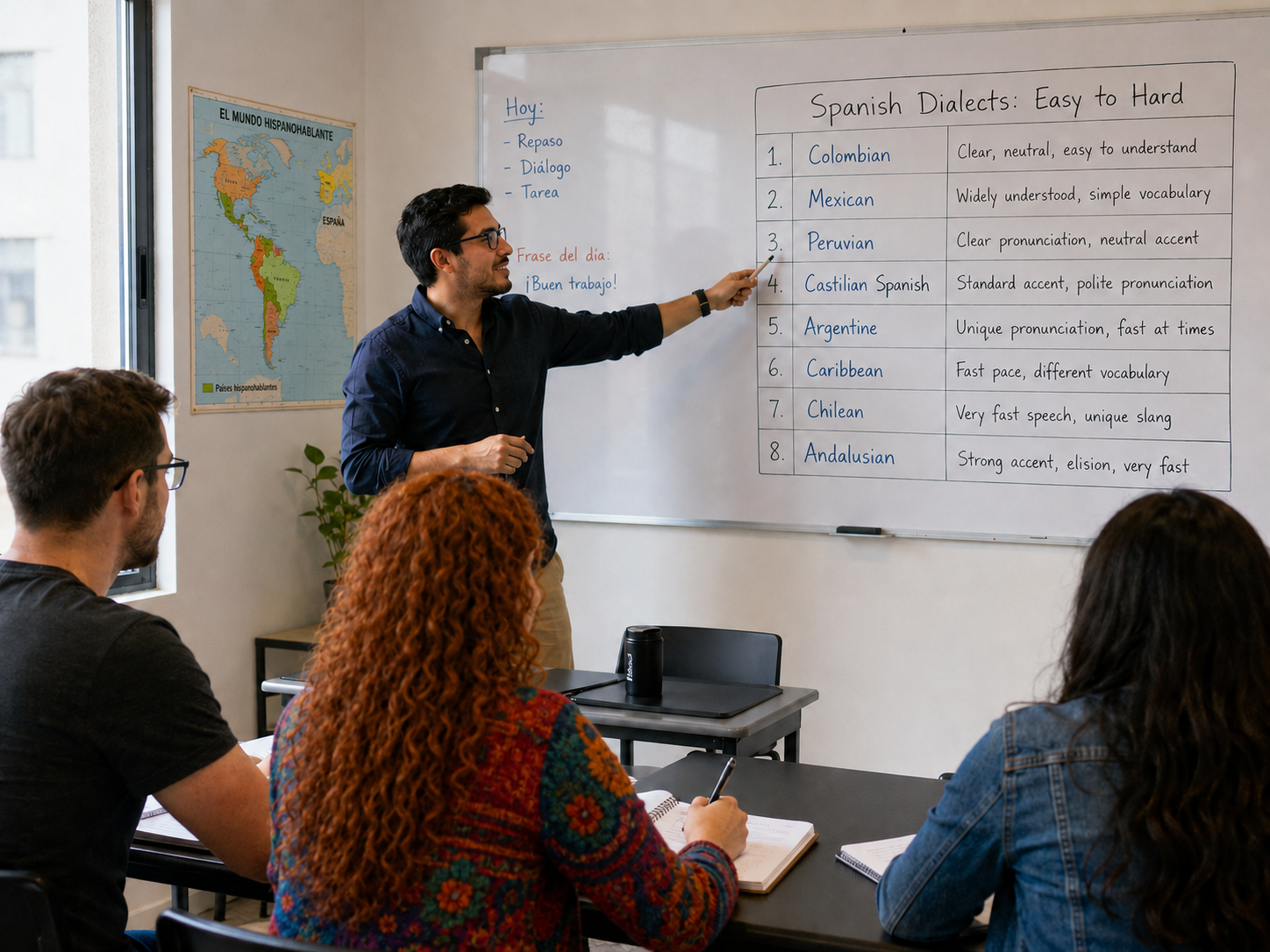
Spanish Dialects Ranked from Easiest to Hardest for Learners
Here is a learner-oriented ranking of major Spanish dialects, from generally easiest to generally hardest for English-speaking students.
1. Colombian Spanish, Especially Bogotá: Very Beginner-Friendly
Colombian Spanish is often described as one of the clearest varieties for learners, especially the Spanish spoken in Bogotá and the central highlands. This does not mean every Colombian speaker sounds the same. Colombia has many regional accents, and coastal Colombian Spanish can be much faster and more Caribbean-influenced. But Bogotá Spanish has a reputation for careful pronunciation, moderate speed, and a relatively neutral sound.
For beginners, this is helpful because word endings are often easier to hear. The final “s” is usually pronounced more clearly than in many Caribbean or southern Spanish varieties. Consonants are less likely to disappear in careful speech. The rhythm often feels steady. In formal or educated contexts, speakers may sound especially clear.
Another reason Colombian Spanish is beginner-friendly is that it often feels close to the Spanish taught in many classrooms. The grammar is familiar, the pronunciation is accessible, and many Colombian teachers online use a clear style that students appreciate. For learners who want to build listening confidence, Colombian podcasts, news clips, interviews, and educational videos can be an excellent starting point.
However, learners should remember that “Colombian Spanish” is not one accent. Coastal cities such as Cartagena and Barranquilla may have speech patterns that resemble Caribbean Spanish, including faster rhythm and more sound reductions. Medellín has its own recognizable accent and expressions. Bogotá may be one of the easiest varieties for learners, but Colombia as a whole is wonderfully diverse.
Best for: beginners, online learners, South America travelers, students who want clear listening practice.
Main challenge: regional variation within Colombia.
Beginner-friendly rating: 5/5.
2. Peruvian Spanish, Especially Lima: Clear and Underrated
Peruvian Spanish, especially the Spanish spoken in Lima, is another excellent option for learners. It is sometimes overlooked because Mexican, Colombian, and Spain Spanish receive more attention in language-learning materials. But Lima Spanish is often quite clear, with relatively conservative pronunciation and a pace that many learners find manageable.
Like Bogotá Spanish, Lima Spanish often preserves consonants clearly in formal speech. Learners can usually hear word boundaries and connect spoken Spanish to written Spanish. This makes it a strong dialect for listening practice, especially for students who want a Latin American variety that is not too slang-heavy in its formal register.
Peruvian Spanish is also useful for travelers interested in South America, especially Peru’s rich history, food culture, and tourism. If you want to visit Lima, Cusco, Machu Picchu, or other parts of Peru, becoming familiar with Peruvian Spanish will help you understand local communication more comfortably.
The main difficulty is exposure. Many students simply do not hear Peruvian Spanish as often as Mexican or Colombian Spanish. There are fewer globally popular Peruvian shows and fewer beginner materials focused specifically on this variety. Also, Peru contains many regional accents, including Andean and Amazonian varieties, which may sound different from Lima Spanish.
Best for: South America travel, learners who want clear Latin American Spanish, students who enjoy Peruvian culture.
Main challenge: fewer mainstream learning resources compared with Mexican Spanish.
Beginner-friendly rating: 5/5.
3. Mexican Spanish: The Most Practical Choice for Many U.S. Learners
Mexican Spanish is one of the most practical dialects for learners in the United States. For many American students, it is the variety they are most likely to hear in daily life, especially in California, Texas, Arizona, Nevada, New Mexico, and many other states. Mexican Spanish is also extremely visible in television, film, music, YouTube, podcasts, and language-learning materials.
Central Mexican Spanish, especially in formal or educational contexts, can be quite clear. The final “s” is usually pronounced, and the pronunciation often matches what students expect from Latin American classroom Spanish. There is no vosotros, and the pronunciation of “z” and “c” before “e” or “i” is usually the same as “s,” which feels simpler for many learners.
Mexican Spanish does have a lot of slang. Words like güey, órale, chido, padre, no manches, and ahorita appear frequently in informal conversation. Ahorita itself can confuse learners because it does not always mean “right now” in the literal sense; it can mean soon, later, in a moment, or sometimes not very soon at all, depending on context. But Mexican slang is widely documented, and because Mexican media is so available, learners can gradually absorb it.
Another challenge is regional variation. Northern Mexican Spanish, coastal varieties, rural speech, and urban Mexico City speech can differ. Still, for U.S.-based learners, Mexican Spanish is often the most useful starting point because you are likely to encounter it often.
Best for: U.S. learners, heritage learners, travel to Mexico, everyday communication in many American communities.
Main challenge: rich slang and regional variation.
Beginner-friendly rating: 5/5.
4. Castilian Spanish from Central and Northern Spain: Systematic but Different
Castilian Spanish, especially from Madrid and central or northern Spain, is a little more challenging for learners who began with Latin American Spanish, but it is not necessarily hard. In some ways, it is very systematic. Spain has abundant learning materials, clear news media, excellent films and series, and a strong tradition of Spanish-language education.
The biggest differences are pronunciation and grammar. In much of Spain, speakers use distinción, which means that “z” and “c” before “e” or “i” are pronounced like the English “th” in “think.” For example, gracias may sound like “grathias,” and zapato may begin with a “th” sound. This is not a lisp; it is a standard feature of many Peninsular accents.
Spain also uses vosotros for informal plural “you.” Latin American learners are used to ustedes for both formal and informal plural situations. In Spain, you will hear vosotros habláis, vosotros tenéis, and vosotros vais. This adds another set of verb forms.
Vocabulary can also differ. In Spain, a computer is often ordenador rather than computadora. Juice is zumo rather than jugo. Vale is used constantly to mean “okay.” Coche is common for “car.” These words are not difficult, but learners need to recognize them.
The speed of casual Spanish in Spain can be challenging, especially in urban conversations. However, standard Castilian Spanish is well represented in courses and media, so learners can find plenty of practice.
Best for: learners planning to travel, study, live, or work in Spain.
Main challenge: vosotros, distinción, fast speech, and Spain-specific vocabulary.
Beginner-friendly rating: 4/5.
5. Central American Spanish: Important but Underrepresented
Central American Spanish includes varieties from Guatemala, Costa Rica, El Salvador, Honduras, Nicaragua, and Panama. This region is extremely important, especially for many learners in the United States with family, community, travel, or work connections to Central America. However, these dialects are often underrepresented in mainstream Spanish courses.
Many Central American accents are not especially hard in pronunciation, especially in inland regions. Learners may find Guatemalan or Costa Rican Spanish relatively clear in formal contexts. The challenge is often grammar and vocabulary. Voseo is common in several Central American countries, meaning speakers may use vos instead of tú. This comes with forms like vos tenés, vos podés, and vos querés.
For learners who have only studied tú, voseo can feel unfamiliar at first. But it follows patterns, and once you learn the forms, it becomes manageable. The bigger issue may be sociolinguistic: when do people use vos, tú, or usted? The answer varies by country, region, age, and relationship.
Central American countries also have rich local slang. Salvadoran, Guatemalan, Nicaraguan, Honduran, Costa Rican, and Panamanian Spanish each include words and expressions that may not appear in general textbooks. But for heritage learners, this is exactly why studying the family or community dialect can be meaningful. Language is not just grammar; it is identity.
Best for: heritage learners, travelers, community-based learners, students working with Central American populations.
Main challenge: voseo and limited representation in mainstream materials.
Beginner-friendly rating: 4/5.
6. Venezuelan Spanish: Between Mainland and Caribbean Patterns
Venezuelan Spanish falls somewhere between clearer mainland Latin American varieties and more challenging Caribbean varieties. Some Venezuelan speakers, especially in formal contexts, are quite easy to understand. But Venezuelan Spanish can also include faster rhythm, local slang, and some consonant weakening, especially in coastal regions.
Learners may hear final “s” weakened or aspirated in some contexts. The rhythm can feel lively and quick. Words may blend more than in Bogotá or Lima Spanish. Venezuelan slang is also strong, with words like pana, chévere, and chamo appearing frequently.
Venezuelan Spanish has become increasingly important because of Venezuelan migration across Latin America, Spain, the United States, and other countries. Learners may encounter Venezuelan Spanish in many communities, even outside Venezuela. It is a useful dialect to recognize, especially at the intermediate level.
From a difficulty perspective, Venezuelan Spanish is not usually ranked as the hardest, but it can be noticeably more challenging than the clearest Andean or central Mexican varieties. Formal speech is accessible; informal conversation may require more exposure.
Best for: learners with Venezuelan friends, colleagues, family connections, or travel goals.
Main challenge: speed, slang, and Caribbean-influenced sound reductions in some regions.
Beginner-friendly rating: 3.5/5.
7. Argentine / Rioplatense Spanish: Beautiful but Distinctive
Argentine Spanish, especially Rioplatense Spanish from Buenos Aires and surrounding areas, is one of the most recognizable Spanish dialects. Many learners love it because it sounds expressive, stylish, and musical. It is associated with tango, literature, cinema, theater, football, psychoanalysis, café culture, and the intense cultural life of Buenos Aires. But it can be challenging because it differs from textbook Spanish in several obvious ways.
The first major difference is voseo. Instead of tú hablas, many Argentines say vos hablás. Instead of tú tienes, they say vos tenés. Instead of tú quieres, they say vos querés. These forms are not random; they are systematic. But if you have spent months memorizing tú forms, vos forms may feel like a new layer of grammar.
The second major difference is pronunciation. In Buenos Aires, the letters “ll” and “y” often sound like “sh” or “zh.” So calle may sound closer to “cashe,” and yo may sound like “sho” or “zho.” This feature is beautiful and iconic, but it can surprise learners at first.
The third difference is intonation. Rioplatense Spanish is often described as having Italian influence in its melody. The rise and fall of the voice may sound different from Mexican, Colombian, or Castilian Spanish.
Finally, Argentine slang—especially lunfardo—adds a lot of local color. Words like che, boludo, laburar, mina, and guita appear often in informal contexts. Some are friendly, some can be rude, and many depend heavily on tone and relationship.
Best for: learners interested in Argentina, Uruguay, tango, film, literature, or Buenos Aires culture.
Main challenge: voseo, “sh/zh” pronunciation, intonation, and slang.
Beginner-friendly rating: 3/5.
8. Andalusian Spanish: Fast, Reduced, and Regionally Rich
Andalusian Spanish, spoken in southern Spain, is often challenging for learners because of sound reductions. Many features associated with Latin American Spanish have historical connections to southern Spain and the Canary Islands, so Andalusian Spanish is important for understanding the development of Spanish around the world.
In Andalusian speech, final “s” may be aspirated or dropped. Consonants may soften. Words may blend together. A sentence that looks easy on paper can sound very different in casual conversation. Learners who are used to careful Castilian Spanish may suddenly feel lost.
For example, los amigos may not sound like the clear textbook version. Final consonants may become much weaker, and syllables may feel compressed. This does not mean Andalusian speakers are “not pronouncing Spanish correctly.” It means the dialect has its own phonetic rules and rhythm.
Andalusian Spanish also varies greatly within Andalusia. Seville, Granada, Málaga, Cádiz, Córdoba, and rural areas do not all sound the same. Some speakers are easier for learners to understand than others, especially in formal situations.
Best for: learners interested in southern Spain, flamenco, Andalusian culture, or advanced listening practice.
Main challenge: dropped or weakened consonants, fast rhythm, and regional variation.
Beginner-friendly rating: 2.5/5.
9. Caribbean Spanish: Cuban, Puerto Rican, and Dominican Spanish
Caribbean Spanish includes Cuban, Puerto Rican, and Dominican varieties, among others. It is vibrant, musical, culturally influential, and extremely important in the United States, especially in places like Florida, New York, New Jersey, and many urban communities. It is also central to salsa, reggaeton, bachata, merengue, and Caribbean cultural identity.
For learners, Caribbean Spanish can be difficult because it is often fast and consonant-light. Final “s” may be aspirated or dropped. Final “r” and “l” may weaken, change, or disappear in some contexts. Words may blend together in ways that make them hard to separate.
For example, a learner expecting to hear “los amigos” very clearly may instead hear something closer to “loh amigo.” Para may become pa’ in fast informal speech. The rhythm can be quick and fluid, which makes it exciting but challenging.
Caribbean Spanish also has rich slang and vocabulary influenced by African, Taíno, and local cultural histories. Dominican Spanish, Cuban Spanish, and Puerto Rican Spanish each have their own expressions. If you are learning Spanish for family, music, travel, or community, Caribbean Spanish may be essential. But if you are a beginner, it may help to start with slower, scripted, or subtitled materials before jumping into fast informal conversations.
Best for: heritage learners, music lovers, U.S. learners in Caribbean Spanish-speaking communities, travelers to Cuba, Puerto Rico, or the Dominican Republic.
Main challenge: speed, dropped consonants, word blending, and slang.
Beginner-friendly rating: 2/5.
10. Chilean Spanish: Often the Hardest for Learners
Chilean Spanish has a legendary reputation among Spanish learners. Many students hear that it is one of the hardest Spanish dialects, and there is a reason for that reputation. Informal Chilean Spanish can be very fast, heavily reduced, and full of local slang.
Chilean speakers may drop or weaken final consonants, compress words, use distinctive rhythm, and rely on expressions that are not common elsewhere. Words like po, cachai, fome, bacán, and al tiro appear frequently in colloquial speech. Even learners who understand Mexican, Colombian, or Spain Spanish may need time to adjust to Chilean Spanish.
One reason Chilean Spanish feels hard is that it reduces many of the clues learners depend on. Beginners listen for full endings, clear syllables, and familiar word shapes. When speech becomes faster and more compressed, those clues disappear. A sentence may contain words you technically know, but you may not recognize them in real time.
That said, Chilean Spanish is not impossible. No dialect is impossible. If you live in Chile, work with Chileans, love Chilean culture, or enjoy a challenge, you can absolutely learn to understand it. The key is gradual exposure. Start with clear Chilean news or educational videos, then move toward interviews, shows, podcasts, and real informal speech.
Best for: advanced learners, Chile-focused travelers, students who want serious listening practice.
Main challenge: speed, reductions, slang, and compressed pronunciation.
Beginner-friendly rating: 1.5/5.
Should Beginners Choose One Spanish Dialect?
Beginners do not need to obsess over dialect from day one. At the beginning, your priority should be building a foundation: pronunciation, essential verbs, basic sentence structure, common vocabulary, listening confidence, and speaking practice. You need enough Spanish to introduce yourself, ask questions, describe your life, talk about your plans, understand simple conversations, and survive real interactions.
That said, it helps to have a primary model. If you live in the United States, Mexican Spanish or general Latin American Spanish is often a practical choice. If your family is from El Salvador, Guatemala, Puerto Rico, Cuba, Argentina, or Spain, your family dialect may be the most meaningful choice. If you plan to study in Madrid, learn Spain Spanish. If you are moving to Chile, start training your ear for Chilean Spanish early.
The best approach is simple: start with one clear model, but do not close your ears to the rest of the Spanish-speaking world. Learn core Spanish first. Then gradually add dialect awareness. Watch videos from different countries. Notice vocabulary differences. Listen to music from multiple regions. Try not to panic when something sounds unfamiliar. Over time, you will become more flexible.
Examples of Spanish Dialect Differences
Here are some common differences learners should know.
Tú, Vos, and Usted
In many countries, tú is the informal singular “you”:
Tú hablas español.
Tú tienes tiempo.
Tú quieres café.
In Argentina, Uruguay, and much of Central America, you may hear vos:
Vos hablás español.
Vos tenés tiempo.
Vos querés café.
Usted is formal in many places, but in some regions, such as parts of Colombia and Central America, it may be used more broadly, even in familiar contexts.
Vosotros vs. Ustedes
In Spain, vosotros is used for informal plural “you”:
Vosotros habláis.
Vosotros coméis.
Vosotros vivís.
In Latin America, ustedes is used for plural “you” in both formal and informal situations:
Ustedes hablan.
Ustedes comen.
Ustedes viven.
Vocabulary Differences
A car may be:
carro in much of Latin America
coche in Spain and Mexico
auto in Argentina and other Southern Cone regions
A computer may be:
computadora in Latin America
ordenador in Spain
Juice may be:
jugo in Latin America
zumo in Spain
Okay may be:
vale in Spain
está bien, bueno, or ok in many Latin American contexts
Guagua may mean:
bus in Cuba, the Dominican Republic, Puerto Rico, and the Canary Islands
baby in Chile and some Andean regions
These differences are not reasons to panic. They are simply part of learning a global language.
How to Practice Listening to Different Spanish Dialects
The best way to understand dialects is to listen gradually and intentionally. Do not begin with the hardest material. If you are a beginner, start with slow podcasts, teacher-led videos, and clear interviews. Then move to news, documentaries, TV shows, movies, and casual conversations.
For Colombian Spanish, try news clips, educational podcasts, and interviews with speakers from Bogotá. For Mexican Spanish, explore beginner-friendly YouTube channels, telenovelas, podcasts, and everyday conversation videos. For Spain Spanish, watch Spanish news, Madrid-based shows, and listening materials that teach vosotros. For Argentine Spanish, listen to interviews, films, and podcasts from Buenos Aires with subtitles at first. For Caribbean Spanish, start with music lyrics, slower interviews, and subtitled shows before attempting fast casual speech. For Chilean Spanish, use clear formal materials first, then gradually move into colloquial videos.
Shadowing can also help. Choose a short clip, listen several times, read the transcript or subtitles, and repeat aloud. Try to imitate rhythm, not just individual words. Spanish dialects are not only about vocabulary; they are about music, timing, stress, and reductions.
Common Myths About Spanish Dialects
Myth 1: There is one correct Spanish.
There is standard spelling and formal grammar, but no single “correct” accent. Spanish from Mexico, Colombia, Spain, Argentina, Chile, Cuba, Peru, and every other region is real Spanish.
Myth 2: Latin American Spanish is always easier than Spain Spanish.
Not necessarily. Colombian or Peruvian Spanish may feel easier than fast Madrid speech, but some Latin American dialects, such as Chilean or Caribbean Spanish, may be much harder for learners than standard Castilian Spanish.
Myth 3: Mexican Spanish is the only useful dialect in the United States.
Mexican Spanish is extremely useful in the U.S., but it is not the only important dialect. Many U.S. communities include speakers from El Salvador, Guatemala, Cuba, Puerto Rico, the Dominican Republic, Colombia, Venezuela, Peru, and many other countries.
Myth 4: Chilean Spanish is impossible.
Chilean Spanish is difficult, especially informal speech, but it is not impossible. It simply requires more exposure, patience, and practice with local vocabulary and reductions.
Myth 5: Beginners must choose a dialect immediately.
Beginners should start with a clear model, but they do not need to make a permanent decision. Your Spanish will naturally adapt as your goals become clearer.
Myth 6: Spanish speakers from different countries cannot understand each other.
They usually can. There may be confusion with slang, speed, or local vocabulary, but Spanish remains broadly mutually intelligible across countries.
Which Spanish Dialect Should You Learn?
If you are learning Spanish in the United States and do not have a specific country goal, Mexican Spanish or general Latin American Spanish is a very practical starting point. You will find abundant resources, media, and real-life opportunities to practice.
If you want clear listening practice, Colombian Spanish from Bogotá and Peruvian Spanish from Lima are excellent choices. If you are going to Spain, focus on Castilian Spanish and learn vosotros early. If your family or community uses Central American, Caribbean, Argentine, or Venezuelan Spanish, prioritize that dialect because emotional connection and real communication matter more than an abstract ranking.
If you are an advanced learner, challenge yourself with Chilean, Caribbean, and Andalusian Spanish. These dialects can train your ear to handle fast, reduced, real-world speech.
The goal is not to erase your accent or imitate one country perfectly. The goal is to communicate with confidence, understand different speakers, and appreciate Spanish as a living language shared by many communities.
FAQ: Spanish Dialects Ranked by Difficulty
What is the easiest Spanish dialect to learn?
Many learners find Colombian Spanish from Bogotá, Peruvian Spanish from Lima, and central Mexican Spanish among the easiest varieties because they are often clear, moderately paced, and close to what students learn in class.
What is the hardest Spanish dialect to understand?
Chilean Spanish is often considered one of the hardest for learners because of its speed, sound reductions, and local slang. Fast informal Caribbean and Andalusian Spanish can also be very challenging.
Is Mexican Spanish easier than Spanish from Spain?
For many U.S. learners, Mexican Spanish feels easier because it is more familiar, more common in American communities, and does not use vosotros. However, Spain Spanish is not inherently harder; it simply has different pronunciation, vocabulary, and grammar features.
Is Colombian Spanish really the clearest Spanish?
Bogotá Spanish is often praised for clarity, but “clearest” is subjective. Some learners also find Peruvian, central Mexican, and formal Castilian Spanish very clear.
Why is Chilean Spanish so difficult?
Chilean Spanish can be fast, reduced, and full of local expressions. Learners may struggle because words do not always sound the way they appear in textbooks.
Should I learn Latin American Spanish or European Spanish?
Choose based on your goals. If you plan to travel or live in Spain, learn European Spanish. If you live in the U.S. or plan to travel in Latin America, Latin American Spanish may be more practical.
Can Spanish speakers from different countries understand each other?
Yes, most Spanish speakers from different countries can understand each other, especially in formal or neutral contexts. Slang and very fast informal speech may require adjustment.
Which Spanish dialect is best for Americans?
Mexican Spanish is often the most practical for Americans because of geography, community presence, and media exposure. However, Caribbean and Central American Spanish are also highly relevant in many U.S. cities.
What Spanish dialect is best for travel?
For general Latin American travel, Mexican, Colombian, or Peruvian Spanish are strong choices. For Spain, Castilian Spanish is essential. For specific destinations, learn the local variety.
Should beginners worry about dialects?
Beginners should be aware of dialects but not overwhelmed by them. Start with a clear foundation, then gradually expose yourself to different accents over time.
Learn Spanish with Polyglottist Language Academy
At Polyglottist Language Academy, we help students build real Spanish skills step by step. Our Spanish classes are designed for adult learners who want structure, clarity, conversation practice, and cultural context—not just memorized grammar rules. We offer Spanish classes in Berkeley and online, making it possible for students in the San Francisco Bay Area and beyond to study in a supportive, engaging environment. If your goal is travel, work, family communication, heritage learning, or simply the joy of understanding another language, we would love to help you find the right level and format.
You can also view current Spanish course options here:
Current Spanish Courses
Read More on the Polyglottist Language Academy Blog
If you enjoyed this article, you may also like these related posts from our language-learning blog:
Achieve Fluency with Spanish Classes at Polyglottist Language Academy: In-Person & Online
From Grammar to Fluency: How Spanish Classes in Berkeley Actually Work
Best Spanish Classes in Berkeley for Adults: Complete Local Guide
Why Learning Spanish Online Is a Great Choice: Benefits & How to Begin
Spanish Classes for All Levels in Berkeley: Learn with Expert Instructors