
Coming Later This Year: Practical Digital Language Courses from Polyglottist Language Academy
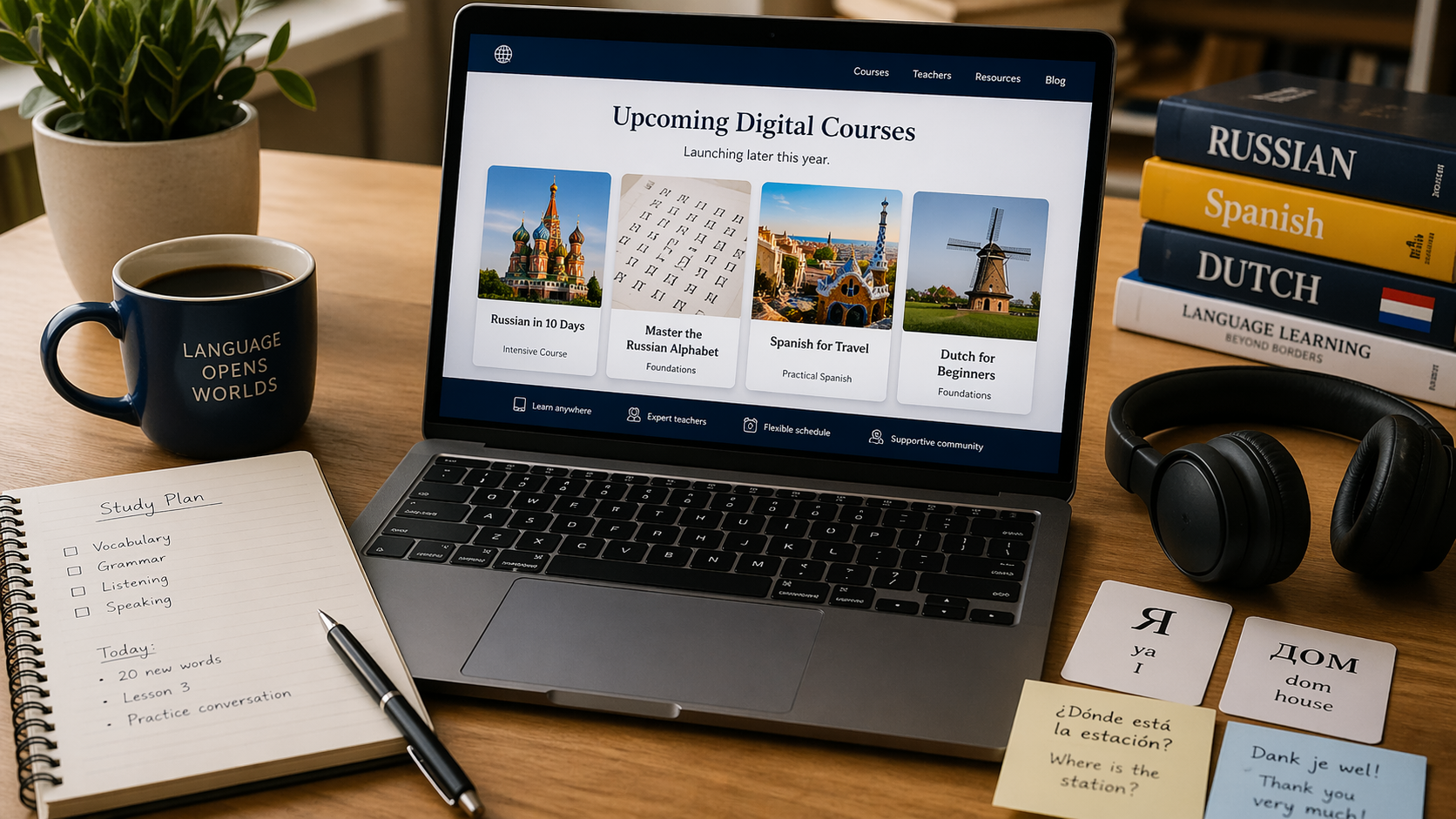
At Polyglottist Language Academy, we have spent years teaching adults in a way that is personal, serious, and deeply human. Our students do not come to us for flashy promises or inflated marketing. They come because they want real progress, thoughtful teaching, and instructors who actually know their subject. They come because they want small classes, meaningful interaction, and a learning experience that respects both their goals and their intelligence.
Later this year, we are excited to begin offering something new: short, focused digital language courses designed to solve very specific problems that language learners often face.
We plan to start with Russian. Our first digital offerings will include short, practical courses such as Russian in 10 Days, Master the Russian Alphabet, and conversational Russian mini-courses built around real-life situations: in a store, at a restaurant, on the street, at the doctor, and in other everyday settings that matter to real people. Later, we hope to expand these digital courses into Spanish, Dutch, and other languages as well.
These courses are not a replacement for what we already do. They are an extension of it. They come out of the same teaching philosophy that has shaped our school from the beginning: language learning should be practical, intelligent, and genuinely useful.
Why we are creating digital courses
Over the years, we have seen the same pattern again and again.
Many adults want to learn a language, but they do not always need or want the exact same thing at the exact same time. Some students are ready to commit to a full live course. Others need help with one specific area first. Maybe they want to master the Russian alphabet before joining a class. Maybe they are preparing for a short trip to a Spanish-speaking country and want to learn practical survival language fast. Maybe they need focused listening practice, targeted pronunciation help, or useful dialogues they can actually imagine using in real life.
And very often, those materials are surprisingly hard to find.
There is plenty of language content online, but much of it is either too broad, too random, too shallow, or simply not very good. Some resources are outdated. Some are boring. Some feel artificial in tone and presentation. Some throw information at learners without giving them a clear, structured path. Others are clearly designed more for clicks than for actual learning.
We want to create something better.
Our goal is to develop short digital courses that are focused, practical, and carefully designed around the real needs of adult learners. Instead of giving students a mountain of disconnected content, we want to offer concise, useful materials that help them solve specific language problems and gain confidence quickly.
Starting with Russian: practical, focused, and beginner-friendly
Russian is the first language we plan to prioritize for our digital course collection, and there is a good reason for that.
For many adults, Russian is deeply fascinating but also intimidating. The alphabet looks unfamiliar. The sounds can feel challenging. The grammar has a reputation for being difficult. Many learners are curious about Russian but feel overwhelmed before they even begin.
That is exactly where the right digital course can make a difference.
Take the Russian alphabet, for example. This is one of the first barriers many students face, but it is also one of the most misunderstood. People see letters like Ж, Ы, Щ, and Ъ and instantly assume the whole language must be impossibly hard. In reality, the alphabet is often much more manageable than learners expect. What stops people is usually not the alphabet itself, but the feeling of visual overwhelm.
That is why a course like Master the Russian Alphabet can be so valuable. Instead of forcing learners to piece things together from random videos and charts, we can guide them through the process in a structured, calm, adult-friendly way. We can show them which letters are easy, which ones are false friends, which ones need more practice, and how to start reading real words much sooner than they expected. We can make the process feel approachable instead of intimidating.
The same is true for a course like Russian in 10 Days. The point is not to make unrealistic promises. The point is to help learners make real, visible progress fast. When someone begins with the right sequence, the right examples, and the right explanation, the language stops feeling like an abstract wall and starts feeling reachable.
And then there are the conversational mini-courses. This is another area where we believe learners need better materials. Many students do not want abstract textbook language first. They want to know what to say in situations that actually happen. How do you order in a restaurant? How do you ask for help on the street? How do you communicate in a store? What do you say at a medical appointment? These are the kinds of questions that matter to real people, especially travelers, heritage learners, and busy adults who want language they can use right away.
Why our digital courses will be different
What makes these courses worth paying attention to is not just the format. It is the expertise behind them.
Polyglottist Language Academy is not a content factory. We are a real language school built around serious teaching. Our instructors are one of our greatest strengths. Many of them hold PhDs and MAs in languages, literature, and related fields, and most have more than 10 years of teaching experience. This matters.
It matters because good language teaching is not just about speaking a language. It is about understanding how adults learn, where they get stuck, which explanations actually help, and how to turn confusion into confidence. It is about knowing how to sequence material, how to simplify without becoming simplistic, and how to build momentum in a way that feels encouraging rather than overwhelming.
That same depth of experience will shape our digital courses.
We are not interested in producing generic language videos with empty energy and recycled phrases. We want to create materials with real pedagogical value. We want them to be clear, engaging, and genuinely useful. We want them to reflect the insight of teachers who have spent years working with adult learners from beginner to advanced levels.
Rooted in the same values as our live classes
Our digital courses are new, but the philosophy behind them is not.
For years, Polyglottist Language Academy has offered very small in-person and online classes in many languages. Our classes usually have just 3 to 6 students, which allows for something that larger programs often cannot offer: real interaction, personal attention, and actual speaking time.
That small-group format makes a real difference. Students are not lost in a crowd. They are seen. They ask questions. They participate. They build relationships with their teacher and classmates. They receive feedback. They stay accountable. And because our groups are small, classes can remain lively, flexible, and conversation-rich.
At the same time, our approach has never been limited to conversation alone in the shallow sense of “just chat and hope for the best.” Yes, we place a strong emphasis on spoken language, because conversation is what many students want most and what many traditional programs neglect. But strong communication does not develop in isolation. That is why our classes also work on pronunciation, grammar, reading, and writing. We want students to become well-rounded language users, not just memorisers of stock phrases.
Over time, that approach works.
Many of our students started with us as complete beginners. Today, some of those same students are at intermediate or advanced levels. That kind of long-term progress does not happen by accident. It comes from thoughtful teaching, consistency, and an environment where people feel supported enough to keep going.
Our digital courses will grow out of that same environment and that same standard.
Filling the gaps that other materials ignore
One of the reasons we are excited about digital courses is that they allow us to create materials that are more specific than a standard course can always be.
A live class needs breadth. It needs continuity. It needs to support a group moving together over time. But digital materials can zoom in.
They can focus on one problem, one situation, one skill, or one short-term goal.
What if a student wants to finally master and practice the Russian alphabet before starting a full course? What if someone wants practical Spanish for a short trip? What if a learner needs focused listening practice for beginner Dutch? What if a student wants dialogues for a doctor’s appointment, a market, a restaurant, or public transportation? What if someone needs help understanding the gap between printed and handwritten Russian? What if they want targeted pronunciation work without committing to a full semester right away?
These are not minor needs. They are extremely common. Yet they are often underserved.
That is where we believe our digital courses can offer something truly useful. We want to create short, specific, high-quality learning materials that people can actually use for real purposes, not just consume passively and forget.
Better videos for modern learners
Another major part of this project is video.
Many language learners already turn to YouTube and other video platforms when they want extra support. That makes sense. Video can be vivid, motivating, and convenient. But the reality is that a lot of current language-learning video content leaves much to be desired.
Some of it feels outdated in style and substance. Some of it is oddly lifeless. Some of it is full of exaggerated enthusiasm but very little depth. Some of it sounds artificial, or treats adults as if they need entertainment more than explanation. Some videos are long without being useful. Others are so fragmented that they never build toward anything meaningful.
We want to create videos that feel different.
We want them to be clear, modern, practical, and rooted in real teaching. We want them to respect the learner’s time. We want them to sound natural. We want them to be visually engaging without becoming gimmicky. Most of all, we want them to help students make progress.
Our hope is that these videos will become valuable not only for new learners discovering us for the first time, but also for our current students, who may want extra support between classes or targeted practice in a specific area.
Not replacing teachers, but extending their reach
There is a lot of talk these days about digital education replacing traditional teaching. That is not our vision.
We believe great teachers matter enormously. Human guidance matters. Feedback matters. Encouragement matters. Real conversation matters.
Our digital courses are not meant to replace the experience of learning with an excellent instructor in a small class. They are meant to complement it. They can help students get started, build confidence, review difficult areas, prepare for travel, or deepen a specific skill. They can make language learning more flexible and more accessible. They can support the live classroom experience rather than compete with it.
In many cases, they may also help new students feel ready to take the next step. A learner who begins with a focused mini-course may later decide to join one of our live online or in-person classes. Someone who takes a travel-focused Spanish course may discover that they want a deeper relationship with the language. A beginner who finally stops fearing Cyrillic may feel ready to begin Russian seriously.
That progression feels natural to us, because it reflects how adults actually learn: through curiosity, usefulness, confidence, and momentum.
Looking ahead: Russian first, then more languages
We are beginning with Russian because we see a real need there and have exciting ideas already in development. But our vision is broader.
Later, we hope to expand this digital course model into Spanish, Dutch, Italian, and other languages that we teach at Polyglottist Language Academy. The same principle will apply: short, practical, specific materials built around real learner needs.
That could mean alphabet and reading support in one language, pronunciation help in another, travel-focused survival language in another, or targeted conversation modules built around common real-life settings. The possibilities are wide, but the underlying goal will remain the same: to create materials that are genuinely useful and hard to find elsewhere.
A natural next step for Polyglottist Language Academy
In many ways, creating digital courses feels like a natural next step for our school.
We already know what our students struggle with, because we work with them directly. We already know what kinds of explanations work, because our instructors have been refining them for years. We already know the value of small-group instruction, careful sequencing, and practical language use. And we already know that many learners want resources that are more focused, more human, and more thoughtfully designed than what they usually find online.
So now we want to build them.
We want to create digital courses that reflect the same seriousness, warmth, and intelligence that define our live classes. We want to make materials that students can trust. We want to fill gaps that other resources leave open. And we want to help more learners take meaningful first steps in languages that may once have felt out of reach.
Final thoughts
Language learning does not have to be huge and vague to be meaningful. Sometimes what changes everything is one focused resource at the right moment: a short course that helps you read a new alphabet, prepare for a trip, understand a real-life dialogue, or stop feeling overwhelmed by the first stage of learning.
That is the spirit behind the digital courses we are developing at Polyglottist Language Academy.
We are excited to begin with Russian. We are excited to create practical materials like Russian in 10 Days, Master the Russian Alphabet, and conversational Russian courses for real-world situations. And we are excited to expand that vision into Spanish, Dutch, and other languages in the future.
Most of all, we are excited to bring the expertise of our exceptional instructors into a new format.
Because good language teaching should not feel outdated, artificial, or generic. It should feel alive, thoughtful, and genuinely helpful.
That is what we are building.