
What Should You Learn First in Russian? Alphabet, Grammar, or Phrases?
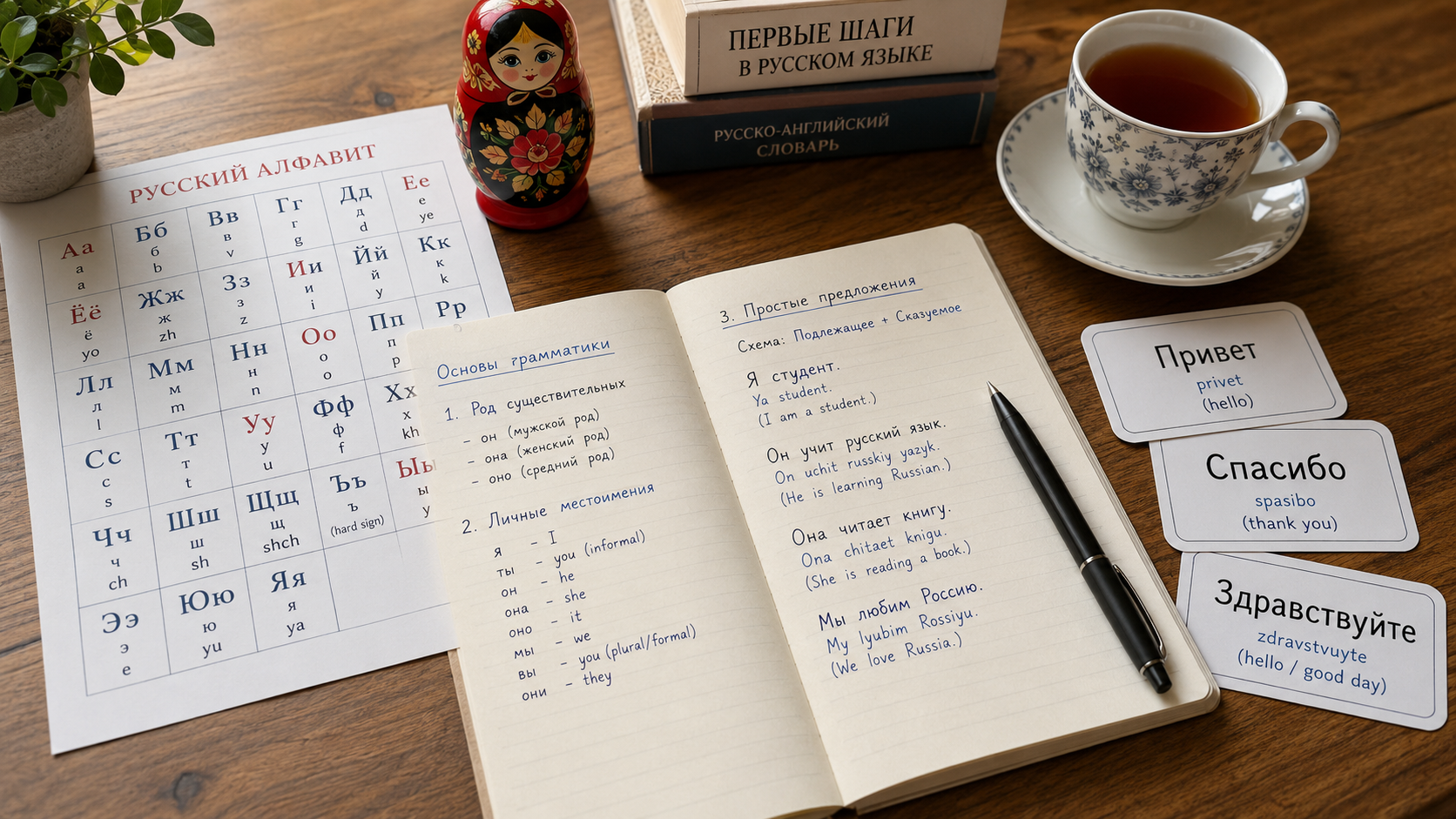
When you first decide to learn Russian, it can feel as if you are standing at the entrance to a beautiful but slightly intimidating city where every street sign is written in a new alphabet every guidebook warns you that somewhere ahead are six grammatical cases, verb aspects, motion verbs, unfamiliar sounds, and a whole new way of building sentences.
That is why one of the first questions almost every beginner asks is: What should I learn first in Russian?
Should you start with the alphabet, so you can read Cyrillic?
Should you start with phrases, so you can say something useful right away?
Or should you start with grammar, because Russian grammar has such a serious reputation?
The honest answer is: you should not choose only one.
The fastest and least overwhelming way to begin Russian is to combine all three from the beginning, but in the right order and in the right amount. You should start learning the Russian alphabet and pronunciation immediately, memorize a small number of useful survival phrases from day one, and introduce grammar gradually through simple sentence patterns, not through heavy charts and abstract explanations.
In other words, the first stage of Russian should not feel like preparing for a grammar exam. It should feel like opening the door to the language: learning how Russian looks, how it sounds, how to say basic things, and how simple sentences begin to work.
Many adults make Russian harder than it needs to be because they start in the wrong place. Some stay in transliteration for too long and never become comfortable reading real Russian. Others memorize long lists of phrases but cannot change them or understand how they are built. Others dive into case tables before they can read a basic word and quickly feel defeated.
A better approach is balanced, practical, and confidence-building.
You do not need to master Cyrillic before speaking. You do not need to understand all six cases before introducing yourself. You do not need to memorize 100 phrases before learning how Russian sentences work. But you do need a clear sequence.
This article will help you understand what to learn first in Russian, why the alphabet matters, why phrases are useful immediately, why grammar should be introduced gently, and how to organize your first few weeks so Russian feels challenging but manageable.
Why Russian Feels So Intimidating at the Beginning
Russian has a reputation. Even before people begin studying it, they often hear that Russian is “one of the hardest languages” for English speakers. They hear about six cases, three genders, verb aspects, irregular stress, motion verbs, and a different alphabet.
So before the beginner has even learned how to say hello, Russian already feels like a mountain.
Part of this fear comes from the visual difference. If you start French, Spanish, Italian, Dutch, or German, the words may look unfamiliar, but at least the alphabet is mostly familiar. Russian is different. The Cyrillic alphabet immediately signals to English speakers: “This language is not going to behave like English.”
Then there is the sound of Russian. Russian has rolled or tapped “r” sounds, hard and soft consonants, vowel reduction, and word stress that can shift in ways that feel unpredictable. A word may look manageable on paper but sound different when spoken quickly by a native speaker.
And then there is grammar. Russian grammar is genuinely rich. Nouns change endings depending on their role in the sentence. Adjectives agree with nouns. Verbs come in aspect pairs. Word order is more flexible than in English. Prepositions often require specific cases. Even simple ideas can involve endings that English speakers are not used to thinking about.
But here is the important point: Russian is difficult only if you try to learn everything at once.
The problem is not the alphabet by itself. The alphabet is very learnable. The problem is not basic phrases. You can learn useful phrases on your first day. The problem is not even grammar. Russian grammar becomes manageable when it is introduced gradually.
The real problem is overwhelm.
Beginners often ask, “Should I learn the alphabet first, or should I start speaking?” But that question creates a false choice. You can start learning Cyrillic and speaking simple phrases at the same time. You can also begin noticing tiny grammar patterns without studying entire case tables.
Russian becomes much less frightening when you treat the beginning as a carefully built foundation instead of a test of intelligence.
The Beginner’s Dilemma: Alphabet, Grammar, or Phrases?
Most complete beginners fall into one of three camps.
The first group says, “I must learn the alphabet first.” This is a good instinct, because Cyrillic is essential. But some learners take this too far. They spend weeks drilling letters, handwriting, and pronunciation rules without using any real phrases. They wait until they feel “ready” to speak, but that moment never comes. They know the alphabet in isolation, but they have not connected it to communication.
The second group says, “I just want to speak, so I’ll learn phrases.” This can be motivating. It feels good to say Здравствуйте, Спасибо, and Меня зовут… right away. But if learners stay at the phrase-list stage, they quickly hit a wall. They can repeat memorized expressions, but they cannot build new sentences or understand what each word is doing.
The third group says, “Russian grammar is hard, so I should start with grammar.” This is understandable, especially for analytical adults. Some learners want to understand the system before using the language. But beginning with full grammar explanations often backfires. If you study all six cases before you have enough vocabulary to use them, the rules feel abstract and discouraging.
So what should you do?
You should start with a three-part foundation:
Alphabet and pronunciation, so Russian stops looking mysterious.
Essential phrases, so you can use the language immediately.
Light grammar in context, so you understand how simple sentences work.
The key is proportion. In the first few days, the alphabet and pronunciation should receive a lot of attention. Phrases should be used from the beginning. Grammar should be present, but very light.
You are not trying to master Russian in week one. You are trying to make Russian feel learnable.
Why the Russian Alphabet Should Be One of Your First Steps
The Russian alphabet is called Cyrillic, and learning it early is one of the smartest things you can do.
Some learners are tempted to avoid it. They think, “Can’t I just learn Russian with English letters first?” For a few days, transliteration can be helpful. Seeing “spasibo” next to спасибо can help you connect sound and meaning. But transliteration should be a temporary bridge, not your main learning system.
If you stay in transliteration too long, you create several problems.
First, you prevent yourself from reading real Russian. Russian books, menus, signs, websites, messages, subtitles, and learning materials are written in Cyrillic. If you avoid the alphabet, you remain dependent on beginner materials.
Second, transliteration is imperfect. Russian sounds do not map neatly onto English spelling. Different textbooks and websites may transliterate the same Russian word differently. This can create confusion and poor pronunciation habits.
Third, you delay the moment when Russian starts to feel like a real language rather than a secret code. Once you can read Cyrillic, even slowly, Russian becomes less intimidating. You begin recognizing words. You can sound out names. You can read signs. You can look up vocabulary. You can connect what you hear with what you see.
The good news is that the Russian alphabet is not nearly as difficult as many beginners imagine.
How Hard Is Cyrillic Really?
The Russian alphabet has 33 letters. Some look and sound familiar to English speakers. Others look familiar but sound different. A few look completely new. There are also two signs, the soft sign and hard sign, that do not have their own sound but affect pronunciation.
At first, Cyrillic looks intimidating because your brain sees familiar shapes behaving in unfamiliar ways. For example:
В looks like English “B,” but it sounds like “v.”
Н looks like English “H,” but it sounds like “n.”
Р looks like English “P,” but it sounds like a rolled or tapped “r.”
С looks like English “C,” but it sounds like “s.”
У looks like English “Y,” but it sounds like “oo” as in “food.”
These false friends are the hardest part at the beginning. Your brain wants to read them as English letters. With practice, however, the new associations become automatic.
Many adults can learn to recognize most Cyrillic letters in just a few focused sessions. That does not mean they can read fluently after one day. Reading speed takes time. But you can usually become comfortable enough to sound out basic words within the first week.
A realistic goal is not “I will master Cyrillic perfectly before doing anything else.” A better goal is:
By the end of the first week, I want to recognize the letters, read simple words slowly, and stop feeling afraid of Russian text.
That is enough to begin.
Easy and Tricky Russian Letters for English Speakers
It helps to divide the alphabet into categories.
Some letters are friendly because they look and sound familiar:
А sounds like “a.”
К sounds like “k.”
М sounds like “m.”
О often sounds like “o” when stressed.
Т sounds like “t.”
Other letters look different but are not especially hard once you learn them:
Б sounds like “b.”
Г sounds like “g.”
Д sounds like “d.”
Л sounds like “l.”
П sounds like “p.”
Ф sounds like “f.”
Then come the misleading letters:
В = v
Н = n
Р = r
С = s
У = oo
Х = kh
Е often sounds like “ye” or affects the softness of the previous consonant
The goal is not to memorize the alphabet as an isolated chart. The goal is to connect letters to sounds and words. For example, when you learn the word мама, you immediately see that it is not scary. It is simply “mama.” When you read так, you see letters you already know. When you read ресторан, you begin to recognize a word that resembles “restaurant.”
This is why learning the alphabet with real words is much more effective than staring at a chart.
Why Staying in Transliteration Too Long Will Hold You Back
Transliteration is useful only at the very beginning. It can help you pronounce your first few words while you are still learning the alphabet. But it becomes a problem when it replaces Cyrillic.
For example, the Russian word for thank you is спасибо. In transliteration, it is often written as spasibo. That looks simple, but it does not fully capture the way the word is pronounced in real Russian. The unstressed “o” does not sound like a clear English “o.” Stress and vowel reduction matter.
Another example is хорошо, meaning “good” or “well.” In transliteration, you may see khorosho or horosho. Neither version is perfect for English speakers. But once you read хорошо in Cyrillic and hear it many times, you begin to connect the real Russian spelling with the real Russian sound.
If you rely on transliteration, you may feel you are making quick progress, but you are building on a weak foundation. Eventually, you will have to switch to Cyrillic anyway. It is better to make that switch early, while your vocabulary is still small.
A good rule is this:
Use transliteration only as training wheels. Remove it as soon as possible.
Why You Should Learn Useful Russian Phrases from Day One
While the alphabet is essential, it should not be the only thing you study at the beginning. You should also learn a small number of useful phrases immediately.
Why?
Because language is not just a system. It is communication.
If your first week of Russian consists only of letters, sounds, and charts, you may understand the alphabet, but you may not feel emotionally connected to the language. Phrases give you a sense of real use. They let you speak out loud. They help you imagine yourself in a real interaction.
Some excellent first phrases include:
Здравствуйте — Hello / formal greeting
Привет — Hi
Спасибо — Thank you
Пожалуйста — Please / you’re welcome
Да — Yes
Нет — No
Извините — Excuse me / sorry
Я не понимаю — I don’t understand
Вы говорите по-английски? — Do you speak English?
Меня зовут… — My name is…
Как вас зовут? — What is your name?
Очень приятно — Nice to meet you
До свидания — Goodbye
These phrases are not just vocabulary. They also teach you rhythm, politeness, pronunciation, and cultural habits.
For example, Russian has different levels of formality. Привет is casual, while Здравствуйте is more formal. Как тебя зовут? is informal, while Как вас зовут? is formal or polite. Even at the beginner level, you are already learning how Russians manage social distance.
This is why phrase learning is powerful. It gives you language you can actually use, while also introducing grammar and culture naturally.
How Phrases Build Confidence
Adults often underestimate how important confidence is in language learning. Children are usually willing to repeat, imitate, and make mistakes. Adults often want to understand everything before speaking. This can make them cautious.
Russian can intensify that caution because beginners are aware that the language is complex. They may think, “I should not say anything until I know the grammar.” But that is the wrong mindset.
Speaking simple phrases early helps you break the fear barrier.
When you can say Здравствуйте, Спасибо, and Меня зовут…, Russian is no longer just an abstract subject. It becomes something you can do. That feeling matters.
Even memorized phrases are useful because they give your mouth practice forming Russian sounds. They help you get used to stress, intonation, and consonant clusters. They also make lessons more enjoyable. A beginner who can greet someone, thank someone, and introduce themselves feels more motivated than a beginner who has only memorized letters.
The key is to keep the phrase list small and meaningful. You do not need 200 phrases in week one. You need 10 to 20 phrases that you can pronounce well, recognize in Cyrillic, and use in simple situations.
The Limits of Phrase-Only Learning
Phrase learning is useful, but phrase-only learning is not enough.
If you memorize Меня зовут Анна, you can say “My name is Anna.” But what happens when you want to say “His name is Ivan” or “Her name is Maria”? What happens when someone asks you a question in a slightly different way? What happens when you want to say where you live, what you do, or what you like?
Without structure, memorized phrases remain frozen.
This is why some learners feel they make fast progress at first, then suddenly stop. They know greetings and travel phrases, but they cannot create their own sentences. They have learned Russian as a set of scripts rather than as a system.
The solution is not to avoid phrases. The solution is to use phrases as a bridge into grammar.
For example, from Меня зовут…, you can begin noticing how Russian expresses “my name is” differently from English. From Я не понимаю, you can learn the pronoun я and the verb form понимаю. From Вы говорите по-английски?, you can learn вы, a polite “you,” and the verb говорите, “you speak.”
This is grammar in context. It is much more beginner-friendly than starting with a full verb conjugation table.
Should You Learn Russian Grammar First?
Russian grammar matters. There is no way around it. If you want to move beyond basic phrases, you will need grammar.
But grammar should not be your first and only focus.
The problem is that many Russian grammar explanations are designed like reference materials. They present the whole system at once: all six cases, all pronouns, all endings, all verb forms, all exceptions. This can be useful later, but it is too much for a complete beginner.
At the beginning, grammar should answer practical questions:
How do I say “I am…”?
How do I say “I live in…”?
How do I say “I speak…”?
How do I ask “Do you speak English?”
How do I say “This is…”?
How do I make a simple sentence?
How do I recognize masculine, feminine, and neuter nouns?
That is enough.
You do not need to understand every use of the genitive case in your first week. You do not need to master perfective and imperfective aspect immediately. You do not need to study every motion verb before saying “I am going home.”
Grammar should support communication, not replace it.
The Grammar Topics That Actually Help Beginners
In the first few weeks, the most useful grammar topics are simple and practical.
Start with personal pronouns:
я — I
ты — you, informal
вы — you, formal or plural
он — he
она — she
мы — we
они — they
Then learn a few basic sentence patterns:
Я студент. — I am a student.
Я американец / американка. — I am American.
Я живу в Калифорнии. — I live in California.
Я говорю по-английски. — I speak English.
Я немного говорю по-русски. — I speak a little Russian.
Это Москва. — This is Moscow.
Это мой друг. — This is my friend.
These simple sentences teach you a lot. You learn that Russian often omits the verb “to be” in the present tense. You learn basic pronouns. You learn how to say where you live. You learn how to talk about languages. You learn how to introduce people and things.
Next, you can begin learning noun gender:
Masculine nouns often end in a consonant.
Feminine nouns often end in -а or -я.
Neuter nouns often end in -о or -е.
This helps you understand why adjectives change:
хороший ресторан — a good restaurant
хорошая книга — a good book
хорошее кафе — a good café
You do not need to memorize every adjective ending immediately. You just need to notice the pattern.
This is how grammar should begin: small, useful, and connected to real sentences.
What Grammar Should You Postpone?
Some grammar topics are important, but they should not dominate the first stage.
For example, Russian cases are essential. You will need them. But studying all six cases at once is usually overwhelming. A beginner does not need a massive table of noun endings on day two.
Instead, cases should be introduced gradually. You might first learn the nominative case because it is the dictionary form. Then you might encounter the accusative in simple sentences with direct objects. Later, you may learn the prepositional case for location: в Москве, в школе, в ресторане.
The same is true for verbs of motion. Russian has a fascinating and complex system for expressing going, walking, carrying, driving, flying, and movement in different directions. But beginners do not need the full system immediately. They can first learn a few practical expressions, such as:
Я иду домой. — I am going home on foot.
Я еду в Москву. — I am going to Moscow by transport.
Later, the system can be expanded.
Verb aspect should also be introduced carefully. Russian distinguishes between completed and ongoing/repeated actions in ways English does not. This is important, but it becomes easier when learners already know basic verbs and have seen them in context.
The point is not to avoid grammar. The point is to avoid drowning in grammar before you have enough language to make it meaningful.
A Realistic First Two Weeks of Russian Study
So what should your first two weeks actually look like?
Here is a practical sequence for complete beginners.
Days 1–3: Alphabet, Sounds, and First Phrases
In the first three days, focus heavily on Cyrillic and pronunciation, but include basic phrases immediately.
Your goals:
Recognize most Russian letters.
Learn the most misleading Cyrillic letters.
Practice reading simple syllables and words.
Say basic greetings and polite expressions.
Begin hearing the rhythm of Russian.
Study activities:
Spend 15–20 minutes learning letters with audio. Do not just look at the alphabet silently. Listen and repeat.
Spend 10 minutes writing letters by hand. This helps your brain remember the shapes.
Spend 10–15 minutes practicing phrases like Здравствуйте, Спасибо, Пожалуйста, Да, Нет, and До свидания.
Read very simple words in Cyrillic, such as мама, там, кот, дом, Москва, ресторан.
At this stage, grammar should be minimal. You may learn that я means “I” and that меня зовут means “my name is,” but you do not need a long explanation.
Days 4–7: Reading Words and Using Mini-Dialogues
By the second half of the first week, begin connecting alphabet knowledge to communication.
Your goals:
Read short Russian words slowly.
Recognize common phrases in Cyrillic.
Introduce yourself.
Ask someone’s name.
Say that you do not understand.
Start noticing pronouns and simple verb forms.
Useful mini-dialogue:
Здравствуйте!
Hello!
Как вас зовут?
What is your name?
Меня зовут Робби. А вас?
My name is Robbie. And you?
Очень приятно.
Nice to meet you.
This type of dialogue is simple, but it teaches real interaction. You are not just memorizing disconnected vocabulary. You are practicing a social exchange.
You can also begin learning phrases like:
Я не понимаю.
I don’t understand.
Повторите, пожалуйста.
Please repeat.
Вы говорите по-английски?
Do you speak English?
These phrases are especially useful because they help you manage communication when you do not understand everything. They give you survival tools.
Weeks 2–3: Simple Sentences and Light Grammar
After the first week, you should continue practicing Cyrillic, but it should no longer be your only focus. Now you can begin building simple sentences.
Your goals:
Read short beginner texts.
Learn 50–100 useful words.
Use personal pronouns.
Learn a few common verbs.
Understand noun gender at a basic level.
Create simple sentences about yourself.
Useful sentence patterns:
Я живу в… — I live in…
Я работаю в… — I work in…
Я говорю по… — I speak…
Я изучаю русский язык. — I am studying Russian.
Мне нравится… — I like…
Это мой / моя / моё… — This is my…
This is also the time to start learning grammar through substitution.
For example:
Я живу в Беркли.
I live in Berkeley.
Она живёт в Москве.
She lives in Moscow.
Мы живём в Калифорнии.
We live in California.
You are learning verb forms, pronouns, and sentence structure, but you are doing it through meaningful language.
How Much Should You Study Each Day?
You do not need to study Russian for three hours a day to make progress. For most busy adults, consistency matters more than intensity.
A realistic beginner routine might look like this:
10 minutes of alphabet or reading practice
10 minutes of listening and repeating phrases
10 minutes of vocabulary review
10–15 minutes of grammar in context
A few minutes of speaking out loud
That is already enough to make progress if you do it regularly.
If you have more time, 45–60 minutes a day is excellent. But even 20–30 focused minutes can be powerful, especially in the first month.
The danger is not studying “too little” on one particular day. The danger is studying randomly, without structure. Many learners spend a lot of time jumping between apps, videos, podcasts, grammar pages, and phrase lists, but they do not build a coherent foundation.
A structured plan helps you avoid that.
The Role of Listening and Pronunciation
Alphabet, phrases, and grammar are important, but pronunciation should not be forgotten.
Russian spelling is more consistent than English in many ways, but pronunciation still requires attention. Stress matters. Unstressed vowels can change sound. Consonants can be hard or soft. Some sounds do not exist in English.
This is why you should never learn Russian only from written materials. From the first day, use audio. Listen to native speakers. Repeat out loud. Pay attention to stress. Try to imitate rhythm, not just individual sounds.
For example, спасибо is not pronounced exactly as an English speaker might read “spasibo.” The stress and vowel reduction matter. Здравствуйте can look impossible at first, but when you hear it and break it into sound chunks, it becomes manageable.
Pronunciation does not have to be perfect at the beginning. But if you ignore it completely, you may build habits that are hard to correct later.
Why Adults Need a Structured Approach
Adult learners often have advantages. They are motivated. They understand why they are learning. They can notice patterns. They can study intentionally.
But adults also have challenges. They are busy. They may be perfectionistic. They may feel embarrassed making mistakes. They may want to understand every rule before speaking.
Russian rewards structure. If you learn randomly, it can feel chaotic. If you follow a clear sequence, it becomes much more manageable.
A good beginner Russian program should do several things:
Teach Cyrillic early and clearly.
Use audio from the beginning.
Introduce useful phrases immediately.
Teach grammar through real sentences.
Avoid overwhelming beginners with too many endings at once.
Include speaking practice.
Review constantly.
Build confidence step by step.
This is especially important for adults who are learning Russian around work, family, travel plans, or personal goals. You do not need a chaotic pile of resources. You need a path.
Final Answer: What Should You Learn First?
So, what should you learn first in Russian?
You should begin with the alphabet, but not only the alphabet.
You should learn phrases from day one, but not only phrases.
You should introduce grammar early, but lightly and in context.
The best beginner formula is:
Alphabet + pronunciation first.
Survival phrases immediately.
Grammar gradually through simple sentence patterns.
In the first few days, focus strongly on Cyrillic and sounds. At the same time, learn greetings, polite expressions, and basic survival phrases. By the end of the first week, begin reading simple words and using mini-dialogues. In weeks two and three, start building simple sentences with pronouns, common verbs, and basic noun gender.
Do not wait until you “finish” the alphabet to speak. Do not wait until you “understand” all the grammar to use Russian. Do not memorize phrases without learning how they work.
Russian is not easy, but it is much more approachable when you build the foundation in the right order.
The goal of the beginning stage is not perfection. The goal is momentum.
If you can read simple Cyrillic, say basic phrases, understand a few sentence patterns, and keep practicing consistently, you are already on the right path.
FAQs: What Should Beginners Learn First in Russian?
Should I learn the Russian alphabet before speaking?
You should start learning the Russian alphabet immediately, but you do not need to master it completely before speaking. The best approach is to learn Cyrillic and simple phrases at the same time. This helps you connect the written language with real communication from the beginning.
Can I learn Russian without learning Cyrillic?
You can learn a few phrases through transliteration, but you cannot make serious progress in Russian without Cyrillic. Russian is written in Cyrillic, and relying on English letters for too long will slow down your reading, pronunciation, vocabulary learning, and access to real materials.
How long does it take to learn the Russian alphabet?
Many adults can learn to recognize most Russian letters within a few days of focused practice. Reading fluently takes longer, but you can usually begin reading simple words within the first week if you practice daily with audio and examples.
Should I start Russian with grammar?
You should not start with heavy grammar charts, but you should begin noticing simple grammar patterns early. Learn pronouns, basic sentence structures, a few common verbs, and noun gender gradually. Save full case tables, verb aspect, and motion verbs for later.
Are Russian cases too hard for beginners?
Russian cases are challenging, but they become easier when introduced gradually. Beginners should not try to memorize all six cases at once. It is better to learn cases through useful phrases and simple sentence patterns.
What Russian phrases should I learn first?
Start with greetings, polite expressions, and survival phrases: hello, thank you, please, yes, no, excuse me, I don’t understand, please repeat, do you speak English, my name is, and nice to meet you.
Is Russian harder than other languages?
Russian is more challenging for English speakers than many Western European languages because it uses Cyrillic and has a more complex case system. However, it is not impossible. With a structured approach, beginners can start reading, speaking, and understanding basic Russian much sooner than they often expect.
What is the best way to start learning Russian as an adult?
The best way is to follow a structured beginner program that combines Cyrillic, pronunciation, useful phrases, listening, speaking, and grammar in context. Adults usually progress faster when they have a clear sequence instead of jumping randomly between apps, videos, and grammar websites.
Learn Russian with Polyglottist Language Academy
If you are beginning Russian and want a clear, structured path, Polyglottist Language Academy can help you build the right foundation from the start.
Our Russian classes are designed for adult learners who want more than random apps or memorized phrase lists. In our beginner classes, you learn the Cyrillic alphabet, pronunciation, essential phrases, listening skills, and grammar step by step, with guidance from experienced instructors. You do not have to figure out the order by yourself. You receive a structured path, live practice, corrections, and the support of a real class.
Whether your goal is travel, culture, literature, family communication, heritage learning, or simply the joy of learning a beautiful and fascinating language, Russian becomes much more approachable when you learn it with the right method.
To begin your Russian journey, visit Polyglottist Language Academy and sign up for one of our Russian classes. A strong foundation in the first few weeks can make the entire language feel more accessible, motivating, and rewarding.
You May Also Like These Articles
If you are just getting started with Russian, you may also enjoy these related articles from our blog: