
How to Learn Japanese Without Living in Japan
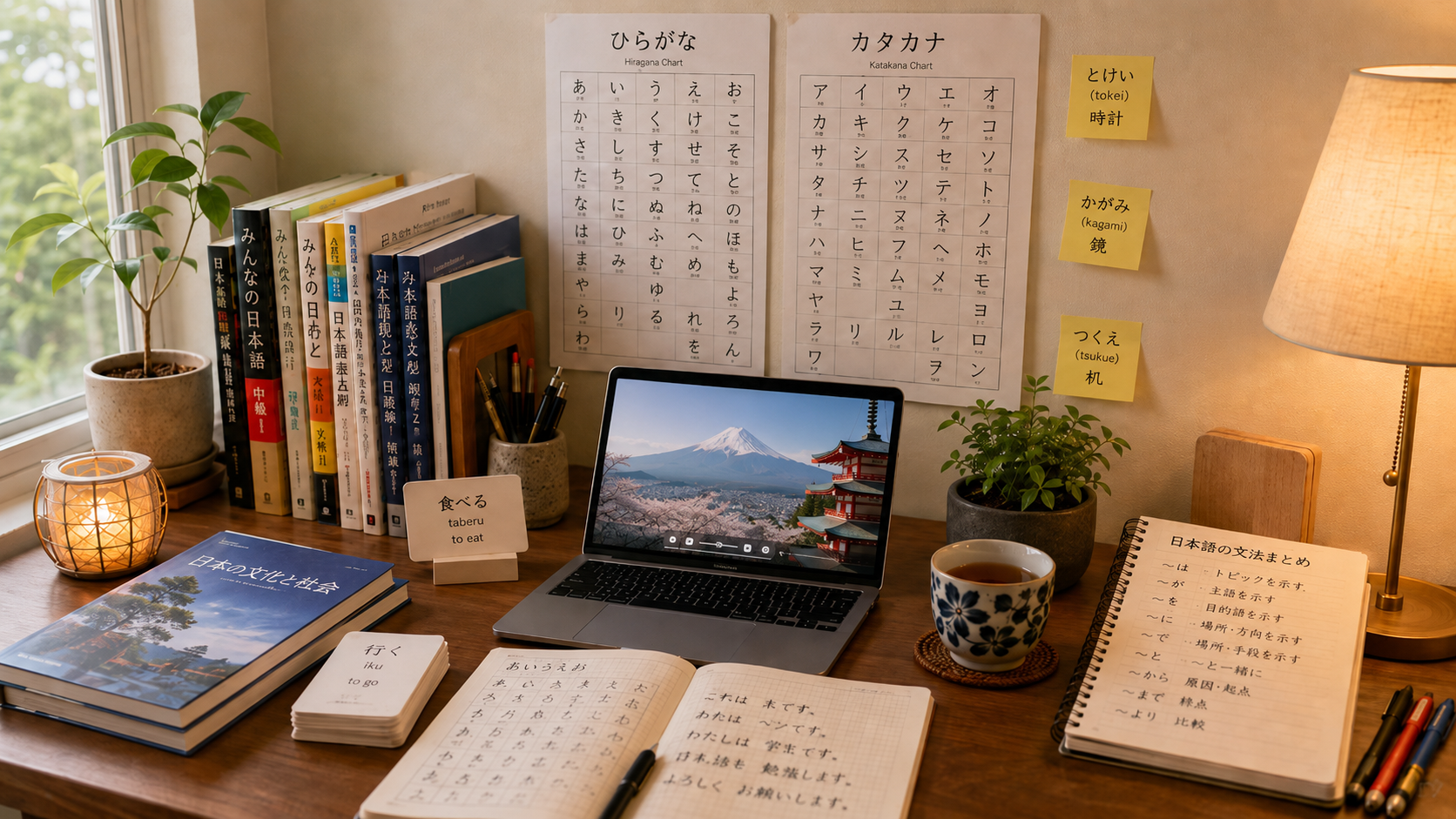
Learning Japanese can feel like standing at the edge of a beautiful but unfamiliar city at night: the signs are written in characters you cannot yet read, the sounds seem fast and delicate, the cultural rules feel invisible, and somewhere in the distance there is the dream of walking through Tokyo, Kyoto, Osaka, or a quiet seaside town and understanding not only what people are saying, but how they are thinking, joking, apologizing, inviting, refusing, and connecting.
Many adults who want to learn Japanese believe there is only one “real” way to do it: move to Japan.
It is an understandable idea. After all, Japanese is spoken in Japan. The writing system is everywhere there. Daily life provides endless chances to hear the language, read menus, ask for directions, watch the news, listen to announcements, and interact with native speakers. Living in Japan can absolutely help. But here is the part many learners do not realize: living in Japan does not automatically make you fluent.
Many foreigners live in Japan for years and still struggle to hold natural conversations. Some work in English-speaking environments, socialize mostly with other foreigners, rely on translation apps, or learn only the phrases they need to survive daily routines. They may become comfortable ordering food, buying train tickets, or greeting neighbors, but that is not the same as developing real fluency. Location helps, but it does not replace structure, consistency, correction, speaking practice, and a thoughtful learning plan.
The good news is that you can learn Japanese without living in Japan.
Not only is it possible, but for many busy adults, it may actually be more effective to begin from home. When you study Japanese outside Japan, you can create a focused routine, work with a teacher who understands your level, build the foundation slowly, practice speaking in a supportive environment, and use online resources in a strategic way. You do not have to be surrounded by Japanese twenty-four hours a day to make progress. You need regular contact with the language, a clear method, and enough guidance to avoid wasting months jumping from app to app, video to video, and textbook to textbook.
Japanese is different from English, but different does not mean impossible. It has a new writing system, a different sentence order, particles that may feel mysterious at first, levels of politeness that reflect social relationships, and cultural habits that are woven into the language itself. But once you learn the right order of study, Japanese becomes much more approachable. You do not have to master kanji before speaking. You do not need to understand anime at full speed in your first year. You do not need to move to Tokyo to start forming sentences, reading simple texts, or having your first conversations.
What you need is a realistic plan.
This guide will show you how to learn Japanese from home, how to create your own form of immersion outside Japan, what to focus on first, what mistakes to avoid, and how online Japanese classes can give you many of the same benefits people hope to get from living abroad.
The Myth of Total Immersion
One of the most common beliefs about language learning is that immersion is the magic solution. People imagine that if they simply move to another country, the language will somehow enter their brain naturally. They will hear it in cafés, on trains, at the grocery store, at work, and after a few months, they will suddenly understand everything.
This does happen for some people, especially children or adults who are forced to use the language every day. But for many adult learners, immersion without structure can be surprisingly inefficient.
Imagine moving to Japan as a beginner. You hear Japanese constantly, but most of it is too fast. You recognize a few words, but not enough to understand full sentences. You see signs everywhere, but you cannot read most of the characters. When people speak to you, they may switch to English if they think it will be easier. At restaurants, you point. At train stations, you follow icons. At work, your company may operate partly in English. At home, you relax by watching shows in your native language because your brain is tired.
In this situation, you are surrounded by Japanese, but you are not necessarily learning Japanese efficiently.
This is the difference between exposure and learning.
Exposure means the language is around you. Learning means you are actively noticing patterns, understanding meaning, practicing output, receiving correction, and building long-term memory. Living in Japan can provide exposure, but it does not guarantee active learning.
That is why someone studying Japanese seriously from California, New York, Amsterdam, London, Toronto, or anywhere else can sometimes make faster progress than someone living in Japan passively. A learner who takes weekly classes, studies hiragana and katakana, reviews vocabulary daily, listens to beginner-friendly Japanese, practices speaking with a teacher, and reads graded texts may build a stronger foundation than someone who simply hopes the language will “sink in.”
Japan is a wonderful place to use Japanese. But you can begin learning Japanese long before you live there.
What Immersion Really Means
Immersion does not mean being physically located in a country. It means creating regular, meaningful contact with the language.
For a beginner, good immersion is not listening to three hours of Japanese news you do not understand. It is hearing Japanese that is just slightly above your current level. It is seeing words repeatedly in context. It is practicing small conversations until they become natural. It is learning to connect sound, meaning, grammar, and culture.
Real immersion includes four things:
First, you need input. This means listening and reading. You hear Japanese through podcasts, teacher recordings, dialogues, videos, songs, shows, and conversations. You read Japanese through hiragana practice, simple sentences, graded readers, manga, captions, menus, and beginner texts.
Second, you need output. This means speaking and writing. You say sentences aloud. You answer questions. You introduce yourself. You describe your day. You write short diary entries. You use the language instead of only recognizing it.
Third, you need feedback. This is where many self-study learners get stuck. You may think you are saying something correctly, but without a teacher or knowledgeable speaker, you might repeat the same mistake for months. Feedback helps you improve faster.
Fourth, you need repetition. Japanese will not become familiar after one encounter. You need to see and hear words many times. You need to repeat grammar patterns until they feel less strange. You need to review hiragana, katakana, kanji, vocabulary, and sentence structures regularly.
When you combine these four elements, you create immersion wherever you are.
You may not be walking through Shibuya every day, but you can still begin your morning with Japanese audio, attend an online class in the evening, review vocabulary during lunch, read a short Japanese dialogue before bed, and practice speaking every week. That is not passive exposure. That is intentional immersion.
Start with a Structured Japanese Class
One of the best ways to learn Japanese without living in Japan is to take a structured class, either online or locally.
Japanese is not a language where most beginners benefit from total randomness. Apps, videos, and podcasts can be helpful, but without a sequence, learners often become overwhelmed. One day they study hiragana. The next day they watch a video about the difference between は and が. Then they try to memorize twenty kanji. Then they learn a few anime phrases. Then they stop for two weeks because it feels like too much.
A structured class solves this problem.
A good Japanese class gives you a clear path. You learn what to study first, what to postpone, how to pronounce words, how to form sentences, and how to practice speaking at your level. A teacher can explain why Japanese sentences work differently from English sentences. A teacher can help you understand particles, politeness, verb forms, and natural phrasing. Most importantly, a teacher can keep you from feeling alone.
For adult learners, accountability matters. It is easy to tell yourself you will study Japanese “sometime this week.” It is harder to skip when you know you have class on Tuesday evening and your teacher will expect you to participate. A class creates rhythm.
It also creates community. Even a small group class can make a big difference because you hear other learners ask questions, make mistakes, and improve. You realize that you are not the only person struggling to remember katakana or confusing です and ます. Learning becomes less lonely and more human.
Learn Hiragana First
The first writing system most Japanese learners should study is hiragana.
Hiragana is one of the two Japanese phonetic scripts. It is used for native Japanese words, grammar endings, particles, and many beginner materials. Unlike English spelling, hiragana is relatively consistent. Once you learn the symbols, you can sound out words.
Learning hiragana early is important because it helps you stop relying only on romanization. Romanized Japanese, or rōmaji, can be useful for the first few days, but staying with it too long becomes a problem. Japanese pronunciation, spelling, grammar, and reading habits make more sense when you begin using Japanese scripts.
Do not worry if hiragana feels slow at first. At the beginning, reading even a simple word can feel like decoding a puzzle. That is normal. Your brain is building a new visual system. With daily practice, hiragana becomes familiar.
A realistic goal is to learn hiragana over one to two weeks, then keep reviewing it in real words and sentences. You do not need perfect speed immediately. You need steady recognition.
Learn Katakana Next
After hiragana, study katakana.
Katakana is used for many foreign loanwords, foreign names, emphasis, brand names, animal sounds, and technical words. English speakers often recognize many katakana words once they learn how Japanese adapts foreign sounds.
For example, コーヒー means coffee, ホテル means hotel, and タクシー means taxi. These words may look intimidating before you learn katakana, but they quickly become useful.
Many beginners find katakana harder than hiragana because some characters look similar, and because loanwords are not always pronounced exactly like English. But katakana is extremely practical, especially for travel, menus, signs, and modern daily life.
Do not skip it. If you learn only hiragana, you will miss a huge part of written Japanese around you.
Begin Speaking Before You Feel Ready
Many Japanese learners make the mistake of waiting too long to speak.
They tell themselves, “I’ll start speaking after I learn more grammar,” or “I’ll practice conversation after I know more vocabulary,” or “I don’t want to make mistakes.” This is understandable, but it slows progress.
Speaking is not a reward you receive after mastering Japanese. Speaking is one of the ways you learn Japanese.
At the beginner level, speaking does not mean discussing politics or literature. It means practicing small, useful sentences:
こんにちは。
Hello.
はじめまして。
Nice to meet you.
私はロビーです。
I am Robbie.
アメリカから来ました。
I am from the United States.
日本語を勉強しています。
I am studying Japanese.
コーヒーが好きです。
I like coffee.
These sentences may seem simple, but they train your mouth, ear, memory, and confidence. They help you understand word order. They make grammar real.
Speaking early also prevents the “silent learner” problem. Some people study Japanese for years through apps, flashcards, and grammar books but freeze when they need to say a sentence aloud. They know about Japanese, but they have not practiced using Japanese.
The earlier you begin speaking, the more natural it becomes.
Understand Japanese Sentence Structure
Japanese sentence structure is one of the biggest differences for English speakers.
In English, we usually say:
I eat sushi.
In Japanese, the structure is closer to:
I sushi eat.
私は寿司を食べます。
Watashi wa sushi o tabemasu.
I eat sushi.
The verb usually comes at the end. This can feel strange at first, but it becomes easier with practice. Instead of translating word by word, learn sentence patterns.
For example:
私は__が好きです。
I like ___.
私は__に行きます。
I go to ___.
私は__を食べます。
I eat ___.
私は__を飲みます。
I drink ___.
昨日、__しました。
Yesterday, I did ___.
These patterns help you build sentences quickly. Instead of memorizing isolated words, you learn how words fit into communication.
Japanese also uses particles, such as は, が, を, に, で, and の. These small words show the relationship between parts of a sentence. They can be confusing at first because English does not use them in the same way. Do not try to master every particle immediately. Learn them gradually in context.
Learn Kanji Gradually
Kanji is often the part of Japanese that scares beginners the most.
There are thousands of kanji characters, and each character can have multiple readings. This sounds overwhelming, especially if you are used to alphabetic writing systems. But you do not need to learn all kanji at once. You do not even need to make kanji the center of your first month.
Start with hiragana and katakana. Then begin learning basic kanji slowly, through useful words.
For example:
日 — day, sun
月 — moon, month
人 — person
山 — mountain
川 — river
口 — mouth
日本 — Japan
学生 — student
先生 — teacher
Kanji becomes less frightening when you learn it in words, not as random symbols. Instead of memorizing a character in isolation, connect it to vocabulary, pronunciation, meaning, and context.
A good long-term approach is to learn a small number of kanji consistently. Five to ten new kanji per week is more useful than trying to memorize one hundred and forgetting them all. Over time, kanji becomes one of the most fascinating parts of Japanese because it reveals meaning visually.
Use Apps, But Do Not Rely on Apps Alone
Language apps can be helpful. They make it easy to practice vocabulary, review kana, listen to short phrases, and keep a daily habit. They are especially useful for busy adults who need short study sessions during lunch breaks, commutes, or evenings.
But apps should support your learning, not replace it.
Most apps cannot fully teach you how to have a real conversation. They may not correct your pronunciation well. They may not explain why a sentence sounds unnatural. They may not adapt to your personal goals. They may also create the illusion of progress because tapping answers on a screen feels easier than producing language in real time.
Use apps for repetition. Use them for vocabulary. Use them for kana review. Use them to keep Japanese present in your daily life.
But combine them with live instruction, listening, reading, speaking, and writing.
Build a Japanese Environment at Home
You can create a Japanese-rich environment even if you live thousands of miles from Japan.
Start with small changes. Put Japanese where you can see it and hear it. Label a few objects in your home with Japanese words. Put a hiragana chart near your desk. Keep a Japanese notebook visible. Follow Japanese language accounts on social media. Listen to beginner Japanese audio while walking, cooking, cleaning, or driving.
You can also create a “Japanese corner” at home. This does not have to be elaborate. It might be a small part of your desk with your textbook, notebook, flashcards, pens, and a cup of tea. The point is psychological: when you sit there, your brain knows it is time for Japanese.
Change some of your media habits. Watch Japanese shows with intention. Listen to Japanese music. Follow Japanese cooking channels. Watch travel videos in Japanese. Try Japanese podcasts for learners. Read simple manga or graded readers.
The key is to make Japanese part of your environment without making it stressful. You are not trying to turn your entire life into a classroom. You are creating frequent, friendly contact with the language.
Watch Japanese Media Actively
Many learners love Japanese because of anime, film, dramas, food, design, literature, video games, or pop culture. These interests are powerful motivators.
However, watching Japanese media passively is not enough. You can watch hundreds of hours of anime and still not speak Japanese well if you never study the language actively.
To use media effectively, choose a short scene and work with it. Listen once for enjoyment. Then listen again and try to catch familiar words. Write down one or two useful phrases. Repeat a line aloud. Notice pronunciation, rhythm, and emotion. Turn on Japanese subtitles when you are ready. Rewatch scenes instead of always consuming new content.
You do not need to understand everything. In fact, you will not understand everything for a long time. That is fine. The goal is to train your ear and gradually connect real Japanese with what you are learning in class.
For beginners, learner-friendly content is often more useful than native-speed entertainment. Japanese children’s shows, slow podcasts, beginner dialogues, and graded listening materials can help bridge the gap.
Practice Listening Every Day
Listening is one of the most important skills in Japanese.
Because Japanese rhythm, intonation, and sentence structure differ from English, your ear needs time to adjust. Even when you know a word on paper, you may not recognize it in speech at first.
Daily listening helps.
This does not mean you need an hour every day. Even ten minutes of focused listening can make a difference. Listen to the same short dialogue several times. Try shadowing, which means repeating immediately after the speaker. Do not worry about sounding perfect. Focus on rhythm, speed, and flow.
Japanese pronunciation is not impossible for English speakers, but it requires attention. Long vowels matter. Double consonants matter. Pitch accent can change meaning. A teacher can help you notice these details early, before habits become hard to change.
Use Spaced Repetition for Vocabulary
Japanese vocabulary takes time to build. You need words for food, time, family, travel, work, hobbies, emotions, actions, and daily routines. Flashcards can help, especially when they use spaced repetition.
Spaced repetition means reviewing words right before you are likely to forget them. Tools such as Anki and other flashcard systems are built around this idea. They can be very effective, but only when used consistently and realistically.
Do not create enormous flashcard decks that become impossible to maintain. Start small. Add words you actually encounter in class, reading, or listening. Include example sentences when possible. Review a little every day.
Vocabulary is easier to remember when it is connected to meaning. Instead of memorizing isolated lists, connect words to your life:
朝、コーヒーを飲みます。
In the morning, I drink coffee.
週末、映画を見ます。
On the weekend, I watch movies.
日本に行きたいです。
I want to go to Japan.
Words become stronger when you use them.
Write Simple Japanese Sentences
Writing helps you slow down and notice structure.
You do not need to write essays as a beginner. Start with tiny diary entries:
今日は忙しかったです。
Today was busy.
朝、コーヒーを飲みました。
In the morning, I drank coffee.
夜、日本語を勉強しました。
At night, I studied Japanese.
すしが食べたいです。
I want to eat sushi.
Writing short sentences helps you practice vocabulary, particles, verb forms, and word order. It also gives your teacher something concrete to correct.
Over time, you can write about your family, work, hobbies, travel plans, favorite foods, and daily life. This is especially useful if you are learning Japanese outside Japan because it helps you bring Japanese into your own world.
Use Language Exchange Carefully
Language exchange can be a great tool, but it works best when you use it wisely.
A language exchange partner is usually someone who wants to learn your language while helping you practice theirs. For example, you might speak English with a Japanese speaker for thirty minutes, then practice Japanese for thirty minutes.
The challenge is that beginners often do not know enough Japanese yet to hold long conversations. They may become nervous, switch to English, or spend the whole time being corrected without understanding why.
To make language exchange useful, prepare ahead of time. Choose a topic. Write five sentences. Practice introducing yourself. Ask simple questions. Use what you are learning in class. Keep expectations modest.
Language exchange is not a replacement for a teacher. A native speaker may know what sounds natural but may not know how to explain grammar clearly. A trained teacher can guide you step by step. A language partner can provide extra practice.
Both can be valuable, but they serve different roles.
Learn Japanese Culture Alongside the Language
Japanese is deeply connected to culture. You cannot fully understand the language without learning about politeness, indirect communication, social roles, and context.
For example, Japanese often avoids overly direct refusal. Instead of saying a blunt “no,” a speaker may say something softer or more indirect. Politeness levels change depending on who you are speaking to. A phrase that sounds fine with a friend may not be appropriate with a teacher, customer, or older person.
Bowing, greetings, gift-giving, apologies, silence, group harmony, and respect all influence communication. Even simple phrases carry cultural meaning.
Learning culture from outside Japan is completely possible. You can read cultural guides, watch Japanese films and shows, attend cultural events, visit Japanese restaurants or markets, join local Japanese community events, and learn from teachers who explain not only what to say, but when and how to say it.
This is one of the advantages of structured classes. A good Japanese teacher does not simply translate words. They explain the situation behind the words.
What Can You Learn in Three Months?
In three months, a consistent beginner can make a strong start.
You may learn hiragana and katakana, introduce yourself, ask and answer simple questions, talk about likes and dislikes, understand basic greetings, read simple words, recognize common phrases, and begin using simple sentence patterns.
You will not be fluent in three months, but you can become comfortable with the basics. More importantly, you can stop feeling that Japanese is completely mysterious.
A realistic three-month goal is confidence with the writing system, basic pronunciation, and survival-level conversation.
What Can You Learn in Six Months?
After six months of steady study, you may be able to hold simple conversations about yourself, your schedule, hobbies, food, family, work, and travel plans. You may understand slow beginner-level audio, read short texts, recognize basic kanji, and use common particles and verb forms with growing confidence.
You will still make mistakes. Listening to native-speed Japanese will still be difficult. But you may begin to feel that Japanese has a structure you can understand.
At this stage, consistency matters more than intensity. A learner who studies three or four times a week for six months usually does better than someone who studies intensely for two weeks and then stops.
What Can You Learn in One Year?
After one year, a serious adult learner can often reach a meaningful beginner-to-low-intermediate level. You may be able to handle travel situations, talk about daily life, understand simple conversations, read beginner texts, write short paragraphs, and recognize a growing number of kanji.
This is also when many learners begin to enjoy Japanese more deeply. The early confusion starts to fade. You begin noticing grammar patterns in real media. You recognize words in songs or shows. You can express personal thoughts, even if simply.
One year is enough to build a real relationship with the language.
What Can You Learn in Two Years?
After two years of consistent study, especially with classes and speaking practice, many learners can become comfortable at an intermediate level. You may be able to discuss more topics, understand more natural speech, read easier native materials with support, and communicate in many travel and social situations.
You will still be learning. Japanese is a long-term language. Kanji, listening speed, politeness levels, and natural expression take time. But two years of structured study can transform Japanese from an intimidating dream into a usable skill.
The important thing is not to compare yourself to fantasy timelines. Japanese takes time, but progress is absolutely possible outside Japan.
Common Mistakes to Avoid
One mistake is relying only on apps. Apps are convenient, but they cannot provide the full experience of language learning.
Another mistake is avoiding speaking practice. Japanese will not become spoken language unless you speak it.
A third mistake is trying to memorize kanji without context. Kanji needs words, readings, examples, and repetition.
Another common mistake is studying grammar as if it were mathematics. Grammar matters, but it must be connected to communication.
Some learners also consume Japanese media passively and assume that watching anime or dramas will automatically create fluency. Media helps most when you use it actively.
Another mistake is waiting until you feel ready. You may never feel fully ready. Start with simple sentences now.
Finally, many adults fail not because Japanese is impossible, but because they do not have a routine. They study when they feel inspired, then disappear for weeks. A small routine beats occasional enthusiasm.
A Realistic Weekly Routine for Busy Adults
You do not need to study Japanese all day. A realistic adult routine might look like this:
Take one live Japanese class per week.
Review class notes for fifteen minutes the next day.
Practice vocabulary with flashcards for ten minutes three or four times a week.
Listen to beginner Japanese audio while walking or commuting.
Write three simple sentences twice a week.
Watch one short Japanese video actively.
Practice speaking aloud for five minutes at a time.
This may not sound dramatic, but it works because it is sustainable. Japanese becomes part of your life rather than a project you abandon when work gets busy.
Why Online Japanese Classes Work
Online Japanese classes can replace many of the benefits people associate with living in Japan.
You get live interaction. You hear real pronunciation. You receive correction. You practice speaking. You follow a structured curriculum. You ask questions. You learn cultural context. You meet other learners. You stay accountable.
For busy adults, online classes are especially practical. You do not have to commute. You can study from home. You can fit lessons into your schedule. You can learn from a qualified teacher even if there are no Japanese classes near you.
Online learning is not second-best. When done well, it can be focused, personal, and highly effective.
The key is choosing a class that includes speaking, explanation, progression, and human feedback. Watching prerecorded videos can be useful, but live instruction gives you something self-study cannot: interaction.
Can You Become Fluent Without Living in Japan?
Yes, you can become highly proficient in Japanese without living in Japan, but you need to define fluency realistically.
Fluency does not mean knowing every word or reading every newspaper article with ease. It means being able to communicate comfortably in the situations that matter to you. For one learner, that may mean traveling confidently. For another, it may mean speaking with family. For another, it may mean reading manga, understanding films, working with Japanese clients, or preparing for future life in Japan.
Living in Japan can accelerate some skills, especially listening and daily interaction. But it is not the only path. Many learners build strong Japanese from abroad through classes, online tutoring, reading, listening, speaking practice, and consistent review.
The question is not “Do I live in Japan?” The better question is “How much meaningful contact with Japanese do I create every week?”
Japanese Belongs in Your Real Life
The most successful learners connect Japanese to their real lives.
Do not study only textbook sentences about imaginary people. Learn to talk about your actual routines, your city, your job, your family, your favorite food, your travel plans, your hobbies, and your opinions. Japanese becomes more memorable when it belongs to you.
If you love cooking, learn Japanese food vocabulary. If you love travel, learn hotel and train phrases. If you love film, learn how to describe movies. If you love literature, begin with simple stories. If you love design, follow Japanese creators. If you plan to visit Japan, build your study around real travel situations.
Motivation grows when language feels personal.
Final Thoughts: You Do Not Need to Wait for Japan
You do not need to postpone Japanese until you can move abroad. You do not need to wait for the perfect schedule, the perfect app, the perfect textbook, or the perfect moment. You can begin now, wherever you are.
Start with hiragana. Learn katakana. Take a structured class. Speak early. Listen daily. Review vocabulary. Learn kanji gradually. Build Japanese into your home environment. Use media actively. Study culture alongside language. Keep going even when progress feels slow.
Japanese is not easy, but it is deeply rewarding. It opens the door to a rich culture, unforgettable travel experiences, beautiful writing, fascinating grammar, and a completely new way of seeing communication.
And you can begin that journey from your own desk.
Learn Japanese with Polyglottist Language Academy
At Polyglottist Language Academy, we help adult learners study languages in a structured, supportive, and realistic way. Our Japanese classes are designed for students who want more than random app practice. We focus on clear explanations, speaking practice, cultural understanding, and steady progress.
Whether you are a complete beginner, preparing for travel, reconnecting with Japanese after studying it in the past, or looking for an online class that fits your busy schedule, our teachers can help you build a strong foundation.
Explore our current Japanese classes and sign up for a course with Polyglottist Language Academy. You do not need to live in Japan to begin learning Japanese. You just need the right guidance, regular practice, and a class that keeps you moving forward.
FAQs About Learning Japanese Without Living in Japan
Can I become fluent in Japanese without living in Japan?
Yes. You can become highly proficient in Japanese without living in Japan if you study consistently, practice speaking, listen regularly, read level-appropriate material, and receive correction from a teacher. Living in Japan can help, but it is not required for serious progress.
How long does it take to learn Japanese from home?
It depends on your goals and study routine. In three months, you can learn the basics. In six months, you can begin having simple conversations. In one year, you can build a solid beginner-to-low-intermediate foundation. In two years, consistent learners can often communicate in many everyday situations.
Do I need to watch anime to learn Japanese?
No. Anime can be motivating and useful, but it is not required. Some anime also uses exaggerated or informal speech that may not be appropriate in everyday situations. Use anime as extra exposure, but combine it with structured lessons, listening practice, speaking, and reading.
Should I learn hiragana, katakana, or kanji first?
Start with hiragana, then learn katakana. After that, begin kanji gradually through useful vocabulary. Do not try to master all kanji before speaking Japanese. Speaking, listening, grammar, and reading should grow together.
Are online Japanese classes effective?
Yes. Online Japanese classes can be very effective when they include live instruction, speaking practice, feedback, structure, and cultural explanation. For busy adults, online classes are often one of the most practical ways to study consistently.
Can adults learn Japanese successfully?
Absolutely. Adults can learn Japanese successfully, especially when they use clear strategies and realistic routines. Adults often bring strong motivation, discipline, cultural curiosity, and life experience to language learning.
How much should I study Japanese every day?
For many busy adults, twenty to thirty minutes a day is a good starting point. Even ten focused minutes can help if you are consistent. Weekly classes plus short review sessions throughout the week can produce strong progress over time.
What is the best way to practice speaking Japanese outside Japan?
The best way is to take a live class, work with a teacher, join conversation practice, use language exchange carefully, and speak aloud during your own study sessions. Begin with simple sentences and build gradually.
Can I learn Japanese only with apps?
Apps can help with vocabulary, kana, and review, but they are usually not enough by themselves. To communicate well, you also need speaking practice, listening, grammar explanation, feedback, and real interaction.
How can I immerse myself in Japanese at home?
Listen to Japanese audio, follow Japanese media, label objects, read simple texts, watch videos actively, write short diary entries, attend online classes, and include Japanese in your daily routines. Immersion is about meaningful contact, not physical location.
Read More on Our Blog
Continue exploring Japanese language learning with these related articles from the Polyglottist Language Academy blog:
The Best Way To Start Learning Japanese As A Complete Beginner
Japanese Pronunciation For Beginners: What English Speakers Get Wrong
How To Practice Japanese Every Day Even With A Busy Schedule
Hiragana, Katakana, And Kanji: What Japanese Learners Need To Know First
Japanese Lessons In Palo Alto: A Smarter Way To Learn The Language
Learn Japanese In Walnut Creek: Small Classes, Real Progress
Japanese Classes In San Francisco For Adults: Where To Start