
The Best Study Routine for Beginner Japanese Learners
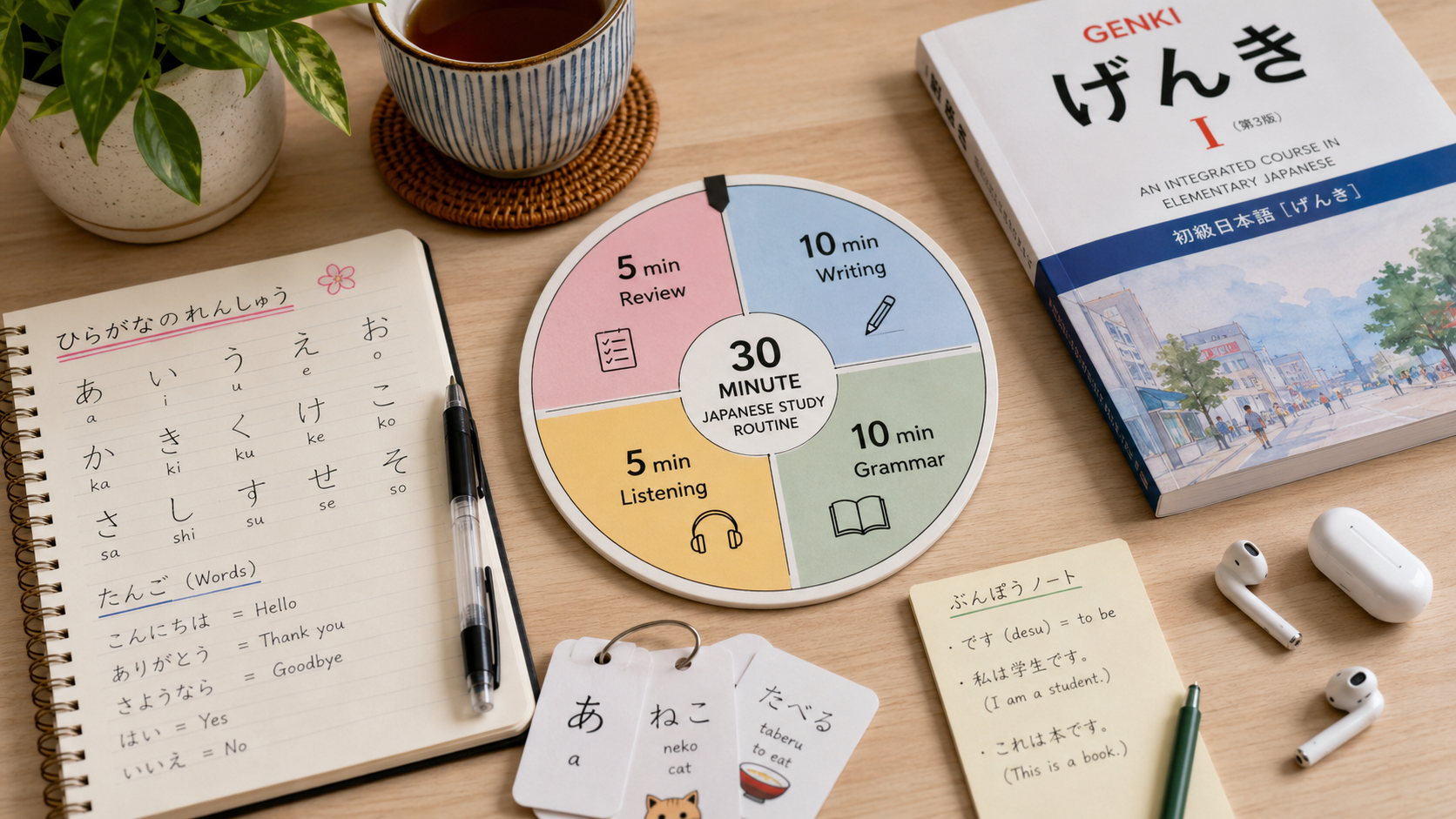
If you are standing at the very beginning of your Japanese learning journey, looking at hiragana charts, unfamiliar grammar patterns, polite phrases, kanji characters, anime clips, travel expressions, textbook dialogues, and language apps all at once, it can feel as though Japanese is not one language but an entire mountain range—beautiful, fascinating, intimidating, and impossible to cross unless someone shows you where the first path begins.
This is the stage where many beginners become overwhelmed. They are excited, but they do not know what to do first. Should they memorize hiragana? Should they learn greetings? Should they start kanji immediately? Should they watch Japanese shows? Should they use Duolingo? Should they buy a textbook? Should they practice speaking from day one? Should they focus on grammar or vocabulary? Should they study for ten minutes a day or two hours a week?
The truth is that beginner Japanese learners do not usually fail because Japanese is impossible. They struggle because their study routine is unclear. They do too many random things, or they do the same thing every day without balance. They memorize words but cannot make sentences. They learn grammar but cannot understand spoken Japanese. They write hiragana once and then forget it. They watch anime but do not build the foundation needed to understand it. They buy three textbooks and finish none of them.
A good study routine changes everything.
The best Japanese study routine for beginners is not the most intense one. It is the one you can actually follow. It gives you structure without making you miserable. It includes writing, reading, speaking, listening, grammar, vocabulary, and review. It helps you make visible progress every week. Most importantly, it prevents the common beginner problem of jumping from resource to resource without building real skill.
Japanese is a language that rewards consistency. You do not need to study five hours a day. You do not need to learn 100 kanji in your first month. You do not need perfect pronunciation immediately. What you need is a smart routine that builds your foundation step by step.
This article will show you how to create that routine.
Why Japanese Beginners Need a Study Routine
Japanese is different from English in several major ways. The sentence structure is different. The writing system is different. The politeness system is different. The way information is left out of sentences is different. Even the rhythm of speech feels different.
Because of this, beginners need more than motivation. Motivation is wonderful, but it comes and goes. A study routine keeps you moving even when the excitement fades.
Without a routine, a beginner might spend one day memorizing hiragana, the next day watching a grammar video, the next day learning random anime phrases, and the next day trying to write kanji. This feels active, but it often produces scattered knowledge.
With a routine, each skill supports the others. Hiragana helps you read beginner dialogues. Dialogues help you understand grammar. Grammar helps you make sentences. Speaking practice helps you remember vocabulary. Listening practice helps pronunciation. Review keeps everything from disappearing.
A routine turns Japanese from a confusing collection of tasks into a clear path.
The First Rule: Do Not Try to Learn Everything at Once
The biggest mistake beginners make is trying to master every part of Japanese immediately.
Japanese has three writing systems:
Hiragana — used for native Japanese words, grammar endings, and beginner materials.
Katakana — used for foreign words, loanwords, names, and emphasis.
Kanji — characters of Chinese origin used for meaning-based writing.
A beginner may see all three and panic. But you do not need to master all three at the same time.
The smartest order is:
Learn pronunciation and basic greetings.
Learn hiragana.
Begin simple sentence patterns.
Add katakana.
Introduce basic kanji gradually.
Build listening and speaking habits from the beginning.
This order gives you a foundation without overwhelming you.
Think of Japanese as a house. Hiragana is part of the floor. Grammar is the frame. Vocabulary is the furniture. Listening is the air inside the rooms. Speaking is how you actually live there. Kanji is important, but you do not need to build the roof before you have walls.
How Much Should a Beginner Study Each Day?
The ideal beginner routine depends on your schedule, but consistency matters more than long study sessions.
For most adult learners, the best routine is:
30 minutes a day, five to six days a week.
This is enough to make progress without burning out. If you are very busy, even 15 minutes a day can work if you are consistent. If you have more time, 60 minutes a day is excellent, but only if you can keep it up.
A good beginner routine should include:
5–10 minutes of review
10 minutes of writing or reading practice
10–15 minutes of grammar or vocabulary
5–10 minutes of listening or speaking
You do not need to do every skill for the same amount of time every day. The goal is balance across the week.
The Best 30-Minute Daily Routine for Beginner Japanese Learners
Here is a simple daily routine that works well for beginners.
Minutes 1–5: Review What You Already Know
Start every session with review. This is essential. Japanese has many new patterns, and if you do not review, you will constantly feel like you are starting over.
Review can include:
hiragana flashcards
vocabulary from your last lesson
a short dialogue
grammar patterns
sentence examples
phrases you want to memorize
For example, review sentences like:
わたしは学生です。
Watashi wa gakusei desu.
I am a student.
これは本です。
Kore wa hon desu.
This is a book.
日本語を勉強しています。
Nihongo o benkyō shite imasu.
I am studying Japanese.
Review should be active. Do not just look at the page. Cover the answer. Say it aloud. Write it. Test yourself.
Minutes 6–15: Work on Hiragana, Katakana, or Reading
In the first weeks, focus heavily on hiragana. Hiragana is one of the most important first steps in Japanese because it helps you move away from romanization.
Romanization, or rōmaji, can be useful at the very beginning, but you should not depend on it for too long. If you always read Japanese through English letters, you delay your ability to recognize Japanese as Japanese.
Start with hiragana rows:
あ い う え お
a i u e o
か き く け こ
ka ki ku ke ko
さ し す せ そ
sa shi su se so
Write them by hand. Say them aloud. Read simple words.
Examples:
あさ
asa
morning
いぬ
inu
dog
ねこ
neko
cat
すし
sushi
sushi
After hiragana becomes more familiar, begin katakana.
Examples:
アメリカ
Amerika
America
コーヒー
kōhī
coffee
ホテル
hoteru
hotel
コンピューター
konpyūtā
computer
Katakana is especially useful for English speakers because many loanwords come from English. But the pronunciation changes, so do not assume the words sound exactly like English.
Minutes 16–25: Learn One Grammar Pattern
Do not try to learn five grammar points in one session. Beginner Japanese becomes much easier when you focus on one pattern at a time.
For example, one day you might study:
A は B です。
A wa B desu.
A is B.
Examples:
わたしはアメリカ人です。
Watashi wa Amerika-jin desu.
I am American.
田中さんは先生です。
Tanaka-san wa sensei desu.
Mr./Ms. Tanaka is a teacher.
これはペンです。
Kore wa pen desu.
This is a pen.
Another day, you might study:
A は B ではありません。
A wa B dewa arimasen.
A is not B.
Examples:
わたしは学生ではありません。
Watashi wa gakusei dewa arimasen.
I am not a student.
これは本ではありません。
Kore wa hon dewa arimasen.
This is not a book.
Another day:
A は B ですか。
A wa B desu ka.
Is A B?
Examples:
これは水ですか。
Kore wa mizu desu ka.
Is this water?
山田さんは医者ですか。
Yamada-san wa isha desu ka.
Is Yamada a doctor?
This method works because grammar becomes usable. You are not just reading about Japanese; you are building sentences.
Minutes 26–30: Speak or Listen
End each session with sound. Japanese cannot stay only on paper.
You can:
repeat a dialogue aloud
listen to beginner audio
shadow a native speaker
record yourself
practice a self-introduction
read hiragana words aloud
repeat vocabulary with correct rhythm
A simple self-introduction is a great daily speaking exercise:
はじめまして。
Hajimemashite.
Nice to meet you.
わたしはロビーです。
Watashi wa Robī desu.
I am Robbie.
アメリカ人です。
Amerika-jin desu.
I am American.
日本語を勉強しています。
Nihongo o benkyō shite imasu.
I am studying Japanese.
よろしくお願いします。
Yoroshiku onegai shimasu.
Nice to meet you / I look forward to learning with you.
Say it slowly. Then say it naturally. Then try it without looking.
A Weekly Study Routine for Beginner Japanese
Daily routines are useful, but weekly structure is even better. Here is a smart weekly plan for beginners.
Monday: Hiragana or Katakana + Basic Sentences
Focus on writing and reading. Review characters, then practice simple sentences.
Example goal: Read and write 10 hiragana words.
Tuesday: Grammar Pattern Day
Choose one grammar structure and practice making your own sentences.
Example goal: Make 10 sentences with です.
Wednesday: Listening and Pronunciation
Listen to beginner dialogues. Repeat aloud. Focus on Japanese rhythm, not speed.
Example goal: Repeat one short dialogue 10 times.
Thursday: Vocabulary in Context
Learn vocabulary by category, but always use it in sentences.
Example categories:
food
family
school
work
travel
numbers
time expressions
Do not just memorize 水 (mizu, water). Use it:
水をください。
Mizu o kudasai.
Water, please.
Friday: Speaking Practice
Practice introductions, questions, and short answers.
Examples:
お名前は何ですか。
Onamae wa nan desu ka.
What is your name?
どこから来ましたか。
Doko kara kimashita ka.
Where are you from?
日本語は難しいですか。
Nihongo wa muzukashii desu ka.
Is Japanese difficult?
Saturday: Review and Mini-Test
Test yourself. Can you read the characters you studied? Can you make sentences without looking? Can you understand a short dialogue?
Sunday: Light Exposure or Rest
Watch a beginner-friendly Japanese video, listen to a song, review flashcards casually, or take a full rest. Rest matters because your brain needs time to absorb the language.
What Should Beginners Learn First?
Beginner Japanese learners should focus on survival foundations before advanced details.
Your first goals should be:
Pronounce Japanese sounds clearly.
Read hiragana.
Recognize katakana.
Introduce yourself.
Ask and answer simple questions.
Understand basic particles like は, を, に, and で.
Learn polite present-tense verbs.
Build a vocabulary of everyday words.
Understand basic word order.
Listen to beginner-level Japanese regularly.
Do not start with obscure grammar. Do not try to memorize 500 kanji in your first month. Do not spend all your time watching native-level content and feeling discouraged.
Start with what you can actually use.
The Role of Hiragana in Your Routine
Hiragana should be a major focus at the beginning. A realistic goal is to learn hiragana in one to three weeks, depending on how much time you study.
Do not aim only to recognize hiragana. Aim to read it smoothly.
For example, beginners often memorize the chart but still struggle when reading real words. That is normal. Reading requires practice.
Try reading simple words daily:
たべる
taberu
to eat
みる
miru
to see / to watch
いく
iku
to go
くる
kuru
to come
かわいい
kawaii
cute
おいしい
oishii
delicious
Once you can read these without relying on romanization, Japanese starts to feel less mysterious.
The Role of Katakana in Your Routine
Katakana is sometimes neglected by beginners, but it is extremely useful. You will see it on menus, signs, product names, websites, and travel materials.
Examples:
レストラン
resutoran
restaurant
タクシー
takushī
taxi
ホテル
hoteru
hotel
メニュー
menyū
menu
パソコン
pasokon
personal computer
A good routine introduces katakana after hiragana is mostly stable. Do not wait too long, but do not try to master both at the exact same time if you feel overwhelmed.
When Should Beginners Start Kanji?
Beginners should start kanji gently, not aggressively.
Kanji is important, but it can easily become intimidating. The goal in the beginning is not to memorize hundreds of characters. The goal is to understand how kanji works and learn a small number of useful characters.
Start with basic kanji like:
日
day / sun
本
book / origin
人
person
山
mountain
川
river
水
water
火
fire
木
tree
月
moon / month
時
time / hour
Learn kanji in words, not just as isolated symbols.
For example:
日本
Nihon
Japan
日本語
Nihongo
Japanese language
一人
hitori
one person
水曜日
suiyōbi
Wednesday
Kanji becomes easier when it is connected to real vocabulary.
Grammar: The Foundation That Makes Japanese Work
Japanese grammar feels strange to English speakers because the structure is different.
English often uses subject-verb-object:
I eat sushi.
Japanese often uses subject-object-verb:
わたしは寿司を食べます。
Watashi wa sushi o tabemasu.
I sushi eat.
The verb usually comes at the end. Particles show the role of each word.
は marks the topic.
を marks the direct object.
に can mark destination, time, or indirect object.
で can mark location of action or means.
か marks a question.
A beginner routine should include regular particle practice because particles are one of the biggest early challenges.
Examples:
わたしは学生です。
Watashi wa gakusei desu.
I am a student.
寿司を食べます。
Sushi o tabemasu.
I eat sushi.
学校に行きます。
Gakkō ni ikimasu.
I go to school.
図書館で勉強します。
Toshokan de benkyō shimasu.
I study at the library.
コーヒーを飲みますか。
Kōhī o nomimasu ka.
Do you drink coffee?
Do not worry if particles take time. They are not mastered in one week. They become clearer through repeated exposure.
Vocabulary: Learn Words You Can Use Immediately
Beginner vocabulary should be practical. You need words that help you make sentences, not random lists of animals, colors, or advanced nouns.
Start with:
pronouns and people
family words
food and drink
places
common verbs
adjectives
numbers
days and time
greetings
classroom expressions
travel basics
Useful beginner verbs include:
食べます
tabemasu
to eat
飲みます
nomimasu
to drink
行きます
ikimasu
to go
来ます
kimasu
to come
見ます
mimasu
to see / watch
聞きます
kikimasu
to listen / ask
話します
hanashimasu
to speak
勉強します
benkyō shimasu
to study
Once you know these, you can make many sentences.
日本語を勉強します。
Nihongo o benkyō shimasu.
I study Japanese.
水を飲みます。
Mizu o nomimasu.
I drink water.
映画を見ます。
Eiga o mimasu.
I watch a movie.
東京に行きます。
Tōkyō ni ikimasu.
I go to Tokyo.
This is how vocabulary becomes useful.
Listening: Start Earlier Than You Think
Many beginners wait too long to practice listening. They think they need more grammar first. But listening should start from the beginning.
At first, you will not understand everything. That is fine. Your goal is to train your ear.
Listen for:
rhythm
repeated phrases
sentence endings
particles
polite verb endings
familiar vocabulary
Use beginner dialogues, not native-level dramas at first. Native material can be motivating, but it is often too fast and too complex for true beginners.
A good listening routine might be:
Listen once without reading.
Listen again while reading the transcript.
Repeat each sentence aloud.
Listen a final time without reading.
This method builds both comprehension and pronunciation.
Speaking: Begin Before You Feel Ready
Many learners delay speaking because they feel embarrassed. They want to wait until they “know enough.” But speaking is a skill that develops through practice, not through waiting.
Beginners can start with simple patterns:
わたしは___です。
Watashi wa ___ desu.
I am ___.
___が好きです。
___ ga suki desu.
I like ___.
___に行きます。
___ ni ikimasu.
I go to ___.
___を食べます。
___ o tabemasu.
I eat ___.
Examples:
わたしは学生です。
I am a student.
日本が好きです。
I like Japan.
カフェに行きます。
I go to a café.
ラーメンを食べます。
I eat ramen.
These are simple, but they build confidence. Speaking early prevents Japanese from becoming only a reading exercise.
Pronunciation: Build Good Habits Early
Japanese pronunciation is not impossible for English speakers, but beginners should pay attention to several details.
Japanese Vowels Are Clear
Japanese vowels are usually consistent:
あ = a
い = i
う = u
え = e
お = o
Do not reduce vowels the way English often does.
Long Vowels Matter
Long vowels can change meaning.
おばさん
obasan
aunt
おばあさん
obāsan
grandmother
Double Consonants Matter
A small pause can change meaning.
きて
kite
come
きって
kitte
stamp / cut, depending on context
Japanese Rhythm Is Different
Japanese does not use English-style stress in the same way. Try to keep the rhythm even and clear.
A good routine includes repeating after native audio, recording yourself, and paying attention to vowel length.
The Best Study Resources for Beginners
A good Japanese routine usually combines several resource types.
You may use:
a structured textbook
a live class
flashcards
audio dialogues
hiragana and katakana writing sheets
a grammar reference
beginner videos
language exchange later, after you know basics
However, do not use too many resources at once. Choose one main path and a few support tools.
Your main path might be a class or textbook. Apps and videos should support that path, not replace it.
Too many resources create the illusion of progress while scattering your attention.
Common Beginner Mistakes to Avoid
Mistake 1: Depending on Romanization Too Long
Rōmaji is useful at first, but if you rely on it too much, hiragana and katakana will feel harder later.
Mistake 2: Ignoring Listening
Japanese must be heard regularly. Reading alone is not enough.
Mistake 3: Memorizing Words Without Sentences
Words are easier to remember when you use them in real patterns.
Mistake 4: Starting Too Many Resources
One textbook, one class, one app, and one audio source are enough. You do not need ten different systems.
Mistake 5: Trying to Learn Kanji Too Fast
Kanji is important, but beginners should learn it gradually.
Mistake 6: Avoiding Speaking
You will not feel ready at first. Speak anyway, even with simple sentences.
Mistake 7: Studying Only Once a Week
One long session per week is less effective than short daily sessions.
A 60-Minute Routine for Serious Beginners
If you have one hour a day, here is a stronger routine:
10 minutes: review flashcards and old sentences
10 minutes: hiragana, katakana, or kanji writing
15 minutes: grammar study
10 minutes: sentence creation
10 minutes: listening and shadowing
5 minutes: speaking or recording yourself
This routine is excellent because it balances input and output.
You read.
You write.
You listen.
You speak.
You think about grammar.
You review.
That balance is the secret.
A 15-Minute Routine for Busy Learners
If you are very busy, do not give up. Use a compact routine.
5 minutes: review vocabulary
5 minutes: read or write hiragana
5 minutes: listen and repeat sentences
Even 15 minutes a day can keep Japanese alive. The danger is not studying a little. The danger is stopping completely.
A small daily habit is powerful.
How to Know Your Routine Is Working
Your routine is working if, after several weeks, you can:
read hiragana more easily
recognize some katakana
introduce yourself
make simple sentences
understand basic classroom phrases
remember vocabulary from previous weeks
hear familiar words in audio
explain a few grammar patterns
speak a little more confidently
Progress in Japanese is not always dramatic. Sometimes it feels slow. But small improvements compound.
One day, a sentence that once looked impossible suddenly feels normal. That is progress.
Why a Class Can Improve Your Routine
Self-study can work, but many beginners benefit enormously from a class. A class gives you structure, accountability, feedback, and speaking practice.
A teacher can explain confusing grammar, correct pronunciation, and tell you what matters most at your level. Classmates give you a reason to speak. A schedule keeps you from drifting.
For adult learners, especially busy ones, this structure is valuable. You do not waste time wondering what to study next. You follow a path.
A good Japanese class can turn your personal study routine into something much stronger.
Final Thoughts: The Best Routine Is the One You Can Repeat
The best study routine for beginner Japanese learners is not complicated. It is consistent, balanced, and realistic.
Study a little almost every day.
Review constantly.
Learn hiragana early.
Add katakana soon after.
Start kanji gently.
Practice grammar through sentences.
Listen from the beginning.
Speak before you feel ready.
Use apps as support, not as your entire method.
Take a class if you want structure and feedback.
Japanese is a long journey, but the beginning does not need to feel chaotic. With the right routine, you can make steady progress and enjoy the process.
You do not need to master Japanese immediately. You only need to build the habit of returning to it day after day. Every hiragana character, every sentence, every phrase, every listening exercise, and every small speaking attempt becomes part of your foundation.
And eventually, the language that once looked impossible begins to open.
FAQs About the Best Study Routine for Beginner Japanese Learners
How long should I study Japanese every day as a beginner?
Most beginners do well with 30 minutes a day, five to six days a week. If you are very busy, 15 minutes daily can still help. Consistency is more important than long occasional sessions.
Should I learn hiragana or katakana first?
Most beginners should learn hiragana first because it is used heavily in beginner materials and grammar endings. Katakana should come soon after, especially because it appears often in loanwords and travel vocabulary.
When should I start learning kanji?
You can start basic kanji after you have begun hiragana and simple grammar. Do not try to learn too many kanji at once. Start with common characters like 日, 人, 本, 水, and 山.
Can I learn Japanese with apps only?
Apps can help with review and vocabulary, but they are usually not enough by themselves. Japanese beginners often need grammar explanations, pronunciation feedback, speaking practice, and structured progression.
Is Japanese grammar hard for beginners?
Japanese grammar is different from English, but many beginner patterns are logical. The biggest challenge is getting used to word order, particles, and polite verb forms.
How can I practice speaking Japanese if I am a beginner?
Start with simple sentence patterns and self-introductions. Read dialogues aloud, repeat after audio, record yourself, and practice short answers. You do not need advanced grammar to begin speaking.
How often should I review old Japanese material?
Every study session should begin with review. Even five minutes of review can make a big difference. Japanese requires repeated exposure.
Should I watch anime or Japanese dramas as a beginner?
You can watch them for motivation, but they should not be your main study method at the beginning. Native-level content is often too fast and complex. Use beginner dialogues and graded materials first.
What is the biggest mistake beginner Japanese learners make?
The biggest mistake is studying randomly without a routine. Beginners often jump between apps, videos, textbooks, and kanji lists without building a clear foundation.
Can adults learn Japanese successfully?
Yes. Adults can learn Japanese very successfully with structure, consistency, and realistic expectations. A good routine and supportive class environment make a major difference.
Learn Japanese with Polyglottist Language Academy
If you are ready to begin Japanese but do not want to waste time with scattered resources and confusing explanations, Polyglottist Language Academy can help you build a clear foundation from the start.
Our Japanese classes are designed for adult learners who want structure, support, and real progress. Whether you are learning Japanese for travel, culture, work, anime, family, or personal enrichment, a guided class can help you understand pronunciation, hiragana, katakana, basic grammar, and everyday conversation step by step.
Japanese is a beautiful and rewarding language, but you do not have to figure it out alone. With the right teacher, a supportive learning environment, and a smart routine, you can make steady progress and enjoy the journey.
Sign up for Japanese classes with Polyglottist Language Academy and take the first step toward learning Japanese with confidence.
You May Also Like These Articles
If you enjoyed this article, you may also want to read:
Is Japanese Hard To Learn? An Honest Guide For English Speakers
Why Japanese Feels Difficult At First—And How To Push Through
How To Practice Japanese Every Day Even With A Busy Schedule
Hiragana, Katakana, And Kanji: What Japanese Learners Need To Know First
Japanese Classes In San Francisco For Adults: Where To Start
Learn Japanese In Oakland: Small Group Classes That Actually Help You Speak