
Best Online Japanese Classes for Students in San Jose
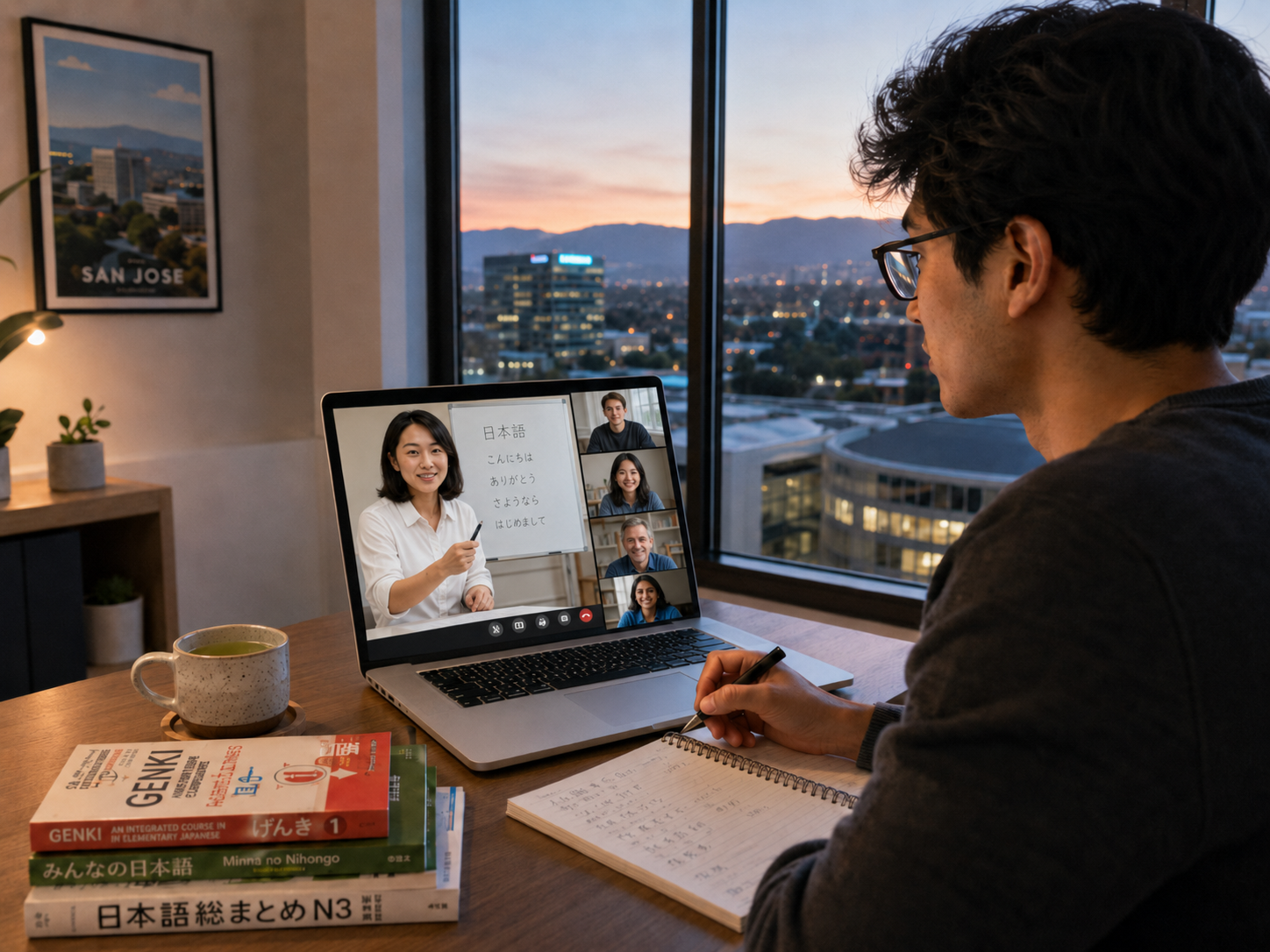
If you are a student in San Jose trying to learn Japanese between classes, exams, internships, work shifts, tech projects, family responsibilities, weekend plans, and the endless distractions of modern life, you may already have discovered that wanting to learn Japanese is easy—but finding the right class, the right schedule, the right teacher, and the right level of structure is much harder.
Japanese is one of those languages that attracts people for many different reasons. Some students want to understand anime, manga, music, games, or Japanese films without relying completely on subtitles. Some want to travel to Tokyo, Kyoto, Osaka, Hokkaido, or Okinawa and feel more confident ordering food, asking for directions, reading signs, and interacting politely with local people. Some are interested in Japanese technology, design, business, gaming, robotics, fashion, or traditional culture. Others simply love the challenge of learning a language that works very differently from English.
In San Jose and the broader South Bay, Japanese makes especially good sense. San Jose is not just a large California city; it is the heart of Silicon Valley, a region shaped by technology, international business, universities, start-ups, and multicultural communities. Students at San Jose State University, San Jose City College, De Anza, Foothill, West Valley, and other nearby schools often have global interests and demanding schedules. Many working adults in the area are connected to tech, design, gaming, engineering, business, or international travel. For them, Japanese is not only a fascinating language—it can also be part of a broader personal, academic, or professional path.
But here is the real question: what are the best online Japanese classes for students in San Jose?
The answer depends on your goals. A complete beginner needs something different from a heritage learner. A college student who wants extra speaking practice needs something different from a tech professional preparing for travel. Someone who wants casual exposure through anime may need a different approach from someone preparing for the JLPT or planning to study abroad in Japan.
However, the best online Japanese classes usually have a few things in common: they are structured, live, interactive, beginner-friendly, small enough for real speaking practice, and taught by teachers who understand how to explain Japanese clearly to English speakers.
This guide will walk you through what San Jose students should look for in an online Japanese class, how online classes compare with in-person options, what complete beginners should expect, how to think about hiragana, katakana, and kanji, and why a small, live online class can be one of the most effective ways to start learning Japanese seriously.
Why San Jose Students Are Interested in Learning Japanese
San Jose is a natural place for interest in Japanese to grow. The city sits in one of the most international regions in the United States. People in the South Bay are often used to hearing multiple languages, working with people from around the world, and thinking globally. Japanese fits beautifully into that environment.
For college students, Japanese may connect to study abroad, international business, Asian studies, computer science, game design, art, literature, linguistics, or personal enrichment. A student at San Jose State University, for example, may be interested in Japanese because of academic programs, exchange opportunities, or long-term career goals. A student at a community college may want a flexible language course that fits around work, transfer requirements, or personal interests.
For tech professionals and future tech workers, Japanese has another kind of appeal. Japan has had a major global influence on consumer electronics, gaming, robotics, automotive design, animation, and digital culture. Even if you do not need Japanese for your current job, learning it can deepen your understanding of a culture that has shaped many industries.
Then there are anime, manga, and gaming fans. Many Japanese learners begin with entertainment. They hear Japanese dialogue, memorize phrases from shows, recognize honorifics like san, sama, and sensei, and slowly become curious about how the language really works. At some point, subtitles are no longer enough. They want to read, listen, and speak for themselves.
Other learners are drawn by travel. Japan is one of the most rewarding destinations in the world, but even basic Japanese can change the experience dramatically. Being able to say すみません (sumimasen), ありがとうございます (arigatō gozaimasu), 駅はどこですか (eki wa doko desu ka?), or これはいくらですか (kore wa ikura desu ka?) helps you feel more present and respectful.
In San Jose, where students and professionals are busy, ambitious, and often globally minded, online Japanese classes offer something especially valuable: a way to learn seriously without spending extra time commuting across the Bay Area.
Why Online Japanese Classes Are a Good Fit for San Jose Learners
San Jose is spread out, traffic can be frustrating, and students often have complicated schedules. Even if there are in-person Japanese classes somewhere in the area, getting to them consistently can be difficult.
This is where online Japanese classes become very practical.
With online classes, you can study from home, your dorm, your apartment, your office, or a quiet room on campus. You do not need to drive across town, find parking, or rush from work to class. For many students and busy adults, the difference between “I should take a class someday” and “I actually attend every week” is simply convenience.
Online Japanese classes can also give you access to better teaching options. Instead of being limited to whatever is available within a few miles of your home, you can choose a teacher or school that fits your level, goals, schedule, and learning style.
A good online class is not just a video lecture. The best online Japanese classes are live and interactive. Students speak, ask questions, repeat phrases, practice dialogues, receive corrections, read aloud, and work with classmates. The teacher guides the lesson, explains difficult grammar, and helps students avoid common mistakes.
For shy beginners, online classes can even feel less intimidating. Speaking Japanese for the first time can feel awkward. It is easier for some students to begin from the comfort of home rather than in a large classroom. A small online group gives you structure without the pressure of a big lecture hall.
Of course, online learning has possible weaknesses. A poorly designed online class can become passive. Students may sit silently, watch the teacher talk, and never practice speaking. That is why the format matters. A good online Japanese class should include conversation practice, pronunciation correction, reading practice, short exercises, review, homework, and a clear path to the next level.
Online vs. In-Person Japanese Classes in San Jose
Both online and in-person Japanese classes can be useful. The right choice depends on your needs.
In-person classes can be great for students who want a campus environment, academic credit, or a traditional classroom experience. Community colleges and universities may offer structured Japanese courses with exams, textbooks, and formal progression. Local cultural centers or community programs may also provide valuable language and cultural experiences.
However, in-person classes are not always ideal for everyone. They may meet at fixed times that do not work with your schedule. They may require commuting. They may be too academic, too fast, too slow, too large, or aimed at children rather than adult learners.
Online Japanese classes offer more flexibility. They are especially helpful if you are balancing school, work, internships, family, or a demanding tech schedule. They also work well for learners who want live instruction but do not need college credit.
For many San Jose students, the best choice is a structured online class with a real teacher and a small group. This combines the accountability of a formal class with the convenience of online learning.
Apps and self-study tools can be useful supplements, but they usually do not replace live instruction. Apps can help you memorize vocabulary, review hiragana, or practice kanji. But they rarely give you real-time correction. They do not always explain why your sentence sounds unnatural. They cannot adjust the lesson when you are confused. Most importantly, they do not force you to speak.
If your goal is to actually communicate in Japanese, you need some form of live practice.
What Makes a Good Online Japanese Class?
Not all Japanese classes are equal. Before enrolling, look for several important features.
1. A beginner-friendly structure
A good beginner class should not assume that you already know hiragana, kanji, or grammar. It should start with pronunciation, greetings, basic sentence patterns, and the writing system in a clear order.
Japanese can become overwhelming if everything is introduced at once. A strong class gives you one layer at a time.
2. Small class size
Small groups matter. If there are too many students, you may spend most of the class listening instead of speaking. In a small class, you get more turns, more feedback, and more confidence.
For beginners, this is especially important. You need to say words aloud. You need to make mistakes. You need a teacher who can hear your pronunciation and correct you gently.
3. Speaking practice from the beginning
Some students think they need to memorize a lot before speaking. This is not true. Even in the first class, you can practice greetings, introductions, simple questions, and polite phrases.
A good class gets you speaking early with phrases like:
こんにちは。
Hello.はじめまして。
Nice to meet you.私はロビーです。
I am Robbie.アメリカから来ました。
I am from America.日本語を勉強しています。
I am studying Japanese.
Speaking early helps you become comfortable with the sounds and rhythm of Japanese.
4. Clear explanation of grammar
Japanese grammar is not impossible, but it is very different from English. Word order, particles, politeness levels, verb endings, and sentence structure all need patient explanation.
For example, English usually follows subject-verb-object order:
“I eat sushi.”
Japanese often follows subject-object-verb order:
私は寿司を食べます。
Watashi wa sushi o tabemasu.
I sushi eat.
This feels strange at first, but it becomes logical with practice.
A good teacher explains grammar clearly without drowning students in technical language.
5. Real-time correction
One of the biggest advantages of live classes is correction. A teacher can help you pronounce long vowels, distinguish similar sounds, use particles correctly, and choose natural phrases.
For example, many beginners struggle with particles such as:
は (wa) — topic marker
が (ga) — subject marker
を (o) — object marker
に (ni) — direction, time, indirect object
で (de) — place of action, method
へ (e) — direction
These particles are much easier to learn when a teacher gives real examples and corrects you as you speak.
6. Cultural context
Japanese is deeply connected to culture. Politeness, formality, indirect communication, greetings, bowing, gift-giving, and social roles all shape how the language is used.
A good Japanese class does not only teach translation. It explains when and why you use certain phrases.
For example, ありがとう and ありがとうございます both express thanks, but they do not feel exactly the same. どうも can be casual or vague depending on context. すみません can mean excuse me, sorry, or thank you in certain situations.
These details matter.
Japanese for Complete Beginners: What to Expect
If you are a complete beginner, you may wonder what your first weeks of Japanese will look like.
A well-designed beginner course should not throw you into kanji and complicated grammar immediately. Instead, it should build gradually.
Weeks 1–2: Sounds, greetings, and hiragana
At the beginning, you will usually learn Japanese pronunciation, basic greetings, and the first hiragana characters.
Japanese pronunciation is generally more regular than English pronunciation, but there are still important details: long vowels, double consonants, pitch accent, and the difference between sounds like r and l for English speakers.
You may learn phrases such as:
おはようございます。
Good morning.こんにちは。
Hello.こんばんは。
Good evening.ありがとうございます。
Thank you.すみません。
Excuse me / sorry.お願いします。
Please.
You will also begin learning hiragana, the basic phonetic script used throughout Japanese.
Weeks 3–4: More hiragana and simple sentences
As you learn more hiragana, you can begin reading simple words and phrases. You may also start forming simple sentences.
For example:
私は学生です。
I am a student.これは本です。
This is a book.日本語を勉強します。
I study Japanese.コーヒーを飲みます。
I drink coffee.
You may also learn basic question patterns:
これは何ですか。
What is this?お名前は何ですか。
What is your name?どこから来ましたか。
Where are you from?
Later beginner stage: Katakana, particles, verbs, adjectives, and basic kanji
Once hiragana becomes more comfortable, students usually learn katakana. Katakana is used for foreign loanwords, names, emphasis, and many modern terms.
Examples:
コーヒー — coffee
コンピューター — computer
アメリカ — America
ホテル — hotel
レストラン — restaurant
Then basic kanji are introduced gradually, usually with very common words like numbers, days of the week, people, places, and verbs.
The key is not to rush. Japanese is a long-term language. You build it layer by layer.
Hiragana, Katakana, and Kanji: What Students Should Know
One of the first things that makes Japanese look intimidating is the writing system. Japanese uses three scripts: hiragana, katakana, and kanji.
Hiragana
Hiragana is a phonetic script. Each character represents a sound, such as a, ka, shi, to, or me. Hiragana is essential because it appears in almost every Japanese sentence.
Beginners should usually learn hiragana first.
Why? Because it helps you move beyond romaji, the Romanized version of Japanese. Romaji can be useful at the very beginning, but if you rely on it too long, it slows your progress.
Katakana
Katakana is also phonetic, but it is mostly used for foreign words, names, borrowed terms, sound effects, and emphasis.
For English speakers, katakana can be fun because many words are recognizable:
テレビ — television
タクシー — taxi
サラダ — salad
クラス — class
ゲーム — game
However, katakana words often sound different from English, so students still need practice.
Kanji
Kanji are characters of Chinese origin. They represent meaning and often have multiple readings.
For example:
日 can relate to sun or day.
本 can mean book or origin.
日本 means Japan.
Kanji can feel intimidating, but beginners do not need to learn hundreds immediately. A good class introduces kanji slowly, with useful words and real context.
The recommended order is usually:
Hiragana
Katakana
Basic kanji
This order gives students a strong foundation without overwhelming them.
Group Classes vs. Private Japanese Lessons vs. Apps
San Jose students have several options for learning Japanese. Each has advantages.
Small online group classes
Small online group classes are often the best choice for beginners who want structure, affordability, and speaking practice.
Benefits include:
regular weekly schedule
live teacher instruction
classmates to practice with
lower cost than private lessons
accountability
clear progression from level to level
Group classes are especially useful for students who need motivation. You are not studying alone. You are part of a class, which makes it easier to continue.
Private Japanese lessons
Private lessons are best for learners who need a customized plan. For example, private lessons may be ideal if you are preparing for the JLPT, moving to Japan soon, working with Japanese clients, or struggling with a specific grammar point.
The downside is cost. Private lessons are usually more expensive than group classes. They also depend heavily on the teacher’s skill and structure.
Apps and self-study
Apps can be helpful, especially for vocabulary, kana practice, and daily review. They are convenient and often inexpensive.
But apps alone are rarely enough. Many learners become good at recognizing answers on a screen but freeze when they need to speak. They may understand isolated words but not know how to form real sentences.
The strongest approach is often a combination:
take a live class for structure and speaking
use apps for extra review
watch Japanese media for listening exposure
practice writing and reading between lessons
Online Japanese Classes for San Jose College Students
College students often benefit from online Japanese classes because their schedules are unpredictable. Between lectures, assignments, part-time jobs, internships, clubs, and exams, it can be difficult to commit to a traditional in-person class.
An online Japanese class can fit more easily into student life. You can attend from your dorm, apartment, library study room, or home. You do not need to commute after a long day on campus.
Online classes can also support students who are already taking Japanese at a university or community college. Sometimes academic courses move quickly, focus heavily on exams, or do not provide enough speaking time. A small online class can give students extra practice in a lower-pressure environment.
For students preparing to study abroad in Japan, online classes can be especially helpful. Classroom Japanese and real-life Japanese are not always the same. You need practical phrases for train stations, restaurants, convenience stores, dorm life, host families, and everyday politeness.
A good online class can help you practice these situations before you arrive.
Japanese for Tech Professionals and Silicon Valley Learners
San Jose is also home to many working adults who want to learn Japanese for professional or personal reasons. Engineers, designers, product managers, entrepreneurs, game developers, and tech workers may be drawn to Japanese because of Japan’s influence in technology, gaming, design, robotics, and consumer products.
Even basic Japanese can be valuable when traveling for work, building relationships, attending conferences, or collaborating with Japanese colleagues. It shows respect and curiosity. It can also help you understand cultural expectations around communication, hierarchy, formality, and group harmony.
For tech professionals, online classes are often much more realistic than in-person courses. Work schedules can change. Meetings run late. Commutes are tiring. A live online class removes many barriers.
Japanese also offers a refreshing mental challenge. For people who spend their workdays in code, spreadsheets, design tools, or meetings, language learning can be a different kind of intellectual exercise—structured, creative, cultural, and deeply human.
Common Mistakes When Choosing Japanese Classes
Before enrolling in a class, it helps to know what to avoid.
Mistake 1: Relying only on apps
Apps are useful, but they cannot fully teach you to speak. If you only tap answers on a screen, you may develop passive knowledge without real communication skills.
Mistake 2: Choosing a class that moves too fast
Japanese takes time. A class that rushes through hiragana, grammar, particles, and kanji may leave beginners feeling lost. A good beginner class should be structured but not overwhelming.
Mistake 3: Ignoring hiragana and katakana
Some students want to stay in romaji because it feels easier. But serious Japanese learning requires hiragana and katakana. The sooner you start, the better.
Mistake 4: Trying to memorize too much kanji too soon
Kanji are important, but beginners should learn them gradually. It is better to learn kanji in useful words and sentences than to memorize huge lists without context.
Mistake 5: Choosing a class with too little speaking practice
If you want to speak Japanese, you need to speak in class. A lecture-style course may teach grammar but leave you unable to communicate.
Mistake 6: Not checking who the class is designed for
Some Japanese programs are designed for children, heritage learners, or academic credit. These can be excellent, but they may not fit adult beginners or busy college students looking for practical conversation.
Mistake 7: Studying inconsistently
Japanese rewards consistency. A weekly class, regular homework, and short daily review are far more effective than occasional intense study sessions.
Questions to Ask Before You Enroll
Before choosing an online Japanese class, ask these questions:
Is this class truly beginner-friendly?
Do I need to know hiragana before starting?
How many students are usually in the class?
Will I speak Japanese every session?
Does the teacher correct pronunciation and grammar?
Are the lessons live or recorded?
What textbook or materials are used?
How much homework should I expect?
Is there a next level after this class?
Is the class designed for adults, college students, or children?
Can I join from San Jose or anywhere in the South Bay?
Does the class focus only on grammar, or also on conversation and culture?
The best Japanese class is not always the cheapest or the most famous. It is the one you will actually attend, enjoy, and continue.
What Are the Best Online Japanese Classes for San Jose Students?
The best online Japanese classes for San Jose students are usually live, structured, small, and practical. They should help you build a foundation in pronunciation, hiragana, katakana, basic grammar, vocabulary, and conversation.
For complete beginners, the ideal class should not assume prior knowledge. It should introduce Japanese step by step and give students many chances to speak. For college students, it should fit around school schedules and provide extra practice beyond textbooks. For tech professionals, it should be flexible enough to fit around work while still offering real progress.
A strong online Japanese course should feel like a real class—not just a collection of videos. You should know what you are learning, why it matters, what to practice, and how to continue to the next level.
Why Polyglottist Language Academy Is a Great Option for San Jose Students
If you are looking for online Japanese classes in San Jose, the South Bay, or anywhere in the Bay Area, Polyglottist Language Academy offers a supportive and structured way to begin or continue your Japanese studies.
Our online Japanese classes are designed for busy adult learners and students who want clear explanations, small-group interaction, and practical communication skills. Instead of trying to figure everything out alone with apps or scattered videos, you can learn with a teacher who guides you step by step.
At Polyglottist Language Academy, we believe language learning should be personal, encouraging, and realistic. Japanese is a beautiful but demanding language, and students need the right structure. That means learning hiragana and katakana in a manageable way, practicing real phrases from the beginning, understanding grammar clearly, and getting comfortable speaking aloud.
For San Jose students, online classes are especially convenient. You can join from home, campus, or wherever you study best—without driving across the Bay Area. Whether you are a college student, a working professional, an anime fan, a traveler, or someone who has always wanted to learn Japanese, our classes can help you make steady progress.
If you are ready to stop wishing you knew Japanese and start actually learning it, we invite you to explore our current Japanese class schedule and sign up for a class with Polyglottist Language Academy.
FAQ: Online Japanese Classes for Students in San Jose
What are the best online Japanese classes for students in San Jose?
The best online Japanese classes for San Jose students are live, small, structured, and beginner-friendly. Look for classes that include speaking practice, clear grammar explanations, writing system support, cultural context, and real teacher feedback.
Can I learn Japanese online as a complete beginner?
Yes. Japanese can absolutely be learned online as a complete beginner, as long as the class is live, structured, and interactive. A good beginner course starts with pronunciation, greetings, hiragana, basic sentence patterns, and simple conversation.
Are online Japanese classes better than apps?
Online classes and apps serve different purposes. Apps are useful for review, vocabulary, and kana practice. Live online classes are better for speaking, correction, structure, accountability, and real communication.
Should I learn hiragana or kanji first?
Most beginners should learn hiragana first, then katakana, and then basic kanji. Hiragana appears throughout Japanese and gives you the foundation you need to read beginner materials.
How long does it take to learn basic Japanese?
With consistent study, many learners can build basic conversational skills in 6 to 12 months. Progress depends on how often you attend class, review, practice speaking, and expose yourself to Japanese outside class.
Are online Japanese classes good for college students?
Yes. Online Japanese classes are excellent for college students because they are flexible, convenient, and often lower-pressure than formal academic courses. They can also provide extra speaking practice alongside university or community college classes.
Do I need to live in San Jose to take online Japanese classes?
No. Online Japanese classes can usually be taken from anywhere, as long as the schedule works for your time zone. This article focuses on San Jose students, but online classes are also useful for learners throughout the Bay Area and beyond.
Are group Japanese classes or private lessons better?
Group classes are often best for beginners because they are more affordable, social, and structured. Private lessons are better for students with very specific goals, unusual schedules, or advanced needs.
What is the best way to practice speaking Japanese online?
The best way is to join a live class where you speak every session. You can also practice with classmates, language exchange partners, tutors, or short daily speaking exercises.
How do I choose the right Japanese class?
Choose a class that matches your level, schedule, and goals. Look for small class size, live instruction, speaking practice, teacher feedback, clear progression, and a supportive environment for adult learners.
Continue Learning with Polyglottist Language Academy
Learning Japanese is not something you have to do alone. With the right teacher, the right class, and a clear plan, Japanese becomes much less intimidating and much more enjoyable.
At Polyglottist Language Academy, we offer language classes for adults and motivated students who want real progress in a supportive environment. Our Japanese classes help learners build a foundation in pronunciation, writing, grammar, conversation, and culture—step by step.
If you are in San Jose, the South Bay, or anywhere online and want to begin learning Japanese, we would be happy to help you find the right level and class.
Visit Polyglottist Language Academy to learn more about our Japanese classes and reserve your place in an upcoming course.
Read More on the Polyglottist Language Academy Blog
If you are interested in Japanese, language learning, and practical study tips, you may also enjoy these related articles: