
How Long Does It Take to Learn Japanese? A Realistic Timeline
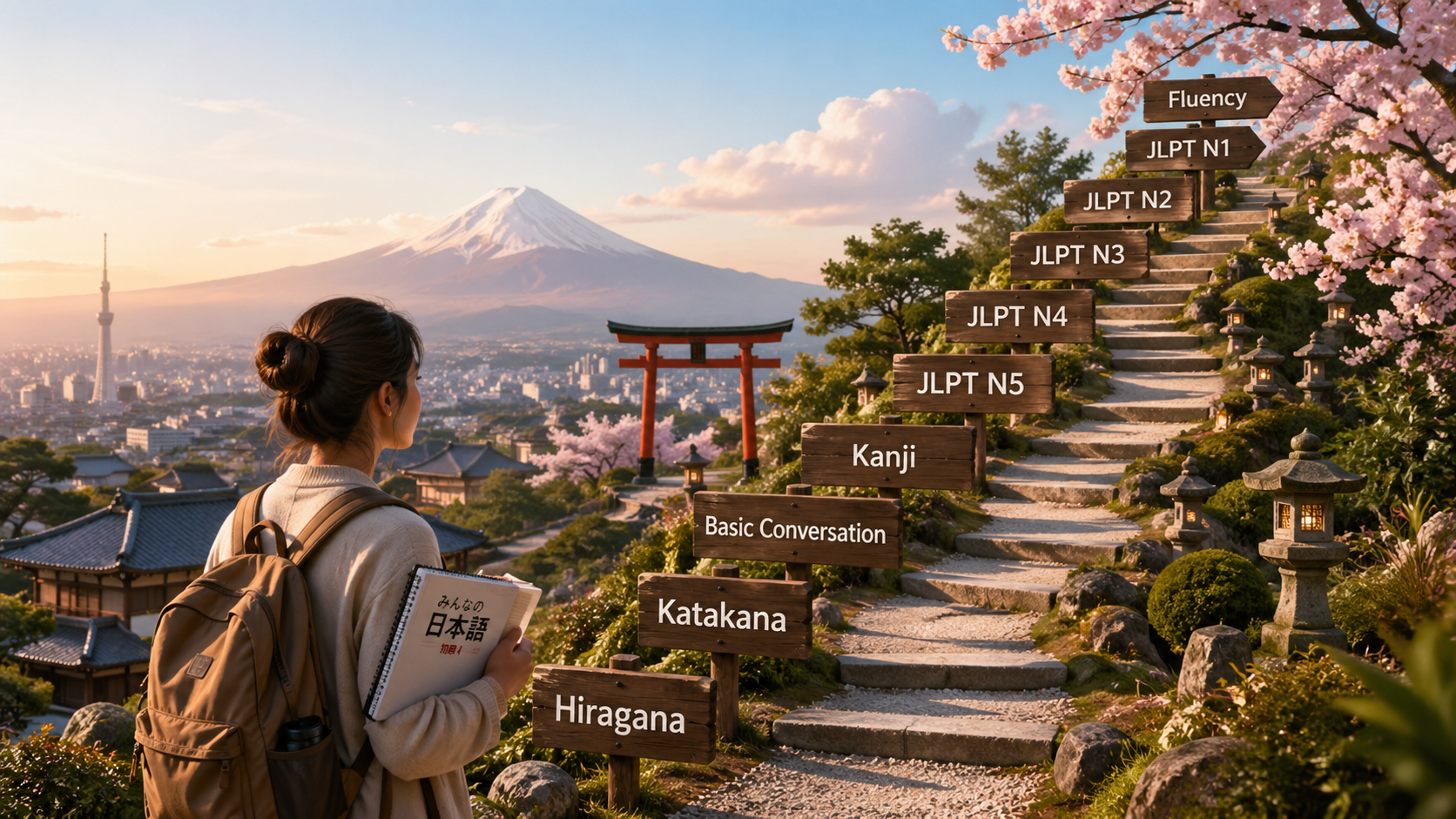
For many people, Japanese begins as a fascination long before it becomes a study plan: maybe it starts with anime, a dream trip to Tokyo or Kyoto, a love of Japanese food, or simply the strange feeling of seeing a sentence written in hiragana, katakana, and kanji and wondering how human beings can read something so visually different from English.
Then, at some point, curiosity becomes a serious question: How long does it actually take to learn Japanese?
This is where things become confusing. Online, you will find every possible answer. One person says you can “be fluent in three months.” Another says Japanese takes ten years. One app promises conversational Japanese after a few weeks. A language institute says it takes thousands of hours. A textbook tells you to memorize grammar patterns, kanji, and vocabulary before you even think about speaking.
So what is the truth?
The honest answer is that Japanese takes time, but not all goals require the same amount of time. You do not need professional-level Japanese to travel in Japan, order ramen, introduce yourself, ask for directions, or have a simple conversation. You do not need to know 2,000 kanji before you start speaking. You do not need to be “fluent” before Japanese becomes useful and enjoyable.
At the same time, Japanese is not a language most English speakers master casually. It is not like learning another Romance language after studying Spanish or French. Japanese asks you to get used to a different sentence structure, a different writing system, different social rules, different levels of politeness, and a different way of organizing information in conversation.
That does not mean Japanese is impossible. It means your expectations need to be realistic.
A better question than “How long does it take to learn Japanese?” is:
What do you want to do in Japanese, and how many hours per week can you realistically study?
The answer changes dramatically depending on your goal. Learning enough Japanese for travel may take a few months. Holding simple conversations may take six months to a year. Reaching JLPT N2 or professional working proficiency usually takes years of consistent study.
Let’s break it down clearly.
Is Japanese really difficult for English speakers?
Yes, Japanese is considered one of the most difficult languages for English speakers to learn well. The U.S. Foreign Service Institute, which trains diplomats, classifies Japanese as a “super-hard” language. Its estimate for reaching professional working proficiency is about 2,200 classroom hours.
That number can sound terrifying, but it needs context. Professional working proficiency is not the same as beginner conversation. It means being able to use Japanese in serious work settings, understand complex speech, and function at a high level.
For comparison, the same organization estimates that languages like French or Spanish require around 600 classroom hours for English speakers to reach professional working proficiency. Japanese takes much longer because it differs from English in almost every major area: grammar, vocabulary, writing, pronunciation patterns, and cultural communication.
However, Japanese also has encouraging features. Its pronunciation is relatively manageable for English speakers. There are no grammatical genders like in French, Spanish, German, or Italian. Verbs do not change according to person in the way they do in many European languages. The spelling of hiragana and katakana is highly consistent once you learn the sounds.
In other words, Japanese is hard, but not hard in every possible way. It is unfamiliar more than chaotic.
Why Japanese feels so different
One major challenge is sentence structure. English usually follows a Subject-Verb-Object pattern:
“I eat sushi.”
Japanese usually follows a Subject-Object-Verb pattern:
“I sushi eat.”
Of course, real Japanese grammar is more complex than that, but this basic difference already shows how learners have to retrain their instincts. In Japanese, the verb often comes at the end, so you may have to listen longer before you fully understand what someone is saying.
Another challenge is particles. Japanese uses small words such as は, が, を, に, で, と, and へ to show the function of words in a sentence. These particles can be confusing because English often uses word order instead. For example, は and が can both relate to the subject or topic of a sentence, but they are not interchangeable. Understanding the difference takes time and repeated exposure.
Then there is politeness. Japanese has multiple levels of formality, from casual speech among friends to polite desu/masu forms, to honorific and humble language used in business or formal settings. A sentence is not just about grammar. It also communicates relationship, distance, respect, and social context.
The writing system is another major reason Japanese takes time. Learners must deal with three systems:
Hiragana, used for native Japanese words, grammar endings, and particles.
Katakana, used for foreign loanwords, emphasis, sound effects, and some names.
Kanji, characters of Chinese origin that carry meaning and often have multiple pronunciations.
Hiragana and katakana are manageable. Many learners can learn both within the first month. Kanji, however, is a long-term project. You do not need to master all kanji at the beginning, but you do need to build them steadily if you want to read Japanese.
The realistic timeline: what can you do at each stage?
The best way to understand the Japanese timeline is by hours, not calendar months. Someone who studies one hour per week for a year has studied only about 52 hours. Someone who studies one hour per day for a year has studied about 365 hours. Someone who studies two hours per day has studied more than 700 hours in a year.
Those are completely different learning experiences.
Here is a realistic overview.
30 to 50 hours: hiragana and katakana
At this stage, your main goal is to learn the two phonetic writing systems: hiragana and katakana.
With consistent practice, many learners can learn hiragana in one to two weeks and katakana shortly after that. However, recognizing them slowly is different from reading them comfortably. You may technically “know” hiragana after a week, but still need more time before you can read without hesitation.
After 30 to 50 hours, you should be able to read and write kana, sound out Japanese words, recognize simple greetings, and begin using beginner textbooks or apps without relying entirely on romaji.
This is a very important stage because it gives you access to real Japanese. Romaji can help at the very beginning, but it becomes a crutch if you use it too long. The sooner you become comfortable with kana, the better.
50 to 100 hours: travel-survival Japanese
After about 50 to 100 hours, many learners can handle basic travel situations. You may not be able to have deep conversations, but you can learn enough to make a trip to Japan more enjoyable and less intimidating.
At this level, you can learn greetings, numbers, basic directions, restaurant phrases, shopping expressions, train-related vocabulary, and simple questions such as:
“Where is the station?”
“How much is this?”
“I would like this, please.”
“Do you speak English?”
“I have a reservation.”
This is not fluency, but it is useful. For many travelers, this level already changes the experience of Japan. Instead of feeling completely dependent on English, you begin to participate, even in small ways.
If you study one hour per day, you could reach this level in two to four months. If you study two hours per day, you may reach it in one to two months.
200 to 400 hours: simple everyday conversations
At around 200 to 400 hours, Japanese begins to feel like a language you can actually use, not just a collection of memorized phrases.
You can talk about yourself, your family, your work, your hobbies, your schedule, food, weather, travel, and simple opinions. You can ask and answer basic questions. You can understand slow, clear Japanese on familiar topics. You can begin to form your own sentences instead of repeating fixed phrases.
This stage often corresponds to late beginner or early lower-intermediate ability. You may still make many mistakes with particles, verb forms, and word order, but you can communicate.
This is also where many learners experience their first plateau. The exciting beginner phase is over, but real fluency still feels far away. The key is not to quit. This is where structured classes, regular homework, conversation practice, and reading simple materials make an enormous difference.
At one hour per day, this stage may take six months to a year. At two hours per day, it may take three to six months.
350 to 400 hours: JLPT N5
JLPT N5 is the most basic level of the Japanese Language Proficiency Test. It usually includes basic grammar, around 100 kanji, and roughly 800 vocabulary words.
At N5, you can understand simple written sentences and basic conversations if they are slow and clear. You can read simple signs, short textbook passages, and basic daily expressions.
N5 is not conversational fluency. It is more like a foundation. However, it is a useful milestone because it proves that you have moved beyond random phrases and started building the structure of the language.
For many adult learners studying consistently, N5 may take around 350 to 400 hours. That could be about one year at one hour per day, or five to seven months at two hours per day.
600 to 700 hours: JLPT N4
JLPT N4 is still beginner-level, but it is much more practical than N5. At this stage, learners can usually handle more daily-life situations and read short texts with familiar vocabulary.
You may be able to understand simple emails, short messages, textbook dialogues, menus, signs, and basic conversations about everyday topics. Your kanji knowledge may be around 300 characters, and your vocabulary may be around 1,500 words or more.
N4 is a good goal for travelers, hobby learners, and people who want basic independence in Japanese. It is still not enough for serious work or academic study, but it gives you a real foundation.
At one hour per day, N4 may take around two years. At two hours per day, it may take around one year.
900 to 1,200 hours: JLPT N3
N3 is often the stage where learners begin to feel that Japanese is becoming part of their life. You are no longer just studying beginner dialogues. You can start engaging with native materials, although usually with help.
At N3, you may understand conversations on familiar topics, read simple articles, follow some Japanese subtitles, understand parts of anime or dramas, and communicate in many daily situations. You may know around 600 to 650 kanji and several thousand words.
This is also the level where “real Japanese” starts to open up. You can read graded readers, simple manga, social media posts, and easier articles. You can start enjoying Japanese content not just as a learner, but as a participant.
However, N3 is still not full fluency. Natural-speed speech can still feel fast. Native materials may still require a dictionary. You may understand the topic but miss details. Speaking may lag behind reading if you have not practiced conversation regularly.
At one hour per day, N3 might take around two and a half to three years. At two hours per day, some learners may reach it in about one and a half years.
1,500 to 2,200 hours: JLPT N2
N2 is a major milestone. It is often the level expected by employers, universities, and serious professional programs in Japan. It does not mean native-level fluency, but it does suggest strong functional ability.
At N2, you can understand a wider range of written and spoken Japanese. You can read news articles, follow many TV programs, understand workplace conversations, and express yourself on more complex topics. You may know around 1,000 kanji and a large vocabulary base.
This is the level where Japanese becomes professionally useful. It is also the level where many learners feel they have crossed from “student of Japanese” into “Japanese user.”
Getting to N2 takes serious commitment. For many learners, it requires several years of consistent study. At one hour per day, N2 may take four to six years. At two hours per day, it may take two to three years. Intensive learners who study more than 15 hours per week may reach it faster, especially if they combine structured study with immersion.
2,150 to 4,500 hours: JLPT N1 and professional-level Japanese
N1 is the highest level of the JLPT. It includes advanced reading, listening, vocabulary, grammar, and kanji. Even N1 does not automatically mean you sound like a native speaker, but it does indicate a very high level of comprehension.
Professional-level Japanese, especially for academic, legal, literary, technical, or business settings, may require thousands of hours of exposure and practice. You need not only grammar and vocabulary, but also cultural knowledge, register control, reading speed, listening stamina, and confidence.
At this stage, learners may be able to read dense texts, understand nuanced arguments, follow formal presentations, write professional emails, and participate in serious conversations. But even advanced learners continue learning. Japanese is deep, and the difference between “advanced learner” and “native-like” can be enormous.
For most adult learners, N1 or professional-level Japanese takes years, not months.
Timeline by study intensity
Your weekly study schedule matters more than your enthusiasm on day one.
A casual learner studying one hour per week may enjoy Japanese, but progress will be very slow. At that rate, reaching high proficiency could take decades. This does not mean casual study is useless. It can be enjoyable, especially for culture, travel, or hobby learning. But it is not a realistic path to fluency.
A moderate learner studying three to five hours per week can make steady progress. This might mean one class per week plus homework, or several short study sessions. This learner can reach travel-level Japanese, N5, N4, and eventually N3 with consistency, but it may take several years.
A serious learner studying seven to ten hours per week has a much better chance of reaching strong intermediate ability within a few years. This could include one or two classes per week, daily vocabulary review, listening practice, and speaking practice.
An intensive learner studying 15 to 20 hours per week can progress much faster. This resembles a part-time academic schedule. With strong resources, good instruction, and daily exposure, such a learner could reach N2 in two to three years, sometimes faster.
An immersion learner living in Japan may progress quickly in listening and speaking because Japanese is part of daily life. However, immersion alone does not magically teach kanji, grammar, or formal language. Even in Japan, serious learners still need structured study.
Speaking, reading, listening, and writing do not develop equally
One of the most frustrating things about Japanese is that your skills may not grow at the same speed.
You might read better than you speak. You might understand textbook audio but not real conversations. You might know hundreds of kanji but freeze when someone asks you a simple question. You might be able to speak casually but struggle to read a children’s book.
This is normal.
Speaking requires fast recall. You need to choose words, particles, verb endings, and politeness levels in real time. Many learners avoid speaking because they are afraid of mistakes, but avoiding speaking only delays progress.
Listening is often harder than beginners expect. Native speakers speak quickly, reduce sounds, omit information, and rely heavily on context. Japanese conversations often do not state everything directly. You have to infer meaning from situation, tone, and shared understanding.
Reading takes time because of kanji. However, reading can become a strength if you use graded readers, spaced repetition, and consistent practice. Many learners eventually read better than they listen because written Japanese allows them to slow down and use a dictionary.
Writing by hand is a separate skill. Many adult learners focus more on typing Japanese than handwriting kanji. This is practical, especially if your goals are travel, conversation, online communication, or reading. Handwriting can improve memory, but you do not need perfect handwritten kanji to communicate in modern Japanese.
Do you need to learn kanji right away?
Yes, but gradually.
You do not need to memorize 2,000 kanji before you start speaking. That is one of the most damaging myths about Japanese. You can begin speaking with very little kanji knowledge. You can learn greetings, sentence patterns, basic verbs, and useful expressions while slowly building your reading skills.
However, you should not ignore kanji forever. If you avoid kanji completely, your progress will eventually become limited. Japanese vocabulary is deeply connected to kanji. Kanji helps you understand meaning, distinguish similar words, read signs, recognize names, and access real materials.
A good approach is to learn kana first, then start kanji in small daily amounts. Even five to ten kanji per week can build a strong foundation over time. Spaced repetition tools can help, but kanji should also be learned in context through words and sentences, not only as isolated symbols.
A realistic progression might look like this:
N5: around 100 kanji
N4: around 300 kanji
N3: around 600 to 650 kanji
N2: around 1,000 kanji
N1: around 2,000 or more kanji
The key is patience. Kanji is not a one-month project. It is a long-term habit.
Can you learn Japanese from anime?
Anime can help, but it should not be your only method.
Anime is motivating. It exposes you to voices, emotion, rhythm, slang, cultural references, and natural speed. It can help you stay excited about Japanese, and motivation matters.
However, anime is not designed as a beginner course. Characters may use exaggerated speech, fantasy vocabulary, masculine or feminine styles that do not fit your real-life identity, and casual expressions that would sound inappropriate in many situations. Beginners often hear sounds but do not know what they are hearing.
Anime becomes more useful once you have basic grammar and vocabulary. At around N4 or N3, you can begin using anime more actively: watching with Japanese subtitles, repeating short lines, writing down useful phrases, and comparing what you hear to what you read.
The same applies to dramas, YouTube, podcasts, music, and Japanese social media. They are excellent supplements, but they work best when combined with structured study.
Can adults learn Japanese well?
Absolutely.
Adults may not always absorb pronunciation and grammar as effortlessly as young children, but adults have other advantages. They can organize study time, understand grammar explanations, use memory tools, set goals, compare patterns, and choose resources strategically.
Adult learners can and do reach N2, N1, professional proficiency, and high conversational ability. The main issue is not age. It is consistency, motivation, method, and time.
A motivated adult who studies intelligently for several years can make impressive progress. A child who has no interest and receives poor instruction may not progress much at all.
What slows learners down?
The biggest problem is not that Japanese is impossible. The biggest problem is inconsistency.
Many learners study intensely for two weeks, then stop for a month. They switch resources constantly. They collect apps, textbooks, and YouTube channels but do not follow one path long enough. They avoid speaking because they feel embarrassed. They spend too much time planning and not enough time practicing.
Another common problem is unrealistic expectations. If you believe you should be fluent in six months, you may feel like a failure when you are not. But if you understand that six months can give you a solid beginner foundation, you can appreciate your progress.
A third problem is studying only one skill. Some learners only use apps and never speak. Some only watch anime and never learn grammar. Some memorize kanji but cannot form sentences. Japanese requires a balanced approach.
A practical roadmap for your first year
In your first month, focus on hiragana, katakana, pronunciation, greetings, numbers, and basic sentence patterns. Do not overwhelm yourself with advanced grammar or hundreds of kanji. Your goal is to enter the language calmly and consistently.
By three months, you should be learning basic grammar, common verbs, simple particles, and perhaps your first 50 to 100 kanji. Start listening to beginner audio and reading very simple sentences. If possible, begin speaking early, even if your sentences are extremely simple.
By six months, you can aim for solid beginner ability. You may be able to introduce yourself, talk about your schedule, order food, describe likes and dislikes, and understand slow conversations. You may be working toward N5 or early N4.
By one year, if you study consistently, you may reach N4 or low N3 ability, depending on intensity. You may be able to read simple materials, understand more spoken Japanese, and have short conversations about familiar topics. You will still make mistakes, but you will have a real foundation.
The first year is not about becoming perfect. It is about building habits, confidence, and structure.
So, how long does it really take?
Here is the simplest realistic answer:
To learn kana: a few weeks to one month
To learn survival Japanese for travel: two to four months
To have simple conversations: six months to one year
To reach JLPT N5: around one year at a moderate pace
To reach JLPT N4: one to two years
To reach JLPT N3: one and a half to three years
To reach JLPT N2: two to six years, depending on intensity
To reach N1 or professional-level Japanese: several years of serious study
These numbers are not meant to discourage you. They are meant to free you from false promises.
You do not need to be fluent in three months. You do not need to master kanji before speaking. You do not need to move to Japan immediately. You do not need to become perfect before Japanese becomes rewarding.
You simply need to begin, continue, and study in a way that matches your real goal.
FAQs about how long it takes to learn Japanese
Can I learn Japanese in three months?
You can learn useful Japanese in three months, but you will not become fluent. With consistent study, three months can give you hiragana, katakana, basic greetings, simple sentence patterns, travel phrases, and perhaps the beginning of N5 grammar. That is a valuable start, but it is not fluency.
How many hours a day should I study Japanese?
For steady progress, one hour per day is much better than one long session once per week. If you can study two hours per day, you will progress faster, especially if you divide your time between grammar, vocabulary, listening, reading, and speaking.
Is Japanese harder than French or Spanish?
For most English speakers, yes. Japanese is usually much harder because the writing system, grammar, vocabulary, and cultural communication patterns are less familiar. French and Spanish share many words and structures with English. Japanese requires a bigger adjustment.
How long does it take to become conversational in Japanese?
For simple everyday conversations, many learners need around 200 to 400 hours. This may take six months to a year with consistent study. Deeper conversational fluency usually takes much longer, especially if you want to understand natural-speed speech and respond comfortably.
How long does it take to read manga in Japanese?
Simple manga with furigana may become accessible around N4 or N3, often after 600 to 1,000 hours of study. You will still need a dictionary at first. More complex manga, novels, and newspapers require stronger kanji and vocabulary knowledge.
Do I need to learn kanji to speak Japanese?
No, you can begin speaking before you know much kanji. However, kanji becomes essential if you want to read Japanese, expand vocabulary efficiently, and reach intermediate or advanced levels.
Is JLPT N2 enough to work in Japan?
For many jobs, N2 is considered a strong working level, especially for roles that require communication in Japanese. Some fields may require N1, especially translation, law, academia, or highly formal business roles. Speaking ability also matters, since the JLPT does not test speaking.
Can I learn Japanese without living in Japan?
Yes. Many learners reach strong levels without living in Japan. Online classes, tutors, conversation partners, media, graded readers, podcasts, and structured study can create a strong learning environment anywhere. Living in Japan helps, but it is not the only path.
Learn Japanese with Polyglottist Language Academy
If you are serious about learning Japanese, the most important step is not finding a magical shortcut. It is finding a structure that keeps you moving.
At Polyglottist Language Academy, we help adult learners build real language skills through small, supportive classes that focus on communication, grammar, pronunciation, reading, and cultural understanding. Japanese can feel intimidating when you study alone, especially when you face kana, kanji, particles, and unfamiliar sentence patterns all at once. A good class gives you guidance, accountability, feedback, and a clear path forward.
Whether your goal is travel, conversation, Japanese culture, manga, anime, work, or long-term fluency, you do not have to figure everything out alone. Start with realistic expectations, study consistently, and give yourself time to grow.
Ready to begin Japanese? Check out our Japanese classes. We would be happy to help you choose the right level and begin your Japanese learning journey with confidence.