
Learn Japanese in Oakland: Small Group Classes That Actually Help You Speak
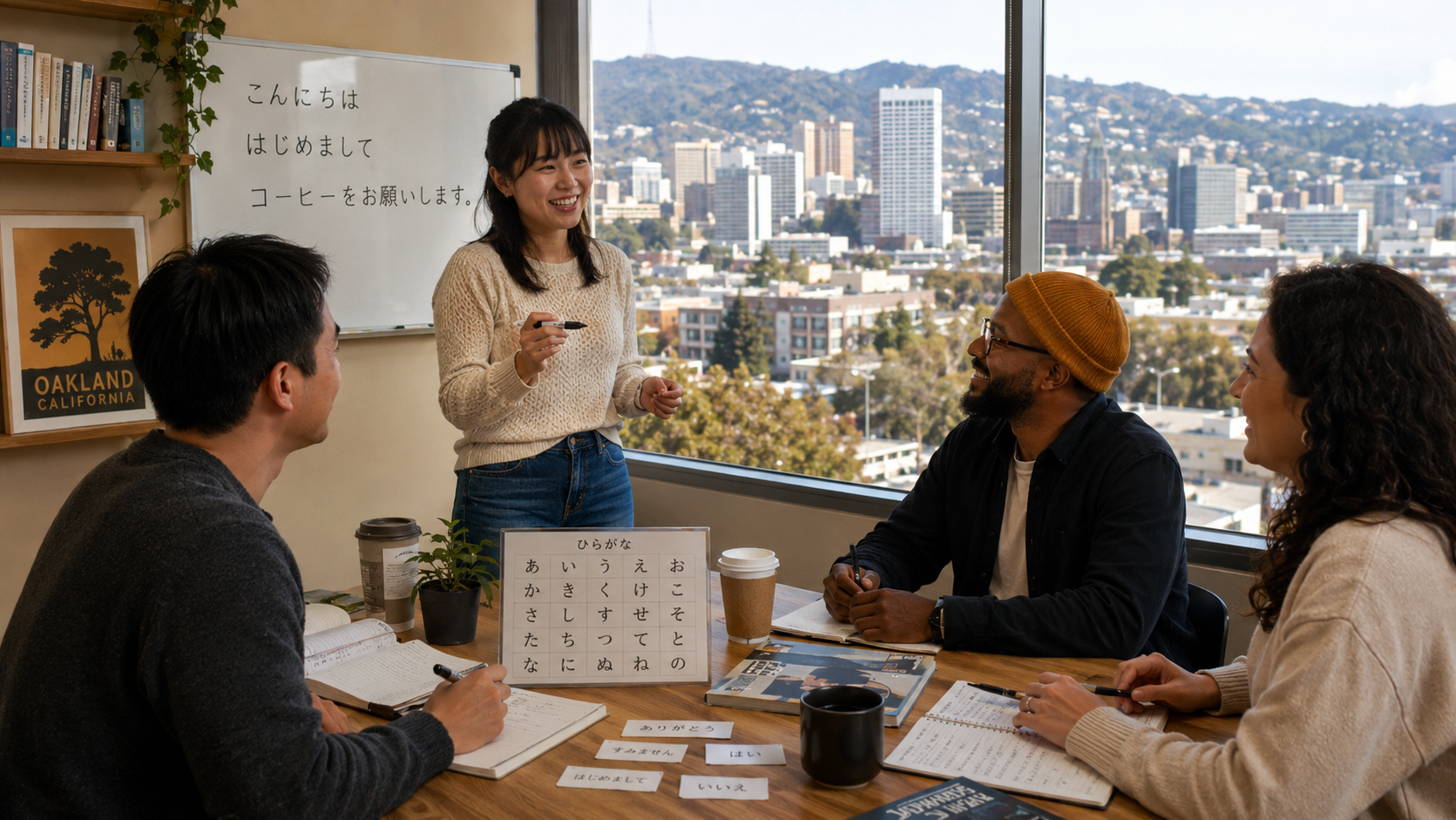
If you live in Oakland, Berkeley, or anywhere in the East Bay and you have ever tried to learn Japanese through an app, a YouTube channel, a textbook, a stack of flashcards, or a burst of enthusiasm before a trip to Tokyo, you may already know the strange frustration of recognizing a few words on a screen but freezing the moment you actually need to say something out loud.
You know こんにちは means hello. You may know that ありがとう means thank you. You may have learned a few kana. You may even recognize words from anime, Japanese films, menus, or travel videos. But when someone asks you a simple question in Japanese — or when you imagine yourself ordering food, introducing yourself, or asking for directions in Japan — suddenly the language feels less like a hobby and more like a test you did not prepare for.
This is one of the biggest problems adult language learners face: studying a language is not the same thing as speaking it.
Japanese makes this especially clear. You can spend weeks learning hiragana and katakana, memorizing vocabulary, reading grammar explanations, and reviewing kanji on an app, but still feel unable to hold even a basic conversation. That does not mean you are bad at languages. It usually means your learning has been too passive. You have been recognizing Japanese, but not producing it. You have been studying about Japanese, but not practicing Japanese with real people.
That is where small group classes can make an enormous difference.
For adult learners in Oakland and the East Bay, a good Japanese class should do more than introduce grammar charts or assign vocabulary lists. It should give you the chance to speak every week, hear Japanese from a real teacher, ask questions, practice pronunciation, repeat useful phrases, role-play real situations, and slowly build the confidence to use Japanese in conversation. It should be structured enough to keep you moving forward, but friendly enough that you are not terrified to make mistakes.
Because mistakes are not the enemy in language learning. Silence is.
If you are searching for Japanese classes in Oakland, you are probably not looking for an abstract academic experience. You probably want something practical. You want to learn Japanese in a way that fits a busy adult life. You want a class where the teacher knows how to guide beginners, where the group is small enough that you actually get to talk, and where the goal is not just “covering material” but helping you use the language.
This article is for you.
We will look at why Oakland and East Bay adults are interested in Japanese, why Japanese can feel challenging at first, why small group classes are especially helpful, what a good beginner Japanese class should include, how classes compare with apps and private lessons, and how to start learning in a way that actually leads to speaking.
Why Learn Japanese in Oakland and the East Bay?
Oakland and the broader East Bay are full of people who are curious about the world. Between Berkeley’s academic culture, Oakland’s creative energy, the Bay Area’s deep ties to Asia, and the region’s love of travel, food, film, design, technology, and lifelong learning, it makes sense that many adults here are drawn to Japanese.
Some people want to learn Japanese because they are planning a trip to Japan. They imagine themselves walking through Tokyo, ordering ramen in a tiny restaurant, navigating train stations, visiting Kyoto temples, or chatting politely with hotel staff. They do not necessarily need to become fluent immediately. They want enough Japanese to travel with more confidence and respect.
Others come through culture. Japanese food, anime, manga, cinema, literature, architecture, fashion, ceramics, video games, and music have all become global gateways into the language. Someone might start with Studio Ghibli, Haruki Murakami, sushi, ramen, city pop, Japanese design, or a favorite anime series — and eventually realize that subtitles and translations only go so far.
Some learners have professional reasons. The Bay Area has international business connections, technology ties, academic exchanges, and career paths where Japanese can be useful. Others have family or heritage connections. Some simply want a meaningful intellectual challenge.
And many adults are looking for something beyond apps.
Apps are convenient. They are useful. They can help with vocabulary, kana, kanji review, and daily practice. But after months of tapping through exercises, many learners realize they still cannot speak. They need structure. They need feedback. They need a teacher. They need human interaction.
That is why small group Japanese classes are such a good fit for Oakland, Berkeley, and East Bay learners. They offer a middle ground between studying alone and hiring a private tutor. They provide community, accountability, real-time correction, and regular speaking practice — all without the intensity or cost of one-on-one lessons.
What People Really Mean When They Search “Japanese Classes Oakland”
When someone searches for Japanese classes Oakland, they may technically be searching for a location. But the deeper search intent is usually more specific.
They may be asking:
Where can I learn Japanese as an adult?
Can I find a beginner Japanese class near Oakland or Berkeley?
Are there Japanese classes that are not just for children?
Can I learn in a small group instead of a huge classroom?
Will I actually get to speak?
Is there a class that fits my work schedule?
Can I take Japanese online if I live in Oakland?
Do I need to know hiragana already?
Is Japanese too hard to start as an adult?
These are practical questions.
Most adult learners are not looking for a university lecture. They are not necessarily looking for an intensive exam-prep program. They often want a class that feels welcoming, organized, and useful. They want a teacher who can explain difficult points clearly. They want classmates who are also learning from scratch or near the same level. They want to leave each class feeling they can say something they could not say before.
That is the difference between a class that merely teaches Japanese and a class that helps you speak Japanese.
Is Japanese Hard for Beginners?
Yes, Japanese is challenging for English speakers. It is important to be honest about that.
Japanese is not like Spanish, French, or Italian, where English speakers can rely on the Latin alphabet, shared vocabulary, and familiar grammar concepts. Japanese asks you to learn new writing systems, a different sentence order, particles, levels of politeness, and a communication style that often depends heavily on context.
But “hard” does not mean “impossible.”
It means you need a good method.
Let’s look at the main challenges.
The Three Writing Systems: Hiragana, Katakana, and Kanji
Japanese uses three writing systems:
Hiragana is used for native Japanese words, grammar endings, and particles.
Katakana is used for foreign loanwords, foreign names, emphasis, and sound effects.
Kanji are characters, originally from Chinese, that carry meaning and are used in many nouns, verb stems, adjectives, and written expressions.
For beginners, this can feel overwhelming. English uses one alphabet. Japanese uses three scripts together.
For example, a normal Japanese sentence may include kanji, hiragana, and katakana all in one line. That looks intimidating at first. But a good beginner class breaks this down gradually. You do not need to master every kanji before you can begin speaking. You can start with hiragana, add katakana, and slowly introduce useful kanji over time.
In fact, learning the writing system in a structured class can be much easier than doing it alone because a teacher can help you understand what matters first and what can wait.
Japanese Sentence Order Feels Different
English usually follows subject–verb–object order:
I drink coffee.
Japanese usually follows subject–object–verb order:
I coffee drink.
In Japanese:
私はコーヒーを飲みます。
Watashi wa kōhī o nomimasu.
I drink coffee.
The verb comes at the end. This can feel backwards to English speakers, especially at first.
But the good news is that Japanese sentence patterns are often very consistent. Once you get used to the rhythm, you can start building sentences with confidence.
A small group class helps because you practice these patterns out loud repeatedly. You do not just read about word order. You hear it, say it, repeat it, and use it in different contexts.
Particles Can Be Confusing
Japanese particles are small words or markers that show how different parts of the sentence function. Some common particles include:
は topic marker
が subject marker
を object marker
に time, direction, or indirect object
で location or method
と with / and
Particles are one of the biggest hurdles for English speakers because they do not work exactly like English prepositions.
For example:
コーヒーを飲みます。
Kōhī o nomimasu.
I drink coffee.
The particle を marks coffee as the object — the thing being drunk.
Beginners often try to skip particles or guess them randomly. But particles are essential to Japanese grammar. A teacher can help you learn them gradually through useful sentences rather than abstract grammar charts.
Politeness Matters in Japanese
Japanese has different levels of politeness. Beginners often start with polite forms such as です and ます, because they are safe and appropriate in many situations.
For example:
学生です。
Gakusei desu.
I am a student.
日本語を勉強します。
Nihongo o benkyō shimasu.
I study Japanese.
This polite style is useful with teachers, strangers, shop staff, and people you do not know well.
Later, students learn casual forms used with friends and family, and eventually more formal honorific and humble language used in professional situations. This can become complex, but beginners do not need to learn everything at once.
A good class introduces politeness in a practical way: what should you say to a teacher, a barista, a classmate, a friend, or a stranger in Japan?
That kind of cultural guidance is difficult to get from an app alone.
Listening to Real Japanese Takes Practice
Many beginners can understand slow classroom Japanese but feel lost when they hear natural Japanese speech. That is normal.
Real spoken Japanese can be fast. Subjects are often omitted. Sounds blend together. Casual forms appear. People use fillers, slang, and context. Anime, dramas, YouTube videos, and real conversations may sound very different from beginner textbook audio.
This is why listening practice needs to be gradual.
A good class helps you bridge the gap between slow, clear beginner Japanese and more natural speech. You hear your teacher. You hear classmates. You practice short dialogues. Over time, you build listening stamina.
Why Small Group Japanese Classes Work
Small group classes are especially helpful for Japanese because they combine structure, teacher guidance, and speaking practice. For many adult learners, this is the missing piece.
Here is why.
Small Groups Give You More Speaking Time
In a large class, it is easy to hide. You can sit quietly, take notes, and avoid speaking. That may feel comfortable, but it does not build fluency.
In a small group, you cannot disappear — and that is a good thing. You get more chances to speak. You answer questions. You repeat phrases. You practice dialogues. You make mistakes and correct them.
This is exactly what language learners need.
Speaking Japanese requires active production. You have to retrieve words, choose particles, pronounce sounds, and respond in real time. That skill only develops through practice.
Small Groups Are Less Intimidating Than Large Classes
Many adult learners feel nervous speaking a new language. This is especially true with Japanese because the writing system and grammar can feel unfamiliar.
A small group creates a safer environment. You are surrounded by other learners who are also making mistakes. The teacher gets to know your level. You become familiar with your classmates. The class starts to feel like a learning community rather than a performance.
That matters.
Confidence is not something you get before speaking. Confidence is something you build by speaking repeatedly in a supportive environment.
Small Groups Offer More Structure Than Apps
Apps are helpful, but they often do not provide a complete learning path. You may learn vocabulary but not know how to use it. You may recognize grammar but not produce it. You may practice kanji but not speak. You may build a long streak without building real communication skills.
A class gives you structure.
You know what to study this week. You know what to review. You know what level you are in. You have a teacher guiding the sequence. You have classmates moving through the same material.
For adults with busy lives, structure is not a luxury. It is often the difference between continuing and quitting.
Small Groups Are More Affordable Than Private Lessons
Private lessons can be excellent, especially for learners with specific goals. But they are also more expensive. For many beginners, a small group class offers the best balance: live instruction, real speaking practice, teacher feedback, and a lower cost than one-on-one tutoring.
You also get something private lessons do not always provide: peer interaction.
You hear other students’ questions. You practice with different people. You realize you are not the only one confused by particles or pronunciation. You learn from the group.
Teacher Feedback Makes a Difference
Japanese pronunciation is not impossible, but it does require attention. Long vowels, double consonants, rhythm, and pitch accent can affect how natural you sound. Grammar also requires correction. A tiny particle can change the sentence.
An app may tell you that an answer is wrong, but it cannot always explain why in a way that fits your exact sentence.
A teacher can.
A teacher can say:
“Use を here because coffee is the object.”
“This phrase is grammatically correct, but it sounds too casual for a stranger.”
“Your vowel is too short.”
“In this situation, Japanese speakers would usually say it this way.”
“You do not need to say 私 every time.”
That kind of feedback is invaluable.
Why “Actually Help You Speak” Matters
Many adult learners spend months or years studying a language without feeling able to speak it. This happens because language learning has two sides: passive recognition and active production.
Passive recognition means you can recognize a word when you see it or hear it.
Active production means you can use that word yourself in real time.
Apps and textbooks often build passive recognition. Speaking practice builds active production.
For example, you may recognize:
コーヒー
coffee
飲みます
drink
を
object marker
But can you quickly say:
コーヒーを飲みます。
I drink coffee.
Or:
コーヒーをお願いします。
Coffee, please.
Or:
毎朝コーヒーを飲みます。
I drink coffee every morning.
That is the difference.
A class that helps you speak does not simply explain Japanese. It makes you use Japanese. It gives you repetition, correction, and real-time practice.
What Should a Good Beginner Japanese Class Include?
A strong beginner Japanese class for adults should balance speaking, listening, reading, writing, grammar, pronunciation, and culture. It should not overwhelm students with everything at once, but it should also not ignore essential foundations.
Here is what a good beginner class should include.
Hiragana and Katakana
Beginners should learn hiragana and katakana early. These two scripts are essential for reading Japanese. A class may introduce them gradually, giving students time to practice recognition, writing, and pronunciation.
The goal is not perfection in one week. The goal is steady familiarity.
Greetings and Introductions
Students should learn practical beginner phrases such as:
こんにちは
Hello
はじめまして
Nice to meet you
よろしくお願いします
A polite phrase used when meeting someone or asking for cooperation
ありがとうございます
Thank you
すみません
Excuse me / sorry
They should also learn to introduce themselves:
私はロバートです。
I am Robert.
アメリカから来ました。
I am from America.
日本語を勉強しています。
I am studying Japanese.
These are useful from the first class.
Basic Sentence Patterns
A beginner class should teach common structures such as:
X は Y です。
X is Y.
X を Vます。
I do V to X.
場所で Vます。
I do V at a place.
時間に Vます。
I do V at a time.
These patterns allow students to create many sentences without needing advanced grammar.
Particles in Context
Particles should be introduced through real examples, not just lists.
For example:
私は学生です。
I am a student.
コーヒーを飲みます。
I drink coffee.
カフェで勉強します。
I study at a café.
七時に行きます。
I go at seven.
This helps students understand particles through use.
Speaking Practice Every Class
Every class should include speaking. Not just listening. Not just reading. Not just grammar explanation.
Students should practice:
Pair dialogues
Introductions
Question-and-answer drills
Role-plays
Pronunciation practice
Short conversations
Real-life scenarios
For example:
Ordering coffee
Asking for directions
Talking about hobbies
Introducing yourself
Shopping
Talking about your schedule
Saying what you like and dislike
This is how Japanese becomes usable.
Listening Practice
A good class should expose students to Japanese they can understand, then gradually increase difficulty. Listening should include teacher speech, classmates, short dialogues, and audio materials.
Students need to hear Japanese repeatedly before it becomes comfortable.
Culture and Etiquette
Japanese language and culture are deeply connected. Students should learn not only what words mean, but when and how to use them.
For example:
When should you use polite forms?
How do you address a teacher?
Why is よろしくお願いします so important?
How do you apologize politely?
Why are direct refusals often softened?
What should you say when entering a shop or restaurant?
These details help learners avoid awkwardness and understand the language more deeply.
Simple Kanji Over Time
A beginner class should not dump hundreds of kanji on students immediately. But it should introduce kanji gradually.
Useful early kanji include:
日 day / sun
月 month / moon
人 person
本 book / origin
水 water
火 fire
山 mountain
Kanji becomes less scary when learned slowly and in context.
Japanese Classes vs Apps vs Private Lessons
Many learners wonder whether they should use apps, take group classes, or hire a private tutor. The best choice depends on your goals, budget, and learning style.
Apps
Apps are useful for:
Vocabulary review
Kana practice
Kanji repetition
Short daily study
Maintaining a habit
Apps are convenient and can be a great supplement. But they rarely provide enough speaking practice, correction, or cultural explanation.
Private Lessons
Private lessons are useful for:
Personalized attention
Flexible pacing
Specific goals
Intensive speaking practice
Exam preparation or special needs
The downside is cost. Private lessons can also feel intense for some beginners.
Small Group Classes
Small group classes are useful for:
Regular speaking practice
Teacher feedback
Classmate interaction
Structured progression
Lower cost than private lessons
Accountability
Confidence-building
For many adult beginners, small group classes are the best starting point. You get guidance, community, and practice without feeling alone or overwhelmed.
The ideal combination is often: small group class + app review at home.
Use the app for daily reinforcement. Use the class for speaking, questions, correction, and real human practice.
Why Oakland and East Bay Learners Benefit from Small Classes
Adult learners in Oakland, Berkeley, Emeryville, Alameda, Piedmont, San Leandro, and the broader East Bay often have full lives. They work. They commute. They travel. They have families, creative projects, businesses, or demanding schedules. They need language learning that is efficient, social, and realistic.
A small group class fits that lifestyle.
It gives you a regular appointment with the language. It gets you out of passive learning mode. It lets you meet other people with the same interest. It turns Japanese from something you “should study sometime” into something you actually practice each week.
And in a region like the East Bay, where people value culture, education, international travel, and community, small group Japanese classes feel natural. They are not just about grammar. They are about connection.
You may start because you want to travel to Japan. You may continue because you enjoy the class. You may stay because Japanese opens up an entire world of food, film, literature, conversation, and culture.
How to Get Started with Japanese
If you are a complete beginner, do not wait until you “know enough” to join a class. That is exactly what beginner classes are for.
Here are a few simple ways to prepare:
Learn a few basic greetings
Start with:
こんにちは — hello
ありがとうございます — thank you
すみません — excuse me / sorry
はい — yes
いいえ — no
Begin hiragana slowly
You do not need to master it before class, but learning a few characters can help you feel less intimidated.
Set a realistic goal
Instead of saying “I want to become fluent,” start with:
I want to introduce myself.
I want to read hiragana.
I want to order food.
I want to understand basic classroom Japanese.
I want to hold a simple conversation.
Small goals create momentum.
Practice between classes
Even ten minutes a day helps. Review vocabulary. Listen to beginner audio. Practice kana. Say phrases out loud.
Be willing to speak badly at first
This is important. No one speaks beautifully at the beginning. You will make mistakes. That is how speaking develops.
A good class will help you make those mistakes safely and correct them gradually.
What Makes a Good Japanese Teacher?
A good Japanese teacher for adults does more than know Japanese. They know how to explain Japanese to beginners.
Look for a teacher who:
Speaks clearly
Encourages students to talk
Explains grammar simply
Corrects mistakes kindly
Understands adult learners
Balances structure and conversation
Teaches culture along with language
Gives students practical phrases
Makes students feel comfortable speaking
The right teacher can make Japanese feel manageable instead of overwhelming.
FAQs About Japanese Classes in Oakland
Where can I learn Japanese in Oakland?
If you live in Oakland, you can look for Japanese classes in Oakland, Berkeley, or online programs serving East Bay students. Many Oakland learners are willing to attend classes in nearby Berkeley or join live online classes if the schedule is convenient. Polyglottist Language Academy offers language classes for adults and serves students from Oakland, Berkeley, and the wider Bay Area.
Are there Japanese classes for adults in Oakland?
Yes, adult learners in Oakland and the East Bay have several options, including small group classes, online classes, private tutors, and community programs. If your goal is to speak, look for classes that emphasize conversation, teacher feedback, and practical use rather than only memorization.
Is Japanese hard for beginners?
Japanese is challenging for English speakers because of the writing systems, sentence order, particles, and politeness levels. However, beginners can still make steady progress with a structured class. Pronunciation is manageable, basic sentence patterns are logical, and you can start speaking simple Japanese early.
Can I learn Japanese in a small group class?
Yes. Small group classes are one of the best ways to learn Japanese as an adult beginner. They provide structure, speaking practice, teacher correction, and interaction with classmates. You get more speaking time than in a large class and more community than in private lessons.
Are small group Japanese classes better than apps?
Small group classes and apps serve different purposes. Apps are useful for review, vocabulary, kana, and kanji practice. Classes are better for speaking, listening, pronunciation correction, grammar explanation, accountability, and cultural context. Many learners benefit from using both.
Do I need to know hiragana before joining a beginner Japanese class?
Usually, no. Many beginner Japanese classes teach hiragana from the start. However, learning a few characters before class can help you feel more confident. If you are unsure, contact the school and ask what level of reading knowledge is expected.
How long does it take to learn basic Japanese?
With consistent weekly classes and regular practice at home, many adult learners can learn basic travel phrases and simple conversation within a few months. More comfortable beginner conversation may take six months to a year. Fluency takes much longer, but you can use Japanese meaningfully long before you are fluent.
Can adults learn Japanese successfully?
Absolutely. Adults can learn Japanese very successfully, especially when they have structure, motivation, and regular practice. Adult learners often bring strong discipline and clear goals. The key is consistency and willingness to speak, even imperfectly.
Should I take private Japanese lessons or group classes?
Private lessons are best if you need highly personalized instruction or have a specific goal. Small group classes are ideal if you want structure, conversation practice, peer support, and a more affordable option. For many beginners, small group classes are the best place to start.
What should I expect in my first Japanese class?
In your first Japanese class, you can expect basic greetings, pronunciation practice, simple introductions, and possibly an introduction to hiragana. A good beginner class should feel welcoming and manageable. You should not be expected to know everything already.
Learn Japanese with Polyglottist Language Academy
If you are ready to move beyond apps and start speaking Japanese with real guidance, Polyglottist Language Academy can help.
We offer language classes for adults in small, supportive groups designed to help students build confidence step by step. Our approach is practical, structured, and conversation-focused. We understand that adult learners need clear explanations, regular practice, and a comfortable environment where they can make mistakes and improve.
Whether you live in Oakland, Berkeley, or elsewhere in the Bay Area, our Japanese classes are designed to help you build a real foundation in the language. You will practice pronunciation, useful phrases, sentence patterns, listening, reading, writing, and cultural context — not as disconnected pieces, but as part of learning to actually communicate.
Japanese takes time. But you do not have to figure it out alone.
If you are interested in learning Japanese in a small group class that helps you speak, we invite you to explore our current and upcoming classes at Polyglottist Language Academy and sign up for the level that fits you best.
The first step is not fluency.
The first step is joining a class and beginning.
Keep Reading: Related Articles from Our Blog
If you enjoyed this article, you may also like these related posts:
The Best Way To Start Learning Japanese As A Complete Beginner
Japanese Pronunciation For Beginners: What English Speakers Get Wrong
How To Practice Japanese Every Day Even With A Busy Schedule
Hiragana, Katakana, And Kanji: What Japanese Learners Need To Know First
Japanese Lessons In Palo Alto: A Smarter Way To Learn The Language
Learn Japanese In Walnut Creek: Small Classes, Real Progress
Japanese Classes In San Francisco For Adults: Where To Start