
What Makes Russian Different From Other European Languages?
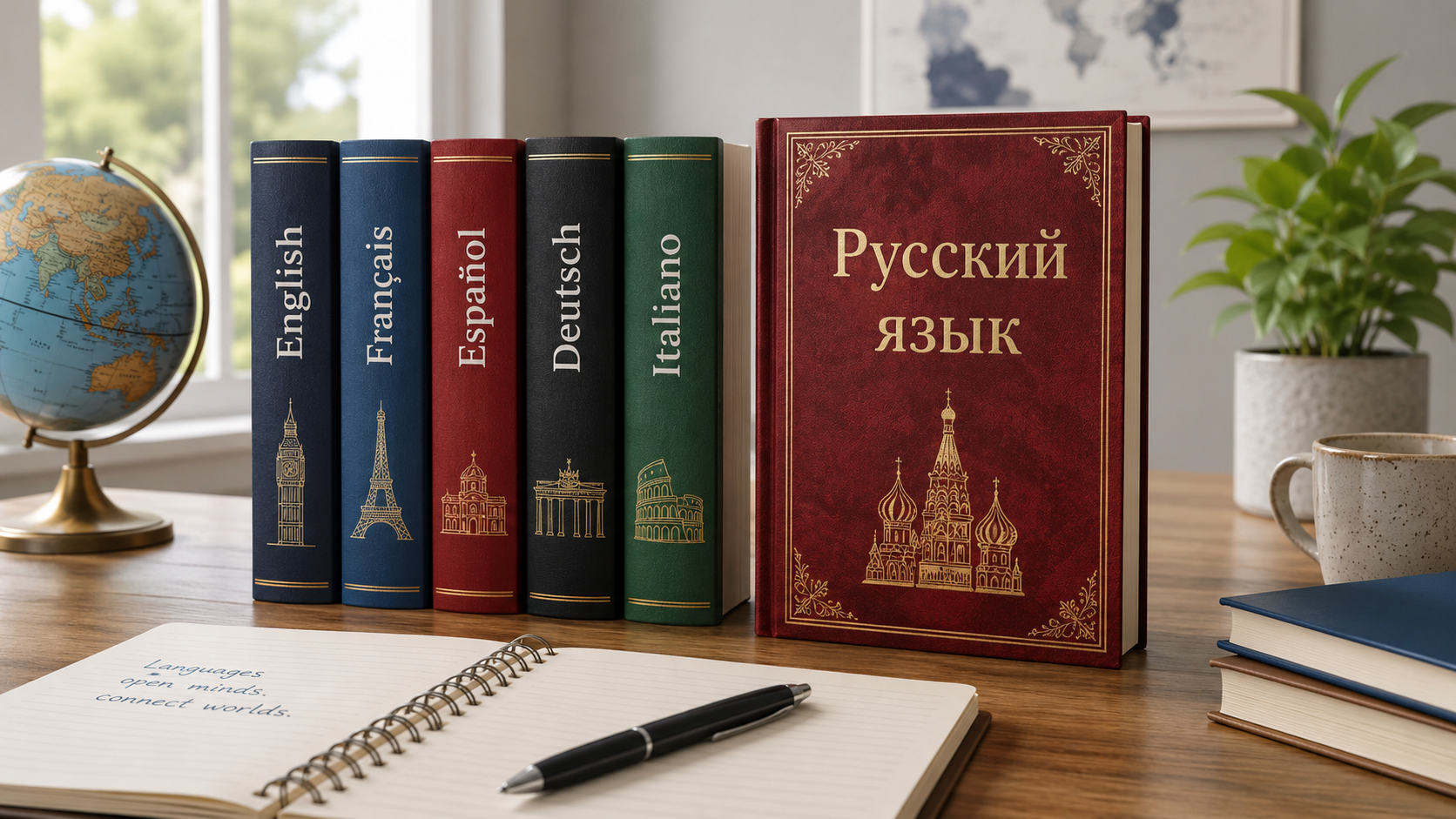
If you grew up speaking English, studied French or Spanish in school, heard Italian in movies, noticed that Dutch and German look vaguely familiar on signs, and then suddenly opened a Russian textbook only to see Cyrillic letters, shifting endings, strange-looking consonant clusters, and sentences that seem to place words in an order you would never expect, it is very easy to feel as if Russian belongs to a completely different linguistic universe.
But that first impression is only partly true.
Russian is different from many of the European languages English speakers usually encounter first. It does not look like French, Spanish, Italian, German, Dutch, or Portuguese on the page. It does not use articles like “a,” “an,” or “the.” It changes noun endings in ways that English stopped doing centuries ago. It has a verb system that forces you to think about whether an action is ongoing, repeated, completed, attempted, finished, interrupted, or done once with a clear result. It has formal and informal ways to say “you.” It has a famous alphabet that scares beginners before they even start.
And yet Russian is not “alien.” It is not random. It is not impossible. In fact, Russian is a European language, an Indo-European language, and a close cousin—not a sibling, perhaps, but certainly a cousin—of English, German, Dutch, French, Spanish, Italian, and Portuguese.
What makes Russian fascinating is that it combines the familiar and the unfamiliar. It shares deep historical roots with other European languages, but it developed in a very different branch of the family tree. It has recognizable vocabulary here and there, but much of its core vocabulary feels new. It uses grammar in ways that Western European languages often abandoned long ago. It gives speakers tools for expressing emphasis, completion, movement, emotional closeness, respect, distance, and sincerity in ways that can feel surprisingly precise once you begin to understand them.
For many learners, Russian is intimidating at first because the differences are visible immediately. With French or Spanish, the alphabet looks familiar, so beginners feel they are starting from something they already know. With Russian, the alphabet itself announces: “This will be different.”
But difference is not the same thing as difficulty.
Some parts of Russian are genuinely challenging. Cases, verb aspect, verbs of motion, stress patterns, and pronunciation all require time and practice. But other parts are much easier than learners expect. Cyrillic can be learned much faster than most people imagine. Russian spelling is often more regular than English spelling. There are no articles to memorize. The tense system is less crowded than in many Romance languages. And once you begin to see the internal logic of Russian, the language starts to feel less like a wall and more like a beautifully engineered machine.
So what exactly makes Russian different from other European languages? Let’s look at the main features that make Russian feel unusual, powerful, and deeply rewarding to learn.
Russian Is European, But Not Western European
The first thing to understand is that Russian belongs to the Indo-European language family. That means it is historically related to English, German, Dutch, French, Spanish, Italian, Portuguese, Greek, Hindi, Persian, and many other languages.
Within that large family, Russian belongs to the Slavic branch. More specifically, it is an East Slavic language, closely related to Ukrainian and Belarusian. This already explains a lot. English, Dutch, and German are Germanic languages. French, Spanish, Italian, and Portuguese are Romance languages descended from Latin. Russian comes from a different branch of the same family tree.
This is why Russian can feel both familiar and foreign. At the deepest level, it shares Indo-European roots with many European languages. But in everyday learning, it behaves very differently from the languages most English speakers know.
For example, Romance languages often feel accessible to English speakers because English has borrowed so many words from French and Latin. Words like nation, culture, important, possible, history, literature, and information have close relatives in French, Spanish, Italian, and Portuguese. Russian has borrowed many international words too, especially in modern vocabulary, but its basic everyday vocabulary is mostly Slavic. That means common words such as “to speak,” “to go,” “house,” “person,” “hand,” “water,” “friend,” and “to know” often look completely unfamiliar at first.
Compare:
English: water
Spanish: agua
French: eau
German: Wasser
Russian: вода́
Or:
English: hand
German: Hand
Dutch: hand
Russian: рука́
Russian belongs to Europe linguistically and culturally, but it does not sit in the same familiar Western European zone as French, Spanish, Italian, Dutch, or German. It opens a different door into Europe: Eastern Europe, Slavic culture, Orthodox traditions, imperial history, Soviet history, post-Soviet identity, and one of the richest literary traditions in the world.
The Cyrillic Alphabet Looks Harder Than It Is
For many beginners, the first shock is the alphabet. Russian uses Cyrillic, not the Latin alphabet. A word like здравствуйте can look impossible before you have learned how the letters work.
But Cyrillic is often the most overestimated difficulty in Russian.
Modern Russian uses 33 letters. Some look and sound familiar:
А sounds like “a”
М sounds like “m”
К sounds like “k”
Т sounds like “t”
О often sounds like “o” when stressed
Some letters look familiar but represent different sounds:
В sounds like “v”
Н sounds like “n”
Р sounds like a rolled “r”
С sounds like “s”
У sounds like “oo”
And some letters look completely new:
Ж sounds like the “s” in “measure”
Ш sounds like “sh”
Ч sounds like “ch”
Щ is a softer, longer “shch” or “sh” sound
Ы is a vowel that English speakers need to practice
At first, this feels strange. But the advantage is that Cyrillic is learnable. Unlike English spelling, which is full of historical irregularities, Russian spelling is much more systematic. Once you learn the alphabet and basic pronunciation rules, you can usually read Russian words aloud even if you do not yet know what they mean.
This is very different from English, where words like though, through, rough, cough, and thought all behave differently. Russian has its own complications, especially stress and vowel reduction, but the writing system itself is not the real monster. Most serious beginners can learn to read Cyrillic in a few focused days or a week. Becoming fluent is another matter, of course, but decoding the alphabet is a much smaller mountain than it appears from the outside.
Cyrillic also gives learners an emotional reward. The moment you can read your first Russian signs, menus, names, and short sentences, the language stops looking like a secret code. You begin to recognize words. Москва becomes Moskva. ресторан becomes restoran. театр becomes teatr. такси becomes taksi.
Suddenly Russian is no longer a wall of mysterious symbols. It is a language you can enter.
Russian Pronunciation Has Stress, Softness, and Reduction
Russian pronunciation is one of the areas where learners immediately notice a difference from Romance languages such as Spanish or Italian.
In Spanish and Italian, vowels tend to be clear and stable. Once you know how a vowel is pronounced, it usually stays recognizable. Russian vowels behave differently. Stress matters enormously. A stressed vowel is pronounced clearly, but unstressed vowels may change their sound.
One famous example is молоко́, meaning “milk.” It is written with three о letters, but only the final о is stressed. The earlier vowels are reduced, so the word sounds more like “muh-lah-KO” than “mo-lo-ko.” This surprises learners who expect each written letter to produce the same sound every time.
Russian stress is also unpredictable. It can fall on different syllables, and it is usually not marked in normal writing. That means learners need to memorize stress as part of the word. This can be frustrating at first, but it is also part of what gives Russian its rhythm and musicality.
Another major feature is palatalization, often described as “soft” consonants. Many Russian consonants come in hard and soft pairs. A soft consonant is pronounced with the tongue raised slightly toward the palate, giving it a subtle “y-like” quality. This distinction can change meaning, so it is not just decorative.
For English speakers, soft consonants require ear training. At first, мать and мат may sound very similar. But in Russian, the soft ending in мать matters. It changes the word.
Russian also has consonant clusters that can feel intense: встреча, здравствуйте, взгляд, встречаться. To speakers of Italian or Spanish, where words often flow with open syllables and clear vowels, Russian can sound dense. But that density is rule-governed. Russian is not harsh by nature; it simply uses sounds and clusters that many Western learners are not used to hearing.
Once learners become familiar with soft consonants, shifting stress, and vowel reduction, Russian begins to sound less “hard” and more expressive. It can be sharp, yes, but also soft, melodic, intimate, playful, and poetic.
Russian Cases Change the Shape of Sentences
The case system is one of the biggest differences between Russian and most Western European languages.
In English, word order does most of the grammatical work. If we say “The woman sees the man,” we know the woman is doing the seeing because she comes before the verb. If we say “The man sees the woman,” the meaning changes because the word order changes.
Russian also has a basic word order, but it relies much more heavily on endings. Nouns, pronouns, adjectives, and some numbers change form depending on their role in the sentence.
Russian has six main cases:
Nominative — the subject
Accusative — the direct object
Genitive — possession, absence, quantity, “of” relationships
Dative — “to” or “for” someone
Instrumental — “with” or “by means of” something
Prepositional — used after certain prepositions, often for location or topic
For example, the Russian word for “house” is дом. But depending on the sentence, you may see forms like дом, дома, дому, домом, or доме.
In English, we often use prepositions and word order to express these relationships:
to the house
in the house
from the house
with the house
near the house
Russian often expresses similar relationships through a combination of prepositions and endings. The ending is not optional; it carries grammatical meaning.
This is one reason Russian feels so different. A beginner cannot simply memorize words in isolation. You eventually need to know how words change when they enter a sentence.
But cases also give Russian power. Because endings identify the role of each word, Russian word order can be much more flexible than English word order. You can move words around for emphasis, contrast, rhythm, or emotional effect without losing the basic meaning.
This is why Russian can sound compact and expressive. The grammar is doing work that English often does with extra words.
Russian Word Order Is Flexible, But Not Random
English word order is relatively strict. “I love Moscow” and “Moscow love I” do not mean the same thing; the second one simply sounds wrong.
Russian word order is more flexible because case endings show who is doing what to whom. This does not mean you can throw words anywhere. Russian word order has its own logic, especially around topic, emphasis, and what information is new or important.
For example:
Ваня купил книгу.
Vanya bought a book.
This is a neutral sentence.
But Russian can also say:
Книгу купил Ваня.
It was Vanya who bought the book.
Or:
Книгу Ваня купил.
As for the book, Vanya bought it.
The basic facts remain similar, but the emphasis changes. English often needs stress, extra words, or special constructions to do this. Russian can do it naturally through word order and intonation.
This flexibility is one of the beautiful things about Russian, but it can confuse beginners. When learners first see Russian sentences, they may wonder why the words are not in the order they expected. The answer is usually not “Russian has no rules.” The answer is that Russian is organizing information differently.
In Russian, word order often tells you what the speaker assumes you already know, what is being emphasized, what is being contrasted, and what emotional weight the sentence carries.
This is one reason Russian literature can be so powerful in the original. Word order can create subtle shifts in tone that are difficult to translate fully into English.
Russian Verbs Make You Think About Completion
Russian verbs are one of the most distinctive parts of the language.
English has many tenses: I read, I am reading, I have read, I had read, I will read, I will have read, and so on. Romance languages also have rich tense systems. Russian has fewer tense forms, but it has something that can feel even more important: aspect.
Aspect is the difference between viewing an action as a process, habit, repeated event, or unfinished activity versus viewing it as a completed whole.
For example:
читать means “to read” in an ongoing, repeated, or general sense
прочитать means “to read through” or “to finish reading”
This distinction is not just advanced grammar. It is central to Russian. When you choose a verb, you often need to choose whether the action is complete or incomplete, one-time or repeated, result-focused or process-focused.
English can express this too, but often with extra words:
I was reading the book.
I read the book every evening.
I finished reading the book.
I managed to read the book.
Russian builds many of these distinctions into the verb system.
This can be difficult because learners cannot simply ask, “What is the Russian word for read?” Very often there are two related verbs, and choosing between them changes the meaning.
Russian verbs of motion add another layer. Russian distinguishes between going on foot and going by vehicle, between going in one direction and going habitually or back and forth, and then uses prefixes to show entering, leaving, arriving, passing by, crossing over, going around, and more.
For example, the concept “to go” can involve different verbs depending on whether you are walking, driving, going once, going regularly, arriving, leaving, or moving around.
To English speakers, this seems complicated. But it also reveals something elegant about Russian: movement is described with remarkable precision. Russian does not just ask “go or not go?” It asks how, where, in what direction, with what result, and whether the movement is a single trip or a repeated pattern.
This is one of the reasons Russian changes how learners think. It trains you to notice the shape of actions.
Russian Has No Articles
One of the most surprising differences is that Russian has no equivalent of “a,” “an,” or “the.”
For English speakers, articles are everywhere:
I saw a dog.
I saw the dog.
She bought a book.
She bought the book.
Russian does not mark this distinction with articles. A sentence like Я купил книгу can mean “I bought a book” or “I bought the book,” depending on context.
At first, this feels like a relief. No articles! No need to memorize whether a word is masculine or feminine for the article, as in French, Spanish, Italian, Portuguese, or German.
But then learners discover the challenge: Russian still expresses definiteness and indefiniteness, just not with articles. It uses context, word order, demonstratives, intonation, and shared knowledge between speakers.
This means Russian relies heavily on context. If both speakers know which book is being discussed, the sentence can mean “the book.” If the book is new information, it can mean “a book.”
For English speakers, this can feel vague. For Russian speakers, it feels normal. The language does not need articles because it has other tools.
This is a good reminder that languages do not all divide reality in the same way. English requires you to constantly choose between “a” and “the.” Russian does not. Russian requires you to constantly think about case and aspect. English does not.
Every language makes some things explicit and leaves other things to context.
Russian Politeness Works Differently
Russian has two main ways to say “you”: ты and вы.
Ты is informal. It is used with close friends, family, children, and people with whom you have an informal relationship. Вы is formal or polite. It is used with strangers, older people, teachers, officials, clients, and in professional settings.
This may sound familiar if you have studied French, Spanish, German, or other European languages. French has tu and vous. Spanish has tú and usted. German has du and Sie. But Russian uses this distinction in its own cultural way.
The choice between ты and вы can carry emotional weight. Moving from вы to ты can signal closeness, warmth, friendship, or equality. But using ты too soon can feel rude, intrusive, or disrespectful. On the other hand, switching back to вы can create distance or signal displeasure.
Russian also has a formal naming system that is very different from English. In respectful settings, people are often addressed by first name plus patronymic: for example, Анна Сергеевна or Михаил Иванович. The patronymic is based on the father’s name and carries a formal, respectful tone.
This gives Russian a layered system of address. You can call someone by full first name, short name, diminutive, surname, first name plus patronymic, or title depending on the relationship.
For learners, this is not just vocabulary. It is culture. Russian has many ways to signal distance, respect, affection, hierarchy, intimacy, or irony through names and pronouns.
A person named Александр may be Александр in a formal context, Саша among friends, Сашенька in affectionate speech, Александр Иванович in professional respect, or simply Саш in casual conversation.
English can express these feelings too, but Russian builds them deeply into everyday naming patterns.
Russian Communication Can Feel More Direct
Another difference is not purely grammatical. It is cultural.
Russian communication can feel more direct than English communication. English, especially in American and British professional settings, often uses softeners:
I was just wondering if maybe…
Would you possibly be able to…
I’m not sure this is the best option…
That might be a little difficult.
Russian often uses fewer layers of verbal cushioning. A Russian speaker may say something much more directly:
Это невозможно.
This is impossible.Это неправильно.
This is incorrect.Мне не нравится.
I don’t like it.
To English speakers, this can sound blunt. But in Russian cultural logic, directness is not necessarily rude. It can signal honesty, seriousness, and respect for the other person’s time.
Russian also has a different relationship with small talk. In many English-speaking cultures, casual friendliness with strangers is normal. Smiling, chatting, and using cheerful phrases are part of public politeness. In Russian culture, public friendliness with strangers is often more restrained. A neutral face is not necessarily unfriendly. It may simply be normal public behavior.
But once a relationship becomes closer, Russian communication can become very warm, personal, generous, and emotionally intense. Many learners discover that Russian has a public/private contrast: more reserved in public, but often deeply sincere in friendship.
This is one of the cultural lessons of learning Russian. You learn not to judge warmth by the same external signals you might use in English. A lack of constant smiling does not mean coldness. Direct speech does not always mean aggression. Formality does not always mean distance forever. Russian emotional life is rich, but it is expressed through different codes.
Russian Vocabulary Carries History
Russian vocabulary reflects centuries of history: Slavic roots, Orthodox Christianity, the Russian Empire, European influence, Soviet life, scientific vocabulary, literature, and modern global culture.
Some words are old and deeply Slavic. These are often the everyday words that beginners must learn first: вода, хлеб, дом, рука, мать, друг, говорить, знать.
Other words came through Church Slavonic, giving Russian a formal, elevated, or religious layer. This is important for literature, philosophy, religious writing, and older styles of speech.
Russian also borrowed from European languages, especially French, German, Dutch, and later English. In the 18th and 19th centuries, French had enormous prestige among the Russian aristocracy. German influenced technical, military, and scientific vocabulary. Dutch left traces especially in maritime and practical domains. Modern English contributes many technology, business, and pop-culture terms.
Then there is Soviet vocabulary: words connected to institutions, ideology, bureaucracy, work, education, and daily life in the USSR. Some of these words are historical, but many still appear in jokes, literature, family stories, films, and political discussions.
This means Russian vocabulary is not just a list of words. It is a map of cultural memory. When you learn Russian, you begin to notice layers: old Slavic, religious, literary, bureaucratic, Soviet, modern, slang, poetic, and international.
That is one reason Russian is so rewarding for people interested in history, literature, politics, or culture. The language itself carries the past.
Russian Is Hard, But Not in the Way Beginners Expect
Russian has a reputation for being very difficult. That reputation is not completely undeserved, but it is often misunderstood.
The alphabet is not the hardest part. It is unfamiliar, but learnable.
The real challenges usually come later:
remembering case endings
choosing the correct case after prepositions
using verb aspect naturally
understanding verbs of motion
learning unpredictable stress
hearing the difference between hard and soft consonants
speaking with accuracy in real time
These are real challenges. Russian requires patience. It is not a language where English speakers can rely heavily on familiar vocabulary and guess their way through.
But Russian also has features that are easier than people expect:
no articles
relatively logical spelling
fewer tense forms than many learners fear
a manageable alphabet
many international words in modern vocabulary
strong grammatical patterns once you understand them
The key is not to approach Russian as “English with different words.” Russian requires you to accept a different system. If you fight the system, it feels impossible. If you learn the logic step by step, it becomes manageable.
A beginner does not need to master all six cases immediately. You can start with greetings, pronunciation, the alphabet, simple present-tense verbs, basic sentence patterns, and useful phrases. Then cases and aspect can be introduced gradually.
Russian rewards structured learning. It is difficult to absorb randomly, but it becomes much more approachable with a good teacher, clear explanations, and consistent practice.
Russian Gives You a Different Way to Think
One of the most beautiful reasons to learn Russian is that it gives you access to a different way of organizing thought.
The case system trains you to see relationships between words. Verb aspect trains you to notice whether an action is complete, repeated, attempted, or still unfolding. Verbs of motion train you to notice direction, method, and movement patterns. Names and patronymics train you to notice social distance and respect. Diminutives train you to hear affection, irony, tenderness, and familiarity.
Russian also gives access to literature that has shaped the world: Pushkin, Tolstoy, Dostoevsky, Chekhov, Akhmatova, Bulgakov, Tsvetaeva, Pasternak, Solzhenitsyn, and many others. Even in translation, Russian literature is powerful. But in the original, you begin to see how the grammar, rhythm, word order, and emotional tone work together.
Russian is often associated with intensity, and there is truth in that. It is a language capable of deep seriousness, dark humor, philosophical argument, tenderness, sarcasm, bureaucracy, poetry, and emotional confession. It can sound official and heavy in one sentence, then intimate and playful in the next.
Learning Russian does not simply teach you how to order food or introduce yourself, although it does that too. It teaches you to enter another cultural logic.
So, What Really Makes Russian Different?
Russian is different from other European languages because it preserves and develops features that many Western European languages have simplified, reduced, or handled differently.
It uses a different alphabet. It has a rich case system. It has flexible word order. It has no articles. It relies heavily on verb aspect. It treats movement with unusual precision. It marks social relationships through pronouns, names, and forms of address. It carries layers of Slavic, Orthodox, imperial, Soviet, and modern vocabulary. It often values directness and sincerity over surface-level politeness.
But Russian is not different because it is chaotic. It is different because it is systematic in another way.
For English speakers, learning Russian is not just a language project. It is an intellectual adventure. It asks you to stop assuming that your own language’s habits are universal. It asks you to notice endings, sound changes, context, completion, direction, emotional distance, and cultural nuance.
That is exactly what makes Russian so rewarding.
You do not learn Russian because it is easy. You learn it because it opens a door that few other European languages open in quite the same way.
FAQs About Russian and Other European Languages
Is Russian harder than French, Spanish, or Italian?
For most English speakers, yes, Russian is usually harder than French, Spanish, or Italian. The main reasons are the Cyrillic alphabet, case endings, verb aspect, verbs of motion, and less familiar vocabulary. However, Russian is not impossible. Some parts, such as the lack of articles and relatively logical spelling, are easier than learners expect.
Is Russian related to English?
Yes. Russian and English are both Indo-European languages, which means they share a distant historical ancestor. However, English is Germanic, while Russian is Slavic. They are related, but not closely enough for Russian to feel immediately familiar to most English speakers.
Is the Russian alphabet difficult?
The Russian alphabet looks intimidating at first, but it is one of the easier parts of the language to begin learning. Most learners can start reading basic Cyrillic within a few days of focused practice. The bigger challenge is not the alphabet itself, but stress, pronunciation, and building vocabulary.
Why does Russian have cases?
Russian uses cases to show the grammatical role of nouns, pronouns, and adjectives in a sentence. Cases tell you whether something is the subject, direct object, indirect object, possession, location, instrument, or part of a prepositional phrase. English mostly uses word order and prepositions for this, while Russian uses endings.
Why is Russian word order so flexible?
Russian word order is flexible because case endings show the function of each word. This allows speakers to move words around for emphasis, contrast, rhythm, or style without losing the basic meaning. However, Russian word order is not random; it follows rules of focus, context, and natural expression.
Why are Russian verbs so complicated?
Russian verbs are complicated mainly because of aspect and motion. Aspect requires speakers to choose between incomplete, ongoing, repeated, or completed actions. Verbs of motion distinguish direction, method of movement, frequency, and result. This takes practice, but it also makes Russian very precise.
Does Russian have articles like “a” and “the”?
No. Russian does not have articles. A phrase can mean “a book” or “the book” depending on context. This is easier in one sense because learners do not need to memorize articles, but it also means they must learn how Russian uses context and word order to express definiteness.
Is Russian useful outside Russia?
Yes. Russian is spoken by millions of people across Eastern Europe, Central Asia, the Caucasus, Israel, Germany, the United States, and other diaspora communities. It is also important for literature, history, politics, international relations, business, science, and cultural study.
Can adults learn Russian successfully?
Absolutely. Adults can learn Russian successfully, especially with structured instruction and realistic goals. The key is not to rush. A good beginner course should help students master the alphabet, pronunciation, basic phrases, simple grammar, and core sentence patterns before moving into more advanced topics like cases and aspect.
Learn Russian With Polyglottist Language Academy
If Russian has always fascinated you but also intimidated you, that is completely normal. Many adult learners are drawn to Russian because of literature, history, family background, travel, culture, politics, or simple curiosity—but they are not sure where to begin.
At Polyglottist Language Academy, we offer structured, supportive Russian classes designed for adult learners. Our classes help students build real skills step by step: reading Cyrillic, understanding pronunciation, learning essential grammar, practicing conversation, and gaining confidence with a language that may seem difficult at first but becomes much more approachable with the right guidance.
Whether you are a complete beginner or returning to Russian after many years away, our small-group classes give you the chance to learn in a friendly environment with expert instruction and plenty of practice.
Explore our current Russian class schedule and sign up for a course with Polyglottist Language Academy. Russian may be different from other European languages—but that difference is exactly what makes it worth learning.
Check Out Our Other Russian Language and Culture Articles
To continue exploring Russian language, grammar, and culture, you may also enjoy these related articles: