
The Best Way to Start Learning Japanese as a Complete Beginner
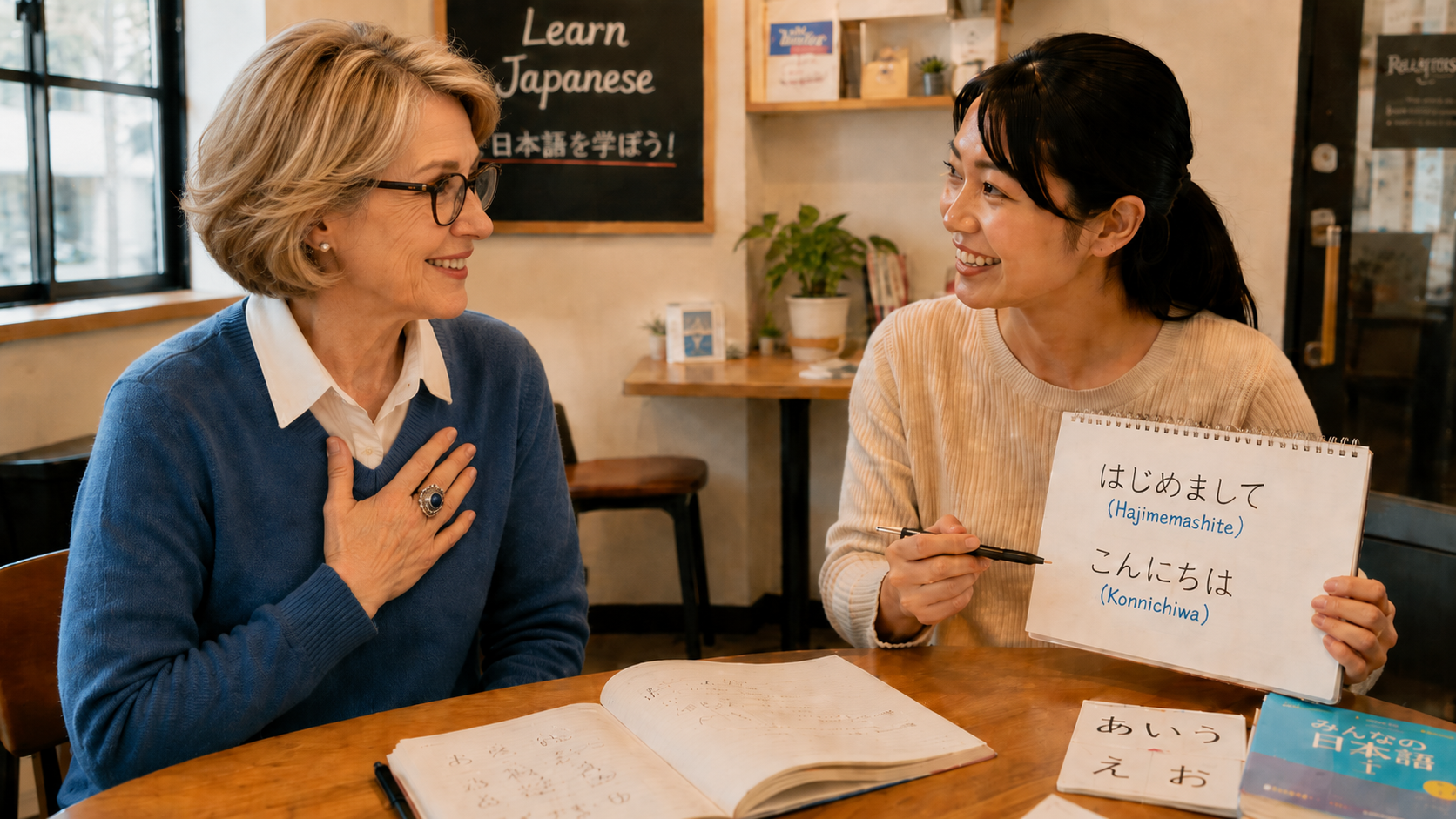
Learning Japanese for the first time can feel like standing at the entrance to an entirely different world: the signs are beautiful but unreadable, the sounds are familiar from films and anime yet difficult to catch, the grammar seems to run in the opposite direction from English, and somewhere behind all of that mystery is the exciting thought that one day you might be able to order ramen in Tokyo, understand a quiet sentence in a Japanese movie, read a simple manga panel without translation, or introduce yourself naturally to a Japanese speaker.
For many complete beginners, Japanese begins as a fascination. Maybe you love Japanese food, cinema, anime, architecture, literature, martial arts, design, video games, music, or travel. Maybe you are planning your first trip to Japan. Maybe you have wanted to learn Japanese for years but kept postponing it because the writing system looked intimidating. Maybe you tried an app, learned こんにちは and ありがとう, memorized a few hiragana, then stopped because you had no idea what to do next.
That is the most common beginner problem with Japanese: not lack of motivation, but lack of sequence.
Japanese is not impossible. It is not a language reserved for people with special brains, perfect memory, or unlimited free time. But it is a language that rewards order. If you begin randomly, Japanese can feel overwhelming very quickly. One day you are learning greetings. The next day you are watching a video about particles. Then someone tells you to memorize kanji. Then you discover there are three writing systems. Then you hear about pitch accent. Then you wonder whether you should study formal or casual speech. Suddenly the language feels like a mountain.
The best way to start learning Japanese as a complete beginner is not to try to learn everything at once. The best way is to build a foundation in the right order: pronunciation, essential phrases, hiragana, basic sentence patterns, listening habits, speaking practice, katakana, and only then a gradual introduction to kanji and more complex grammar.
Japanese becomes much easier when you stop asking, “How do I learn all of Japanese?” and start asking, “What should I learn first?”
Start With the Right Mindset: Japanese Is Different, Not Impossible
The first thing every beginner should understand is that Japanese feels difficult mainly because it is unfamiliar. English speakers are used to languages that share certain features with English. Even if French, Spanish, German, or Italian have grammar challenges, they use the Latin alphabet. Many words look familiar. The sentence structure often feels more recognizable.
Japanese is different. It uses hiragana, katakana, and kanji. Verbs usually come at the end of the sentence. Particles mark the function of words. Politeness is built into grammar. Subjects are often omitted when context is clear. The language does not always say things in the same direct way English does.
But difference is not the same as chaos.
Japanese pronunciation is relatively consistent. Hiragana and katakana are phonetic scripts. Many basic sentence patterns are clear once you learn them. Verbs do not change according to person in the same way they do in many European languages. There is no grammatical gender like in French, Spanish, Italian, or German. You do not have to worry about masculine and feminine nouns.
So yes, Japanese is challenging. But it is also logical. The beginner’s task is not to defeat the whole language immediately. The beginner’s task is to create familiarity.
At the beginning, your goal should be simple: make Japanese feel less foreign every week.
Do Not Begin With Kanji
Many beginners make the mistake of thinking Japanese begins with kanji. They see complex characters such as 勉強, 日本語, 食, 行, and 話, and they assume that learning Japanese means memorizing thousands of symbols before they are allowed to speak.
This is not true.
Kanji is important. If you want to read Japanese well, you will eventually need it. But kanji should not be the center of your first week. If you begin with kanji alone, you may become discouraged before you have experienced the pleasure of actually using Japanese.
A complete beginner should start with sounds, simple phrases, and hiragana. You can introduce a few kanji early if they are useful and memorable, such as 日, 本, 人, 山, 川, or 学, but you do not need to build your entire beginner plan around kanji.
Think of kanji as a long-term relationship, not a first-date requirement.
Step 1: Learn the Basic Sounds of Japanese
Before you memorize grammar charts or writing systems, spend a little time listening to the sound of Japanese.
Japanese has five basic vowel sounds:
あ — a, as in “father”
い — i, as in “machine”
う — u, similar to “oo,” but often lighter
え — e, as in “bed”
お — o, as in “more,” but shorter and cleaner
These vowels matter because Japanese pronunciation is built around them. Once you understand the basic sound system, words become easier to pronounce and remember.
Beginners should pay attention to a few pronunciation features early:
Japanese syllables are usually short and even. Try not to stretch English habits into Japanese words.
Long vowels matter. おばさん means “aunt,” while おばあさん means “grandmother.” That extra vowel length changes meaning.
Double consonants matter. きて and きって are not the same. The small pause in the middle is meaningful.
The Japanese “r” is not exactly the English “r.” It is often closer to a light tap between “r,” “l,” and “d.”
You do not need perfect pronunciation on day one. But you should begin with careful listening. If your ear develops early, your speaking will be much stronger later.
Step 2: Learn Useful Phrases Immediately
Some learners try to master the writing system before learning any real phrases. This can make Japanese feel abstract. From the first week, you should learn sentences you can actually use.
Start with simple expressions:
こんにちは。
Konnichiwa.
Hello.
ありがとうございます。
Arigatō gozaimasu.
Thank you.
すみません。
Sumimasen.
Excuse me / I’m sorry.
はじめまして。
Hajimemashite.
Nice to meet you.
よろしくお願いします。
Yoroshiku onegaishimasu.
Nice to meet you / I look forward to it / Please treat me kindly.
私の名前はロビーです。
Watashi no namae wa Robii desu.
My name is Robbie.
アメリカから来ました。
Amerika kara kimashita.
I am from America.
日本語を勉強しています。
Nihongo o benkyō shite imasu.
I am studying Japanese.
These phrases give you an emotional connection to the language. You are no longer studying symbols in isolation. You are greeting, thanking, apologizing, introducing yourself, and saying something true about your life.
That matters.
Language learning is not just memory. It is identity. The sooner you can say something real in Japanese, the sooner Japanese becomes part of you.
Step 3: Learn Hiragana First
After basic pronunciation and survival phrases, your first major writing goal should be hiragana.
Hiragana is one of the two Japanese phonetic scripts. It is used for native Japanese words, grammar endings, particles, and beginner materials. It is the foundation of Japanese reading.
There are 46 basic hiragana characters. That sounds like a lot at first, but they follow patterns. For example:
あ い う え お
a i u e o
か き く け こ
ka ki ku ke ko
さ し す せ そ
sa shi su se so
Once you understand the structure, hiragana becomes manageable.
The mistake many beginners make is trying to learn hiragana only as a chart. A chart is useful, but it is not enough. You should learn hiragana in words:
すし — sushi
ねこ — cat
いぬ — dog
やま — mountain
さかな — fish
こんにちは — hello
ありがとう — thank you
Reading real words helps your brain connect shape, sound, and meaning. It also makes the process more enjoyable.
A realistic beginner goal is to learn hiragana over two to four weeks. Some people learn it faster, especially with daily practice. Others need more time. That is fine. The goal is not speed. The goal is steady recognition.
Do not wait until your hiragana is perfect before continuing. Learn it, review it, use it, and keep moving.
Step 4: Use Romaji Briefly, Then Let It Go
Romaji means Japanese written in the Latin alphabet, such as arigatou, sushi, sensei, or Tokyo.
Romaji can be useful in the very beginning. It helps you start speaking before you can read Japanese scripts. It can support pronunciation when you are learning your first phrases.
But romaji should be temporary.
If you rely on romaji too long, you may start pronouncing Japanese through English spelling habits. You may also delay your ability to read real Japanese. Hiragana and katakana are not decorations. They are part of the language.
A good beginner method is to use romaji for the first few lessons, then gradually replace it with hiragana. For example:
ありがとう
arigatō
thank you
Then later:
ありがとう
thank you
Eventually, you want your eyes to recognize ありがとう directly, without needing the romanized version.
Step 5: Learn Sentence Patterns, Not Isolated Words
Vocabulary is important, but beginners often make the mistake of memorizing lists of disconnected words.
They learn:
water
tea
coffee
book
teacher
student
Japan
America
eat
drink
go
But they cannot say anything.
Instead, learn words inside sentence patterns.
For example:
私は__です。
Watashi wa ___ desu.
I am ___.
私は__が好きです。
Watashi wa ___ ga suki desu.
I like ___.
__を飲みます。
___ o nomimasu.
I drink ___.
__を食べます。
___ o tabemasu.
I eat ___.
__に行きます。
___ ni ikimasu.
I go to ___.
Now vocabulary becomes usable.
コーヒーを飲みます。
Kōhī o nomimasu.
I drink coffee.
すしを食べます。
Sushi o tabemasu.
I eat sushi.
日本に行きます。
Nihon ni ikimasu.
I am going to Japan.
日本語が好きです。
Nihongo ga suki desu.
I like Japanese.
This is one of the best beginner strategies: learn grammar as reusable patterns. Do not try to analyze every detail at once. Learn a pattern, practice it with different words, say it aloud, and use it until it feels natural.
Step 6: Understand the Basic Word Order
Japanese word order is different from English.
English often follows:
Subject + Verb + Object
I eat sushi.
Japanese often follows:
Subject + Object + Verb
I sushi eat.
私はすしを食べます。
Watashi wa sushi o tabemasu.
I eat sushi.
The verb usually comes at the end. This can feel strange at first, but it becomes easier if you practice simple sentences repeatedly.
Think of Japanese as a language that often builds context first and action last.
For example:
私は明日、友達と東京に行きます。
Watashi wa ashita, tomodachi to Tōkyō ni ikimasu.
Tomorrow, I will go to Tokyo with a friend.
In English, we want the verb early: “I will go.”
In Japanese, the sentence leads you through the topic, time, person, and place before ending with the action: 行きます, “go.”
At first, this may feel backwards. But with practice, it becomes elegant. Japanese teaches you to wait for the verb.
Step 7: Learn Particles Slowly and in Context
Particles are small words that show the function of words in a Japanese sentence. Common particles include は, が, を, に, で, の, と, and も.
Beginners often panic when they first encounter particles because there is no perfect English equivalent. But you do not need to master every particle immediately.
Start with a few common ones:
は marks the topic.
私は学生です。
Watashi wa gakusei desu.
I am a student.
を marks the object.
水を飲みます。
Mizu o nomimasu.
I drink water.
に can mark direction or time.
日本に行きます。
Nihon ni ikimasu.
I go to Japan.
の often shows possession or connection.
私の本です。
Watashi no hon desu.
It is my book.
で can mark where an action happens.
レストランで食べます。
Resutoran de tabemasu.
I eat at a restaurant.
Do not study particles as a giant abstract grammar problem. Study them inside sentences. Every time you learn a particle, attach it to a phrase you can actually say.
Step 8: Begin Speaking Before You Feel Ready
Many Japanese learners wait too long to speak.
They think: “I will speak after I know more grammar.”
Or: “I will speak after I learn hiragana.”
Or: “I will speak after I finish my textbook.”
Or: “I do not want to sound foolish.”
But speaking is not the final reward. Speaking is part of the learning process.
A complete beginner should speak from the first week, even if the sentences are tiny. Say greetings aloud. Introduce yourself. Ask simple questions. Repeat dialogues. Read hiragana words out loud. Answer your teacher’s questions with one-word or short-sentence responses.
You might say:
はい。
Hai.
Yes.
いいえ。
Iie.
No.
わかりません。
Wakarimasen.
I do not understand.
もう一度お願いします。
Mō ichido onegaishimasu.
One more time, please.
英語で何ですか。
Eigo de nan desu ka.
What is it in English?
These classroom phrases are powerful because they help you stay inside the learning environment. You do not need advanced Japanese to participate. You need the language of learning.
Step 9: Listen Every Day, Even If You Understand Very Little
Listening is essential from the beginning. But the goal is not to understand everything. The goal is to become familiar with rhythm, intonation, and common words.
Listen to beginner Japanese dialogues. Listen to greetings. Listen to slow stories. Listen to textbook audio. Listen to simple podcasts for learners. Watch short videos with subtitles.
At first, you may only recognize one word in a whole sentence. That is normal.
Then you recognize two words.
Then you begin to hear sentence endings.
Then you notice です, ます, か, は, を, and に.
Then the language starts separating itself into pieces.
Listening is like walking through fog. At first, everything is blurred. But if you keep returning, shapes appear.
A good beginner routine is five to ten minutes of listening per day. Not one huge session once a week. Daily contact matters more than heroic effort.
Step 10: Learn Katakana After Hiragana
Once hiragana is reasonably familiar, begin katakana.
Katakana represents the same basic sounds as hiragana, but the symbols are different. It is used for foreign loanwords, foreign names, brand names, technical words, emphasis, and sound effects.
For English speakers, katakana can be surprisingly useful because many words come from English or other foreign languages:
コーヒー — coffee
ホテル — hotel
タクシー — taxi
レストラン — restaurant
テレビ — television
アメリカ — America
コンピューター — computer
However, katakana is not always easy. Some characters look similar, and loanwords are adapted to Japanese pronunciation. For example, “coffee” becomes コーヒー, “restaurant” becomes レストラン, and “McDonald’s” becomes マクドナルド.
Still, katakana is extremely practical. If you plan to travel in Japan, katakana will help you recognize words on menus, signs, packaging, maps, and advertisements.
A strong beginner plan is:
First month: pronunciation, greetings, hiragana, basic sentences.
Second month: more sentence patterns, katakana, simple listening and speaking.
Third month: more grammar, more vocabulary, first kanji, short dialogues.
Step 11: Add Kanji Gradually
After hiragana and katakana, begin kanji slowly.
Do not start by memorizing hundreds of characters in isolation. Learn kanji through useful words.
For example:
日 — sun / day
日本 — Japan
人 — person
日本人 — Japanese person
山 — mountain
川 — river
水 — water
火 — fire
木 — tree
本 — book
学生 — student
先生 — teacher
Kanji becomes easier when it is connected to vocabulary, pronunciation, and meaning. If you learn 日 only as an abstract symbol, it may feel random. But if you learn it in 日本, 日曜日, and 今日, you begin to see how it lives inside real Japanese.
Kanji is a long journey. You do not need to rush. A beginner who learns 50 to 100 useful kanji in the first few months is doing well.
Step 12: Use Apps, But Do Not Let Apps Become the Whole Method
Apps can be helpful. They are good for daily review, vocabulary, kana practice, and habit-building. But apps alone often do not teach you how to communicate.
An app may help you recognize words. It may help you review hiragana. It may remind you to study. But it cannot always correct your pronunciation, explain why your sentence sounds unnatural, or help you build real conversation confidence.
Use apps as support, not as your entire Japanese education.
A strong beginner approach might include:
A structured class or tutor
A beginner textbook or course
Daily kana practice
Listening practice
Speaking practice
A vocabulary review app
Short writing exercises
Simple cultural learning
Japanese requires a balanced diet. Apps are snacks. Useful, convenient, and sometimes motivating—but not the whole meal.
Step 13: Build a Weekly Routine You Can Actually Keep
The best Japanese study plan is not the most ambitious one. It is the one you can continue.
A busy adult beginner might follow this routine:
Three days per week: 20 minutes of hiragana, vocabulary, or grammar.
Two days per week: 10 minutes of listening.
One day per week: Japanese class.
One day per week: review and speaking practice.
That is enough to begin.
If you have more time, wonderful. But do not design a plan that requires two hours a day if your real life cannot support it. Consistency beats intensity.
Japanese progress comes from repeated contact. You do not need to suffer. You need rhythm.
Step 14: Learn Culture Alongside Language
Japanese is deeply connected to culture. Politeness, indirectness, humility, respect, and social awareness often appear in the language itself.
For example, よろしくお願いします does not have one simple English translation. It can mean “nice to meet you,” “please take care of this,” “I look forward to working with you,” or “thank you in advance,” depending on context.
すみません can mean “excuse me,” “sorry,” or even “thank you” in some situations.
いただきます, said before eating, carries gratitude for the meal, the people who prepared it, and the life involved in the food.
If you only translate word by word, Japanese can feel confusing. But if you learn the cultural logic behind expressions, the language becomes more meaningful.
This is why a good beginner course should not teach Japanese as grammar only. It should teach Japanese as communication.
Common Mistakes Complete Beginners Should Avoid
The first mistake is trying to learn everything at once. Japanese has many parts, but they do not all need to be mastered immediately.
The second mistake is avoiding speaking. You will never feel completely ready. Start with small sentences.
The third mistake is relying on romaji too long. Use it briefly, then move toward hiragana and katakana.
The fourth mistake is memorizing vocabulary without sentence patterns. Words become useful when they live inside communication.
The fifth mistake is treating kanji as a wall. Kanji is a long-term project, not the entrance exam to Japanese.
The sixth mistake is jumping between too many resources. One clear beginner path is better than twenty disconnected tools.
The seventh mistake is expecting fast fluency. Japanese takes time. But you can make meaningful progress from the very beginning.
A Simple 30-Day Beginner Japanese Plan
Here is a realistic first-month plan for a complete beginner.
Week 1: Sounds and Survival Phrases
Learn the five vowel sounds. Practice greetings, thank-you phrases, apologies, and self-introduction. Listen to slow beginner audio every day. Learn how Japanese rhythm feels.
Goal: You can greet someone, say your name, say thank you, and recognize the sound of basic Japanese.
Week 2: Hiragana Begins
Start learning hiragana in small groups. Practice reading simple words. Continue speaking basic phrases aloud. Learn 私は__です and 私は__が好きです.
Goal: You can recognize some hiragana and make a few simple sentences.
Week 3: More Hiragana and First Grammar
Finish learning most hiragana. Practice particles は, を, and の in simple sentences. Learn 食べます, 飲みます, 行きます, and 勉強します.
Goal: You can read slow hiragana words and say simple actions.
Week 4: Review, Speaking, and Confidence
Review hiragana. Practice a short self-introduction. Listen to beginner dialogues. Learn a few classroom phrases. Begin recognizing Japanese sentence order.
Goal: You can introduce yourself, read basic hiragana slowly, and understand how simple Japanese sentences are built.
After 30 days, you will not be fluent. But you will no longer be outside the language. You will have entered.
FAQs About Starting Japanese as a Complete Beginner
Is Japanese hard for English speakers?
Japanese is challenging because it is very different from English, especially in writing, sentence structure, particles, and politeness. However, it is not impossible. Pronunciation is relatively consistent, basic sentence patterns can be learned step by step, and beginners can start speaking useful Japanese early.
Should I learn hiragana or katakana first?
Learn hiragana first. Hiragana is used for native Japanese words, grammar endings, particles, and beginner materials. After hiragana becomes familiar, study katakana, which is used for foreign loanwords, names, emphasis, and many modern terms.
Do I need to learn kanji right away?
No. You should not ignore kanji forever, but you do not need to make it your first priority. Start with pronunciation, useful phrases, hiragana, basic grammar, and speaking. Then add kanji gradually through useful words.
Can I learn Japanese without living in Japan?
Yes. Living in Japan can help, but it is not required. You can make strong progress with structured classes, daily listening, speaking practice, reading practice, vocabulary review, and consistent exposure to Japanese from home.
How long does it take to learn basic Japanese?
You can learn basic greetings, self-introductions, simple sentence patterns, and hiragana within the first few weeks or months, depending on your schedule. Reaching conversational comfort takes longer and requires regular speaking, listening, grammar, and vocabulary practice.
Is it better to take a class or study alone?
Self-study can work for motivated learners, but a class gives structure, feedback, accountability, and speaking practice. For Japanese especially, guidance is helpful because beginners can easily become overwhelmed by writing systems, particles, grammar, and pronunciation questions.
Should I use Duolingo or other apps?
Apps can be useful for review and habit-building, but they should not be your only method. Use apps alongside structured lessons, listening practice, speaking practice, and reading practice.
When should I start speaking Japanese?
Immediately. Start with greetings, simple introductions, classroom phrases, and short sentence patterns. Speaking early helps you build confidence and prevents you from becoming a silent learner who understands exercises but freezes in conversation.
What is the best first goal for a Japanese beginner?
Your first goal should be to build a foundation: learn basic pronunciation, useful phrases, hiragana, simple sentence patterns, and a small set of everyday vocabulary. Do not aim for perfection. Aim for familiarity and consistency.
Learn Japanese With Polyglottist Language Academy
If you are a complete beginner and want to start Japanese in a structured, supportive way, Polyglottist Language Academy can help you build the foundation step by step. Our Japanese classes are designed for adult learners who want clear explanations, practical communication, pronunciation practice, reading and writing support, and cultural understanding—not just random vocabulary lists or isolated grammar drills. The academy’s Japanese class page describes courses for beginners learning hiragana and katakana as well as more advanced learners refining fluency, and current course descriptions emphasize pronunciation, essential hiragana, sentence structure, and practical communication.
At Polyglottist Language Academy, we believe language learning should feel human, encouraging, and realistic. You do not need to know Japanese before joining a beginner class. That is exactly what beginner classes are for. Whether your goal is travel, culture, anime, literature, work, or personal enrichment, the most important step is to begin with guidance and keep going.
Explore our current Japanese classes and sign up for a course with Polyglottist Language Academy. The best way to start learning Japanese is not to wait until you feel ready. It is to begin, one sound, one phrase, one character, and one conversation at a time.
Check Out Our Other Blog Articles
If you enjoyed this guide, you may also like these related articles from the Polyglottist Language Academy blog:
How To Practice Japanese Every Day Even With A Busy Schedule
Hiragana, Katakana, And Kanji: What Japanese Learners Need To Know First
Why Japanese Feels Difficult At First—And How To Push Through
Is Japanese Hard To Learn? An Honest Guide For English Speakers
How Long Does It Take To Learn Japanese? A Realistic Timeline
Learn Japanese In Oakland: Small Group Classes That Actually Help You Speak
Best Japanese Classes In Berkeley For Beginners And Busy Adults