
Beginner Russian For Everyday Situations
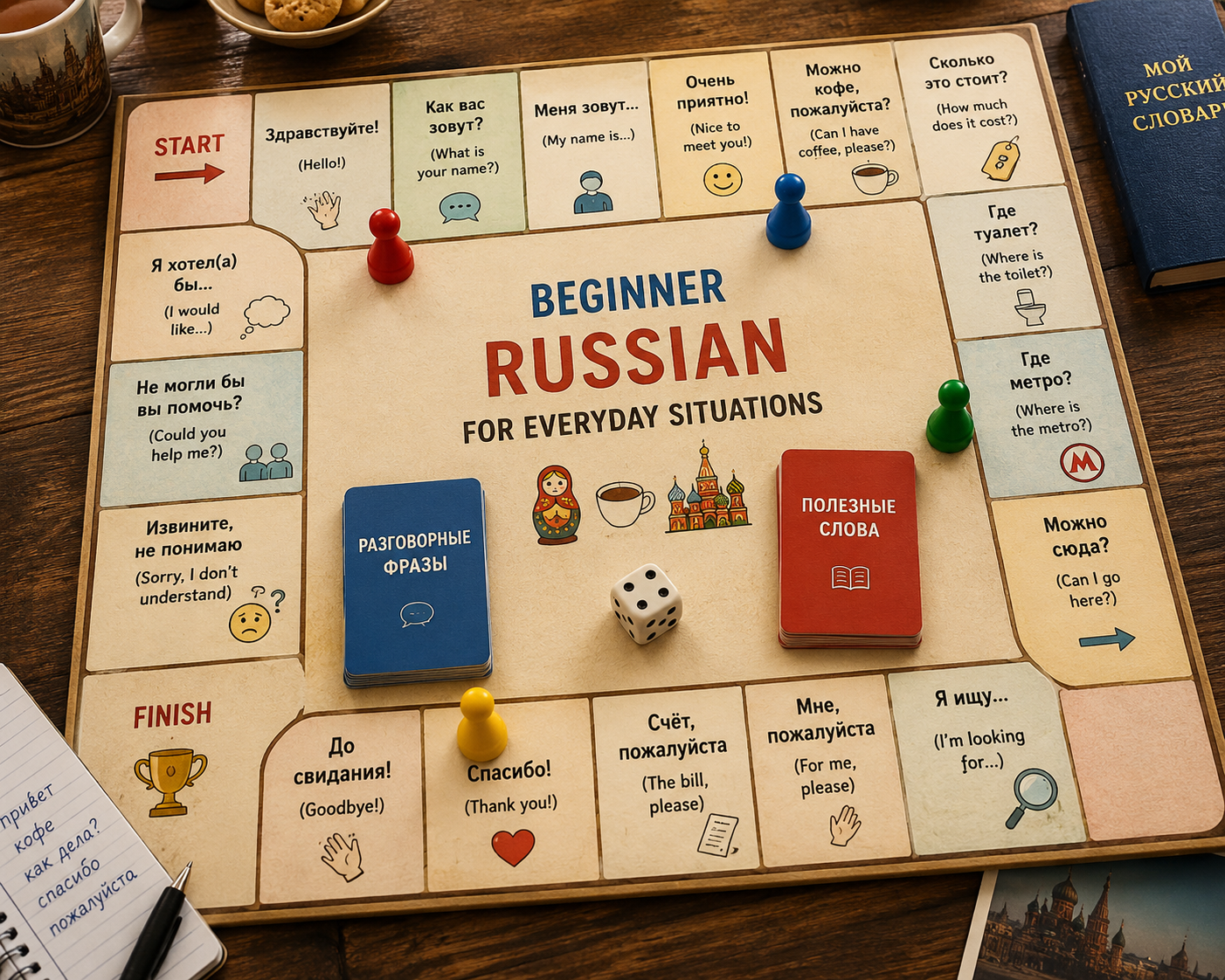
When you first decide to learn Russian, it is easy to imagine the language as a massive mountain of Cyrillic letters, mysterious grammar rules, six cases, unpredictable word endings, and fast conversations you may never be able to follow—but in real life, the first steps into Russian do not have to begin with a grammar textbook, a verb chart, or a long list of words you will forget by tomorrow.
They can begin with one simple sentence.
Здравствуйте. Меня зовут Анна.
ZDRAS-tvuy-tye. Mee-NYA za-VOOT AN-na.
Hello. My name is Anna.
That is already Russian.
It is not advanced Russian. It is not literary Russian. It will not let you discuss Dostoevsky, politics, or the difference between perfective and imperfective verbs. But it lets you do something incredibly important: start a conversation.
And for a beginner, that is everything.
Many people who want to learn Russian make the mistake of thinking they must understand the language before they use it. They imagine that first they must learn the alphabet perfectly, then memorize grammar tables, then master pronunciation, then learn hundreds of verbs, and only after all of that will they finally be “allowed” to speak. But that is not how real communication works. You can begin using Russian much earlier than you think—if you focus on the situations that matter most.
Everyday Russian begins with the kinds of phrases you actually need: greeting someone, introducing yourself, saying where you are from, ordering coffee, asking where the bathroom is, buying something in a shop, saying you do not understand, asking someone to repeat, and thanking people politely. These are not glamorous phrases, but they are powerful. They turn Russian from a subject into a tool.
A beginner does not need to know everything. A beginner needs to know what to say when something happens.
What do you say when you walk into a café?
What do you say when someone asks your name?
What do you say when you do not understand?
What do you say when you need help?
What do you say when you want to be polite?
This article will give you beginner Russian for everyday situations: practical phrases, short dialogues, pronunciation help, cultural notes, and simple strategies for practicing. The goal is not to overwhelm you. The goal is to give you useful Russian you can imagine saying in real life.
How Much Russian Does a Beginner Really Need?
Russian is a complex language, but beginner communication does not require complete grammar mastery. You do not need to know every case ending to order tea. You do not need to understand verb aspect to say thank you. You do not need to read Russian literature before you can introduce yourself.
For everyday beginner situations, you need three things:
First, you need high-frequency phrases. These are words and expressions you will use again and again: hello, please, thank you, excuse me, yes, no, I don’t understand, how much, where, I need, can I have.
Second, you need sentence patterns. These are simple structures you can reuse by changing one word:
Мне нужно...
Mne NOOZH-na...
I need...
Можно...?
MOZH-na...?
May I have...? / Is it possible...?
Где...?
Gdye...?
Where is...?
Я из...
Ya iz...
I am from...
Third, you need confidence to speak imperfectly. This may be the most important part. Beginners often hesitate because they are afraid of making mistakes. But the truth is simple: if you wait until you can speak perfect Russian, you will wait too long. Speak with simple phrases first. Accuracy will improve over time.
Essential Polite Russian Phrases
Politeness matters in Russian, especially when speaking with strangers, teachers, older people, shop assistants, waiters, taxi drivers, or anyone in a formal situation. These phrases should be among the first you learn.
Да
Da
Yes
Нет
Nyet
No
Спасибо
Spa-SEE-ba
Thank you
Спасибо большое
Spa-SEE-ba bal-SHO-ye
Thank you very much
Пожалуйста
Pa-ZHA-luy-sta
Please / You’re welcome
Извините
Eez-vee-NEE-tye
Excuse me / Sorry
Простите
Pras-TEE-tye
Sorry / Forgive me
Ничего
Nee-chee-VO
It’s okay / No problem
Notice that пожалуйста has two meanings. It can mean “please,” as in:
Повторите, пожалуйста.
Paf-ta-REE-tye, pa-ZHA-luy-sta.
Please repeat.
But it can also mean “you’re welcome,” as in:
— Спасибо.
— Пожалуйста.
— Thank you.
— You’re welcome.
This is one of those small details that makes Russian feel more natural.
Greetings for Everyday Russian
Russian has formal and informal greetings. As a beginner, it is safer to learn the formal versions first.
Здравствуйте
ZDRAS-tvuy-tye
Hello, formal
Доброе утро
DO-bra-ye OO-tra
Good morning
Добрый день
DO-briy dyen’
Good afternoon / Hello
Добрый вечер
DO-briy VYE-cher
Good evening
Привет
Pree-VYET
Hi, informal
До свидания
Da svee-DA-nee-ya
Goodbye, formal
Пока
Pa-KA
Bye, informal
Use Здравствуйте when you enter a classroom, shop, office, hotel, café, or formal conversation. Use Привет with friends, classmates you know well, children, or people your age in casual settings.
A safe beginner rule: when in doubt, use Здравствуйте.
Everyday Situation 1: Introducing Yourself
Introducing yourself is one of the most important beginner skills. You will use this in classes, travel situations, language exchanges, and social situations.
Basic self-introduction
Здравствуйте. Меня зовут Ольга.
ZDRAS-tvuy-tye. Mee-NYA za-VOOT OL-ga.
Hello. My name is Olga.
Я из Нидерландов.
Ya iz Nee-der-LAN-dof.
I am from the Netherlands.
Я учу русский.
Ya oo-CHOO ROOS-skiy.
I am learning Russian.
Очень приятно.
O-chen’ pree-YAT-na.
Nice to meet you.
This is a beautiful first script because it gives you a complete identity in Russian. You can say your name, your country, and the fact that you are learning.
Short dialogue
— Здравствуйте. Как вас зовут?
ZDRAS-tvuy-tye. Kak vas za-VOOT?
Hello. What is your name?
— Меня зовут Анна. А вас?
Mee-NYA za-VOOT AN-na. A vas?
My name is Anna. And you?
— Меня зовут Сергей. Очень приятно.
Mee-NYA za-VOOT Ser-GEY. O-chen’ pree-YAT-na.
My name is Sergey. Nice to meet you.
— Мне тоже очень приятно.
Mne TO-zhe O-chen’ pree-YAT-na.
Nice to meet you too.
The phrase Меня зовут... literally works differently from English, but do not worry about that now. Learn it as one complete phrase: “My name is...”
Everyday Situation 2: Saying Where You Are From
After your name, people may ask where you are from.
Откуда вы?
At-KOO-da vy?
Where are you from? formal
Я из Америки.
Ya iz A-ME-ri-ki.
I am from America.
Я из Канады.
Ya iz Ka-NA-dy.
I am from Canada.
Я из Германии.
Ya iz Ger-MA-nee-i.
I am from Germany.
Я из Англии.
Ya iz AN-glee-i.
I am from England.
Я из Нидерландов.
Ya iz Nee-der-LAN-dof.
I am from the Netherlands.
Short dialogue
— Откуда вы?
At-KOO-da vy?
Where are you from?
— Я из Америки. А вы?
Ya iz A-ME-ri-ki. A vy?
I am from America. And you?
— Я из России.
Ya iz Ras-SEE-i.
I am from Russia.
— Очень приятно.
O-chen’ pree-YAT-na.
Nice to meet you.
Do not panic if country names change slightly after из. This is Russian grammar in action. You can study the rule later. At the beginning, memorize the phrase as a whole.
Everyday Situation 3: Talking About Languages
This is one of the most useful areas for beginners because it helps you manage the conversation.
Вы говорите по-английски?
Vy ga-va-REE-tye pa an-GLEES-kee?
Do you speak English?
Я говорю по-английски.
Ya ga-va-RYOO pa an-GLEES-kee.
I speak English.
Я немного говорю по-русски.
Ya ne-MNO-ga ga-va-RYOO pa ROOS-kee.
I speak a little Russian.
Я не говорю по-русски.
Ya nye ga-va-RYOO pa ROOS-kee.
I do not speak Russian.
Я учу русский.
Ya oo-CHOO ROOS-skiy.
I am learning Russian.
Short dialogue
— Вы говорите по-английски?
Vy ga-va-REE-tye pa an-GLEES-kee?
Do you speak English?
— Да, немного.
Da, ne-MNO-ga.
Yes, a little.
— Я учу русский.
Ya oo-CHOO ROOS-skiy.
I am learning Russian.
— Очень хорошо!
O-chen’ ha-ra-SHO!
Very good!
This dialogue is useful because it tells the other person how much Russian you know. It also gives you a polite way to ask for English if you need it.
Everyday Situation 4: Saying You Do Not Understand
Every beginner needs survival phrases. These phrases are not optional—they are essential.
Я не понимаю.
Ya nye pa-nee-MA-yoo.
I don’t understand.
Повторите, пожалуйста.
Paf-ta-REE-tye, pa-ZHA-luy-sta.
Please repeat.
Говорите, пожалуйста, медленнее.
Ga-va-REE-tye, pa-ZHA-luy-sta, MYED-len-nee-ye.
Please speak more slowly.
Можно ещё раз?
MOZH-na ye-SHCHO ras?
One more time?
Что это значит?
Shto E-ta ZNA-chit?
What does this mean?
Short dialogue
— Извините, я не понимаю.
Eez-vee-NEE-tye, ya nye pa-nee-MA-yoo.
Sorry, I don’t understand.
— Повторите, пожалуйста.
Paf-ta-REE-tye, pa-ZHA-luy-sta.
Please repeat.
— Медленнее?
MYED-len-nee-ye?
More slowly?
— Да, медленнее, пожалуйста.
Da, MYED-len-nee-ye, pa-ZHA-luy-sta.
Yes, more slowly, please.
This is one of the most useful beginner dialogues because it helps you stay in the conversation instead of giving up.
Everyday Situation 5: Ordering Coffee or Food
Cafés are perfect places to practice beginner Russian because the conversations are predictable.
Можно кофе, пожалуйста?
MOZH-na KO-fe, pa-ZHA-luy-sta?
Can I have coffee, please?
Мне, пожалуйста, чай.
Mne, pa-ZHA-luy-sta, chai.
Tea for me, please.
Мне, пожалуйста, воду.
Mne, pa-ZHA-luy-sta, VA-doo.
Water for me, please.
С молоком?
S ma-la-KOM?
With milk?
Без сахара.
Byez SA-kha-ra.
Without sugar.
Счёт, пожалуйста.
Shchyot, pa-ZHA-luy-sta.
The bill, please.
Café dialogue
— Здравствуйте. Что будете?
ZDRAS-tvuy-tye. Shto BOO-de-tye?
Hello. What will you have?
— Мне, пожалуйста, кофе и воду.
Mne, pa-ZHA-luy-sta, KO-fe i VA-doo.
Coffee and water for me, please.
— С молоком?
S ma-la-KOM?
With milk?
— Да, с молоком.
Da, s ma-la-KOM.
Yes, with milk.
— Хорошо.
Ha-ra-SHO.
Okay.
— Спасибо.
Spa-SEE-ba.
Thank you.
This dialogue gives you a flexible pattern. Replace кофе with чай, воду, салат, суп, or борщ.
Everyday Situation 6: Shopping and Asking the Price
Shopping conversations are also predictable, especially if you know how to ask the price.
Сколько это стоит?
SKOL-ka E-ta STO-it?
How much does this cost?
Сколько стоит вода?
SKOL-ka STO-it va-DA?
How much does water cost?
Я возьму это.
Ya vaz-MYOO E-ta.
I’ll take this.
Можно картой?
MOZH-na KAR-tay?
Can I pay by card?
Можно наличными?
MOZH-na na-LEECH-ny-mi?
Can I pay in cash?
Shop dialogue
— Здравствуйте. Сколько это стоит?
ZDRAS-tvuy-tye. SKOL-ka E-ta STO-it?
Hello. How much does this cost?
— Это стоит сто рублей.
E-ta STO-it sto roo-BLEY.
It costs one hundred rubles.
— Хорошо. Я возьму это.
Ha-ra-SHO. Ya vaz-MYOO E-ta.
Okay. I’ll take this.
— Картой или наличными?
KAR-tay i-li na-LEECH-ny-mi?
By card or cash?
— Картой, пожалуйста.
KAR-tay, pa-ZHA-luy-sta.
By card, please.
Even if you do not understand every word, you will recognize the structure of the exchange.
Everyday Situation 7: Asking for Directions
Directions can be intimidating because people may answer quickly. Still, a few phrases can help a lot.
Где метро?
Gdye me-TRO?
Where is the metro?
Где туалет?
Gdye too-a-LYET?
Where is the bathroom?
Где отель?
Gdye a-TYEL?
Where is the hotel?
Где музей?
Gdye moo-ZEY?
Where is the museum?
Там.
Tam.
There.
Налево.
Na-LYE-va.
To the left.
Направо.
Na-PRA-va.
To the right.
Прямо.
PRYA-ma.
Straight ahead.
Direction dialogue
— Извините, пожалуйста. Где метро?
Eez-vee-NEE-tye, pa-ZHA-luy-sta. Gdye me-TRO?
Excuse me, please. Where is the metro?
— Метро там, направо.
Me-TRO tam, na-PRA-va.
The metro is there, to the right.
— Направо?
Na-PRA-va?
To the right?
— Да, направо.
Da, na-PRA-va.
Yes, to the right.
— Спасибо большое.
Spa-SEE-ba bal-SHO-ye.
Thank you very much.
A beginner strategy: repeat the key direction back. If someone says налево, you can say налево? This confirms that you heard correctly.
Everyday Situation 8: Taking a Taxi
Taxi phrases are useful because they are short and practical.
В аэропорт, пожалуйста.
V a-e-ra-PORT, pa-ZHA-luy-sta.
To the airport, please.
В отель, пожалуйста.
V a-TYEL, pa-ZHA-luy-sta.
To the hotel, please.
Сколько это будет стоить?
SKOL-ka E-ta BOO-det STO-it?
How much will it cost?
Остановите здесь, пожалуйста.
A-sta-na-VEE-tye zdyes’, pa-ZHA-luy-sta.
Stop here, please.
Taxi dialogue
— Здравствуйте. В аэропорт, пожалуйста.
ZDRAS-tvuy-tye. V a-e-ra-PORT, pa-ZHA-luy-sta.
Hello. To the airport, please.
— Хорошо.
Ha-ra-SHO.
Okay.
— Сколько это будет стоить?
SKOL-ka E-ta BOO-det STO-it?
How much will it cost?
— Примерно тысяча рублей.
Pree-MYER-na TY-sya-cha roo-BLEY.
About one thousand rubles.
— Хорошо, спасибо.
Ha-ra-SHO, spa-SEE-ba.
Okay, thank you.
You do not need to understand every possible answer. Learn the main question and numbers gradually.
Everyday Situation 9: Checking Into a Hotel
Hotel conversations are usually formal, so use polite Russian.
У меня бронь.
Oo mee-NYA bron’.
I have a reservation.
Меня зовут Джон Смит.
Mee-NYA za-VOOT John Smith.
My name is John Smith.
Паспорт, пожалуйста.
PAS-port, pa-ZHA-luy-sta.
Passport, please.
Вот, пожалуйста.
Vot, pa-ZHA-luy-sta.
Here you are.
Где завтрак?
Gdye ZAF-trak?
Where is breakfast?
Hotel dialogue
— Здравствуйте. У меня бронь.
ZDRAS-tvuy-tye. Oo mee-NYA bron’.
Hello. I have a reservation.
— Как вас зовут?
Kak vas za-VOOT?
What is your name?
— Меня зовут Джон Смит.
Mee-NYA za-VOOT John Smith.
My name is John Smith.
— Паспорт, пожалуйста.
PAS-port, pa-ZHA-luy-sta.
Passport, please.
— Вот, пожалуйста.
Vot, pa-ZHA-luy-sta.
Here you are.
This dialogue is short but realistic. It teaches you exactly what you need.
Everyday Situation 10: Asking for Help
Every beginner should know how to ask for help.
Помогите, пожалуйста.
Pa-ma-GEE-tye, pa-ZHA-luy-sta.
Help me, please.
Мне нужна помощь.
Mne noozh-NA PO-moshch’.
I need help.
Я потерял паспорт.
Ya pa-te-RYAL PAS-port.
I lost my passport. said by a man
Я потеряла паспорт.
Ya pa-te-RYA-la PAS-port.
I lost my passport. said by a woman
Мне нужно такси.
Mne NOOZH-na tak-SEE.
I need a taxi.
Мне нужен врач.
Mne NOO-zhen vrach.
I need a doctor.
Help dialogue
— Извините. Помогите, пожалуйста.
Eez-vee-NEE-tye. Pa-ma-GEE-tye, pa-ZHA-luy-sta.
Excuse me. Help me, please.
— Что случилось?
Shto sloo-CHEE-las’?
What happened?
— Я потеряла паспорт.
Ya pa-te-RYA-la PAS-port.
I lost my passport. said by a woman
— Вам нужна полиция?
Vam noozh-NA pa-LEE-tsi-ya?
Do you need the police?
— Да, спасибо.
Da, spa-SEE-ba.
Yes, thank you.
These are not phrases you want to use often, but knowing them can make you feel safer.
Formal and Informal Russian: Вы and Ты
Russian has two forms of “you”: вы and ты.
Вы is polite or formal. Use it with strangers, teachers, older people, service workers, officials, doctors, and people you do not know well.
Ты is informal. Use it with friends, family, children, or people who clearly invite you to use it.
Compare:
Как вас зовут?
Kak vas za-VOOT?
What is your name? formal
Как тебя зовут?
Kak tee-BYA za-VOOT?
What is your name? informal
Вы говорите по-английски?
Vy ga-va-REE-tye pa an-GLEES-kee?
Do you speak English? formal
Ты говоришь по-английски?
Ty ga-va-REESH pa an-GLEES-kee?
Do you speak English? informal
For beginners, the best rule is: start with вы. It is respectful and safe. If the other person wants to be informal, they may suggest it.
Cultural Notes for Everyday Russian
Russian communication can feel different from English-speaking communication. This does not mean it is unfriendly. It is simply a different cultural style.
First, Russians may not smile at strangers as automatically as Americans do. A serious face in public does not necessarily mean anger or coldness. In many Russian-speaking contexts, smiles are more personal and meaningful.
Second, Russian service encounters may feel more direct. A shop assistant or waiter may not use as many soft phrases as you expect in English. This does not always mean rudeness. It may simply be efficiency.
Third, polite phrases matter. Здравствуйте, пожалуйста, спасибо, and извините are small words that make interactions smoother.
Fourth, formal speech is important. Using вы with strangers shows respect. Using ты too quickly may sound too familiar.
As a beginner, you do not need to master every cultural nuance. But you should learn to sound polite, calm, and respectful.
Minimal Grammar You Need for Everyday Russian
You can begin speaking Russian with a few useful patterns.
Меня зовут...
My name is...
Я из...
I am from...
Я живу в...
I live in...
Я говорю по-английски.
I speak English.
Я немного говорю по-русски.
I speak a little Russian.
Я не понимаю.
I do not understand.
Я не знаю.
I do not know.
Можно...?
Can I...? / Is it possible...?
Где...?
Where is...?
Сколько стоит...?
How much does... cost?
Мне нужно...
I need...
These patterns are more useful at the beginning than isolated vocabulary lists. Instead of learning “water” alone, learn:
Можно воду, пожалуйста?
Can I have water, please?
Instead of learning “taxi” alone, learn:
Мне нужно такси.
I need a taxi.
Instead of learning “metro” alone, learn:
Где метро?
Where is the metro?
Russian grammar will come. But everyday communication can start now.
How to Practice Beginner Russian for Everyday Situations
The best way to practice is not to memorize huge lists. It is to repeat short, useful phrases until they become automatic.
Start with one situation per day. For example, Monday can be introductions. Tuesday can be café phrases. Wednesday can be asking for directions. Thursday can be shopping. Friday can be survival phrases.
Read the phrase aloud. Then repeat it without looking. Then change one word.
Мне, пожалуйста, кофе.
Coffee for me, please.
Мне, пожалуйста, чай.
Tea for me, please.
Мне, пожалуйста, воду.
Water for me, please.
This is how you make Russian flexible.
You can also record yourself. Say a short dialogue into your phone, then listen. Do you sound clear? Are you stressing the right syllables? Are you speaking too fast? This simple habit can improve your pronunciation quickly.
If you study with a teacher or in a small group, role-play is extremely helpful. One student is the waiter. Another is the customer. One asks directions. Another answers. One is the hotel receptionist. Another is the guest.
These situations may feel simple, but they create real speaking confidence.
Common Beginner Mistakes
The first mistake is avoiding Cyrillic completely. Transliteration is useful at the beginning, but you should start learning the Russian alphabet early. Words like метро, такси, кафе, and кофе are not difficult to read once you know the letters.
The second mistake is focusing only on grammar. Grammar matters, but if you spend months memorizing case tables and still cannot order coffee, your learning is out of balance.
The third mistake is using ты with everyone. Use вы with adults you do not know.
The fourth mistake is translating word-for-word from English. Russian often uses different structures. For example, “I have a reservation” is У меня бронь, not a literal translation of English.
The fifth mistake is learning too many phrases at once. It is better to master twenty useful phrases deeply than to skim one hundred phrases and remember none of them.
The sixth mistake is being afraid to speak. You will make mistakes. That is normal. A beginner who speaks imperfectly will progress faster than a beginner who waits silently for perfection.
FAQs About Beginner Russian for Everyday Situations
What Russian phrases should I learn first?
Start with greetings, polite phrases, introductions, “I don’t understand,” “Please repeat,” “How much does this cost?” and “Where is...?” These phrases are useful in almost every beginner situation.
Is Russian too hard for beginners?
Russian is challenging, but beginner Russian is manageable if you focus on practical phrases first. You do not need to master all grammar before you start speaking.
Do I need to learn Cyrillic right away?
You can use transliteration at the very beginning, but you should learn Cyrillic as soon as possible. It will help you read signs, menus, maps, and real Russian words.
Should I learn formal or informal Russian first?
Learn formal Russian first. Use вы and Здравствуйте with strangers and adults you do not know. This is safer and more polite.
How many Russian words do I need for travel?
You can do a lot with a few hundred high-frequency words and phrase patterns. For travel, focus on greetings, numbers, food, transport, directions, hotel phrases, and emergency expressions.
Can I speak Russian if I do not know the cases?
Yes. You can begin with memorized phrases and sentence patterns. Cases are important, but beginners can communicate before they fully understand them.
What is the best way to practice everyday Russian?
Practice short dialogues aloud. Repeat, record yourself, role-play with a teacher or partner, and change one word at a time to create new versions.
How do I say “I don’t understand” in Russian?
Say: Я не понимаю — Ya nye pa-nee-MA-yoo. You can add Повторите, пожалуйста — “Please repeat.”
How do I order coffee in Russian?
You can say: Можно кофе, пожалуйста? — MOZH-na KO-fe, pa-ZHA-luy-sta? — Can I have coffee, please?
How do I ask if someone speaks English?
Say: Вы говорите по-английски? — Vy ga-va-REE-tye pa an-GLEES-kee? — Do you speak English?
Learn Russian with Polyglottist Language Academy
Beginner Russian becomes much easier when you learn it in a structured, supportive environment. Apps and phrase lists can be helpful, but they cannot always correct your pronunciation, explain cultural context, or give you real conversation practice.
At Polyglottist Language Academy, our Russian classes are designed for adult learners who want practical progress. We help students build a foundation in pronunciation, Cyrillic, everyday phrases, grammar, and conversation step by step. You will not just memorize words—you will practice using Russian in real situations, from introductions and café conversations to travel phrases and simple discussions about your life.
Whether you are a complete beginner or returning to Russian after a long break, our classes can help you gain confidence and consistency.
Ready to begin? Visit Polyglottist Language Academy and sign up for a Russian class today.
Check Out Our Other Russian Learning Articles
If you enjoyed this article, you may also find these Russian learning guides helpful:
How To Introduce Yourself In Russian Like A Beginner Who Actually Prepared
The Fastest Way To Start Speaking Russian As An Absolute Beginner
Russian Printed Vs. Handwritten Letters: What Beginners Need To Know
Coming Later This Year: Practical Digital Language Courses From Polyglottist Language Academy
Russian Printed Vs. Handwritten Letters: What Beginners Need To Know
Why Russian Feels So Hard At First And How To Make It Easier