
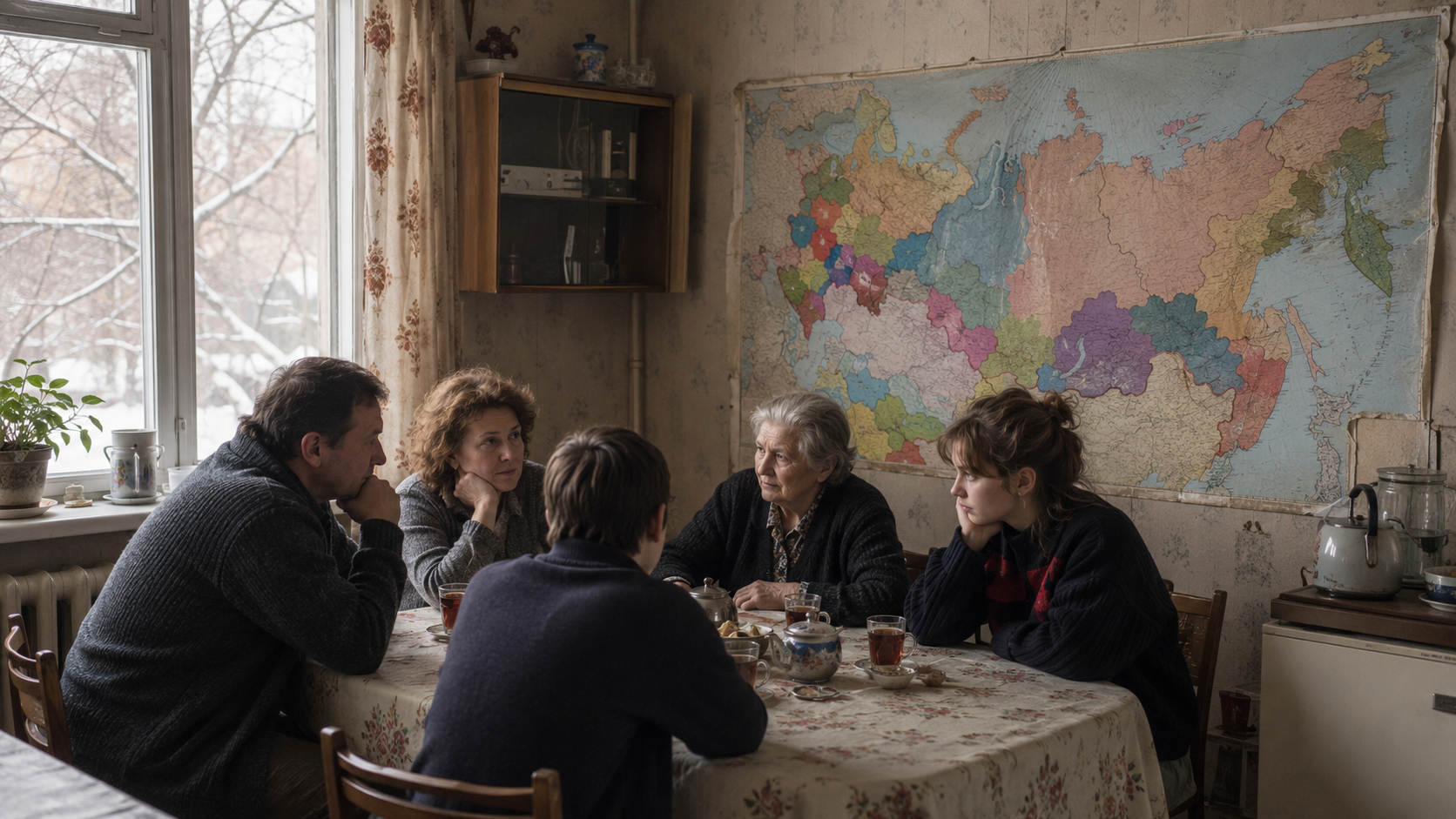
On December 25, 1991, millions of people went to sleep as citizens of a country that no longer existed.
Their passports still said Союз Советских Социалистических Республик—the Union of Soviet Socialist Republics. Their school diplomas, military records, birth certificates, savings accounts, apartment documents, and family histories all belonged to the Soviet system. Yet the red Soviet flag had been lowered over the Kremlin, Mikhail Gorbachev had resigned, and the enormous state that had shaped much of the twentieth century was disappearing from the political map.
For some people, this moment felt like liberation. For others, it felt like abandonment, humiliation, or the beginning of frightening uncertainty. Many experienced both emotions at once.
That contradiction is the most useful place to begin. The Soviet Union did not simply “lose the Cold War,” turn into Russia, or collapse because one leader made a disastrous mistake. It was a multinational state weakened by economic stagnation, political reform, national movements, institutional rivalry, and a final struggle over who had the authority to govern.
To understand what actually happened, it helps to look beyond dramatic television images and imagine the event from a kitchen table: a family listening to the news, a map on the wall, glasses of tea growing cold, and a Soviet passport resting in a drawer.
First, the Soviet Union was not simply Russia
People outside Eastern Europe often use “Russia” and “the Soviet Union” as though they were interchangeable. They were not.
The Soviet Union was founded in 1922 as a union of Soviet republics governed by the Communist Party. Russia was the largest and most powerful of those republics, but it was formally only one member of the union—the Russian Soviet Federative Socialist Republic, usually shortened to the RSFSR.
By the time the USSR dissolved, it contained 15 republics:
Armenia, Azerbaijan, Belarus, Estonia, Georgia, Kazakhstan, Kyrgyzstan, Latvia, Lithuania, Moldova, Russia, Tajikistan, Turkmenistan, Ukraine, and Uzbekistan.
This distinction is not a minor technicality. The Soviet Union did not end only because the government in Moscow changed. It ended because authority shifted away from the central Soviet government and toward the individual republics. Those republics then became independent countries.
The Communist Party had been the structure connecting this enormous territory. It controlled politics, government administration, the military, education, the media, and much of economic life. When the party’s authority weakened, the entire state lost the mechanism that had held its institutions together.
That is why reforms that appeared political—allowing more open discussion, limiting censorship, holding more competitive elections—also threatened the unity of the country itself.
The Soviet system had been slowing down for years
When Mikhail Gorbachev became the Soviet leader in 1985, he did not inherit a healthy system that suddenly collapsed under his leadership.
The Soviet economy had already entered a long period of stagnation. Central planning could mobilize enormous resources for industrial projects, military production, and space exploration, but it was much less effective at responding to what ordinary consumers needed or wanted.
Factories were rewarded for meeting production targets, not necessarily for producing useful, reliable, or desirable goods. A factory might technically fulfill its plan while producing items of poor quality or in quantities that did not match actual demand.
Shortages became part of daily life. People learned where certain products might appear, which stores received better deliveries, and whom to ask for access to something difficult to find. Personal connections—known in Russian as блат—often helped people obtain goods, services, repairs, or appointments that official channels could not reliably provide.
The Soviet Union also faced declining productivity, agricultural problems, technological limitations, dependence on energy exports, and the enormous cost of maintaining military competition with the United States. The war in Afghanistan, which lasted from 1979 to 1989, added financial costs, casualties, and damage to Soviet prestige.
At the same time, the leadership appeared increasingly old and disconnected. Leonid Brezhnev died in 1982. He was followed by Yuri Andropov, who died in 1984, and Konstantin Chernenko, who died in 1985. The rapid succession of elderly leaders made the Soviet political system appear less like the confident builder of the future and more like a structure unable to renew itself.
None of this proves that collapse was inevitable. Historians still disagree about whether the USSR could have survived through slower reforms, a looser federation, or stronger economic management. But by the mid-1980s, it was clear that continuing without major change was becoming increasingly difficult.
Gorbachev tried to save the system, not destroy it
One of the most persistent myths about the end of the Soviet Union is that Gorbachev deliberately dismantled it.
His original goal was almost the opposite. He wanted to modernize socialism, revive the economy, reduce bureaucratic paralysis, and restore public confidence in the Soviet project.
The three words most associated with his reforms were:
Перестройка — perestroika, or restructuring
Гласность — glasnost, or openness
Демократизация — demokratizatsiya, or democratization
Perestroika was meant to reform the economy and state administration. Glasnost allowed greater public discussion, more honest reporting, and criticism of problems that had previously been hidden. Democratization introduced limited political competition and weakened the Communist Party’s monopoly on power.
Gorbachev also created the Congress of People’s Deputies, allowed more competitive elections, and pursued what he called “new thinking” in foreign policy. This involved reducing confrontation with the West and becoming less willing to use military force to preserve Communist governments abroad.
The problem was not simply that reform occurred. The problem was that the old system weakened before a new, functioning system had been built.
Central planning became less effective, but a stable market economy did not replace it. The Communist Party lost authority, but new democratic institutions remained fragile. Republics gained political space, but the constitutional relationship between those republics and the Soviet center remained unresolved.
Gorbachev opened doors that could not easily be closed again.
Glasnost changed what people were allowed to remember
For language learners, гласность is often translated simply as “openness.” But the word carried enormous emotional and political weight.
Under glasnost, Soviet citizens began seeing previously censored books, films, historical documents, and public discussions. Newspapers and television programs addressed Stalinist terror, political repression, the Gulag, corruption, environmental destruction, and government failures.
The official version of history began to fracture.
For decades, the Soviet government had presented itself as the authoritative interpreter of the past. It decided which writers could be published, which historical events could be discussed, and which political mistakes had to remain invisible.
Once people could openly question those narratives, they did not only criticize past leaders. They began questioning the legitimacy of the institutions still governing them.
The 1986 Chernobyl disaster became especially important. The explosion itself was catastrophic, but the government’s initial secrecy and confused response revealed the dangers of a system accustomed to hiding bad news. Chernobyl did not single-handedly destroy public trust, but it became a powerful symbol of what secrecy could cost.
Glasnost created excitement, but it also produced moral shock. People were being asked to believe in a reformed system while simultaneously discovering how much that system had concealed.
In the grocery queue, politics became personal
Economic collapse can sound abstract when described through productivity, state revenue, or monetary policy. For ordinary Soviet citizens, it was experienced in more immediate ways.
A shop might have shelves but little worth buying. A product could appear unexpectedly, causing a queue to form before anyone knew exactly what was being sold. Families stored certain goods when they became available because there was no guarantee they would appear again soon.
The Russian word очередь means “queue” or “line.” It was—and remains—an ordinary word, but in late Soviet memory it can evoke an entire social experience: waiting, uncertainty, conversation with strangers, rumors about deliveries, and the calculation of whether standing for an hour was worth the possibility of obtaining something useful.
Another important word is дефицит, meaning “shortage” or “scarce goods.” In Soviet usage, it often referred not only to a general economic shortage but to a desirable item that was difficult to obtain. A particular food, pair of shoes, household appliance, book, or imported product could be described as дефицитный—scarce and therefore especially valuable.
By the late 1980s, shortages, rationing, distribution failures, and uncertainty were widening the distance between official promises and daily experience. Yet it is important to distinguish this crisis from what followed. In many former Soviet republics, the economic disruption of the 1990s became even more severe, bringing inflation, unemployment, unpaid wages, lost savings, and the collapse of familiar institutions.
This helps explain why memories of the Soviet period remain so divided. A person may remember censorship and political control while also remembering predictable employment, subsidized housing, or a stable social identity. Another person may remember the same period primarily through repression, occupation, or cultural suppression.
Both memories can exist without producing a single, simple verdict.
The union began breaking apart from many directions
The Soviet collapse is often told almost entirely through events in Moscow: Gorbachev, Yeltsin, the Kremlin, the August coup.
But the USSR was a multinational state, and national movements in the republics were central to its dissolution.
In Estonia, Latvia, and Lithuania, independence movements focused heavily on restoring the sovereignty lost when the Baltic states were incorporated into the Soviet Union during World War II. The Singing Revolution and the Baltic Way—a human chain stretching across the three republics—made national resistance visible to the world.
Lithuania declared the restoration of its independence in March 1990.
In Ukraine, the movement toward sovereignty drew on language, history, republican institutions, democratic mobilization, and growing distrust of the central government. In the Caucasus, national movements were often intertwined with territorial disputes and ethnic conflict, including the struggle over Nagorno-Karabakh. Georgia, Armenia, and Azerbaijan faced different combinations of nationalism, political upheaval, and violence.
In Central Asia, mass mobilization generally developed differently. In several republics, independence initially emerged more through decisions by political elites than through the same type of broad independence movement seen in the Baltic states.
There was no single “republic experience.” The desire for independence could arise from memories of occupation, demands for democratic government, economic interests, cultural revival, elite competition, fear of another national group, or some combination of these.
Violence in Vilnius, Tbilisi, and Baku also demonstrated that the breakup was not entirely peaceful.
The strangest rebellion came from Russia itself
The most damaging challenge to the Soviet center did not come only from the geographical edges of the union. It also came from Russia.
Boris Yeltsin had once been a prominent Communist Party official. After breaking with the party leadership, he reinvented himself as a populist opponent of privilege and central control. He became president of the Russian republic in June 1991.
This created a remarkable political situation.
Gorbachev was president of the Soviet Union, but Yeltsin was president of Russia—the largest republic, the location of Moscow, and the institutional core of the union.
When the Russian government declared that Russian laws took precedence over Soviet laws, the central state began losing authority inside its own political and geographical center.
There were now two rival sources of power: an all-union government struggling to preserve a reformed federation and a Russian government claiming sovereignty from that union.
Gorbachev and Yeltsin are sometimes presented as opposites: the noble reformer versus the reckless destroyer, or the failed Communist versus the democratic hero. Neither description is sufficient.
Gorbachev helped create the political space that made opposition possible. Yeltsin used that space to build a rival center of authority. Their conflict accelerated the collapse, but neither man controlled all the forces that had been released.
The fall of the Berlin Wall was connected—but it was not the same event
The collapse of Communist governments in Eastern Europe in 1989 dramatically weakened Soviet power.
Poland, Hungary, Czechoslovakia, East Germany, Bulgaria, and Romania experienced political transformations. The Berlin Wall fell in November 1989, and Germany was reunified the following year.
Gorbachev’s decision not to use large-scale military force to preserve these governments was historically significant. Earlier Soviet leaders had used military intervention to crush or contain political challenges in Hungary in 1956 and Czechoslovakia in 1968.
By 1989, that policy had changed.
The Soviet Union’s unwillingness to enforce the old political order reduced fear abroad and weakened its image as an unchallengeable superpower. But the fall of the Berlin Wall did not itself dissolve the USSR. Eastern Europe’s revolutions and the Soviet collapse were related stages in the breakdown of the Cold War order, not the same event.
Western military and economic pressure also mattered. The arms race, technological restrictions, energy-market changes, and the cost of international competition placed additional stress on the Soviet system.
Still, the claim that Ronald Reagan or the United States single-handedly defeated the USSR is too simple. External pressure intensified internal weaknesses. It did not create all of them, nor did it determine exactly how the final breakup unfolded.
The coup meant to save the USSR helped finish it
In August 1991, Communist hardliners and senior officials attempted to stop the disintegration of central authority.
They opposed a proposed new union treaty that would have transferred more power to the republics. Gorbachev was detained at his vacation residence in Crimea. Tanks entered Moscow. An emergency committee announced that it was assuming power.
The coup plotters appeared to represent the old Soviet machinery: security officials, party conservatives, military authority, and the promise of restored order.
But they hesitated. Important sections of the military and security services did not fully support them. Citizens gathered around the Russian parliament building, known as the White House. Yeltsin climbed onto a tank and denounced the coup.
That image became one of the defining photographs of the period. Yet the importance of the coup was larger than one man standing on one tank.
Its failure destroyed what remained of the Communist Party’s credibility. It showed that the central Soviet leadership could no longer reliably command its own institutions. It also strengthened Yeltsin and weakened Gorbachev almost beyond repair.
The people attempting to preserve the Soviet Union had demonstrated that the Soviet state could no longer preserve itself.
The country disappeared in stages
After the coup failed, events moved rapidly.
Republic after republic declared or confirmed independence. Ukraine’s referendum on December 1, 1991, was decisive. An independent Ukraine made any meaningful continuation of the old union politically and materially unrealistic.
On December 8, the leaders of Russia, Ukraine, and Belarus signed the Belavezha Accords. They declared that the USSR no longer existed as a geopolitical reality or subject of international law and announced the creation of the Commonwealth of Independent States.
Other former republics joined the process through the Alma-Ata Protocol on December 21.
On December 25, Gorbachev resigned as president of the Soviet Union. That evening, the Soviet flag was lowered over the Kremlin.
On December 26, the Soviet Union was formally dissolved.
There is an important paradox here. In a March 1991 referendum, 76.4 percent of participating voters supported preserving some form of renewed union. Yet by December, the state had disappeared.
This does not necessarily mean the referendum was meaningless. Many voters wanted a reformed union—not the existing system exactly as it was. Political conditions then changed dramatically through the summer and autumn, especially after the coup and Ukraine’s independence vote.
People were not choosing between a perfectly stable Soviet Union and a clearly defined alternative. They were making decisions inside a rapidly changing crisis.
Freedom, loss, and the shock of becoming “post-Soviet”
For many people, the collapse created real freedoms.
Censorship weakened. Religious life became more open. People gained greater opportunities to travel, publish, organize politically, study previously forbidden history, and start private businesses.
For countries that understood Soviet rule as occupation or domination, independence restored national institutions, languages, symbols, and historical narratives.
But the disappearance of the Soviet state also brought disruption on a scale that is difficult to capture through political chronology alone.
A factory employee might lose both a salary and the social services connected to the workplace. Savings accumulated over decades could lose their value. A military officer could suddenly be serving in one newly independent country while having family in another. A Russian-speaking person might discover that the language of administration, schooling, or public identity was changing around them.
Families who had once lived in different Soviet republics now lived in separate countries, sometimes divided by new borders, citizenship rules, currencies, and political conflicts.
The collapse produced possibility and disorientation at the same time.
Why 1991 is still present in today’s politics
The Soviet Union ended more than three decades ago, but political arguments about its meaning are still active.
For some, 1991 represents liberation from Communist rule and imperial control. For others, it represents the loss of social stability, international power, territory, and a shared identity.
These conflicting memories shape debates about NATO, Russia’s relationship with Europe and the United States, the sovereignty of former Soviet republics, Russian-speaking populations outside Russia, and the meaning of borders created from Soviet administrative boundaries.
The breakup also left unresolved territorial and ethnic conflicts. Nagorno-Karabakh, Transnistria, Abkhazia, South Ossetia, Tajikistan, and Chechnya all reveal how Soviet-era borders and political arrangements continued to generate violence after the union disappeared.
Russia inherited the Soviet Union’s permanent seat on the United Nations Security Council and became its main legal successor in many international matters. It also inherited nuclear weapons, debt, military institutions, and a profound question of identity: what was Russia after the empire-like union surrounding it had vanished?
That question has never been fully settled.
Present-day political narratives often describe the Soviet collapse as either a glorious democratic victory or a deliberate geopolitical catastrophe imposed from outside. Neither interpretation is historically complete.
The reality was less tidy. The Soviet Union was weakened from within, pressured from outside, challenged by its republics, divided by its elites, and finally dissolved through political decisions made during a rapidly accelerating crisis.
Language after the empire
Russian remained widely spoken across the former Soviet Union because it had long served as a common language of administration, education, migration, military service, and urban life.
After independence, many states strengthened their national languages. Ukrainian, Estonian, Latvian, Lithuanian, Georgian, Kazakh, and others gained greater prominence in schools, government, street signs, media, and public ceremonies.
These changes were often necessary parts of national revival. They could also be emotionally complicated for multilingual families.
Speaking Russian does not automatically mean being ethnically Russian, supporting the Russian government, or rejecting another national identity. A Ukrainian, Latvian, Kazakh, Armenian, or Israeli family may use Russian at home for reasons rooted in education, migration, marriage, geography, or personal history.
This is one of the most important cultural lessons for students. Language and political identity do not always align neatly.
The fall of the Soviet Union changed not only borders but also place names, alphabets, monuments, school curricula, and the vocabulary people used to describe themselves.
What adult Russian students begin to notice
Students often begin Russian by concentrating on cases, verb aspect, pronunciation, and the alphabet. Then cultural references start appearing.
A novel mentions a communal apartment. A film shows people exchanging information in a queue. A family story distinguishes between Russia, and the Soviet Union. Someone speaks nostalgically about childhood while strongly rejecting Soviet politics. Another person describes 1991 as independence rather than collapse.
These differences are not contradictions to be corrected. They are part of the historical landscape carried by the language.
At Polyglottist Language Academy, we believe language study becomes much more rewarding when vocabulary is connected to memory, literature, food, family stories, humor, etiquette, and history. Russian grammar helps students build sentences, but cultural understanding helps them recognize what those sentences may imply.
Readers interested in exploring these connections can learn more about our online Russian classes and the ways language opens access to perspectives that rarely fit into a simple political narrative.
Five myths worth leaving behind
“The Soviet Union was just Russia.”
Russia was the largest republic, but the USSR was a multinational union of 15 republics.
“Gorbachev wanted to destroy the Soviet Union.”
He initially wanted to reform and preserve it.
“The United States defeated the USSR by itself.”
Western pressure mattered, but internal economic, political, institutional, and national crises were decisive.
“The Soviet Union collapsed overnight.”
The formal ending came in December 1991, but the process developed over years.
“The breakup was entirely peaceful.”
The formal dissolution avoided a single all-union civil war, but violence occurred before, during, and after the collapse.
The most accurate explanations resist the temptation to identify one villain, one hero, or one cause.
Frequently asked questions
When did the Soviet Union officially end?
Mikhail Gorbachev resigned on December 25, 1991. The USSR was formally dissolved on December 26, 1991.
How many countries emerged from the Soviet Union?
The 15 Soviet republics became independent states: Armenia, Azerbaijan, Belarus, Estonia, Georgia, Kazakhstan, Kyrgyzstan, Latvia, Lithuania, Moldova, Russia, Tajikistan, Turkmenistan, Ukraine, and Uzbekistan.
Did Russia leave the Soviet Union?
Russia asserted sovereignty and established the authority of Russian law over Soviet law. Because Russia was the largest and most powerful republic, this severely weakened the union. Russia, Ukraine, and Belarus later signed the agreement declaring that the USSR no longer existed.
Did most Soviet citizens want the union to end?
The answer depends on when, where, and how the question was asked. In the March 1991 referendum, a majority of participating voters supported preserving a renewed union. However, several republics did not participate, and political conditions changed dramatically later that year.
Was the Soviet economic system the only cause?
No. Economic stagnation was crucial, but the collapse also involved political reform, declining Communist Party authority, national movements, conflict between Gorbachev and Yeltsin, republican sovereignty, international pressure, and the failed August coup.
Why do some people feel nostalgic for the Soviet Union?
Nostalgia can reflect memories of youth, social security, predictable employment, affordable housing, international status, or a sense of belonging. It does not necessarily mean that a person supports repression or wants the entire Soviet system restored.