
Do Bears Really Walk the Streets in Russia? Busting the Biggest Russian Myths
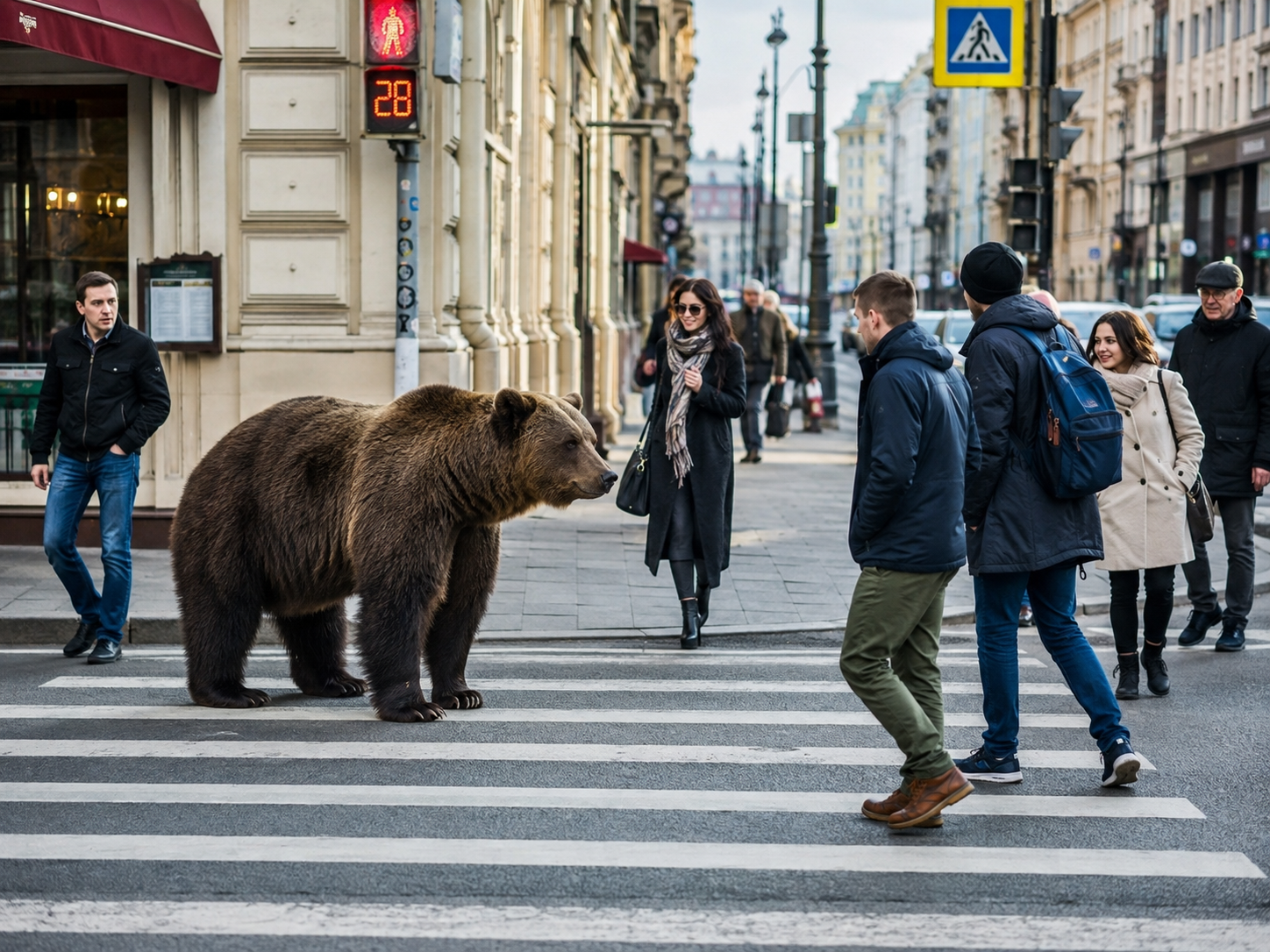
Five minutes into a conversation about Russia, someone usually mentions a bear.
Perhaps it is riding a bicycle. Perhaps it is playing an accordion. Perhaps it is strolling through Moscow while snow falls and a nearby man drinks vodka in a fur hat.
The details change, but the imaginary Russia remains remarkably consistent: bears, blizzards, vodka, unsmiling people, impossibly difficult words, and endless gray apartment buildings.
Foreigners may know that the stereotypes are exaggerated, but they are not always sure where the exaggeration ends and reality begins.
That is what makes Russian myths interesting. Most of them did not appear from nowhere. They usually contain one small piece of truth—a real animal, a real winter, a real drink, a real communication style. The problem begins when that single detail is stretched until it covers an enormous country and everyone who lives there.
A stereotype is like a photograph taken in one corner of a very large room. The photograph may be genuine. It simply is not the whole room.
So, do bears really walk the streets in Russia? Let us begin there.
Yes, Russia Has Bears. No, They Are Not Commuting to Work
Russia has extensive wild areas where brown bears live, particularly across forested and remote regions. Its territory forms an important part of the Eurasian brown bear’s natural range.
That does not mean bears are part of ordinary street life.
Someone living in central Moscow, Saint Petersburg, Kazan, or another major city does not normally look out the window and see a bear waiting at a pedestrian crossing. Most Russians encounter bears in the same ways other urban populations do: in zoos, nature documentaries, stories, cartoons, or perhaps during travel into wilderness areas.
Real encounters can happen near forests and remote settlements, just as wildlife sometimes enters communities in Canada, Alaska, Romania, or other places where human habitation meets bear territory. But an exceptional wildlife sighting is not a normal picture of Russian city life.
So why is the association so powerful?
The bear has long been used as a visual symbol for Russia, especially in political cartoons. Scholars have traced its development as a national metaphor through Russian and international satire, where the animal could represent strength, awkwardness, aggression, endurance, or an enormous power that was difficult to control.
Popular entertainment added another layer. Trained bears appeared historically in fairs and later in circuses, helping to create the image of Russians casually living alongside performing bears.
Put these traditions together, repeat the joke for generations, and eventually the bear stops being a wild animal and becomes Russia’s unofficial roommate.
The myth is funny, but it also teaches an important lesson: cultural symbols are not the same thing as daily life. California has a bear on its state flag, yet no one assumes every Berkeley resident keeps one in the backyard.
Russia Is Cold—but It Is Not One Enormous Snow Globe
Winter is real in Russia. In many regions it is long, dark, snowy, and physically demanding. Siberian cold is not an invention, and cities in northern and inland areas can experience temperatures that are difficult for outsiders to imagine.
But Russia is the largest country in the world by land area. Treating its climate as uniform makes about as much sense as describing the weather of the entire United States by talking only about Alaska.
Russia contains polar, subarctic, continental, temperate, dry, and warmer southern climate zones. The Black Sea coast has a very different rhythm from the Russian Arctic, while summer in Moscow, the Volga region, or southern Russia can be genuinely hot. The World Bank’s climate data for the Russian Federation reflects this range of climate categories rather than one continuous frozen landscape.
The “eternal winter” idea survives partly because snow is visually dramatic. Snow-covered churches, fur hats, frosted windows, and night trains make memorable photographs. A humid July afternoon, crowded beach, or family eating watermelon at a dacha does not fit the established international image quite as neatly.
“Everyone Drinks Vodka” May Be the Most Persistent Myth of All
Vodka has an undeniable place in Russian history, ceremonies, literature, jokes, and popular imagery. Pretending otherwise would be another kind of distortion.
But the leap from “vodka is culturally significant” to “every Russian drinks vodka constantly” turns a complex social history into a cartoon.
Many Russians do not drink vodka. Some drink wine or beer. Some drink only on special occasions. Others do not consume alcohol at all. Age, health, religion, family habits, region, personality, and generation all matter.
Drinking patterns have also changed. According to the World Health Organization, total per-capita alcohol consumption in Russia fell by 43 percent between 2003 and 2016 following a series of alcohol-control measures. That does not erase the serious historical effects of alcohol misuse, but it does show why frozen images of Russian drinking culture can be misleading.
In ordinary homes, tea is often a more useful symbol of social life than vodka.
An offer of tea may be the beginning of a conversation, a visit, a family discussion, a plate of cookies, or an unexpected meal. Historically, the samovar became closely associated with hospitality, although most people today simply use an electric kettle.
A visitor who prepares only for vodka shots may be surprised to spend the evening drinking black tea while being urged to eat another sandwich, pastry, piece of cake, or spoonful of jam.
Russians Do Smile—Just Not Always on Command
“Russians never smile” is one of those stereotypes that begins with an observable difference and then loses all proportion.
Of course Russians smile. They laugh, tease one another, tell stories, flirt, celebrate, play with children, make jokes at work, and send absurd memes to friends.
What may differ is the social function of smiling.
In the United States, a smile can operate as a basic public signal: I acknowledge you, I am friendly, I am not a threat, and our interaction is proceeding normally. A cashier may smile because smiling is part of professional politeness. Two strangers may smile as they pass each other without intending to begin a friendship.
In many Russian settings, smiling has traditionally been treated as a more personal or emotionally motivated expression. A neutral face does not automatically communicate anger. It may simply be neutral.
Researchers and cultural commentators have debated how old this convention is and how much it was shaped by Soviet and post-Soviet social conditions. This is another reason to avoid presenting it as a permanent feature of some mysterious “Russian character.”
Generational, regional, and professional differences also matter. Service standards have changed. International contact has changed. Social media has changed how people present themselves. A young person working in a contemporary café may not behave like a government clerk in a Soviet film.
A Russian acquaintance who does not produce a bright smile during every interaction may still spend an hour helping you solve a problem. In some contexts, practical assistance communicates warmth more convincingly than cheerful small talk.
Direct Does Not Necessarily Mean Rude
Russian can sound strikingly direct to English speakers.
English often softens requests with several layers:
“I was just wondering whether you might possibly have time to send that to me.”
A natural Russian request may reach the point more quickly:
Please send it to me.
To an English-speaking ear, shorter requests and firmer intonation can sound irritated even when no irritation is intended.
This does not mean politeness is absent. It may be expressed through the formal “you”, a person’s first name and patronymic, respectful tone, helpful action, or hospitality. It is simply not always packaged in the same verbal cushioning used in American English.
Adult learners often notice this before they can explain it. They translate a perfectly normal Russian sentence word for word and worry that it sounds too abrupt in English. Or they compose a Russian request using an elaborate English structure that feels strangely indirect to a native speaker.
Russia Is Not One Ethnicity, One Landscape, or One Way of Life
Many outsiders unconsciously use three very different ideas as though they were interchangeable:
Russia as a country
Ethnic Russians as a people
Russian speakers as a linguistic community
These categories overlap, but they are not identical.
The Russian Federation contains numerous ethnic, religious, linguistic, and regional communities. Moscow is not Kazan. Saint Petersburg is not Yakutsk. The North Caucasus is not the Volga region. Life in a remote northern settlement cannot represent life in a southern resort city.
Russian is also spoken far beyond Russia itself. UNESCO has described it as a language with more than 250 million speakers globally and has highlighted the diverse literary contributions of Armenian, Azerbaijani, Kazakh, Kyrgyz, Tajik, and other writers who have used Russian alongside their own cultural traditions.
The Russian Alphabet Is Not a Secret Military Code
Cyrillic looks intimidating largely because it is unfamiliar—and because some letters appear to be playing tricks.
В looks like an English B but sounds like V.
Н looks like H but sounds like N.
Р looks like P but sounds like R.
The beginner’s brain sees a familiar shape, applies the wrong sound, and concludes that the entire system is impossible.
It is not.
The Russian alphabet has 33 letters. Many can be learned quickly, and beginners are often able to decode signs and simple words after only a few focused sessions. Reading fluently takes much longer, but recognizing the alphabet is a finite, manageable first step.
Russian itself is challenging for English speakers. Its case system, verb aspect, verbs of motion, flexible word order, and pronunciation patterns require sustained work. The U.S. State Department places Russian among its Category III “hard languages,” estimating approximately 44 weeks of intensive study for professional-level proficiency under Foreign Service training conditions. Arabic, Mandarin, Cantonese, Japanese, and Korean occupy the more demanding Category IV.
In other words, Russian is difficult—but not uniquely or supernaturally impossible.
The more damaging myth is that an ordinary adult cannot learn it. Adults may learn differently from children, and they often have less free time, but they also bring discipline, context, analytical ability, and clear personal motivation.
For a practical introduction, read Is Russian Hard To Learn? The Honest Answer (With Hours, Timelines, And Tips)
Russian Food Is More Than Cabbage, Potatoes, and Mayonnaise
Some Russian meals are undeniably substantial. Cold weather, agricultural history, preservation methods, Orthodox fasting traditions, Soviet food systems, and regional conditions have all influenced what people cook.
You will find potatoes, cabbage, sour cream, preserved vegetables, soups, dumplings, dark bread, mushrooms, grains, and mayonnaise in many familiar dishes.
But even that list already contains more variety than the stereotype allows.
There are delicate blini, stuffed pirozhki, pelmeni, syrniki, buckwheat, fish dishes, vegetable salads, berry preserves, honey, pastries, pickles, cold soups, hot soups, festive dishes, everyday dishes, and regional foods influenced by the Caucasus, Central Asia, Siberia, the Volga region, Eastern Europe, and other neighboring culinary traditions.
Nor does every Russian family cook the same way. One household may prepare elaborate traditional meals. Another may live on pasta, delivery food, salads, sandwiches, and coffee—like busy people almost anywhere else.
What often surprises visitors is not a specific dish but the scale of hospitality. A host who says, “Come for tea,” may produce enough food for dinner. Refusing the first offer may not end the discussion. You may hear: More?
followed by:
Have some more.
The repeated offer is usually not an attempt to control you. It is a way of making sure the guest does not leave hungry.
Everyday Russia Is Usually Less Dramatic Than Imaginary Russia
Foreign portrayals of Russia often move between two extremes.
In one version, everyone is an aristocrat walking through a ballroom in a Tolstoy novel. In another, everyone lives inside a bleak spy thriller. There are palaces, secret agents, oligarchs, revolutionaries, stern grandmothers, military parades, and men staring tragically into the snow.
What disappears is ordinary life.
People commute, complain about traffic, take children to school, renovate kitchens, walk dogs, choose phones, argue over family plans, watch television, order groceries, meet friends in cafés, worry about work, and send messages asking what time everyone will arrive.
This may sound obvious, but it is one of the most important corrections a language learner can make.
A language is not spoken by a collection of national symbols. It is spoken by individuals while doing ordinary things.
The Biggest Myth Is That There Is One “Russian Personality”
Are Russians direct? Some are.
Are they hospitable? Many are.
Do they value sincerity? Often.
Do they love tea, literature, winter, dachas, or long conversations in the kitchen? Some do, while others may dislike every item on that list.
National patterns can help us interpret unfamiliar behavior, but they should never become cages. A cultural tendency is not a personality test. Region, generation, education, family, profession, religion, travel experience, and individual temperament all shape how a person communicates.
The most rewarding moment in language study comes when “Russians” stop appearing in your mind as a single imaginary character.
Instead, you begin to hear particular voices.
One person speaks quickly and jokes constantly. Another chooses every word carefully. Someone loves traditional poetry. Someone else prefers science fiction, video games, or Korean dramas. One friend insists that you eat more. Another forgets to offer tea at all.
That is not the disappearance of culture. It is a deeper encounter with it.
Moving Beyond the Cartoon Version of Russia
Learning Russian helps students understand not only grammar and vocabulary but also the small cultural details that stereotypes miss: how an invitation is phrased, why a neutral face may not be unfriendly, how food is offered, what a diminutive communicates, and why the same sentence can sound warm, impatient, ironic, or affectionate depending on intonation.
At Polyglottist Language Academy, our online Russian classes are designed for adult learners who want more than disconnected vocabulary lists. Language becomes more memorable when it is connected to real situations, relationships, humor, food, etiquette, and everyday expression.
Explore Russian Classes at Polyglottist Language Academy
Related Polyglottist Articles
Russian Wedding Traditions: What Happens At A Traditional Russian Wedding
Russian Blini: History, Recipes, And Why They're More Than Just Pancakes
5 Russian Stereotypes That Are Actually True (And 5 That Are Completely Wrong)
Russian Black Bread: What It Is And Why Russians Are So Proud Of It
Frequently Asked Questions About Russian Myths
Do wild bears ever enter towns in Russia?
They can occasionally approach remote communities located close to forests or wilderness, particularly when food is scarce or natural habitats overlap with human settlement. This is a wildlife-management issue, not an ordinary feature of life in major Russian cities.
Why is Russia represented by a bear?
The bear became a recurring metaphor for Russia in political cartoons and satire. Depending on the artist and historical period, it could symbolize strength, size, endurance, clumsiness, danger, or unpredictability. Performances involving trained bears also reinforced the association in popular imagination.
Do Russians really say “na zdorovye” as a toast?
На здоровье is widely presented in English-language films as a Russian toast, but that is not its most natural everyday use. It may be said in response to thanks for food, somewhat like “you’re welcome” or “enjoy.” For an actual toast, Russians may say За здоровье!—“To health!”—or make a more personal toast appropriate to the occasion.
Should I smile less when speaking with Russians?
There is no need to suppress your natural expression. Simply remember that strangers may not automatically return an American-style public smile. A neutral expression does not necessarily mean that someone is angry, suspicious, or unfriendly.
Is Russian spoken only in Russia?
No. Russian is used by communities across many parts of Eastern Europe, the Caucasus, Central Asia, Israel, Germany, North America, and elsewhere. People study it for family communication, cultural access, travel, literature, research, heritage, and professional reasons.
Is Russian too difficult to begin as an adult?
Russian requires patience, particularly when learners reach cases, verb aspect, and verbs of motion. However, adults can begin reading Cyrillic, introducing themselves, ordering food, and holding simple conversations much sooner than the language’s intimidating reputation suggests. Consistency matters more than being unusually gifted.