
Can You Learn Russian in a Year? What's Actually Possible and How to Do It
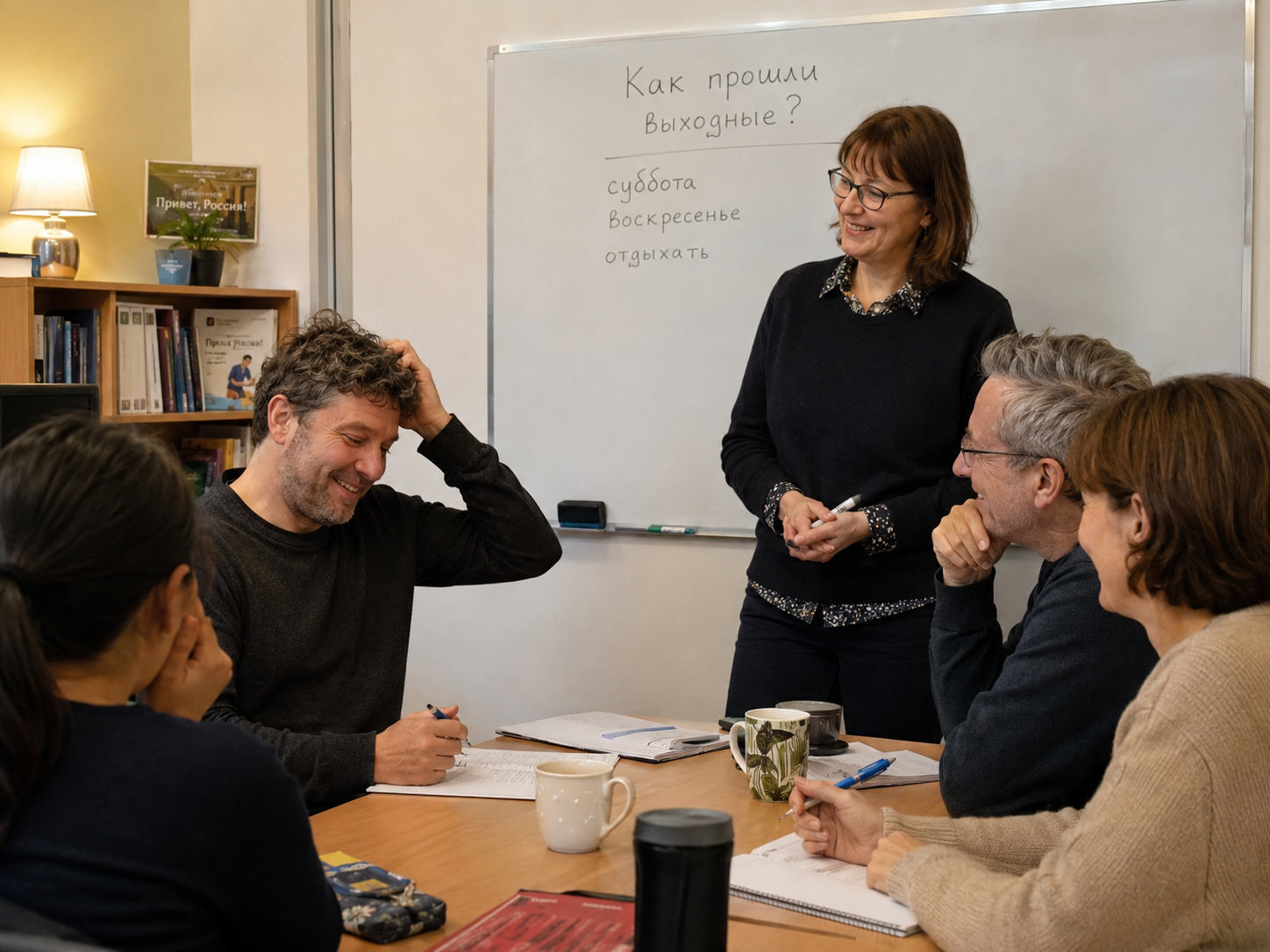
Three months into Russian, you may feel surprisingly clever.
You can read the alphabet. You recognize words like метро (metro), ресторан (restaurant), and кофе (coffee). You can introduce yourself, order tea, and explain that you have a dog.
Then your teacher asks what you did last weekend.
You know the word for weekend. You studied the past tense. You have definitely seen the verb you need. But the moment it is your turn to speak, every useful word quietly leaves the room.
This is one of the stranger things about learning Russian: progress often feels backward.
At the beginning, every small achievement is obvious. A month ago, Cyrillic looked impossible; now you can read a street sign. Later, you know ten times as much, but you notice every mistake, hear how fast native speakers talk, and become painfully aware of everything you still cannot do.
So, can you learn Russian in a year?
Yes.
But probably not in the way people imagine when they picture “fluency.” After twelve months, you may be able to hold an everyday conversation, read simple texts, travel with much more confidence, and understand a patient Russian speaker. You may also continue mixing up case endings, missing words in fast conversations, and making creative choices with verbs of motion.
Both can be true.
First, what does “learn Russian” mean to you?
One person wants to visit St. Petersburg and handle basic situations without immediately switching to English. Another wants to speak with grandparents or relatives. Someone else wants to understand songs, watch films, discuss politics, or read Bulgakov and Dostoevsky in the original.
These are not the same goal.
You can learn enough Russian for a trip much sooner than you can learn enough to follow a lively dinner conversation between several native speakers. Reading adapted stories is one thing. Reading nineteenth-century literature without a dictionary is another.
Even the word conversational is slippery.
Are you conversational if you can talk about your family, work, hobbies, and weekend plans? Probably.
Are you conversational if you can explain a medical problem, argue about history, or understand three people interrupting one another? That takes much longer.
Language ability also develops unevenly. A learner may read quite well but freeze when speaking. Another may talk confidently while making plenty of grammatical mistakes. Someone may understand a grammar lesson and still be unable to use the same structure in real time.
The CEFR levels—A1, A2, B1, and beyond—are useful because they focus on what a person can actually do. At A1, a learner can use basic expressions and manage very simple exchanges. At A2, they can handle familiar, routine situations. At B1, they can begin speaking in connected sentences about experiences, plans, and familiar topics. Those levels can still vary by skill; your reading may be stronger than your listening, for example.
For a busy adult beginning from zero, a realistic first-year result is often practical A1 or developing A2 ability. Some learners move faster. Others need more time. No serious teacher can promise a specific level based only on the date you started.
A better question is this:
What would you like to be able to do in Russian one year from now?
That question gives you something real to work toward.
One year can mean 100 hours—or 800
People often compare their progress without comparing their actual study time.
Someone who takes one lesson a week and occasionally opens an app has not had the same “year of Russian” as someone who studies every day, works with a tutor, listens to podcasts, reads, and speaks regularly.
The calendar tells only part of the story.
Two or three hours a week
This is a very normal pace for an adult with work, family, travel, and all the ordinary interruptions of life.
It may include one weekly class, a little homework, and a few short vocabulary reviews. Over a year, that adds up to roughly 100 to 150 hours.
That is enough to make meaningful progress.
You may learn to read Cyrillic, introduce yourself, order food, ask for directions, make simple purchases, understand numbers and prices, and talk briefly about familiar parts of your life. You may read menus, signs, short messages, and beginner-level texts.
Conversation will probably remain slow. You may rely on familiar phrases. Unexpected questions can still cause a complete system failure.
The biggest problem at this pace is usually not the limited number of hours. It is allowing Russian to appear only once a week.
If your class is on Tuesday and you do nothing until the following Tuesday, every lesson begins with an archaeological expedition through last week’s vocabulary.
Ten minutes on several days can work better than one enormous weekend session. Read a short dialogue while drinking coffee. Listen to the same recording again while walking. Describe the weather. Talk to your dog in Russian.
The dog will not correct your cases, but you will still be practicing retrieval.
Five to seven hours a week
For many adult learners, this is the most productive pace.
It is serious enough for the language to gather momentum, but not so demanding that it requires you to reorganize your entire life.
Over one year, five to seven weekly hours may produce roughly 250 to 350 hours of study and practice. At this pace, you have room for a class, homework, vocabulary review, listening, reading, and extra speaking.
By the end of the year, you may be able to talk about work, family, food, hobbies, travel, routines, recent experiences, and future plans. You might write short messages, understand careful speech on familiar subjects, and read graded stories without looking up every second word.
You will still make plenty of mistakes.
You will forget an ending you used correctly five minutes earlier. You will put the stress on the wrong syllable. You will begin a sentence confidently and then discover that you have no verb.
But you will also experience something new: a complete sentence will occasionally come out before you have time to build it in English.
That is a major shift. Russian is beginning to move from calculation into instinct.
Fifteen hours a week or more
This is an intensive year.
Russian is no longer a small weekly activity. It has become a major part of daily life.
A learner at this pace may take several lessons, listen every day, read regularly, write, review grammar, and speak with tutors, friends, colleagues, or family members. Fifteen weekly hours can add up to 750 hours or more within a year.
The results can be impressive. You may hold longer conversations, tell stories, explain problems, discuss opinions in simple language, and follow selected videos or podcasts for learners. You may read easier authentic material with support and function independently in many travel or social situations.
Still, even intensive study does not produce magical, effortless fluency.
The frequently cited Foreign Service Institute estimate of around 1,100 classroom hours for English-speaking diplomats learning Russian is useful for perspective, though it is not a prediction for every learner. Those are intensive programs, and the target is professional working proficiency—not perfect command of every situation.
A person may speak comfortably one-on-one and still feel lost in a fast group conversation. They may read news headlines and struggle with literary prose. They may discuss daily life easily but have little vocabulary for medicine, law, or economics.
Russian does not have one final door marked FLUENT. It has many rooms.
After a year, you may feel at home in several of them while still getting lost in the hallway.
The alphabet is not the mountain
Before starting, many people assume Cyrillic will be the hardest part.
It looks unfamiliar, so it seems like a major barrier. In reality, it is often one of the first challenges learners overcome.
Some letters are friendly: А, К, М, О, and Т look familiar and behave as expected.
Others are tricksters. В sounds like v. Н sounds like n. Р sounds like r. Then there are letters such as Ж, Ц, Ч, Ш, and Щ, which at least have the honesty to look new.
At first, every word feels like a code. You read one letter, then another, and by the time you reach the end, you have forgotten the beginning.
Then something changes.
Москва stops looking like six individual symbols and becomes Moskva. Спасибо becomes spasibo without a long decoding process. You begin recognizing whole words rather than assembling them letter by letter.
The alphabet is not the mountain. It is the ticket booth at the bottom.
The more stubborn problem is transliteration. Reading Russian through English letters feels comfortable, but it keeps you dependent on an imperfect substitute. Transliteration hides spelling patterns, endings, and relationships between words.
Read slowly. Read badly. Read real Cyrillic anyway.
Then the nouns begin changing their clothes
Sooner or later, usually just after you have become pleased with yourself for learning the alphabet, Russian introduces cases.
You learn a noun.
Then you discover that the noun changes.
Then the adjective changes with it.
Then the pronoun changes too.
Russian uses six main cases: nominative, genitive, dative, accusative, instrumental, and prepositional. These cases help show what a word is doing in the sentence.
Is it the subject? The object? A destination? Something you possess? Something you are speaking about? Something you are using?
English often expresses these relationships through word order and prepositions. Russian also changes the word itself.
The first time learners see a complete case table, many assume they must memorize every ending before they are allowed to speak.
That is not how anyone actually learns to use cases.
You learn them through situations.
You learn how to say where you live. Then where you are going. You learn how to ask for something, speak about another person, say that you do not have something, or explain what you are interested in.
At first, you may stop and think through every ending.
Later, a common phrase begins to sound right because you have heard it and used it dozens of times.
You may not be able to explain the grammar rule elegantly, but you know which form belongs there. That is not a shortcut. That is language becoming automatic.
Russian grammar is dense, but it is not random. The case system, verb aspect, and recurring sentence patterns become more manageable as learners meet them repeatedly in useful contexts.
Russian pronunciation enjoys keeping learners humble
Cyrillic may be easier than expected. Pronunciation is often the opposite.
Russian word stress is not always predictable, and it matters. The stressed syllable may even move when a word changes form.
Unstressed vowels can sound different from the way they appear on the page. Hard and soft consonants also create contrasts that many English speakers do not notice immediately.
This explains a very common experience: you know a word perfectly when you see it written, but you fail to recognize it when someone says it.
It also explains why vocabulary should not be learned only as spelling plus English meaning.
The stress is part of the word.
When you learn a new word, hear it. Say it aloud. Notice the stressed syllable. Put it inside a sentence.
We often see learners who have built a respectable vocabulary but are frustrated that native speakers do not always understand them. The word is correct. The ending may even be correct. But the stress lands somewhere unexpected, and the listener needs a moment to work out what was intended.
The word arrived. It was simply wearing the wrong coat.
Verb aspect is not a chapter you finish
Russian verbs often come in imperfective and perfective pairs.
A textbook may explain that imperfective verbs often describe ongoing, repeated, habitual, or general actions, while perfective verbs often emphasize completion, result, or an action viewed as a whole.
This explanation is useful.
It does not mean you will suddenly choose the correct verb in every conversation.
Aspect is not something most learners “cover” on Thursday and use perfectly from Friday onward. It develops through hundreds of examples.
You start noticing that one form appears when someone talks about a habit, while another appears when the result matters. You learn common pairs. You make choices. Your teacher sometimes says, “That is grammatically possible, but a Russian speaker would usually phrase it differently.”
This will happen more than once.
A successful first year does not require perfect control of aspect. It means you begin seeing the distinction and making increasingly sensible choices in common situations.
And then there are verbs of motion
Russian has a detailed system for talking about movement.
Are you walking or traveling by vehicle? Going in one direction or moving around regularly? Going now or habitually? Arriving, leaving, entering, returning, crossing, or passing by?
English often uses go and lets the rest of the sentence provide the details. Russian would like the paperwork completed properly.
Presented all at once, verbs of motion can look like evidence that the language was designed to test human endurance.
In real life, you learn them gradually.
You learn:
I’m going to work.
We went to the museum.
I usually go there by bus.
How do I get to the station?
When are you coming back?
The system makes much more sense when attached to actual journeys than when presented as a forest of arrows in a grammar chart.
The strange middle period: you know more and feel worse
The beginning is often exciting because progress is easy to see.
Last week, you could not read Cyrillic. Now you can.
A month ago, you knew ten verbs. Now you know thirty.
You can introduce yourself, count, order food, and say that you like music.
Then, around the middle of the first year, something odd happens.
You know much more, but you feel less capable.
You notice every mistake. You hear how fast native speakers speak. You realize that understanding a classroom dialogue is not the same as following a spontaneous conversation. You know enough grammar to recognize how much grammar you do not yet control.
This is the moment when many adult learners decide they are “bad at languages.”
Usually, they are not.
They have simply moved beyond the stage when every small achievement feels miraculous.
At the beginning, understanding three words is thrilling. Six months later, understanding half a conversation feels disappointing because you are focused on the half you missed.
Your ability improved. Your standards moved faster.
Teachers recognize this stage immediately. A learner becomes more accurate, more observant, and better at hearing what is happening—then concludes that they are getting worse.
Sometimes frustration is evidence that your ear has become sharper.
Why listening can make you question all your life choices
You read a textbook dialogue and understand nearly everything.
Then the teacher plays the recording.
Suddenly, the speakers appear to have removed half the vowels and glued every word together.
Listening is difficult because it does not wait for you. Reading allows you to pause, examine an ending, and return to the start of the sentence. Spoken language keeps moving.
Unstressed vowels change. Sounds connect. Familiar words appear in unfamiliar forms. One unknown expression distracts you, and by the time you recover, the speaker has moved on.
The solution is not to begin immediately with a complicated Russian film and hope that your brain eventually surrenders.
Short, understandable recordings are more useful.
Listen once without reading. Notice what you catch. Then look at the transcript. Check a few important words. Listen again. Repeat one or two lines. Return to the same recording several days later.
Repeated listening is not cheating and it is not a “language hack.” It is ordinary training.
You are teaching your brain that the word you recognize on paper is the same word hiding inside fast speech.
Listening often improves quietly. One day, you hear a phrase and understand it before you have time to translate.
Nobody sounds a trumpet.
You simply realize that Russian reached you directly.
The gap between recognizing a word on a page and understanding it in natural speech is one of the most common first-year challenges. Learners often mistake this gap for lack of progress, even when their awareness has actually improved.
What the year may look like from the inside
A first year is not a neat staircase, but it often has a recognizable rhythm.
Months 1–3: everything is new
This is the discovery stage.
You learn Cyrillic, basic pronunciation, common vocabulary, present-tense verbs, grammatical gender, and a few essential sentence patterns.
You can say your name, where you live, what you do, what you like, and perhaps what you would like to order.
Progress feels visible. You recognize your first sign. You understand a question without looking at your notes. You discover that магазин (magazin) means “shop,” not “magazine,” and feel mildly deceived.
Every sentence still requires effort, but the language opens quickly.
A good sign of progress is not knowing a certain number of rules. It is responding to a familiar question without first constructing the entire answer in English.
Months 4–6: you know more than you can use
This is the awkward stage.
You may be studying past tense, more cases, adjectives, future forms, possessives, and reflexive verbs.
You understand the explanations. Then someone asks what you did yesterday and your answer involves several long pauses and an emergency change of subject.
Active practice matters here.
Tell short stories. Answer questions you did not prepare in advance. Record voice messages. Use the same grammar pattern in several different situations.
This is also a good time to make Russian personal.
Learn the words for food you actually eat. Read about a city you care about. Listen to a song you enjoy. Explore how people address strangers and friends. Learn why diminutives appear so often in family conversations.
A word tied to a meal, person, place, joke, or memory is easier to keep than a word floating alone on a flashcard.
Months 7–9: sentences begin connecting
At this stage, answers start getting longer.
You add a reason. Ask something back. Tell a short story. Find another way to explain an idea when the exact word is missing.
You may begin working more seriously with aspect, verbs of motion, comparisons, and more complicated case combinations. You may read adapted stories and follow selected videos for learners.
This is also when many students say, “I’ve been studying for months, but I still can’t understand real Russians.”
Native speech is not beginner material.
Do not measure yourself against the fastest conversation you can find. Choose material that stretches you without leaving you completely lost.
Months 10–12: Russian starts sounding more like you
Near the end of the first year, your Russian should begin reflecting your real life.
A traveler may practice hotel problems, transportation, or explaining a food allergy. A heritage learner may prepare questions for family members. Someone interested in music may study lyrics. A food lover may learn the difference between борщ (borshch), щи (shchi), and солянка (solyanka) before mastering every instrumental ending.
You begin moving beyond the fictional people in the textbook and their suspiciously organized schedules.
You learn to discuss your own work, family, interests, and opinions.
That is when the language becomes memorable.
What should you actually do each week?
You do not need a study plan that looks impressive. You need one that survives a normal Wednesday.
For someone studying five to seven hours each week, a useful routine might include:
one structured lesson
several short vocabulary reviews
two or three listening sessions
a little reading
one small writing task
another opportunity to speak
brief pronunciation practice
The exact schedule matters less than regular contact.
Thirty minutes on five days is usually more useful than two and a half hours once a week. Distributed practice helps information remain available over time, while one large session is more likely to produce the illusion of learning followed by rapid forgetting.
Apps can help. They are useful for vocabulary, repetition, listening snippets, and habit-building.
But an app cannot always explain why your sentence sounds strange. It cannot notice every pronunciation problem or adapt a conversation because you suddenly want to talk about your childhood, your dog, or your landlord.
A good teacher can help sequence the grammar, correct recurring errors, work on pronunciation, and create the kind of spontaneous conversation learners often avoid when studying alone.
Many independent learners continue reviewing vocabulary because it feels safe and productive while postponing speaking.
Then they wonder why they recognize 2,000 words and use only 200.
Speaking is not a prize you earn after memorizing enough Russian. It is one of the ways you learn it.
What does a genuinely good first year look like?
A good first year does not end with flawless grammar.
It may end with you being able to read a menu, understand a simple message, introduce yourself, talk about your daily life, and manage a basic travel problem.
You may follow a learner-friendly podcast, read an adapted story, and have a real conversation with a patient speaker.
You will still make mistakes. The difference is that the mistakes no longer stop everything.
You can continue. You can ask for repetition. You can explain the word you do not know. You can find another route through the sentence.
At the beginning, Russian looks like one enormous problem.
After a year, it becomes a series of smaller ones: more listening, stronger pronunciation, faster vocabulary retrieval, better control of endings.
Smaller problems can be worked on.
Questions adult learners often ask
Can I become conversational in Russian in one year?
Yes, especially on familiar subjects. With regular speaking practice, you may be able to discuss daily life, work, family, interests, travel, food, and plans. Fast group conversations and unfamiliar topics will remain much harder.
Is one lesson a week enough?
One weekly lesson can provide structure, correction, and conversation. It works much better when Russian also appears briefly on several other days. Without practice between lessons, progress is usually slower.
Can I study Russian only through an app?
An app can help with vocabulary, basic patterns, and consistency. Most learners eventually need longer listening, clear grammar explanations, pronunciation feedback, and real conversation.
Am I too old to begin?
No. Adults often have less free time, but they bring clear goals, patience, life experience, and a better sense of how they learn. You do not need a perfect memory. You need regular contact with the language.
Do I need to live in a Russian-speaking country?
No. Online lessons, tutors, conversation partners, podcasts, videos, graded reading, and voice messages can create meaningful exposure anywhere. Living abroad helps only when you actively use the language.
How much can I learn before a trip?
Even a few weeks can help you read Cyrillic, greet people, understand numbers, order food, and ask basic questions. A full year can give you enough flexibility to respond when the conversation does not follow your memorized script.
Should I study grammar or focus on conversation?
You need both. Grammar helps you understand how the language works, while conversation teaches you to retrieve and use that knowledge under pressure. Too much grammar without speaking creates passive knowledge. Conversation without guidance can leave the same mistakes uncorrected for a long time.
What happens after the first year?
You continue.
Not because the first year failed, but because it worked.
Polyglottist Language Academy offers online Russian classes for adults who want thoughtful instruction, regular speaking practice, and honest guidance about what progress really looks like.
There are no promises of instant fluency. There is something more useful: structure, feedback, and enough regular contact for the language to become part of your life.
The moment you remember may not be completing a textbook or passing an exam.
It may be standing on a train platform and understanding part of an announcement. Reading a handwritten menu without reaching for your phone. Catching a joke three seconds after everyone else—but still in time to laugh.
Or perhaps someone asks you a question in Russian, and for once, you do not translate it.
You simply answer.
A year earlier, the language was a wall of unfamiliar sounds and shapes.
Now it says something.
And you are part of the conversation.
Explore Russian Classes at Polyglottist Language Academy
Related Reading
Is Russian Worth Learning? An Honest Look For English Speakers
Russian Cyrillic Vs. English: 10 Letters That Look The Same But Sound Different
Is Russian Hard To Learn? The Honest Answer (With Hours, Timelines, And Tips)
The Russian Alphabet In 2 Hours: A Complete Beginner's Guide To Cyrillic
Why You Still Can’t Read Russian After Learning The Alphabet