
The Russian Alphabet in 2 Hours: A Complete Beginner's Guide to Cyrillic
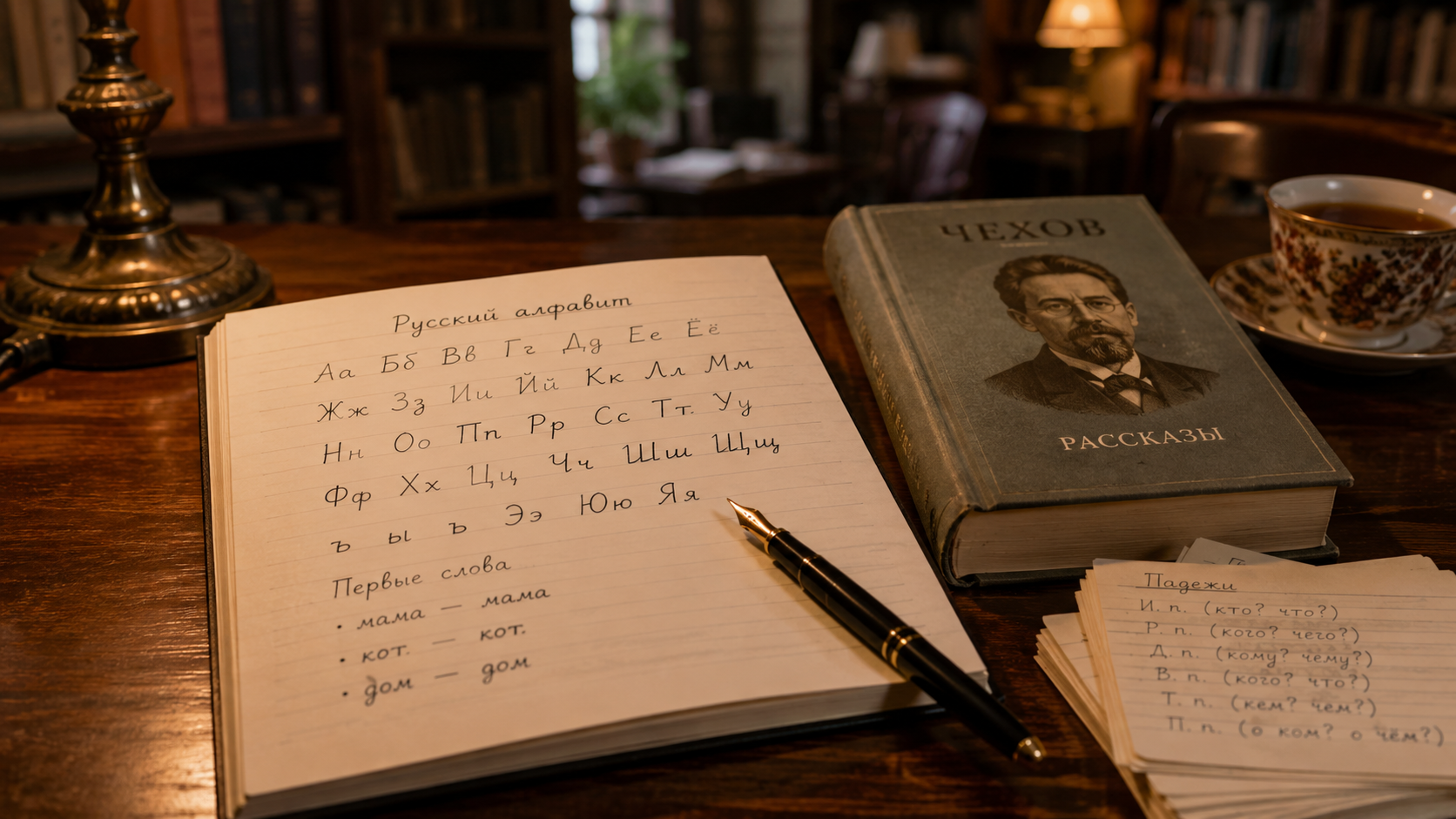
If you have ever looked at a Russian menu, street sign, novel, church inscription, passport stamp, metro map, or even the name of a famous writer like Достоевский or Чехов and felt that the letters seemed to belong to a secret code rather than a living language, the good news is that the Russian alphabet is far less mysterious than it appears — and with the right method, a complete beginner can begin reading real Russian words in just a couple of focused hours.
For many English speakers, Russian feels intimidating before the first lesson even begins. The alphabet looks unfamiliar. The words are long. Some letters look like English letters but mean something completely different. Others look like symbols from mathematics, ancient manuscripts, or a puzzle designed to make learners panic. A beginner sees Ресторан, Москва, Спасибо, or Здравствуйте and may think, “I will never be able to read this.”
But that first impression is misleading.
The Russian alphabet, called Cyrillic, has only 33 letters. That is not a small number, but it is not overwhelming either. More importantly, Russian spelling is often much more consistent than English spelling. Once you know the letters and the basic sound patterns, you can read many Russian words aloud even if you do not yet understand them. That is a major advantage. In English, a learner must deal with strange spellings like “through,” “though,” “thought,” “tough,” and “bough.” In Russian, the relationship between letters and sounds is more predictable.
This does not mean Russian pronunciation is perfectly simple. Stress matters. Vowels can change when unstressed. Some consonants become soft. Some letters do not represent sounds by themselves. But the alphabet itself is not the mountain many beginners imagine. It is the front door. Once you open it, the language becomes much less frightening.
Learning Cyrillic is also psychologically powerful. Before you learn it, Russian feels distant. After you learn it, the language starts to become readable. Suddenly, signs are not just decorations. Names are not just mysterious strings of characters. You can recognize words. You can sound out phrases. You can look at a Russian textbook, a song title, a map, or a restaurant menu and think, “I can at least begin.”
That moment matters.
In this guide, we will walk through the Russian alphabet in a beginner-friendly way. You will learn which letters are easy, which letters are deceptive, which letters are completely new, and how to practice them in a logical two-hour study session. By the end, you may not speak Russian yet, but you will understand how Cyrillic works — and you will be much closer to reading your first real Russian words.
Why Learning the Russian Alphabet First Is Worth It
Some beginners wonder whether they really need to learn Cyrillic right away. They ask, “Can’t I just use transliteration?” Transliteration means writing Russian words with English letters, such as spasibo for спасибо or privet for привет.
Transliteration can be useful for a few minutes at the beginning, but it quickly becomes a problem. It makes Russian look like English, and that leads to bad pronunciation habits. It also prevents you from seeing how the language is actually built.
For example, the Russian word мама is easy once you know the letters. It is simply mama. But if you rely on transliteration, you are still mentally translating Russian into English letters. You are not really entering the Russian writing system.
The same is true for words like:
театр — theater
банк — bank
метро — metro
такси — taxi
музей — museum
ресторан — restaurant
These words are not difficult once you learn Cyrillic. In fact, they can give beginners an immediate sense of progress. But if you avoid the alphabet, you miss this early confidence boost.
Learning Cyrillic from the beginning helps you:
read Russian words more accurately
recognize familiar international vocabulary
avoid bad pronunciation from English spelling
use dictionaries and learning apps more effectively
understand grammar endings later
feel less intimidated by real Russian texts
The Russian alphabet is not a side project. It is the foundation.
The Russian Alphabet: 33 Letters, But Not 33 Problems
The Russian alphabet has 33 letters:
А Б В Г Д Е Ё Ж З И Й К Л М Н О П Р С Т У Ф Х Ц Ч Ш Щ Ъ Ы Ь Э Ю Я
At first glance, this list may look overwhelming. But not all letters are equally difficult. Some look and sound almost like English letters. Some look familiar but are pronounced differently. Some are completely new. A smart way to learn Cyrillic is to divide the letters into groups.
Think of the alphabet in four categories:
Letters that look familiar and sound familiar
Letters that look familiar but sound different
Letters that look new but are easy to pronounce
Letters that require special attention
This method is much easier than trying to memorize all 33 letters in order from the beginning.
Group 1: Letters That Look Familiar and Sound Familiar
Let’s start with the easiest letters. These Russian letters look like English letters and have similar sounds:
А а — sounds like “a” in father
К к — sounds like k
М м — sounds like m
О о — sounds like o in more when stressed
Т т — sounds like t
These are your first friendly letters.
With only these letters, you can already read simple combinations:
мама — mama
том — volume/book
там — there
кот — cat
так — so/like that
Notice how quickly Cyrillic starts to feel less foreign. The word мама is almost transparent. The word кот looks strange at first, but once you know к, о, and т, it becomes readable: kot, meaning “cat.”
This is an important beginner lesson: Russian does not become easier by staring at the entire alphabet at once. It becomes easier when you collect small wins.
Group 2: Familiar-Looking Letters That Trick English Speakers
Now we come to the most dangerous group: letters that look like English letters but do not sound like them.
These are often called “false friends.”
В в — sounds like v, not English b
Н н — sounds like n, not English h
Р р — sounds like a rolled or tapped r, not English p
С с — sounds like s, not English c
У у — sounds like oo, not English y
Х х — sounds like a rough kh, not English x
These letters cause many beginner mistakes.
For example:
Вера is not “Bepa.” It is Vera.
нос is not “hoc.” It is nos, meaning “nose.”
рис is not “puc.” It is ris, meaning “rice.”
суп is not “cyn.” It is sup, meaning “soup.”
ухо is not “yxo.” It is ukho, meaning “ear.”
The letter Р is especially important. It looks exactly like English P, but it sounds like Russian r. So the word Россия is not “Poccnr.” It is Rossiya.
The letter С also tricks learners. In English, c can sound like k or s. In Russian, с is simply s. That consistency is helpful once you stop reading it as English.
The letter У looks like English y, but it sounds like oo. The word музыка begins with mu, not my.
The letter Х is not exactly English h. It is stronger, like the sound in Scottish “loch” or German “Bach.” Do not panic if you cannot produce it perfectly right away. Beginners can start with a strong h and gradually make it more Russian.
This group is the key to unlocking Cyrillic. Once you stop trusting English-looking letters, Russian becomes much easier.
Group 3: New-Looking Letters That Are Actually Simple
Some Russian letters look unfamiliar but represent sounds that English speakers already know.
Б б — b
Г г — hard g, as in go
Д д — d
З з — z
И и — ee, as in see
Л л — l
П п — p
Ф ф — f
Э э — e, as in bed
These letters look Russian, but their sounds are not especially difficult.
Examples:
банк — bank
газ — gas
дом — house
зима — winter
Иван — Ivan
лампа — lamp
папа — dad
фильм — film
это — this/that is
The letter П is very useful because it looks a little like a table or doorway and sounds like p. The word папа means “dad,” and it is one of the easiest words to read once you know the letter.
The letter И sounds like ee. So Иван is pronounced Ivan, but with the first vowel closer to “ee”: ee-VAHN.
The letter Э is useful because it gives you the open e sound, as in это — “this is” or “that is.” Beginners often learn этоvery early because it appears in simple sentences:
Это дом.
This is a house.
Это мама.
This is mom.
Это кот.
This is a cat.
With these letters, you can already start reading many beginner words.
Group 4: The Russian Letters That Feel Truly Russian
Now we come to the letters that feel more exotic to English speakers. These are not impossible, but they deserve special attention.
Ё ё — yo
Ж ж — zh, like the sound in “measure”
Й й — short y, as in “boy”
Ц ц — ts, as in “cats”
Ч ч — ch, as in “chair”
Ш ш — sh, as in “shoe”
Щ щ — a longer, softer shch or soft sh sound
Ы ы — a deep Russian vowel with no exact English equivalent
Ю ю — yu
Я я — ya
Ь ь — soft sign
Ъ ъ — hard sign
Let’s take them one by one.
Ё ё
Ё sounds like yo, as in:
ёлка — fir tree/New Year tree
ёж — hedgehog
моё — my/mine, neuter form
A useful fact: ё is always stressed. However, in many Russian texts, the dots are omitted and ё is written as е. This can confuse beginners. For learning purposes, it is helpful to write the dots at first.
Ж ж
Ж sounds like the s in “measure” or the g in “genre.” It is a buzzing sound:
жук — beetle
журнал — magazine
жизнь — life
This letter is visually memorable. Many learners remember it because it looks like a bug — and жук means beetle.
Й й
Й is like a short y sound. It often appears at the end of words:
мой — my
твой — your
чай — tea
It is not the same as И, though they look related. И is a vowel, while Й is a short consonant-like sound.
Ц ц
Ц sounds like ts, as in the end of “cats”:
центр — center
царь — tsar
улица — street
English speakers can make this sound, but they are not used to seeing it at the beginning of words.
Ч ч
Ч sounds like ch:
чай — tea
час — hour
человек — person
This letter is very common and very useful.
Ш ш
Ш sounds like sh:
школа — school
шапка — hat
машина — car
It is a hard, broad sh sound.
Щ щ
Щ is one of the most intimidating letters for beginners. It is often described as shch, but in modern Russian it is usually closer to a long, soft sh sound.
Examples:
щи — cabbage soup
ещё — still, more
женщина — woman
Do not worry if щ feels difficult at first. You can improve it gradually through listening and repetition.
Ы ы
Ы is famous among Russian learners because English does not have the same vowel. It is a deep, central vowel made with the tongue pulled back. Many teachers describe it by asking students to say ee while pulling the tongue slightly back and relaxing the lips.
Examples:
ты — you, informal
мы — we
сыр — cheese
Beginners do not need to make ы perfect immediately. But they should know it is not the same as и. The difference between ми and мы matters.
Ю ю and Я я
Ю usually sounds like yu:
юг — south
Юлия — Yulia
люблю — I love
Я usually sounds like ya:
я — I
яблоко — apple
язык — language/tongue
These letters can also soften the consonant before them, which becomes important later.
Ь and Ъ
The soft sign ь and hard sign ъ do not represent sounds by themselves.
The soft sign makes the previous consonant soft:
мать — mother
день — day
словарь — dictionary
The hard sign is much less common. It separates sounds:
объект — object
подъезд — entrance
For beginners, the soft sign is far more important than the hard sign.
The Two-Hour Cyrillic Learning Plan
Can you really learn the Russian alphabet in two hours?
You can learn to recognize the letters, understand their sounds, and begin reading basic words in two hours. You will not master every pronunciation detail perfectly, but you can absolutely build a strong foundation.
Here is a practical two-hour plan.
Minutes 0–10: Understand the System
Start by looking at the full alphabet, but do not try to memorize it yet. Your first goal is to understand that Russian has 33 letters and that many of them are manageable.
Read the alphabet aloud once:
А Б В Г Д Е Ё Ж З И Й К Л М Н О П Р С Т У Ф Х Ц Ч Ш Щ Ъ Ы Ь Э Ю Я
Then remind yourself: “I do not need to master this all at once. I need to group it.”
Minutes 10–25: Learn the Familiar Letters
Focus on:
А К М О Т
Practice reading:
мама
там
так
кот
том
Write each letter by hand five times. Saying the sound aloud while writing helps connect the shape to the sound.
Minutes 25–45: Learn the False Friends
Now study:
В Н Р С У Х
Repeat their sounds:
В = v
Н = n
Р = r
С = s
У = u/oo
Х = kh
Practice words:
нос — nose
рис — rice
рука — hand/arm
суп — soup
ухо — ear
Москва — Moscow
This is one of the most important sections. These letters are deceptive because they look familiar. Spend enough time here.
Minutes 45–65: Learn the Main New Consonants
Study:
Б Г Д З Л П Ф
Practice:
банк
газ
дом
зима
лампа
папа
фильм
At this point, you can already read a surprising number of Russian words.
Minutes 65–85: Learn the Special Russian Sounds
Study:
Ж Ц Ч Ш Щ
Practice:
жук
центр
чай
школа
щи
These sounds may feel more Russian, but most of them exist in English or close to English. Ж and Щ may take extra practice.
Minutes 85–100: Learn the Vowels and Iotated Letters
Study:
Е Ё И Й Ы Э Ю Я
Practice:
это
Иван
мой
ты
юг
я
ёлка
Pay attention to Ы, because it is not the same as И.
Minutes 100–110: Learn the Signs
Study:
Ь — soft sign
Ъ — hard sign
Practice:
день
мать
словарь
объект
Do not worry about mastering softness immediately. Just learn that these signs affect pronunciation.
Minutes 110–120: Read Real Words
Now use all your knowledge to read real Russian words:
Россия — Russia
Москва — Moscow
спасибо — thank you
привет — hi
молоко — milk
вода — water
город — city
улица — street
книга — book
человек — person
язык — language
школа — school
This final step is essential. The alphabet becomes real only when you use it to read words.
Russian Letters in Alphabetical Order With Beginner Pronunciation
Here is a complete beginner-friendly list of the Russian alphabet:
А а — a as in father
Б б — b
В в — v
Г г — g as in go
Д д — d
Е е — ye at the beginning of a word; also softens the previous consonant
Ё ё — yo
Ж ж — zh as in measure
З з — z
И и — ee
Й й — short y
К к — k
Л л — l
М м — m
Н н — n
О о — o when stressed; often closer to a when unstressed
П п — p
Р р — rolled or tapped r
С с — s
Т т — t
У у — oo
Ф ф — f
Х х — kh
Ц ц — ts
Ч ч — ch
Ш ш — sh
Щ щ — soft/long sh
Ъ ъ — hard sign
Ы ы — deep Russian vowel, no exact English equivalent
Ь ь — soft sign
Э э — e as in bed
Ю ю — yu
Я я — ya
You do not need to memorize every detail immediately. Your first goal is recognition and basic reading.
Why Russian Handwriting Looks Different
One surprise for beginners is that printed Russian and handwritten Russian can look different. This is especially true in cursive. Russian cursive is beautiful, but it can be difficult for learners because several letters look similar.
For example, printed т may look like English t, but handwritten cursive т can look like an English m. Printed д may look unusual, while cursive д may look like a looped shape. The letter и can also look different in handwriting.
Should beginners learn cursive immediately?
Not necessarily. Start with printed Cyrillic first. Learn to read signs, books, websites, menus, and textbook materials. Once you are comfortable, begin learning handwritten forms. If you try to learn print and cursive at the same time, you may feel overwhelmed.
However, writing letters by hand — even in printed form — is very useful. It helps your memory. When you physically write Ж, Я, Ф, or Д, the shapes become more familiar.
Common Beginner Mistakes With Cyrillic
Mistake 1: Reading Russian Letters as English Letters
This is the biggest mistake. Remember:
В is v, not b
Н is n, not h
Р is r, not p
С is s, not c
У is oo, not y
Mistake 2: Avoiding the Alphabet Too Long
Some students try to learn Russian through transliteration for weeks or months. This slows them down. Learn Cyrillic early, even if imperfectly.
Mistake 3: Trying to Memorize Everything in Alphabetical Order
Alphabetical order is useful later, especially for dictionaries. But for learning, groups are better. Start with easy letters, then false friends, then new letters.
Mistake 4: Ignoring Stress
Russian stress is important. The letter о can sound like o when stressed but closer to a when unstressed. For example, молоко is written with three о letters, but it is pronounced more like ma-la-KO. Beginners should learn stress along with words.
Mistake 5: Expecting Perfect Pronunciation Immediately
Reading Cyrillic and sounding Russian are related but not identical. You can learn the alphabet quickly, but pronunciation takes longer. That is normal.
How to Practice After the First Two Hours
After your first two-hour alphabet session, you should not stop. The goal is to reinforce the letters until reading becomes automatic.
Here is a simple one-week practice plan.
Day 1: Learn the letters in groups
Use the two-hour plan above.
Day 2: Read simple words
Practice words like мама, кот, дом, банк, такси, метро, чай, школа.
Day 3: Practice false friends
Make flashcards for В Н Р С У Х. These letters need repetition.
Day 4: Read signs and names
Try reading Russian city names and famous names:
Москва
Санкт-Петербург
Толстой
Пушкин
Чехов
Достоевский
Day 5: Practice handwriting
Write all 33 letters by hand. Then copy ten simple words.
Day 6: Read short phrases
Practice:
Привет! — Hi!
Спасибо. — Thank you.
Это дом. — This is a house.
Это книга. — This is a book.
Как дела? — How are things?
Day 7: Review and read aloud
Read all the words from the week aloud. Record yourself. Listen back. Notice which letters still slow you down.
By the end of one week, Cyrillic should feel much less intimidating.
The Emotional Side of Learning Cyrillic
Learning the Russian alphabet is not just a technical step. It changes how you feel about the language.
Before Cyrillic, Russian looks closed. After Cyrillic, Russian begins to open. You may still not understand full sentences, but you can enter the writing system. You can recognize names. You can read labels. You can sound out words. You can see patterns.
This is why the alphabet is such a satisfying first achievement. It gives you proof that Russian is learnable.
Many beginners think Russian will be impossible because it looks unfamiliar. But unfamiliar does not mean impossible. It only means new. Once the new shapes become known shapes, the fear begins to disappear.
That confidence matters because Russian is a language that rewards persistence. The grammar is rich. The literature is extraordinary. The culture is deep. The sound of the language is expressive and powerful. But everything begins with the alphabet.
Two hours with Cyrillic can change your relationship with Russian. It can turn confusion into curiosity. It can turn a wall of strange symbols into a system. It can turn “I could never learn this” into “I just read my first Russian word.”
And that is the real beginning.
FAQs About Learning the Russian Alphabet
Can I really learn the Russian alphabet in two hours?
Yes, you can learn to recognize the letters, understand their basic sounds, and begin reading simple Russian words in two hours. You will still need practice to become fast and comfortable, but two focused hours are enough to build a strong foundation.
Is Cyrillic harder than the English alphabet?
For English speakers, Cyrillic looks harder because it is unfamiliar. But Russian spelling is often more consistent than English spelling. Once you learn the letters, many words are easier to sound out than English words.
What are the hardest Russian letters for beginners?
The hardest letters are usually Ы, Ж, Щ, Х, and the soft sign Ь. English speakers also struggle with false friends like В, Н, Р, С, and У because they look like English letters but have different sounds.
Should I learn Russian cursive right away?
No. Beginners should first learn printed Cyrillic. Russian cursive can be learned later, once you are comfortable reading printed letters. However, writing printed letters by hand is very helpful for memorization.
Is Russian pronunciation completely phonetic?
Russian is more phonetic than English, but not perfectly phonetic. Stress affects vowel pronunciation, and some consonants change depending on position. Still, learning Cyrillic gives you a strong reading foundation.
Why does the Russian letter O sometimes sound like A?
In Russian, unstressed о is often pronounced closer to a. For example, молоко is written with three о letters, but it is pronounced closer to ma-la-KO. This is normal and very important in Russian pronunciation.
Do I need to learn the alphabet before speaking Russian?
You can learn a few spoken phrases first, but you should learn the alphabet as early as possible. It helps with pronunciation, vocabulary, grammar, and confidence.
What is the best way to memorize Cyrillic?
Group the letters instead of memorizing them alphabetically. Start with familiar letters, then false friends, then new letters. Write them by hand, read simple words aloud, and practice daily for a week.
Learn Russian with Polyglottist Language Academy
If you are interested in Russian but feel intimidated by the alphabet, grammar, or pronunciation, you are exactly the kind of learner who benefits from structured guidance. Russian becomes much easier when someone shows you what to focus on first, what not to worry about yet, and how to turn unfamiliar material into manageable steps.
At Polyglottist Language Academy, we offer Russian classes for adult learners who want a clear, supportive, and intellectually engaging way to study the language. Our classes are designed to help students move beyond memorized phrases and actually understand how Russian works — from Cyrillic and pronunciation to grammar, conversation, culture, and literature.
Whether your goal is travel, heritage learning, literature, personal enrichment, professional development, or simply the joy of learning a beautiful and powerful language, Russian is a deeply rewarding choice. And the alphabet is the perfect place to begin.
If you are ready to stop seeing Cyrillic as a mystery and start reading Russian with confidence, explore our Russian classes at Polyglottist Language Academy and take the first step into the language.
Read More on Our Blog
Continue learning about Russian language, culture, and study strategies with these related articles: